 New York Know
Brooklyn’s first residential Empire Bins were installed on October 29, 2026, beginning a rollout of more than 700 stationary street containers in Brooklyn Community District 2. The city expects the district’s trash containerization to be complete by the end of fall. That is a completion target, not confirmation that every building has its bins today. Mayor’s October 29 announcement
For anyone walking through Brooklyn Heights, Fort Greene or Downtown Brooklyn, the visible change is a new place for buildings to store trash before collection. For residents, the practical question is more specific: which system does your building use, and who puts the trash into it?
First check the building, not the nearest bin
The rollout covers Community District 2, which includes Downtown Brooklyn, Boerum Hill, Brooklyn Heights, Fulton Ferry, DUMBO, Vinegar Hill, Fort Greene, Clinton Hill and the Brooklyn Navy Yard. This announcement does not put all of Brooklyn on the same installation schedule. DSNY rollout announcement
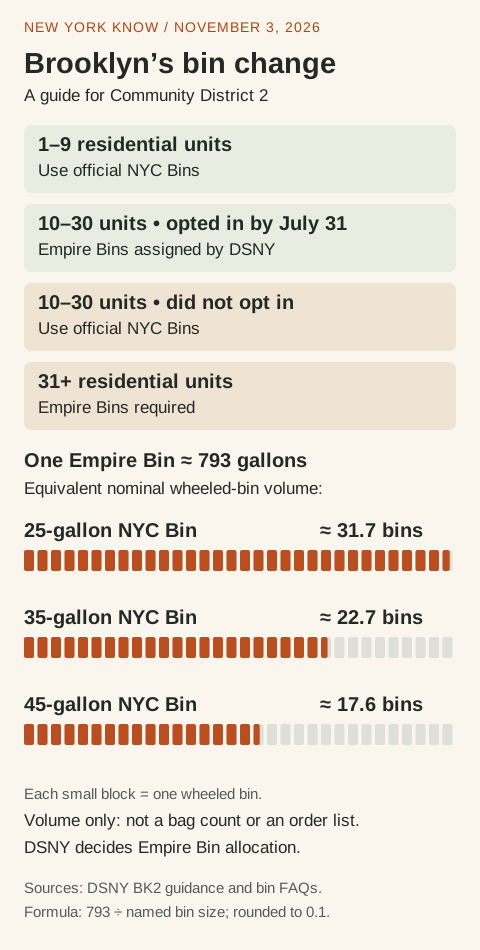
Within BK2, the rule follows the number of residential units:
- 1–9 units: official wheeled NYC Bins are already required for trash.
- 10–30 units, opted in: the building selected Empire Bins during the registration period.
- 10–30 units, did not opt in: the building must use official NYC Bins.
- 31 or more units: Empire Bins are required under the district rollout.
The deadline was July 31, 2026. DSNY now marks registration and opt-in as closed. A medium-size building does not have a new choice to make simply because installation has started. If you do not know what your building selected, ask its manager or superintendent. DSNY’s BK2 building guidance
Open the building guide and capacity comparison. Download the underlying capacity data, building rules or district rollout list.
The comparison uses published capacity, not observations of filled bins. Each equivalent is 793 divided by the wheeled bin’s listed gallon size, rounded to one decimal. It does not estimate a building’s waste or recommend a container order.
A much larger container, with restricted access
DSNY lists an Empire Bin at approximately 793 gallons. That is about 31.7 25-gallon bins, 22.7 35-gallon bins or 17.6 45-gallon bins, comparing nominal volume alone. The small blocks in the graphic represent wheeled-bin equivalents, not individual trash bags. Some properties need multiple Empire Bins; DSNY determines whether additional capacity is needed after a service request. Empire Bin FAQ, NYC Bin specifications
The comparison helps explain why the containers look substantial, but it cannot substitute for a building’s assignment. Bag shape and how a bin is loaded affect usable space. A calculation based on gallons cannot establish whether a particular property has sufficient storage between pickups.
Residents should continue taking waste to their building’s designated collection area. Empire Bins are for building staff and waste managers; access cards unlock only the containers assigned to that property. A bin around the corner is not a public drop-off point. DSNY access instructions
What goes in, and what stays separate
Staff can load bagged trash at any time of day. DSNY says the collection schedule remains unchanged. Recycling and compost do not belong in an Empire Bin, and bags should not be left outside it. Large items that will not fit should go at the curb in front of the building without obstructing the container; check the applicable collection instructions before putting them out. DSNY’s Empire Bin collection guidance
For buildings using the smaller bins, DSNY lists trash sizes of 25, 35 and 45 gallons. Owners and managers are responsible for having enough capacity for their waste. The official bins are sold through NYC Home Depot stores, with availability depending on the store and location. The general one-to-nine-unit requirement began June 1, and full enforcement began September 8, 2026. NYC Bin FAQ, DSNY purchase guidance
What to do during installation
Check with management before changing your disposal routine. For an installed Empire Bin with a faulty card, equipment problem or insufficient capacity, building owners and waste managers can use the DSNY service-request form. The public district announcement does not supply a building-by-building delivery calendar.
Elsewhere in Brooklyn, Community District 8 is scheduled for the next expansion in 2027, alongside five districts in the other boroughs. Those are planned rollouts; they should not be read as containers already available. The accompanying district CSV separates the completed Manhattan rollout, Brooklyn’s current installation and the next phase. NYC311’s expansion schedule