 New York Know
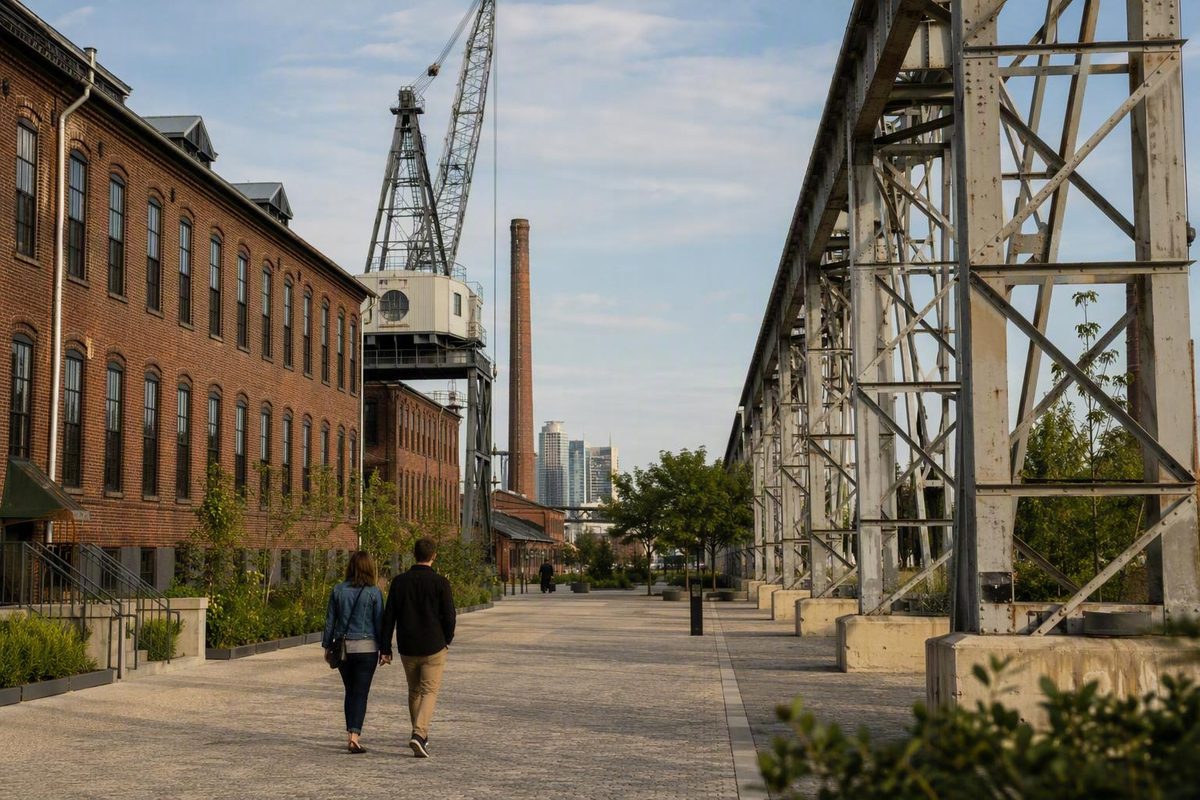
The Brooklyn Navy Yard is not a conventional museum, an unrestricted historic district, or simply another Brooklyn neighborhood to wander. It is a working industrial campus layered with more than two centuries of naval and manufacturing history. That distinction determines how—and whether—you should visit.
Independent visitors can focus on two public-facing buildings along Flushing Avenue: Building 92 for historical interpretation and Building 77 for food, visitor-accessible space, and the ferry landing. A guided tour adds access to parts of the secured campus and makes its dry docks, factories, infrastructure, and adaptive reuse easier to understand.
For most visitors, the Brooklyn Navy Yard works best as a focused half-day rather than one stop in a packed citywide checklist. Choose either a short exhibition-and-food visit or a tour-centered visit, add no more than one nearby Brooklyn area, and confirm operational details before leaving. That compact approach follows a broader walking-first, geographically focused way of planning New York days.
This guide is a researched planning resource rather than a report of unrestricted or guaranteed access. Historical details draw on official naval history, while visitor information comes primarily from the Yard and its partner tour operator. Hours, routes, tenant availability, security arrangements, and transit conditions can change.
What the Brooklyn Navy Yard Is Today
The Brooklyn Navy Yard occupies a waterfront site on Wallabout Bay in northwest Brooklyn. For much of its history, it was a federal naval shipbuilding and repair installation. The Navy deactivated the military installation in 1966; the property subsequently became a city-owned industrial campus operated by the nonprofit Brooklyn Navy Yard Development Corporation.
The important word for visitors is working. People come here to manufacture goods, run businesses, repair vessels, attend meetings, participate in workforce programs, and produce creative work. Historic buildings and infrastructure survive throughout the campus, but they coexist with contemporary workplaces rather than forming an open-air museum.
That creates several levels of access:
- Public-facing spaces: designated areas such as the visitor-accessible parts of Buildings 77 and 92, subject to current opening arrangements.
- Appointment or reservation destinations: workforce services, tenant businesses, rooftop venues, classes, and scheduled events.
- Guided-tour areas: parts of the industrial campus that visitors may enter with an authorized tour.
- Secured working zones: operational areas not open to independent sightseeing.
Most of the campus remains secured. Access beyond designated public areas generally requires a guided tour, event ticket, appointment, or invitation from a tenant. Passing a historic building behind a checkpoint does not mean visitors can enter it, and an attraction appearing on a map does not establish that it accepts walk-ins. Turnstile Tours, which runs tours in partnership with the campus operator, describes the Yard as a secure industrial site whose core areas are generally entered through tours, special events, or tenant invitations (Turnstile Tours’ Brooklyn Navy Yard guidance).
The Yard is therefore most rewarding for travelers interested in maritime history, industrial architecture, manufacturing, urban infrastructure, preservation, or adaptive reuse. It may not merit limited first-trip time for someone whose priorities are major museums, observation decks, theater, or iconic Manhattan sights. For a history-minded visitor—or anyone curious about how a former military complex can remain productive—it offers a distinctive Brooklyn half-day.
Avoid relying heavily on a single present-day acreage, business, employment, or building count when deciding what to expect. Published figures describe different boundaries, dates, or parts of the campus. The useful planning fact is simpler: the site is extensive, active, and only partly accessible to the public.
From Wallabout Bay Shipyard to the “Can-Do Shipyard”
The Brooklyn Navy Yard’s institutional history begins on February 23, 1801, when the federal government purchased 41.93 acres of waterfront property at Wallabout Bay. Some historical summaries round the original acquisition to 40 acres. The first six buildings went up in 1805, and Lieutenant Jonathan Thorn became the first commandant in 1806; broader accounts sometimes place the beginning of full naval activity in the early 1810s. During the War of 1812, the Yard fitted out more than 100 ships for war. USS Ohio, launched in 1820, was the first ship built by the Yard, while USS Maine was launched there in 1890. USS Monitor was built at Continental Iron Works elsewhere in Brooklyn, then completed, outfitted, armed, crewed, and commissioned at the Navy Yard in 1862. The Yard also built or worked on major vessels including USS Arizona, USS Iowa, USS Missouri, and several aircraft carriers, although not every vessel associated with the site was built or launched there (U.S. Naval History and Heritage Command history).
Those distinctions matter because the Yard’s responsibilities extended far beyond constructing ships from the keel up. Its workers built, outfitted, armed, converted, repaired, and overhauled vessels. During the Civil War, for example, the Yard handled both new construction and the conversion of commercial vessels for military service. Its work continued through the expansion of the steel Navy, World War I, and the interwar period.
Across its naval history, the Yard built more than 160 ships. Its repair and conversion work became especially important during World War II, when it acquired the nickname “Can-Do Shipyard.” The Navy’s historical account reports that the Yard repaired 5,000 battle-damaged American and Allied ships, converted 250 vessels to warship standards, and reached a wartime peak of 71,000 civilian and naval personnel. In January 1945, 4,657 women held production jobs there in roles that included welder, electrician, pipefitter, and crane operator. The military installation was deactivated in 1966, ending 165 years between federal acquisition and closure, although industrial activity continued after the Navy’s departure (U.S. Naval History and Heritage Command).
That labor history is as important as the famous ships. Wartime production depended on skilled workers across numerous trades, and women’s production roles challenged assumptions about who could perform demanding industrial work. The Yard’s historical significance lies not only in the vessels that passed through it but also in the workforce, infrastructure, and production systems that made those vessels possible.
What Visitors Can See Without a Guided Tour
Yes, you can visit parts of the Brooklyn Navy Yard independently. The key is to treat Building 77 and Building 92 as separate destinations rather than assuming that the entire campus between them is open for exploration.
Building 77: food, arrival, and ferry access
Building 77 is at 141 Flushing Avenue, near Vanderbilt Avenue. It is one of the Yard’s principal public-facing arrival points, contains the visitor-accessible Market @77 on its ground floor, and connects conveniently with the Brooklyn Navy Yard ferry landing.
The Yard’s public-spaces information has listed Russ & Daughters, Transmitter Brewery, Pizza Yard, Jalapa Jar, Hungry House, Rustik Tavern, Sabor, and She Wolf Bakery as food and beverage options. These should be treated as examples rather than guarantees: businesses can keep different hours from the building, pause service, move, or close. The official Brooklyn Navy Yard public-spaces page provides the address, published building information, vendor list, and reminder to verify individual restaurant hours.
Market @77 is the easier anchor if your visit centers on lunch, a ferry trip, or a guided tour. Its ground floor may also include public art and offers a useful first look at the adaptation of a large industrial building. Public access to that floor does not imply access to offices or tenant spaces elsewhere in Building 77.
Building 92: the historical exhibition
Building 92 is at 63 Flushing Avenue, near Carlton Avenue. The different address is not an inconsistency: it is a separate destination farther west along Flushing Avenue.
Building 92 contains the free permanent exhibition “Brooklyn Navy Yard: Past, Present & Future,” which introduces the site from its early history through its modern industrial use. The official visitor page also identifies employment and workforce services in the building as appointment-only, not ordinary walk-in attractions. It says Building 92 was constructed in 1858 as the Marine Corps Commandant’s Residence, deteriorated after decommissioning, and reopened to the public in 2011 (Brooklyn Navy Yard public-spaces information).
Published opening hours should still be confirmed before an inflexible journey. A visitor reported in January 2025 that the building did not open during the hours shown online. That is one person’s experience, not proof of a continuing closure, but it is a reasonable reminder to check the official listing on the day of a visit (the visitor’s Building 92 report).
Visitors arriving for the exhibition should not expect automatic access to consultations, training services, offices, event rooms, or every floor. Different functions within the same building can have different entry rules.
Other venues are not automatically walk-in attractions
The campus includes rooftop, food-and-drink, production, and event spaces that may interest visitors. Their presence inside the Yard does not mean you can arrive without arrangements. Brooklyn Grange, for example, has been identified in the Yard’s visitor information as accessible by appointment. Other tenant spaces may require a reservation, event ticket, class registration, tour booking, or direct invitation.
Use this access test before adding any campus destination:
- Does the Yard identify it as a public space?
- Does the tenant’s own information say that walk-ins are accepted?
- Is a reservation, event ticket, or appointment required?
- Which entrance should you use?
- Can an independent visitor reach it without entering a secured working zone?
Do not use anecdotal reports of someone being waved through a checkpoint as evidence of current policy. Security arrangements can change, and pandemic-era access experiences are especially poor guides to present conditions.
When a Guided Tour Is Worth Booking
A guided tour is worth booking when the working campus itself—not only the free exhibition or food hall—is the reason for your visit.
Turnstile Tours operates Brooklyn Navy Yard tours in partnership with the Brooklyn Navy Yard Development Corporation. Themes can include naval history, worker experiences, architecture, adaptive reuse, present-day manufacturing, infrastructure, sustainability, and urban ecology. A typical walking-tour benchmark is about two hours and approximately two miles, with tours generally beginning and ending at Building 77, 141 Flushing Avenue. Some booking information identifies the meeting point more specifically as near Russ & Daughters, so use the instructions attached to your reservation (current tour-format overview).
A guide adds more than physical access. The Yard’s scale and layout can be difficult to interpret from Flushing Avenue, where it may appear to be a long wall punctuated by gates and large buildings. Inside, a guide can explain the relationship among factory blocks, dry docks, rail remnants, waterfront infrastructure, later construction, and present-day businesses.
Possible highlights include historic industrial buildings, exhibits, public art, current production spaces, and Dry Dock No. 1. Exact routes can change because of weather, construction, active operations, events, or access restrictions. No individual stop should be treated as guaranteed.
Set realistic physical expectations. Tour listings warn that routes may include cobblestones, embedded railroad tracks, uneven pavement, dirt, mud, steps, steep inclines, and limited opportunities to sit. Comfortable, stable shoes are more useful than polished sightseeing footwear. Visitors with mobility or hearing requirements should ask in advance about the route for their date, step-free alternatives, seating, restrooms, weather exposure, and assistive listening equipment (tour accessibility and terrain details).
Do not schedule another timed attraction immediately after the tour. Even if the walk finishes on time, you may need to use a restroom, eat, rest, find the correct exit, or wait for transit.
Schedules, prices, cancellation terms, child policies, and accessibility arrangements are dynamic. Confirm them on the operator’s current booking page. Reseller descriptions can help explain the general format, but the terms shown during direct booking should control your plans.
Historic Features That Make the Yard Legible
The Brooklyn Navy Yard becomes easier to understand when you stop looking for one grand monument and instead read the surviving infrastructure as a system. Dry docks, gates, tracks, cranes, residences, warehouses, and numbered factory buildings each reveal a different part of the former naval operation.
Dry Dock No. 1
Dry Dock No. 1 was completed in 1851 after approximately a decade of construction and is a New York City designated landmark. Quarters A, the Commandant’s House, was completed in 1806 and is another important early survivor, although it is privately owned and should be understood as part of the historical landscape rather than as a guaranteed interior attraction (historical overview of the Yard and its structures).
The dry dock is especially significant because tour information reports that it remains in use for commercial ship repair. It is therefore not simply a preserved cavity where industrial work once happened; it demonstrates continuity between the naval past and surviving maritime activity at the Yard (tour description of the working 1851 dry dock).
Visitors generally need an appropriate tour or other authorized access to interpret the dry dock at close range. Active operations can also affect sightlines and tour routes.
Quarters A and Building 92
Quarters A represents the Yard’s earliest administrative history. Its status as a privately owned building means visitors should not plan around entering it, even if they see it from an authorized route or public vantage point.
Building 92 tells a later story. Originally constructed as the Marine Corps Commandant’s Residence, it combines an older brick building with a modern addition. Its restoration and reuse as an exhibition and visitor destination make it a concise architectural introduction to a larger pattern across the campus: preservation paired with new functions.
When the exhibition is open, it provides the historical framework needed to understand what lies behind the secured gates. Even from the Flushing Avenue edge, the building can be read both as a historical structure and as a redevelopment project.
Sands Street Gate, tracks, cranes, and numbered buildings
The restored Sands Street Gate preserves a formal entrance associated with the naval complex. Railroad tracks embedded in pavement recall the internal system once used to move materials around a large production site. Cranes and waterfront machinery reveal the scale of ship work, while numbered buildings preserve the practical language of an industrial campus.
Look for oversized door openings, repetitive factory windows, rail alignments, loading areas, and the relationship between buildings and the waterfront. A structure’s placement can suggest whether it served administration, storage, heavy production, or ship movement even when its interior is inaccessible.
Buildings 77, 121, and 20: then and now
Building 77 was constructed during World War II without windows for security and later renovated with windows and public-facing ground-floor uses. Building 121 was built in 1899 as the paymaster’s office and later became associated with distillery use. Building 20, formerly used for shipbuilding work, was redesigned for technology use. The Sands Street Gate was restored in 2010 to reflect its 1896 appearance, and surviving rail tracks remain visible in parts of the pavement (Forgotten New York’s historical streetscape account).
These examples illustrate adaptive reuse without implying that every named building is open to visitors. A consumer-facing tenant identity does not by itself establish walk-in access, particularly when a destination lies beyond a secured entrance.
The Wallabout story beyond ships
The Yard’s history extends beyond vessels and factories. Wallabout Market once occupied part of the area before wartime expansion displaced it. Wallabout Creek was altered and partly filled. The naval hospital and cemetery introduce medical, military, burial, and landscape histories that complicate a ship-centered narrative.
These layers help explain the Yard’s wider effect on shoreline geography, food distribution, transportation, labor, and neighboring communities. Some of that story can be introduced through Building 92 and features visible from public streets. Other elements are much easier to encounter and interpret on a guided tour.
How to Get There Without Complicating the Day
There is no universally best way to reach the Brooklyn Navy Yard. The right choice depends on whether your priority is direct access to Building 77, step-free travel, schedule flexibility, or a convenient connection to the rest of your Brooklyn day.
Transportation planning note
The routes below are a planning framework, not a live service report. Check current NYC Ferry and MTA information before leaving. Confirm the return journey separately from the outbound trip, particularly when using the ferry.
Ferry: the most direct waterfront arrival
The NYC Ferry Astoria route serves the Brooklyn Navy Yard and places passengers close to Building 77 and Market @77. For visitors coming from another ferry stop, it offers the most direct waterfront arrival.
The tour operator states that ferry fares do not use MetroCard or OMNY. Confirm the current fare, payment method, schedule, accessibility arrangements, and service alerts with NYC Ferry before traveling. A convenient inbound sailing does not guarantee an equally useful return departure after a meal or tour.
Subway: flexible, but with a walk
Commonly cited subway stations include:
- York Street
- High Street–Brooklyn Bridge
- Clinton–Washington Avenues
Turnstile Tours describes each as approximately a 15-minute walk from Building 77. It identifies those stations as not wheelchair accessible and lists DeKalb Avenue as the nearest step-free subway alternative, although it is farther away. The same operator lists the B57 and B69 near Building 77, the B62 on Park Avenue, and specifically warns visitors not to use the B67 expecting to disembark inside the secured Yard. It also states that on-site parking is limited to vehicles with accessible permits and that bicycle-tour participants must provide their own bicycles (Turnstile Tours’ directions and accessibility guidance).
Elevator status and service patterns can change, so verify them on the day. Allow extra walking time in heat, rain, snow, or when traveling with someone who needs regular rests. For a timed tour, do not base your arrival margin on an ideal map estimate.
Bus: potentially closer, but route details matter
A bus may reduce the amount of walking, but route names alone are not enough. Confirm the stop serving the public entrance you intend to use, rather than selecting a stop that appears to be inside the campus.
Security boundaries matter here. A mapping application may show a vehicle route through or near the Yard without establishing that an ordinary visitor can enter or exit at an internal stop.
Bicycle: useful with advance planning
Cycling can work well if the Yard is part of a waterfront-focused Brooklyn day. Determine in advance where a bicycle may be secured and whether it can be brought near a venue or tour meeting point. Do not attach it to gates, railings, or industrial infrastructure unless bicycle parking is explicitly permitted.
If using bike share, allow time both to find an available bicycle and to locate an open dock afterward. Neither should be assumed.
Car: do not assume general on-site parking
Driving may make sense for someone carrying equipment or managing particular mobility needs, but it introduces uncertainty. Ordinary visitors should not plan on general on-site parking.
Confirm the correct public entrance before driving, then identify an off-site street or public-parking option and a backup. Construction, events, and neighborhood demand can affect availability.
A Walking-First Half-Day at the Navy Yard
The best Navy Yard itinerary avoids improvising inside secured areas. Anchor the day to the two main public addresses—Building 92 at 63 Flushing Avenue and Building 77 at 141 Flushing Avenue—and decide in advance whether the exhibition or guided tour is the main event.
Option 1: independent public-spaces visit
This version suits visitors who want a free historical introduction and a meal without committing to a longer guided experience.
1. Confirm Building 92 before setting out. Check the official listing on the morning of your visit. If an unexpected closure would materially disrupt the day, try to contact the venue before traveling.
2. Begin at Building 92, 63 Flushing Avenue. Allow enough time to read rather than rush through the permanent exhibition. Its value lies in providing a framework for the Yard’s naval history, workers, industries, and transformation.
3. Continue east along the Flushing Avenue edge. The Yard’s visitor material proposes an approximately one-mile walking concept in this area. Use that as a general framework rather than trying to follow uncertain stop numbering. Remain on public streets and enter only clearly designated visitor spaces.
4. Finish at Building 77, 141 Flushing Avenue. Use Market @77 for lunch, coffee, or a break. If taking the ferry afterward, check the departure time before ordering so that the meal does not become rushed.
This version can be short if your goal is simply the exhibition and food. It also has a straightforward fallback: if Building 92 is unexpectedly unavailable, continue to Building 77 and use the remaining time for one nearby Brooklyn area.
Option 2: tour-centered half-day
This is the stronger choice for visitors who want to understand the campus itself.
1. Arrive at Building 77 early. Use 141 Flushing Avenue as the primary address unless your confirmation gives different instructions. Leave enough time to identify the correct entrance and meeting point.
2. Eat before or after the tour. A light meal beforehand can help on a two-hour walk, but avoid cutting the timing close. Alternatively, take the tour first and use Market @77 as a flexible finish.
3. Take the guided walk. Plan around approximately two hours and two miles, with variable surfaces and an operationally dependent route.
4. Keep the period after the tour flexible. You may want to eat, rest, examine a public exhibit, or wait for transit. Avoid placing another timed attraction immediately afterward.
For either version, add one nearby area rather than attempting a broad Brooklyn sweep. DUMBO works for monumental waterfront views and a busier visitor district. Fort Greene offers a more neighborhood-oriented continuation. Another section of the Brooklyn waterfront can preserve the maritime theme. Choose according to your onward transit rather than trying to include all three.
Keep a Lower Manhattan day separate rather than crossing the river repeatedly to combine unrelated stops. The same compact-route principle used in a walking-first Lower Manhattan itinerary works here: establish one geographical focus and let the day develop around it.
Maritime-history enthusiasts and industrial-architecture visitors should allocate more time, particularly if combining Building 92 with a tour. Visitors interested mainly in the free exhibition and a meal can make a shorter stop.
Build in a contingency:
- Rain or severe heat: shorten the independent walk and prioritize indoor public spaces.
- Ferry disruption: have a subway or bus alternative ready.
- Mobility limitations: minimize transfers and confirm step-free routes and tour terrain.
- Building 92 closure: substitute Building 77 and one nearby area rather than waiting indefinitely.
- Tour delay or fatigue: drop the additional neighborhood instead of rushing across Brooklyn.
A compact day is more coherent than a checklist. The Yard already asks visitors to interpret an unusually complex place; it benefits from unhurried attention.
What to Verify Before You Leave
Pre-visit checklist
The following details are subject to change and should be checked on the day of your visit:
- Building 92: Is the exhibition open today?
- Market @77: What are the building hours, and when is your chosen vendor serving?
- Entrance: Which public or tour entrance should you use?
- Tour: Is your departure operating, and where exactly does the group meet?
- Transit: Are your intended ferry, subway, elevator, and bus services operating normally?
- Tenant attractions: Are walk-ins accepted, or is a reservation, appointment, event ticket, or invitation required?
- Return journey: Does your preferred route work at the time you expect to leave?
Start with the official Brooklyn Navy Yard visitor information and Turnstile Tours’ current booking instructions. Directories, review platforms, and resellers may preserve outdated hours or terms. They can identify possible issues, but they should not be the final authority for visiting a secure working campus.
If you have mobility or hearing requirements, contact the tour operator in advance. Ask specific questions rather than relying on a broad accessibility label:
- Are there steps on the scheduled route?
- Can tracks, cobblestones, mud, or steep sections be bypassed?
- Is seating available?
- Where are the accessible restrooms?
- Can an assistive listening device be arranged?
- Could construction or weather alter the route?
Confirm any other rules that matter to your group. The available visitor information does not establish one complete policy covering identification, security screening, photography, bicycles, children, pets, and restroom access across every venue. Requirements can differ between a public ground floor, a guided tour, a tenant business, and a special event.
Remember that different functions within the same building can have different access. Building 92’s exhibition may be intended for public visitors while employment services remain appointment-only. Rooftop venues, classes, tours, and tenant businesses may require separate reservations.
Do not rely on a quoted tour price or cancellation rule unless you have checked the live booking screen for your chosen date and product.
The simplest decision rule is:
- Visit independently for the Building 92 exhibition and food at Building 77.
- Book a tour if you want to understand—and enter more of—the secured working campus.
The Brooklyn Navy Yard rewards visitors who understand what kind of place it is. Its public-facing spaces can support a short history-and-food stop, while a guided tour offers the clearest view of how naval heritage, active maritime infrastructure, manufacturing, and adaptive reuse coexist. Choose one version, pair it with only one nearby Brooklyn area, and verify hours, access, transportation, and reservations before leaving.
Brooklyn Navy Yard FAQs
Can you walk around the Brooklyn Navy Yard without a tour?
You can independently visit designated public-facing spaces, principally the visitor-accessible areas of Buildings 77 and 92 when open. You should not assume that you can roam internal roads or enter working buildings.
For an independent visit, remain along the public Flushing Avenue edge and use 63 Flushing Avenue for Building 92 and 141 Flushing Avenue for Building 77. Follow posted signs and current staff directions rather than trying alternate gates.
Is the Brooklyn Navy Yard free to visit?
Building 92’s permanent exhibition is listed as free, subject to its current opening status. Market @77 is a public food destination rather than a ticketed museum entrance, although food and drinks must be purchased separately.
Guided tours, classes, ticketed events, and tenant attractions may charge admission or require reservations. Check the relevant operator or venue before visiting.
How long should you spend at the Brooklyn Navy Yard?
A shorter visit can work if you want only the Building 92 exhibition and a meal at Market @77. A tour-centered visit generally requires at least a half-day once you include early arrival, an approximately two-hour walk, food, and transit.
History enthusiasts may want to combine the exhibition and tour. Casual visitors can choose one rather than trying to fit both into a rushed schedule.
What is the best way to get to the Brooklyn Navy Yard?
The ferry offers the most direct waterfront arrival for Building 77 when its schedule fits your day. The subway provides greater routing flexibility but requires a walk from the commonly cited nearby stations. Buses may stop closer, but route and entrance details require checking.
For step-free travel, compare the current ferry, bus, and DeKalb Avenue subway options. Drivers should not assume that ordinary on-site parking is available.
Is the Brooklyn Navy Yard wheelchair accessible?
Some public-facing spaces and tour arrangements may support wheelchair access, but the campus should not be treated as uniformly accessible in every condition. Tour routes can change and may encounter tracks, cobblestones, uneven pavement, mud, steps, inclines, construction, or limited seating.
Contact the venue or tour operator before visiting to discuss the route on your date, step-free entrances, elevators, restrooms, seating, and hearing accommodations. Check live transit accessibility information before beginning the trip.