 New York Know
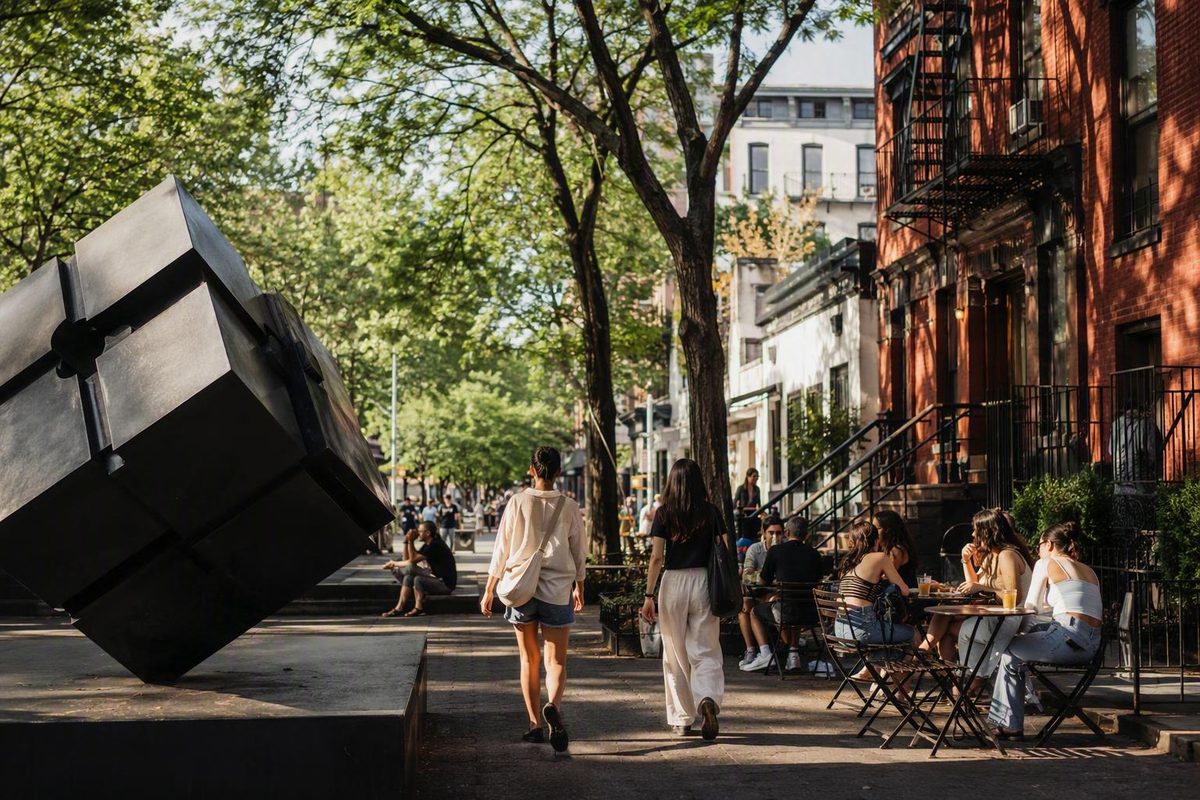
The East Village makes more sense as a neighborhood read on foot than as a checklist of famous venues. Its character appears in the transitions: Astor Place into St. Mark’s Place, former immigrant districts into experimental-arts corridors, and commercial avenues into Tompkins Square Park and the community gardens farther east.
For a first visit, establish a practical boundary, choose the subway station closest to your intended starting point, and move mostly in one direction. Astor Place, St. Mark’s Place, East 7th through East 10th Streets, and Tompkins Square Park provide a useful spine. Food, shopping, immigrant history, performance, gardens, or nightlife can then become one or two focused extensions rather than reasons to crisscross the neighborhood.
Current-status note: This is a geographic and historical planning guide, not a live business directory. Named restaurants, shops, gardens, and performance spaces are examples documented in the supplied neighborhood guides, not confirmation that they are currently open. Check official venue channels and current MTA information before setting out.
Where the East Village is—and why its boundaries are approximate
The East Village is on Manhattan’s East Side in Lower Manhattan. Houston Street is commonly treated as its approximate southern edge and 14th Street as its northern edge. To the west, definitions often use the Bowery, Third Avenue, or a combination of the two. Some maps include the Bowery; others describe it as an adjoining district.
The eastern edge is less settled. Many visitor guides include Alphabet City—the area beginning around Avenue A and continuing east through Avenues B, C, and D. A narrower profile ends the East Village around Avenue A. These are customary neighborhood definitions rather than a single legally established border, so maps, hotel descriptions, and business listings may use different conventions. The variation is visible in this overview of East Village geography and history.
For planning purposes, this guide uses a broad working area:
- South: Houston Street
- North: 14th Street
- West: the Bowery or Third Avenue, depending on the block
- East: through Alphabet City
That definition accommodates the central walking corridors and the places east of Avenue A that many visitors understand as part of the East Village. It also recognizes that narrower maps may exclude some of those eastern blocks.
The East Village is not Greenwich Village. The shared word “Village” reflects naming history, not a single continuous neighborhood.
For much of its history, the present-day East Village was understood as part of the Lower East Side. “East Village” became common in the late 1950s and early 1960s as artists, writers, students, new businesses, and real-estate interests gave the blocks north of Houston Street a more distinct public identity. The label connected the area to the bohemian reputation of Greenwich Village while distinguishing it from the Lower East Side in cultural and commercial language, according to this neighborhood history and chronology.
Two smaller geographic labels help with orientation:
- Alphabet City generally begins around Avenue A and continues through the lettered avenues. Whether all of it falls within the East Village depends on the boundary convention being used.
- Little Ukraine refers to a historically Ukrainian part of the central East Village, associated with churches, community organizations, restaurants, and businesses around Second Avenue and East 6th and 7th Streets.
Expect fuzzy edges in search results. A place marketed as an “East Village attraction” may actually be in NoHo, Union Square, the Bowery, or the Lower East Side. That does not necessarily make it inconvenient, but it can undermine a walking plan. Check the address and plot it relative to Houston Street, 14th Street, Third Avenue, and Avenue A before adding it.
The histories beneath the punk reputation
The East Village is often introduced through punk, but that begins the story very late. Its history includes Lenape land, colonial agriculture, Black settlement and enslavement, affluent residential development, successive immigrant communities, experimental culture, political conflict, preservation, and displacement.
Before Dutch colonization, the area formed part of the homeland of the Lenape. Under Dutch rule, land in the area was divided into farms known as bouweries, the source of the Bowery’s name. Historical summaries also identify Black farmers and free or “half-free” African communities in the wider colonial landscape, alongside farms where prominent landowners enslaved people. The early history therefore cannot be reduced to a pastoral European settlement: agriculture, constrained freedom, enslavement, and colonial expansion existed together.
As Manhattan expanded northward, parts of the present-day East Village briefly developed into an affluent residential district. Townhouses, churches, and institutional buildings appeared along streets including Second Avenue and Stuyvesant Street. The diagonal course of Stuyvesant Street is still useful for reading the older landscape because it interrupts Manhattan’s later grid.
Immigration and urban growth subsequently transformed the district. A substantial German community established Kleindeutschland, or Little Germany, across parts of the wider Lower East Side and East Village. Churches, clubs, businesses, newspapers, and social organizations supported a dense German-speaking population.
The 1904 General Slocum disaster became a devastating rupture. The catastrophe compounded other pressures encouraging residents to leave the district, including movement toward Yorkville. The neighborhood chronology cited above connects this history with the area’s later Jewish, Ukrainian, artistic, and activist traditions.
Jewish immigration reshaped the area as well. Second Avenue became an important Yiddish theater district, sometimes called the “Jewish Rialto.” Although that theater district no longer survives in its former form, it helps explain why performance became so deeply embedded in the East Side’s identity.
Ukrainian immigrants and their descendants created another enduring layer. Churches, community institutions, meeting places, restaurants, and shops helped establish Little Ukraine and a Ukrainian-American presence that remains part of the neighborhood’s public identity. Ukrainian food should therefore be understood as one expression of a larger religious, social, political, and commercial history—not as an isolated culinary theme.
Beats, hippies, political organizers, experimental theater groups, and alternative publications helped create a new public identity for the area. The East Village name became both a cultural label and a marketing device.
Several institutions illustrate distinct eras rather than one undifferentiated “counterculture”:
- La MaMa Experimental Theatre Club represents the neighborhood’s role in experimental and off-off-Broadway theater.
- Nuyorican Poets Café reflects Puerto Rican and wider New York traditions of poetry, music, performance, and cultural activism.
- The Fillmore East, which operated in a former Yiddish theater, became associated with the rock-concert era but is no longer an operating venue.
- CBGB became internationally identified with punk and new wave but has also closed.
Experimental theater, Nuyorican performance, rock promotion, punk, visual art, and political organizing involved different communities and institutions, even where they shared streets, audiences, or inexpensive space.
The East Village is frequently described as the birthplace of American punk. That phrase captures the importance of CBGB and the neighborhood’s musicians, artists, clubs, and audiences, but it is better treated as a common cultural characterization than as an uncontested historical verdict. Punk developed through overlapping scenes and influences rather than at one neatly bounded address. The city’s tourism guide uses the familiar punk, Beat, bohemian, and avant-garde framing while also emphasizing the neighborhood’s present-day dining and nightlife identity.
The East Village also became known for performance art, queer culture, tenant organizing, antiwar activity, community gardening, and disputes over public space.
That history complicates any simple story of decline or improvement. Historic-district designation and restoration can preserve architecture, while longstanding institutions may retain visible connections to immigrant and artistic traditions. At the same time, redevelopment, rising costs, housing pressure, and commercial turnover can displace residents and cultural producers whose work helped create the identity later used to market the area.
Gentrification is therefore more than a visual shift from worn storefronts to polished ones. It concerns control of housing, commercial leases, cultural space, public space, and neighborhood memory. Preservation and displacement can happen simultaneously, as can greater affluence and genuine cultural continuity.
Choose an arrival point before choosing your stops
Do not begin by looking for the single “best” East Village subway station. Choose the part of the neighborhood you intend to explore, then select an arrival point that supports a predominantly one-direction walk.
Common approaches include:
- Astor Place on the 6: useful for the western East Village and the beginning of the core route.
- Second Avenue on the F: useful for a southern or central approach, including parts of the East 4th–7th Street area.
- Third Avenue or First Avenue on the L: useful when beginning along the northern side.
These approaches are identified in a combined East Village and Lower East Side transit overview, but a travel guide cannot establish current service, station construction, elevator availability, or late-night routing. Check the MTA on the day of travel.
Rail stations are concentrated toward the western and northern sides of the neighborhood. That does not mean Alphabet City is uniformly poorly served. The practical issue is that walking distance varies by destination. A stop near Avenue A may require only a modest continuation from the core route; a venue near Avenues C or D can make the return to rail transit substantially longer.
For a first visit, select one arrival station and move mainly east, west, north, or south. Entering near the middle and alternating between the Bowery and Alphabet City wastes time and makes the neighborhood feel less coherent.
Before departure, check:
- Planned service changes and late-night routing.
- Elevator status if step-free access is required.
- Street or station construction.
- Walking distance from the final stop to the return station.
- Whether evening service differs from daytime service.
- The street entrance most suitable for your direction of travel.
Do not assume a station, venue, or complete street route is step-free because a general guide uses the word “accessible.” Confirm every stage through current MTA and venue information.
A compact first walk: Astor Place to Tompkins Square Park
This flexible half-day route is designed for orientation rather than maximum stop count. It introduces the western gateway, a defining commercial street, selected central blocks, an optional immigrant-history detour, and the neighborhood’s principal park.
1. Begin at Astor Place. Use the plaza and surrounding junction as a transition point. Broadway and NoHo are to the west; the East Village opens as you move toward Third Avenue and the numbered streets.
Before starting, decide whether the day’s emphasis will be food, history, architecture, shopping, or culture. That choice should determine where you linger later.
2. Make the architecture detour now, if you want it. Visitors interested in older streetscapes can examine Stuyvesant Street and the area around St. Mark’s Church-in-the-Bowery before committing to the eastbound route. Doing this at the beginning is more efficient than returning from Tompkins Square Park.
If architecture is not a priority, continue directly toward St. Mark’s Place.
3. Walk east on St. Mark’s Place. St. Mark’s Place is the section of East 8th Street between Third Avenue and Avenue A, as described in this former resident’s East Village guide. It is one of the neighborhood’s clearest east–west spines and has long been associated with commerce, youth culture, food, nightlife, and street-level spectacle.
Look at the whole block rather than searching only for a famous address. The useful experience is the mix of older building fronts, narrow shops, apartments, food counters, tattoo businesses, and cultural traces. Storefronts change, so avoid constructing the walk around the assumption that a business shown in an older guide will still be operating.
4. At Second Avenue, choose the direct route or the Little Ukraine variation.
- Direct route: Continue east on St. Mark’s Place toward Avenue A and Tompkins Square Park.
- Little Ukraine variation: Turn south on Second Avenue, examine the East 6th and East 7th Street area, then continue east on East 7th Street toward Avenue A.
The variation keeps the route moving east rather than requiring a return to St. Mark’s Place. It can connect Ukrainian food with churches, signs, community buildings, and institutional history. Treat the area as a living cultural district rather than a restaurant theme.
5. Use one central eastbound street, not every parallel block. If you take the Little Ukraine variation, East 7th Street becomes the main continuation. If you remain on St. Mark’s Place, use it as the direct spine. You can make one short turn onto East 9th or East 10th Street where it serves a specific interest, but avoid weaving repeatedly between avenues.
This is the key to preventing backtracking: choose one primary eastbound line and regard nearby streets as controlled detours, not additional checklists.
6. Finish at Tompkins Square Park. Tompkins Square Park is commonly identified as the neighborhood’s principal park and a central orientation point. It offers a natural place to pause, eat nearby, or decide whether to continue. Time Out likewise connects Astor Place, St. Mark’s Place, and Tompkins Square Park in its suggested neighborhood walk, although its route can be followed in either direction.
From the park, choose one of three exits:
- Finish nearby: Eat or stop for coffee around the park, then walk west toward your selected return station.
- Continue east: Enter Alphabet City only if you have enough time and are comfortable with a longer walk back to rail transit.
- Continue north: If your next activity is toward the northern side, move in that direction rather than returning to the southern-central blocks.
The short version goes directly from Astor Place along St. Mark’s Place to Tompkins Square Park.
The default version adds the Second Avenue turn, East 7th Street, and Little Ukraine.
The slow version adds one meal and one cultural, architectural, or shopping stop. That is generally more rewarding than trying to collect several restaurants, shops, theaters, and gardens spread across the full neighborhood.
Exact walking time depends on pace, crossings, meal waits, shopping, park time, and how often you stop to examine buildings. Plan by sequence rather than by an artificial minute count.
Extend the walk by interest, not by distance
With most of a day available, attach one module to the core route. The best extension continues from wherever you already are; it should not require returning across the neighborhood.
For immigrant history: Add Little Ukraine while you are still in the central blocks. Look for Ukrainian churches, community institutions, businesses, signs, and food. Keep German and Jewish history in the wider narrative, but distinguish surviving institutions from vanished clubs, synagogues, theaters, and restaurants.
For independent culture and shopping: Look for categories rather than a supposedly permanent list: bookstores, record shops, vintage clothing, tattoo shops, stationery stores, and specialist food or design retailers. This remains useful even as individual businesses change.
The Strand is near Union Square and the East Village’s western edge rather than deep inside the neighborhood. If it is part of the plan, visit before moving east or after exiting west. Do not return from Alphabet City solely to add it.
For experimental arts and film: Investigate current programming at La MaMa, Nuyorican Poets Café, spaces associated with Fourth Arts Block, and Anthology Film Archives.
These are programming-dependent institutions, not interchangeable all-day attractions. Anthology Film Archives is particularly associated with avant-garde, experimental, and independent cinema, as summarized in this local culture guide. Confirm the event address as well as the organization’s name; programming may pull the route south, east, or back toward the western edge.
For parks and gardens: Pair Tompkins Square Park with one or two community gardens in Alphabet City.
Do not enter a closed garden or assume that an apparently unlocked space welcomes visitors throughout the day. Build the extension around confirmed access, then continue east or south rather than returning across the core route.
For architecture and streetscape: Use Stuyvesant Street, St. Mark’s Church-in-the-Bowery, St. Mark’s Place, and selected East 7th–10th Street blocks as anchors. Look for changes in lot width, building height, fire escapes, former religious or institutional structures, and the relationship between ground-floor commerce and housing above.
This approach keeps the walk worthwhile when a planned shop or venue is closed. The neighborhood itself—not admission to a particular business—becomes the attraction.
For a guided visit: Commercial tours cover music, food, architecture, immigrant history, activism, Irish history, LGBTQ+ history, nightlife, and broader downtown themes. Marketplace results may also include routes extending into the Lower East Side, Greenwich Village, Little Italy, Midtown, or other adjoining districts.
GetYourGuide states directly on its East Village walking-tour results page that ranking considers popularity, customer ratings, performance, availability, diversity, and revenue, including supplier commissions. That makes marketplace position a commercial discovery tool, not an independent judgment of historical depth or route quality.
Evaluate a tour using:
- Exact starting and ending points
- Streets and neighborhoods covered
- Time actually spent in the East Village
- Duration and walking distance
- Group size
- Seating and rest opportunities
- Accessibility information
- Cancellation and weather terms
- Total price, including fees
- Review volume as well as average rating
A narrowly focused architecture or immigrant-history walk may be more useful than a highly placed downtown tour that spends little time inside the neighborhood.
Use food to read the neighborhood’s layers
Food is one of the easiest ways to understand the East Village, but a useful plan needs more structure than a list of “must-eat” restaurants. Choose by cultural layer, meal type, and position along the walk.
Travel guides portray the neighborhood as internationally varied, with Ukrainian, Japanese, Indian, Italian, Caribbean, Hawaiian, Chinese, Middle Eastern, Moroccan, and contemporary American cooking among the categories represented.
For Ukrainian heritage, Veselka is the most visible example in visitor guides. Multiple supplied accounts describe its East Village presence as dating to 1954. That history makes it relevant to the neighborhood’s Ukrainian culinary story, but it does not establish it as the only or objectively best place to experience Ukrainian food. Check its official channels for present hours, menu, service format, waits, and reservations.
Near the eastern end, Tompkins Square Bagels is frequently used by guide writers as an example of a casual stop near the park. Its location can fit naturally before or after the route’s finish, but repeated recommendation is not proof that it serves the neighborhood’s “best” bagel.
Other names appearing in the supplied guides include B&H Dairy, Cafe Mogador, Ippudo, MáLà Project, Divya’s Kitchen, Abraço, and Veniero’s. They illustrate categories associated with East Village itineraries—diner food, Moroccan cooking, ramen, Chinese dry pot, vegetarian food, coffee, and dessert. Their inclusion here is not confirmation of current operation, menus, prices, or service.
A route-based food plan works better:
- Near the start: Coffee, pastry, or a light meal around Astor Place and the western blocks.
- In the middle: Lunch around Second Avenue or East 6th–9th Streets, possibly connected to Little Ukraine or another cultural interest.
- Near the finish: A snack or casual meal around Tompkins Square Park.
- After the walk: Dinner selected according to the return station, so the final meal does not create a long backtrack.
Separate enduring identity from volatile operating details. A restaurant can have historical importance while changing its menu, prices, hours, reservation system, payment policies, or late-night schedule. Secondary guides may also preserve outdated descriptions long after operations change.
Use this selection framework:
- Dietary needs: Does the current menu clearly accommodate them?
- Budget: Are current menu prices available?
- Desired wait: Are you prepared to queue, or do you need a reservation?
- Seating: Do you need indoor seating, table service, or a reliable place to rest?
- Noise: Would a crowded room make the meal unsuitable?
- Timing: Is the kitchen serving when you expect to arrive?
- Exit plan: How far is the restaurant from the return station?
- Policies: Are age limits, minimum charges, reservations, or particular payment methods involved?
Repetition across travel guides usually indicates visibility, longevity, or broad visitor awareness. It does not demonstrate objective superiority over less-publicized alternatives.
Plan the evening—or a rainy day—around one anchor
Nightlife, live music, comedy, performing arts, bars, and late dining are major parts of the East Village’s visitor identity. They also create the greatest risk of an overcomplicated itinerary.
Choose one anchor—a ticketed performance, film, dinner reservation, or specific bar—and keep everything else within a few blocks. That structure provides a clear destination and a predictable route back to transit.
The Public Theater and other performance spaces are programming-dependent. A building may be open without offering a suitable performance when you arrive. Check the calendar, ticket availability, entrance location, running time, late-seating rules, and accessibility arrangements before committing to the plan.
For independent film, Anthology Film Archives is a logical anchor when its schedule matches your interests. For a lower-commitment rainy day, combine a bookstore, specialty shop, café, and meal within one compact area.
Book Club Bar, East Village Books, the Strand, and specialist retailers appear in neighborhood guides as indoor examples. Their inclusion does not establish current hours or operating status. The Strand also belongs at the western edge of the plan near Union Square, not as a late addition after an afternoon in Alphabet City.
An alcohol-free early-evening plan can be just as coherent:
- Early dinner
- One bookstore or record shop
- An independent film or performance
- Dessert or coffee
- A direct walk to the chosen subway station
For a rainy afternoon, avoid repeatedly entering and leaving small shops across a wide area. Choose one indoor cultural anchor and cluster food and retail around it.
Resident reviews often praise the neighborhood’s nighttime energy while also mentioning noise, crowds, sirens, small apartments, high costs, and block-by-block variation. The pattern is visible in this collection of East Village resident reviews.
Avoid declaring the entire neighborhood categorically safe or unsafe. Use ordinary city situational planning:
- Confirm the return station before the event.
- Check late-night service before leaving.
- Know the distance between the venue and transit.
- Stay aware of your surroundings and keep valuables controlled.
- Prefer a direct, understood route to several improvised late-night stops.
- Arrange an alternative return method if service changes or mobility needs make the walk unsuitable.
Verify age limits, tickets, cover charges, accessibility, dress expectations, seating, bag policies, and last-entry rules with the venue. A listing does not guarantee that every member of a group can enter, and an accessibility filter does not establish that the full route from street to seat will meet a visitor’s needs.
Decide whether the East Village fits your trip
The East Village can be a strong base for travelers who prioritize restaurants, nightlife, independent culture, people-watching, and walking within Lower Manhattan. It may be less suitable for someone seeking consistently quiet nights, large rooms, immediate access to several subway lines, or a schedule centered on distant parts of Manhattan.
The tradeoffs are highly location-specific. Resident and travel-guide accounts mention nighttime noise, busy streets, small accommodations, high costs, and longer walks to rail transit from farther-east blocks. None applies uniformly to every property. A street-facing room above nightlife can feel very different from a rear-facing room in the same building.
Western locations around Astor Place, Third Avenue, Union Square, or NoHo are often suggested for easier rail access. Treat that as a geographic observation, not proof that an affiliate-linked hotel is convenient, quiet, or good value.
A neighborhood label cannot tell you whether a room will be quiet. Ask the property about:
- Street-facing versus rear-facing rooms
- Floor level
- Nearby nightlife or construction
- Window design or sound control
- Elevator access
- Room dimensions and bed arrangement
- Cancellation terms
Do not infer safety, affordability, cleanliness, or family suitability from the East Village name alone. Decide according to the actual building, itinerary, mobility needs, budget, and tolerance for activity.
Even when staying elsewhere, the neighborhood works well as a compact half-day or evening district. It can be paired naturally with NoHo or Union Square at the western edge, or with the Lower East Side when the route continues south across Houston Street. Be explicit about the transition: once you cross into an adjacent area, you are extending the itinerary rather than discovering another distant East Village attraction.
The same geographic discipline shapes New York Know’s walking-first Lower Manhattan itinerary: choose a clear starting point, follow a coherent direction, and avoid repeated cross-city movement.
Before setting out, verify:
- Business and venue status
- Current opening hours
- Event schedules and tickets
- Reservations and likely waits
- Menus, prices, and payment rules
- Age restrictions and entry policies
- Venue and station accessibility
- Subway service and elevator status
- Weather
- The route from the final stop back to transit
That reflects New York Know’s stated approach of grouping sights by area and building days that work on foot. In the East Village, it means choosing a defensible working boundary, arriving near the part you intend to explore, and adding no more than one or two focused extensions.
Astor Place, St. Mark’s Place, selected East 7th–10th Street corridors, and Tompkins Square Park provide the spine. Follow that sequence first. The neighborhood’s immigrant history, independent culture, food, gardens, and nightlife make more sense as layers encountered along a walk than as isolated pins on a map.
What is the East Village best known for?
The East Village is known for punk, experimental theater, performance, activism, independent shops, nightlife, and alternative arts. It is also associated with German, Jewish, and Ukrainian immigrant histories, international dining, bookstores, vintage shops, community gardens, and street life.
Punk is only one layer. A fuller visit connects the countercultural reputation with earlier Lenape, colonial, Black, German, Jewish, and Ukrainian histories and with continuing tensions around preservation, redevelopment, and displacement.
Is the East Village the same as Greenwich Village or the Lower East Side?
No. Greenwich Village is a separate neighborhood to the west.
The East Village was historically treated as part of the Lower East Side before its separate name became common. Today, Houston Street is often used as the approximate division between the East Village to the north and the Lower East Side to the south, although neighborhood boundaries remain customary and disputed.
Can you see the East Village in half a day?
Yes. Begin at Astor Place, follow St. Mark’s Place or the East 7th Street variation, and finish at Tompkins Square Park.
Add one meal or one cultural stop. Several distant restaurants, shops, gardens, and venues will turn a compact visit into repeated backtracking.
Which subway stop is best for the East Village?
It depends on your starting area. Astor Place on the 6 suits the western side and the core eastbound walk. Second Avenue on the F can support a southern or central approach. Third Avenue or First Avenue on the L can suit the northern side.
Destinations around Avenues B, C, and D generally involve more walking. Check current MTA service, construction, elevator status, and the return route on the day of travel.
Is Alphabet City part of the East Village?
Under many common definitions, yes. Alphabet City generally begins around Avenue A and extends east through the lettered avenues, and many visitor guides treat it as an East Village subarea.
Not every source agrees. Some narrower definitions end the East Village around Avenue A. This guide includes Alphabet City within its practical working area while recognizing that the eastern boundary is disputed.