 New York Know
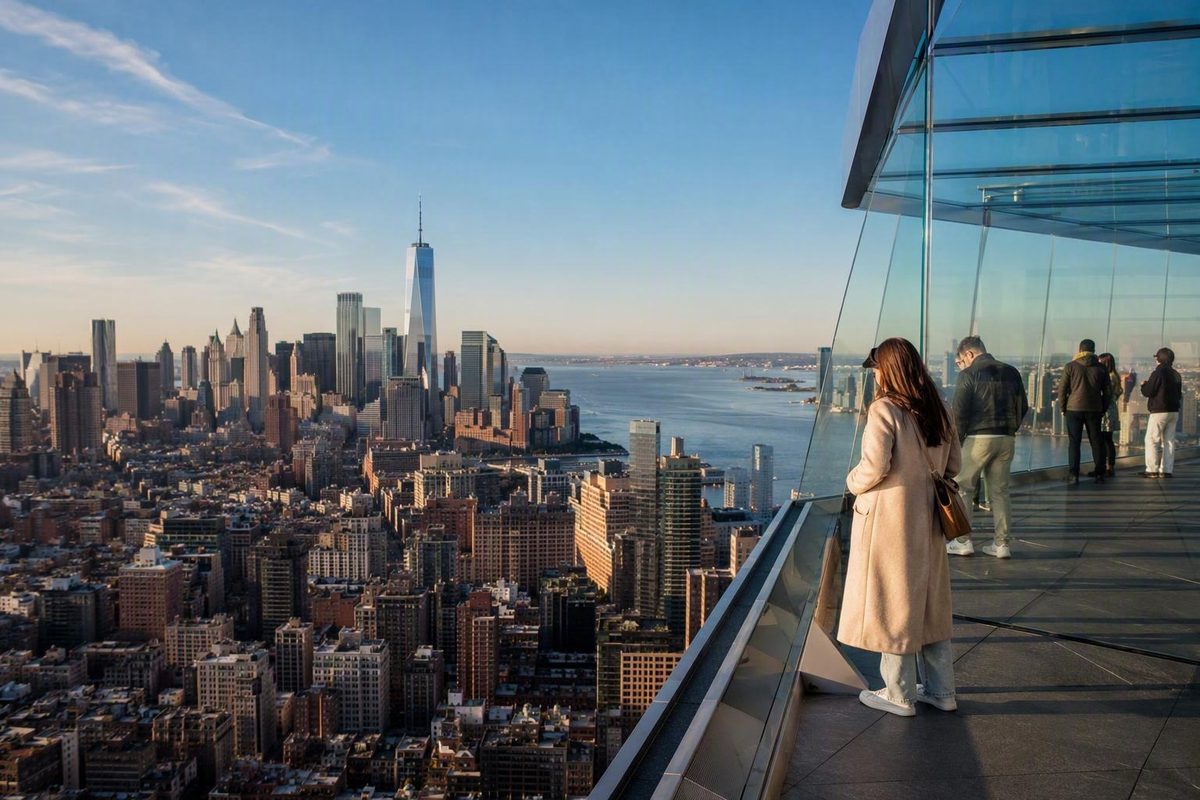
Edge NYC works best as the timed centerpiece of a West Side itinerary, not as an isolated attraction squeezed between stops across Manhattan. Group it with Hudson Yards, the High Line, and Chelsea, and the day becomes easier to navigate and less vulnerable to delays.
The practical strategy is simple: choose a ticket based on how certain your schedule is, reserve roughly two hours for the full arrival-to-exit process, and verify the date-specific schedule before leaving. Edge combines indoor installations and enclosed viewing areas with an exposed outdoor deck, so weather can affect comfort and visibility even when indoor parts of the experience remain available.
- Hours, prices, availability, fees, entry cutoffs, event impacts, and visitor policies can change. Confirm them in the official booking flow before purchasing and again before traveling.*
Edge NYC at a glance: what it is and where the experience begins
Edge is an indoor-outdoor observation experience at 30 Hudson Yards. Although photographs emphasize its projecting outdoor platform, a visit also includes indoor installations and enclosed viewing space. The principal viewing experience is around Level 100, more than 1,100 feet above Manhattan’s West Side. Edge’s official site describes the height and indoor-outdoor format.
The arrival geography is the first detail to understand:
- Travel to Hudson Yards.
- Enter The Shops & Restaurants at Hudson Yards.
- Go to Level 4 for the Edge entrance and check-in.
- Complete ticket checks, security, and the introductory sequence.
- Take the elevator to the viewing areas around Level 100.
Do not navigate to 30 Hudson Yards expecting a separate observation-deck entrance at street level. Your practical destination is the Level 4 Edge entrance inside The Shops. The official Edge directions page confirms the Level 4 location and provides approaches from the subway, Penn Station, and the High Line.
The core experience includes:
- multimedia and immersive installations during the indoor approach;
- an indoor viewing area around Level 100;
- the triangular outdoor deck projecting from the building;
- a concentrated glass-floor section;
- outward-leaning angled glass walls;
- stepped seating called Skyline Seats or Skyline Steps;
- Eastern Point, at the narrow end of the deck.
The glass floor needs clarification. It is one defined feature within the outdoor platform, not the surface of the entire deck. Visitors who dislike looking directly down can use the rest of the outdoor space without standing on it. Anyone booking primarily for a glass-floor photograph should likewise expect one concentrated photo area rather than a completely transparent platform.
Skyline Seats provide a place to pause, while the indoor viewing area offers shelter and a different way to see the city through glass. That combination can help mixed groups in which some people want the exposed outdoor experience and others prefer to remain enclosed.
Edge presents itself as an all-weather attraction because it combines indoor installations and viewing areas with the outdoor deck. This does not guarantee outdoor access, comfortable conditions, or clear views under every weather or operating condition. The affiliated Hudson Yards description distinguishes the indoor environments from the Level 100 outdoor experience.
The most accurate expectation is therefore not “an outdoor deck” or “an indoor observatory,” but a modern observation experience with a major open-air component.
What a standard Edge ticket includes—and what costs extra
Standard admission generally covers the central observation experience:
- indoor exhibits and the arrival sequence;
- the indoor Level 100 viewing area;
- the outdoor sky deck;
- the glass-floor section;
- angled glass walls;
- Skyline Seats;
- Eastern Point.
Food and beverages are generally sold separately. Access to a bar or café does not mean that a drink is included, and a dining reservation should not be assumed to include admission. A named package may include a beverage, but its current description should be checked at checkout.
City Climb is also separate. It is the exterior climbing experience associated with Edge and has its own ticket, preparation process, restrictions, and operating conditions. Standard observation-deck admission should never be interpreted as City Climb admission.
The main ticket categories
The official ticket page reviewed for this guide displayed these products and starting prices:
| Ticket | What the product is designed to provide | Captured starting price |
|---|---|---|
| Advance Saver | A lower eligible price for qualifying early bookings, subject to current timing and availability terms | $34 |
| General Admission | Entry for a selected date and time | $42 |
| Tri-State Resident | Eligible admission linked to a qualifying New York, New Jersey, or Connecticut ZIP code | $36 |
| Flex Admission | Arrival at any time on the selected date | $73 |
| Priority Access | Flexible arrival plus dedicated check-in, fast-pass lanes, and priority elevator access | $88 |
| Champagne Experience | Admission with a glass of sparkling wine | $63 |
The same official page stated that a $2 processing fee would be added to each listed ticket type. These are captured starting prices, not guaranteed checkout totals. Date, time, inventory, eligibility, package terms, and demand can affect the available price. Review the current official Edge products, benefits, prices, and fees before purchasing.
How to choose without overpaying
There is no universally best-value ticket. The useful question is what uncertainty or benefit you are paying to address.
Choose timed General Admission when your itinerary is firm. If Edge is already anchored between a High Line walk and dinner, paying substantially more for flexible arrival may solve a problem you do not have.
Choose Flex Admission when same-day timing is genuinely uncertain. It may make sense if you are arriving by intercity train, following a loose weather-dependent plan, or unsure how long an earlier activity will take.
Consider Priority Access when its stated check-in, lane, and elevator benefits justify the premium. It may be more defensible when a delay could cause you to miss an expensive dinner, performance, or train. Priority treatment does not mean every viewpoint on the deck will be empty.
Use Advance Saver only when your booking qualifies. Check the current timing, inventory, date, and product conditions rather than assuming the lowest advertised price applies to every visit.
Use Tri-State Resident admission only with an eligible ZIP code. Confirm any current identification or verification requirements during booking.
Choose Champagne Experience because you want the included sparkling wine. Ordinary admission does not otherwise exclude a section of the core deck. Verify the current beverage inclusion and any age requirement before paying.
When comparing direct booking, attraction passes, and resellers, compare like with like:
- the final checkout total;
- fixed-time versus flexible arrival;
- processing fees and taxes;
- cancellation or exchange terms;
- weather provisions, if offered;
- included beverages or photo products;
- reservation requirements for pass holders;
- stated queue benefits;
- customer support if plans change.
A lower headline price may become less appealing when it carries a restrictive time, separate fee, or unsuitable change policy. An expensive flexible product can be poor value when you already know exactly when you will arrive.
Do not transfer terms from one seller to another. Read the conditions attached to the exact product in your cart.
Hours, timed entry and how long the full visit really takes
Edge hours are date-sensitive. Supplied official and affiliated pages have displayed conflicting closing times, including conflicting schedules within Hudson Yards material.
Verify before traveling: Check Edge’s official booking page for your exact date. Confirm the opening and closing times, final elevator or entry cutoff, arrival instructions, event impacts, and temporary restrictions. Check once before booking and again on the day of your visit.
An affiliated Hudson Yards page has listed the final elevator as departing 50 minutes before closing, but that cutoff should be reconfirmed for your date. Do not treat a search result, reseller page, old screenshot, or general travel guide as the final authority.
A timed ticket is an arrival reservation
The time on a General Admission ticket governs when you are expected to arrive. It is not a prediction of when you will reach the outdoor deck, and it should not be interpreted as a promise that you may stay indefinitely.
The complete process can include:
- locating the correct entrance inside The Shops;
- ticket checks;
- security screening;
- indoor multimedia spaces;
- waiting for an elevator;
- the elevator journey;
- indoor and outdoor viewing;
- queues for popular photo positions;
- optional food, drinks, or shopping;
- the return journey to street level.
Edge’s planning information recommends allowing 60–90 minutes for a standard visit. It also says the Level 4 multimedia and pre-elevator process can take 30–60 minutes, followed by a reported 52-second elevator ride. These figures should be treated as overlapping planning guidance rather than a precise formula: the brief elevator ride is only one part of an arrival process affected by security, navigation, and demand.
Third-party visitor guidance commonly places the complete experience within a broader one-to-two-hour range. A direct visit focused on the views may be relatively quick; a sunset booking with installations, photographs, queues, and drinks can take longer. Tripadvisor, for example, lists a suggested duration of one to two hours.
The practical time allowance
Use these ranges for itinerary planning:
- 60–90 minutes: a reasonable operator estimate for the standard experience.
- About two hours from arrival to departure: safer when the rest of the day is tightly scheduled.
- More than two hours: sensible for a popular period, extensive photography, drinks, or a high-cost commitment immediately afterward.
The two-hour allowance does not mean two full hours on the outdoor deck. It includes finding the Level 4 entrance, screening, installations, elevator waits, viewing, and returning to street level.
A 6 p.m. ticket followed by a fixed 7:30 p.m. dinner elsewhere may therefore be too tight. Even if the viewing portion takes only an hour, you still need to descend, leave the complex, and travel to the restaurant.
The same is true of holiday hours, private events, and temporary restrictions. Read the terms attached to your exact product and contact the seller before traveling if you expect to be late. Flex Admission exists specifically to reduce the risk associated with a fixed arrival time; ordinary timed admission should not be treated as equally flexible.
Morning, sunset or night: choosing a time by priority
There is no objectively best time to visit Edge. Choose according to the view, atmosphere, budget, and schedule flexibility that matter most to you.
| Priority | Most suitable window | Main trade-off |
|---|---|---|
| Understanding the city’s geography | Daytime | Haze and cloud can still reduce visibility |
| Seeing changing light | Around sunset | Slots may cost more or sell faster |
| City lights and evening atmosphere | Night | Individual landmarks can be harder to identify |
| Protecting a flexible day | Flex ticket or a firm later slot | Flexibility can add substantially to the price |
| Outdoor comfort | Season- and forecast-dependent | Conditions can change after booking |
Daytime: best for understanding the map
Daylight generally makes it easier to distinguish the Hudson River, New Jersey, Midtown, and Lower Manhattan. It is a practical choice when your priority is understanding how the city fits together rather than photographing illuminated towers.
Visibility is never guaranteed. Haze, low cloud, rain, and seasonal light can soften distant views. Edge’s western position also affects which buildings appear prominent and which may align with other towers.
A daytime booking fits naturally into a Hudson Yards and High Line walk. You can approach on foot, use Edge as the day’s fixed-time anchor, and continue into Chelsea without holding the middle of the day open for an evening reservation.
Sunset: three lighting conditions in one visit
Sunset is attractive because one visit may span daylight, twilight, and the illuminated city after dark. Edge’s western position also makes the changing light over the Hudson an important part of the experience.
The trade-offs are availability, possible premium pricing, and competition for popular photo positions. Independent observation-deck comparisons report that sunset inventory can sell quickly and that congestion may develop around the glass floor and other signature positions. These are reported experiences, not attendance guarantees for a particular date. One comparative guide notes dynamic pricing, sunset demand, glass reflections, and busy photo areas.
Check the sunset time for your exact date. Seasonal changes are substantial, and a generic attraction page may display only the current day’s sunset. You also need enough lead time to complete the Level 4 sequence before the light begins to change.
If sunset is the priority, consider selecting a time before the published sunset rather than at the sunset minute. The appropriate lead time depends on current arrival instructions, expected demand, and whether you want to see the skyline in daylight first.
Night: atmosphere over geographic clarity
Night works well when Edge is part of an evening in Hudson Yards. Building lights and moving traffic create a different atmosphere from daylight, and the visit does not consume the middle of a sightseeing day.
The compromise is orientation. The Hudson becomes a dark expanse, and visitors unfamiliar with the city may find individual landmarks harder to identify. Reflections can also become more noticeable when photographing through indoor glass.
Do not choose night because a guide promises fewer visitors. The available evidence does not establish a dependable low-crowd period. Choose it because you want city lights, an evening atmosphere, or a plan that flows directly into nearby dinner or drinks.
Edge’s western perspective
Edge favors views over the Hudson River and New Jersey, together with a long perspective toward Lower Manhattan. Midtown remains visible, but the composition differs from an observatory in central Midtown.
If your main priority is a close, classic Empire State Building composition or a stronger Central Park view, another observatory may suit you better. Observation-deck comparisons commonly distinguish Edge’s modern, western-facing design from Top of the Rock’s more traditional Midtown framing. A New York Pass comparison describes the difference between Edge’s Hudson-facing perspective and Top of the Rock’s Empire State Building and Central Park views.
That is not a defect. It is a reason to choose deliberately. Book Edge for its particular geography and physical design rather than assuming every high viewpoint offers an interchangeable skyline.
Weather, wind and realistic expectations for the view
Edge’s indoor-outdoor format provides some protection from poor conditions, but it does not make weather irrelevant. Indoor installations and enclosed viewing areas can remain part of the visit when the outdoor platform is uncomfortable, while the skyline itself may still be obscured.
Wear or carry a layer appropriate to the forecast, particularly for evening visits and transitional seasons. Independent visitor guidance specifically warns that the outdoor platform can be breezy and recommends bringing layers.
Fog, low clouds, rain, and haze can reduce contrast, hide distant buildings, or remove much of the skyline from view. The attraction may continue operating while delivering a substantially different experience from its promotional photographs.
Do not assume poor weather guarantees a remedy
Refund, exchange, rescheduling, closure, and weather provisions can differ by product and seller. The available evidence does not establish one universal policy for every Edge ticket.
Inspect the terms for your exact booking before paying, especially when purchasing:
- a sunset slot or premium product;
- Champagne Experience;
- a third-party ticket;
- a pass reservation;
- Flex or Priority Access;
- City Climb.
A reseller’s flexible cancellation terms do not automatically apply to direct admission. Terms for the observation deck should not be assumed to govern City Climb, which is a separate exterior activity with distinct requirements and operating considerations.
A practical weather decision
Proceed if the indoor installations, architecture, atmosphere, and possibility of partial views are enough to justify the visit. Cloud does not necessarily eliminate every perspective, and conditions can change during the booking window.
Investigate change options before traveling if an expansive skyline view is your main reason for booking and the forecast indicates persistent fog, low cloud, or severe conditions. Check both the official operating status and the terms attached to your ticket.
Use extra caution when considering City Climb.
Photography expectations
The angled glass barriers create distinctive compositions, but glass also introduces practical limitations:
- reflections may be visible, especially at night or from indoor areas;
- fingerprints and rain can affect photographs through the panels;
- the glass floor and Eastern Point may develop photo queues;
- tripods, lights, video equipment, and bulky professional gear are generally restricted;
- mobile phones and ordinary cameras are the practical options for personal photography.
Do not expect a private photo session or an empty frame. Edge is a shared public attraction, and time at its best-known positions can depend on other visitors. Third-party venue guidance supports the restrictions on tripods, large equipment, and personal-camera use.
Getting to Edge without getting lost inside Hudson Yards
The most direct documented subway approach is the 7 train to 34th Street–Hudson Yards.
From the station:
- Exit at 34th Street and Hudson Boulevard.
- Walk south along Hudson Boulevard toward Vessel.
- Enter The Shops & Restaurants at Hudson Yards.
- Take the elevators to Level 4.
- Follow signs to the Edge entrance.
This route minimizes the outdoor walk and takes you directly into Hudson Yards. Even so, add time to orient yourself inside the shopping complex. “Arrived at the subway station” is not the same as “standing at Edge check-in.”
From Penn Station
If the 7 train is inconvenient—or you are arriving by rail—approach from the Penn Station area. From the A, C, or E station, exit around 33rd Street and Eighth Avenue, then walk west on 33rd Street toward Hudson Yards. Enter The Shops and continue to Level 4.
Penn Station also serves Amtrak, Long Island Rail Road, and New Jersey Transit, making Edge workable for visitors arriving from outside Manhattan. Allow a larger buffer when admission depends on an intercity or commuter train reaching New York on time. A fixed booking immediately after a scheduled rail arrival creates avoidable risk.
From the High Line
The High Line is the most efficient walking approach when Edge is part of a Chelsea day. Exit the elevated park around 30th Street near 10 Hudson Yards, enter The Shops, and take an elevator to Level 4.
This route allows the walk to function as part of the itinerary rather than as a separate transfer. Do not underestimate how long you may pause along the High Line, however. If your Edge entry is fixed, set a turnaround point and monitor the time.
Bus and other approaches
Documented nearby bus routes include:
- M34-SBS;
- M12;
- M11.
Service patterns and arrival times can change, so consult live transit information before departure.
Ferry, bicycle, taxi, rideshare, and car approaches are also possible. Edge’s official directions identify a Midtown ferry terminal, West Side bicycle access, and nearby garages, but the evidence does not establish dependable parking prices or availability. Driving also introduces traffic and garage-entry uncertainty before a timed booking.
Whichever route you choose, save this phrase in your notes:
Edge entrance, Level 4, The Shops & Restaurants at Hudson Yards
Navigating only to the tower’s street address can leave you looking for a separate ground-level observation-deck entrance.
Accessibility, children, bags and photography rules
The standard Edge observation experience is described as offering elevators, ramps, step-free routes, wheelchair access, and accessible restrooms. Visitors for whom a particular accommodation is essential should still confirm arrangements before booking, especially when an event or temporary installation could change the normal route.
City Climb must be considered separately. It has additional physical, mobility, age, equipment, and supervision requirements. Wheelchair access to the standard observation experience does not imply that City Climb operates under the same conditions.
Children and strollers
Children age five and younger are generally admitted free with a ticketed adult. The official planning page confirms the free-admission age, but supplied sources conflict over the current adult-supervision threshold. Families should verify the applicable rule in the official booking terms rather than relying on an under-12 or under-16 figure from a third-party page.
Strollers are generally described as allowed, although third-party visitor guidance says they may need to be folded in elevators or escalators. Because this affects safe movement through the venue, families should confirm the current handling rule before arriving. A compact stroller will generally be easier to manage through screening and crowded viewing areas.
Bags and storage
Do not bring large luggage to Edge. Third-party venue guidance consistently describes large bags and suitcases as prohibited and says visitors should not expect lockers or luggage storage. This is especially important on arrival or departure days: proximity to Penn Station does not mean rolling luggage will be accepted at the attraction.
Outside food and beverages are generally restricted. Rules for water containers may be more specific, so visitors who need to carry water for medical or family reasons should contact the venue before traveling.
Cameras and equipment
Mobile phones and ordinary cameras are generally allowed for personal photography. Tripods, lighting equipment, video gear, and bulky professional equipment are commonly restricted. If your plans go beyond ordinary personal photographs, confirm permission in advance rather than arriving with equipment that cannot be stored.
Assistive listening devices have been reported as available on a first-come, first-served basis. Because availability and procedures can change, contact Guest Services to confirm hearing, mobility, sensory, seating, or route requirements. The affiliated Hudson Yards page lists (332) 204-8500, while third-party accessibility guidance documents the reported assistive-listening, stroller, storage, and equipment arrangements.
A short pre-visit call is worthwhile when accessibility is essential to the day. Ask about the standard route, available devices, companion arrangements, temporary closures, and whether a special event changes normal access.
Is Edge worth it—and how to build it into a walkable West Side day
Edge is worth considering when its particular qualities match what you want:
- contemporary architecture;
- a pronounced sense of outdoor height;
- views toward the Hudson River and New Jersey;
- Lower Manhattan perspectives;
- indoor installations as part of the arrival;
- photographs using angled glass, the floor section, and Eastern Point.
It may be a weaker fit if you primarily want:
- a close, classic Empire State Building composition;
- a stronger Central Park view;
- a historic New York atmosphere;
- less exposure to outdoor height;
- a skyline experience less dependent on wind and visibility;
- a visit centered more on traditional architecture than immersive installations.
These are traveler-dependent trade-offs, not a universal ranking. Someone with height anxiety may prefer an enclosed observatory. A photographer may prioritize landmark alignment. A family may care more about step-free movement and a simple schedule.
The drawbacks also deserve attention. Prices are dynamic, sunset products may cost more, and queues can form during arrival or around signature photo positions. The outdoor deck is exposed to wind and temperature. Glass can create reflections, some landmarks may appear distant or partly aligned with other buildings, and refreshments add to the total cost.
On a short first trip, choosing one observation deck is usually the more efficient planning decision unless comparing skyline perspectives is a major interest. The time and money saved can be spent exploring a neighborhood at street level.
A compact two-hour Hudson Yards plan
This version works when Edge is the principal objective:
- Travel directly to Hudson Yards, preferably on the 7 train.
- Enter The Shops and go directly to Level 4.
- Complete the Edge visit without adding a meal or long shopping stop.
- Return outside and see the Vessel area.
- Leave Hudson Yards for the next neighborhood.
Treat the two hours as arrival-to-departure time, not two full hours on the deck. Add a separate travel buffer before any inflexible commitment.
A half-day High Line and Chelsea plan
This is the most coherent daytime itinerary:
- Begin farther south in Chelsea.
- Walk north on the High Line.
- Exit around 30th Street near Hudson Yards.
- Enter The Shops and reach Level 4 before your reserved time.
- Visit Edge.
- Explore the public spaces around Hudson Yards.
- Continue toward Chelsea for food, galleries, or an evening plan.
The key is direction. Walk generally north toward the reservation instead of visiting Hudson Yards, crossing Manhattan, and returning later. That follows New York Know’s walking-first planning principle: group nearby stops and reduce unnecessary cross-city travel.
For a sunset visit, keep the earlier part of the day in Chelsea and on the High Line, then finish at Hudson Yards. Avoid scheduling a long meal so late that it threatens the timed arrival.
An evening plan
For a compact evening:
- Take the 7 train to Hudson Yards.
- Reach Level 4 with time for check-in.
- Visit Edge near or after sunset.
- Have drinks or dinner in the Hudson Yards area.
Dining reservations and Edge admission are separate unless a specific package explicitly says otherwise. Do not assume a restaurant booking supplies deck access or that ordinary admission includes a meal.
The final booking checklist
Before purchasing and again before departure:
- Confirm the official hours for your exact date.
- Check the final elevator or admission cutoff.
- Review late-arrival and event-impact rules.
- Compare the complete checkout total, not the starting price.
- Confirm exactly what the ticket includes.
- Read cancellation, change, and weather terms.
- Check the forecast for visibility, wind, rain, and temperature.
- Arrange luggage storage elsewhere.
- Verify child-supervision and stroller rules if relevant.
- Save directions to Level 4 inside The Shops.
- Leave enough time before the next fixed reservation.
Edge works best when chosen for its combination of modern design, outdoor height exposure, indoor installations, and western Manhattan perspective—not merely because it is a famous attraction. Anchor a Hudson Yards or High Line day around the reservation, budget roughly two hours for the full process, and check the official booking information immediately before purchasing and again before departure.
Edge NYC FAQ
How long should I allow for Edge NYC?
Allow 60–90 minutes for the standard experience, but reserve about two hours from arrival at The Shops to departure when the rest of your day is tightly scheduled. Navigation, security, indoor installations, elevator waits, photographs, and queues at popular positions can extend the process.
Add more buffer for sunset, drinks, a popular booking period, or an expensive commitment afterward. City Climb is separate and should not be fitted into the standard observation-deck estimate.
What does a standard Edge ticket include?
Standard admission generally includes the indoor exhibits and arrival experience, the indoor Level 100 viewing area, outdoor deck, glass-floor section, angled glass walls, Skyline Seats, and Eastern Point.
Food, cocktails, champagne, dining, City Climb, and premium access are not normally included unless the named product expressly says otherwise. Read the exact product description at checkout because packages can change.
Is City Climb included with Edge admission?
No. City Climb is a separate premium exterior climbing experience with its own ticket and additional physical, age, mobility, supervision, equipment, and weather requirements.
Do not apply standard-deck accessibility, timing, or operating assumptions to City Climb. Confirm its current requirements directly before booking.
What is the easiest subway route to Edge NYC?
Take the 7 train to 34th Street–Hudson Yards. Exit at 34th Street and Hudson Boulevard, walk south toward Vessel, enter The Shops & Restaurants at Hudson Yards, and take the elevators to Level 4.
From Penn Station, walk west on 33rd Street toward Hudson Yards, enter The Shops, and continue to Level 4. In either case, allow time to navigate from the station or street entrance to check-in.
Is Edge NYC wheelchair accessible and can I bring a stroller?
The standard observation experience is described as having elevators, ramps, step-free routes, accessible restrooms, and wheelchair access. Strollers are generally allowed, but supplied visitor guidance says they may need to be folded in elevators or escalators.
Contact Guest Services at (332) 204-8500 to confirm specific mobility, hearing, sensory, seating, or stroller requirements and any temporary route changes. City Climb has separate restrictions and should not be treated as equivalent to the standard accessible observation experience.