 New York Know
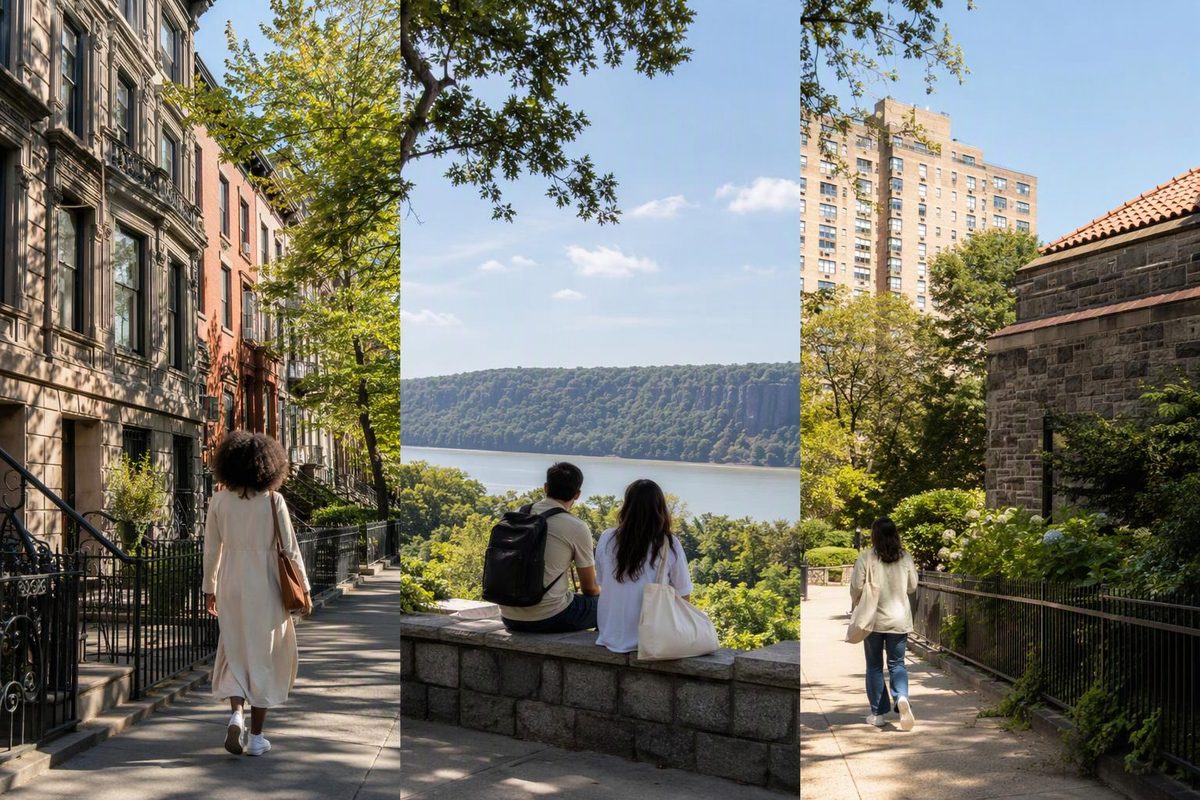
For a first visit to Upper Manhattan, choose Harlem for Black history and culture, Fort Tryon Park for medieval art and Hudson River views, or Inwood for a park-centered day. Pick one rather than trying to cover all three. If you have one flexible half-day and no strong preference, The Met Cloisters and Fort Tryon Park make a straightforward pairing; choose Harlem instead if exhibitions, neighborhood streets and a meal matter more than gardens and river views.
Choose your main interest and visiting day; check the suggested outing and opening-day caveat.
Choose One Compact Outing
Fort Tryon Park + The Met Cloisters
Suggested allowance: 4–5 hours
Arrive at 190 St on the A. Visit the museum first, then walk through the Heather Garden and enjoy the river views.
Choose Thursday–Tuesday for the museum; it is closed Wednesdays. Check holiday closures and current hours.
| Outing | Allowance | Arrival |
|---|---|---|
| Central Harlem | 3–4 hours | 135 St, 2/3 |
| Fort Tryon Park | 4–5 hours | 190 St, A |
| Inwood | 3–5 hours | Inwood–207 St, A |
Schedule, access and budget limits
Allowances are suggested planning budgets, including visits and breaks—not measured tour durations or travel from your accommodation.
Cloisters: 10 a.m.–5 p.m., Thursday–Tuesday; closed Wednesdays, Thanksgiving Day, December 25 and January 1. General adult admission: $30; concessions and pay-what-you-wish eligibility differ. For fully accessible public transit, the Met recommends A to 181 St, then M4; museum access has limitations.
Dyckman Farmhouse: Friday noon–4 p.m.; Saturday 10 a.m.–4 p.m.; closed Sunday–Thursday. General admission: $3; garden free. The museum lists an October 16, 2026 closure and October 17 hours of 10 a.m.–3 p.m. The building has numerous stairs.
Harlem: check the Schomburg exhibition and opening calendar for your date. This tool does not establish gallery opening hours.
Sources: The Met, NYPL and Dyckman Farmhouse visitor information cited in the guide; schedules as of October 8, 2026. Time allowances are editorial suggestions.
Upper Manhattan Is Several Neighborhoods, Not One Stop
For this guide, the practical frame is roughly 110th Street north to Inwood, focusing on Harlem, Hamilton Heights, Washington Heights and Inwood. This is a planning boundary, not a formal definition of “Upper Manhattan.”
The Upper East Side and Upper West Side need separate planning. In particular, The Met Fifth Avenue is not The Met Cloisters. The Cloisters is at 99 Margaret Corbin Drive in Fort Tryon Park, not beside the main museum. Use the Cloisters visitor information when planning this outing.
The suggested allowances in the tool include visits and breaks. They are not fixed tour durations and do not include travel from your accommodation. A compact route leaves room to spend longer in a gallery, stop for lunch or shorten a park walk without losing the rest of the day.
Harlem Works Best As an Exhibition, Walk and Meal
Begin at the Schomburg Center for Research in Black Culture, 515 Malcolm X Boulevard at 135th Street. Arrive at 135 St on the 2/3 for this route. The center’s exhibitions offer an introduction to Black history, arts and culture; its visitor information covers exhibitions, programs and research access.
The Schomburg is also a working research library. If your purpose is to use its collections rather than visit galleries, consult the separate researcher guidance before going. A gallery visit and a research appointment are different plans.
Allow about an hour for an exhibition, then walk south along Malcolm X Boulevard—also called Lenox Avenue—toward 125th Street. Leave time for a meal before deciding whether to extend west along 125th Street. Budget 3–4 hours for the outing, including the exhibition, walk and break.
This route stays within one part of Harlem. It does not attempt to cover Central, West and East Harlem in an afternoon, and it does not depend on adding a second distant attraction.
For fall 2026 visitors, “Forging Ahead: Recent Acquisitions of Black Women Artists” is scheduled through March 27, 2027 in the Schomburg’s Main Exhibition Gallery. It features 21 artists working across several media. Check the exhibition page and library opening calendar before choosing your day.
Fort Tryon Park Pairs the Cloisters With Gardens and Views
Take the A to 190 St and use the elevator exit. The Met directs walkers north along Margaret Corbin Drive through Fort Tryon Park; the direct approach takes approximately 10 minutes. Its visitor information also describes the M4 bus alternative.
Start with The Met Cloisters rather than leaving the museum until the end of the day. Budget roughly two hours for medieval art, architecture and the Unicorn Tapestries. Then walk back through Fort Tryon Park, adding the Heather Garden and Hudson-facing views instead of treating the park merely as the museum’s approach.
The NYC Parks description of Fort Tryon Park documents the Heather Garden and views toward the Hudson River and Palisades. Return toward your arrival station, with a meal break before or after the outing. Allow 4–5 hours overall.
Wednesday Is a Park Day, Not a Cloisters Day
As of October 8, 2026, the Cloisters lists 10 a.m.–5 p.m., Thursday through Tuesday; closed Wednesdays, Thanksgiving Day, December 25 and January 1. General adult admission is $30, with separate concessions and pay-what-you-wish eligibility.
Check the Met’s current hours and admission before departure. If medieval art is your reason for choosing this route, move it away from Wednesday rather than assuming the park can substitute for the museum visit.
The 190 St Elevator Does Not Make the Whole Visit Step-Free
For step-free travel, do not assume that the station elevator resolves access throughout the route and museum. The Met recommends A to 181 St, then the M4 for fully accessible public transit.
Its Cloisters visitor information also notes limitations within the museum and a free shuttle for visitors needing step-free access. Plan the entrance using that guidance, rather than following the standard walking approach by default.
Inwood Works With or Without an Indoor Visit
Arrive at Inwood–207 St on the A and walk south on Broadway to the Dyckman Farmhouse Museum at 4881 Broadway, West 204th Street. These are the museum’s official arrival directions.
If you want to enter the farmhouse, choose the day around its schedule. As of October 8, 2026, the museum lists Friday hours of noon–4 p.m. and Saturday hours of 10 a.m.–4 p.m.; it is closed Sunday–Thursday. It also lists a closure on October 16 and reduced hours of 10 a.m.–3 p.m. on October 17. Check the museum’s opening schedule for your date.
General admission is $3, while the garden is free, according to the museum’s ticket information. The building has narrow passages, low ceilings and numerous stairs. Its visitor policies are particularly relevant if you need step-free access.
After the farmhouse, take a meal break and continue west toward Inwood Hill Park. Choose a shorter park walk or a longer trail outing rather than committing to both. Allow 3–5 hours for the day, depending on the park portion and whether you enter the farmhouse.
The park’s forest, salt marsh and glacial landforms make this a different outing from Central Park sightseeing. The NYC Parks overview of Inwood Hill Park describes its landscape and facilities. If the farmhouse is closed, make the park the main outing rather than counting on an indoor stop.
Hamilton Heights Is a Separate History Outing
If Alexander Hamilton is your main interest, build a smaller Hamilton Heights outing around Hamilton Grange instead of adding it to the Cloisters day.
The free memorial is at 414 West 141st Street in St. Nicholas Park. As of October 8, 2026, NPS lists Wednesday–Sunday hours of 10 a.m.–4 p.m., with guided tours first-come, first-served. Check Hamilton Grange visitor information for the current schedule before arranging the rest of your day around a tour.
Stay Here When Northern Manhattan Is Central to Your Trip
Consider an Upper Manhattan base when Harlem or northern Manhattan is a substantial part of your itinerary—not simply because an accommodation is described as “uptown.” Judge the exact address, walk to the station and routes to your evening plans.
A base near the A can simplify trips between northern Manhattan and western Midtown, but it does not put the main Midtown sights within walking distance. For a first trip dominated by Broadway, Midtown and Lower Manhattan, a dedicated Upper Manhattan outing is generally a better fit than making it your base.
Use the first-trip neighborhood comparison to weigh that tradeoff against the rest of your itinerary.