 New York Know
How to explore New York’s landmark-dense center without backtracking
Midtown Manhattan is more than the blocks around Times Square. It is a dense concentration of transportation hubs, office towers, theaters, shops, public spaces, museums and some of New York City’s most recognizable architecture.
That density is both Midtown’s advantage and its trap. Major sights can appear close together on a map, yet a day quickly becomes tiring when it repeatedly crosses from east to west or combines too many long indoor attractions. Walking between landmarks may take only minutes; entering an observation deck, museum or Broadway theater changes the schedule entirely.
The most practical approach is to treat Midtown as a collection of compact sightseeing zones. Use approximately 34th to 59th Streets as a planning frame, choose the zones that match your interests and move in one general direction. The result is a coherent day rather than an exhausting checklist.
What and where is Midtown Manhattan?
Midtown is the central part of Manhattan where business, transportation, tourism, shopping, architecture and entertainment overlap. Times Square is one highly visible piece of it, but the district also includes or adjoins the Empire State Building, Grand Central Terminal, Rockefeller Center, Fifth Avenue, Bryant Park, the New York Public Library and the Theatre District.
There is no universally accepted Midtown boundary. The answer changes according to the subject:
- A sightseeing guide may use boundaries that connect the largest number of prominent attractions.
- A business definition may emphasize the office districts around Fifth, Sixth, Park and Madison Avenues.
- A neighborhood guide may distinguish Midtown East, Murray Hill, Hell’s Kitchen and the Theatre District.
- An administrative map may use boundaries that do not match everyday neighborhood names.
For practical visitor planning, this guide treats Midtown as running roughly from 34th Street to 59th Street. That range appears in multiple visitor-oriented descriptions, although the same sources acknowledge disagreement over the district’s other boundaries (Our Escape Clause’s Midtown guide).
This boundary is a planning tool, not a territorial claim. It places the Empire State Building and Herald Square near the southern end and the southern edge of Central Park at the northern end. Because Central Park begins at 59th Street, it is clearer to say that the park begins at Midtown’s northern edge than to place the entire park inside Midtown.
The east–west limits are even less consistent. Narrow definitions concentrate on the central avenues. Broader definitions extend west toward the Hudson River or east toward the East River. Two maps can therefore both be useful while classifying Hell’s Kitchen, Midtown East or Murray Hill differently.
To keep the geography clear, this guide uses four labels:
- Core Midtown: The central sightseeing area containing the most tightly clustered landmarks, principally around 34th Street, 42nd Street, Fifth Avenue, Rockefeller Center, Times Square and the Theatre District.
- Midtown subarea: A place that can reasonably be grouped under a broad Midtown definition but retains a recognizable identity of its own. Midtown East, Murray Hill and, in some contexts, Hell’s Kitchen fit here.
- Northern or southern edge: A place at the practical boundary, such as Central Park in the north or Herald Square and the Empire State Building in the south.
- Nearby extension: A destination that can be combined with Midtown but should not automatically be treated as part of its compact sightseeing core.
Under this framework, Hell’s Kitchen is a western neighbor or subarea, depending on the map. Midtown East covers the eastern side of the district but also functions as its own neighborhood label. Murray Hill sits toward the east or southeast and may be included in broader definitions of Midtown.
Hudson Yards, the High Line and Museum Mile are better treated as nearby extensions. Each can be connected to a Midtown day, but doing so lengthens the route and changes its focus. Museum Mile draws visitors well north of the practical core, while Hudson Yards and the High Line pull the day toward Manhattan’s far west side.
The point is not to settle every border dispute. It is to recognize when an itinerary has quietly expanded beyond the compact district you intended to explore.
Understand Midtown as a set of smaller sightseeing zones
Dividing Midtown into zones makes it easier to match sights to interests and avoid unnecessary crossings. These are planning zones rather than definitive neighborhood boundaries.
Herald Square and 34th Street
This is Midtown’s southern arrival-and-skyline zone. Penn Station provides a major transportation anchor, while Macy’s Herald Square and the Empire State Building dominate the immediate visitor geography.
The area works well as the beginning of a northbound day, particularly if you arrive through Penn Station. The Empire State Building becomes a substantial ticketed attraction if you enter its observatory, but it can also be treated as a brief exterior architecture stop. Herald Square is a useful orientation point before moving north toward Bryant Park.
Bryant Park and 42nd Street
Bryant Park and the New York Public Library form one of Midtown’s easiest pairings. The park occupies the blocks between Fifth and Sixth Avenues and 40th and 42nd Streets, with the library’s flagship building beside it (The Wanderbug’s Midtown guide).
From here, 42nd Street creates a natural east–west corridor. Grand Central lies to the east, while Times Square lies to the west. That makes Bryant Park a useful hinge in several itineraries and a convenient pause between larger attractions.
Grand Central and Midtown East
Grand Central Terminal is both a transportation hub and an architectural destination. Around it are office towers, the eastern side of 42nd Street and the Chrysler Building, which is most practical to approach as an exterior architecture stop.
Midtown East extends beyond this immediate cluster, but first-time visitors do not need to cover the entire area to understand it. A compact visit can focus on Grand Central, the Chrysler Building exterior and the surrounding streets before turning west toward Bryant Park or northwest toward Rockefeller Center.
It can be a useful base or an additional walking area, but it does not need to be folded into a first-day landmark route.
Rockefeller Center and Fifth Avenue
This compact zone combines architecture, public spaces, shopping and ticketed attractions. Rockefeller Center, St. Patrick’s Cathedral, Radio City Music Hall and Fifth Avenue are close enough to explore together. MoMA is farther north and west but still fits naturally when it is the day’s principal museum.
Fifth Avenue is not one single attraction. The visitor experience may involve storefronts and window-shopping, landmark architecture, the cathedral or the streets around Rockefeller Center. New York City’s tourism guide likewise presents Rockefeller Center, St. Patrick’s Cathedral, MoMA and the shops of Fifth and Madison Avenues as prominent Midtown experiences (NYC Tourism’s Midtown guide).
Times Square and the Theatre District
Times Square is the center of Midtown’s illuminated signs, dense pedestrian activity and highly commercial street scene. It is also the most visible gateway to the surrounding Theatre District.
The experience can be intense, particularly when you are trying to navigate rather than simply stop and look. Times Square works best as a deliberate destination instead of a corridor you cross repeatedly. If you are attending a Broadway performance, finishing the sightseeing day here is usually more efficient than visiting in the morning and returning at night.
Hell’s Kitchen
Some broad definitions call it Midtown West; others treat it as a separate neighborhood. For trip planning, it is most useful to consider it a western companion to a theater-focused day rather than another name for Times Square.
It can fit naturally before or after a show or serve as a western lodging base. It should not be presented as identical to the billboard-heavy blocks around Times Square.
Midtown planning map — schematic, not to scale
| Position | Central and eastern zones | Western areas | Edge or extension |
|---|---|---|---|
| North | MoMA and the northern Fifth Avenue area | — | Central Park at 59th Street; Museum Mile farther north |
| North-central | Rockefeller Center, St. Patrick’s Cathedral and Fifth Avenue | Radio City Music Hall | — |
| Central | Bryant Park, New York Public Library, Grand Central and Midtown East | Times Square, Theatre District and Hell’s Kitchen | — |
| South-central | Murray Hill to the east or southeast | — | — |
| South | Empire State Building and Herald Square | Penn Station area | Hudson Yards and the High Line farther west |
The boundaries between these areas should be read as soft transitions. They are useful for route planning, not as definitive neighborhood borders.
Prioritize the Midtown sights that fit your trip
The attractions below recur across visitor guides, but repetition establishes prominence rather than an objective ranking of quality. A first-time visitor interested in architecture will prioritize differently from someone coming for Broadway, modern art or skyline views.
Use the table to identify the experience you actually want instead of selecting every famous name automatically.
| Zone | Sight or experience | Experience type | Typical commitment | Access |
|---|---|---|---|---|
| Herald Square and 34th Street | Empire State Building | Art Deco architecture and skyline view | Substantial if entering; brief outside | Observatory is ticketed |
| Bryant Park and 42nd Street | Bryant Park | Public space | Brief to moderate | Generally public |
| Bryant Park and 42nd Street | New York Public Library | Architecture and interior visit | Brief to moderate | Generally free, subject to current access rules |
| Grand Central and Midtown East | Grand Central Terminal | Transportation and architecture | Brief to moderate | Public areas are generally open |
| Grand Central and Midtown East | Chrysler Building | Art Deco exterior | Brief | Exterior viewing is public |
| Rockefeller Center and Fifth Avenue | Rockefeller Center | Architecture, public spaces and shopping | Moderate; longer with an attraction | Exterior spaces can be visited without an attraction ticket |
| Rockefeller Center and Fifth Avenue | St. Patrick’s Cathedral | Religious architecture | Brief to moderate | Generally open to visitors, subject to services and current policies |
| Rockefeller Center and Fifth Avenue | MoMA | Modern and contemporary art | Substantial | Ticketed |
| Times Square and Theatre District | Times Square | Signs, crowds and commercial cityscape | Brief to moderate | Public space; no ordinary admission ticket |
| Times Square and Theatre District | Broadway performance | Live theater | Most of an evening | Ticketed |
| Rockefeller Center and Fifth Avenue | Radio City Music Hall | Entertainment architecture or performance | Brief outside; substantial for a tour or event | Exterior is public; tours and events are ticketed |
| Fifth Avenue | Window-shopping | Streetscape and retail | Flexible | Browsing is free; purchases are not |
Times Square and Broadway
Times Square is best understood as a public urban space rather than a conventional attraction with an entrance. Its defining elements are illuminated signs, dense pedestrian movement, shops, restaurants and its relationship with the Theatre District.
Broadway is different. A performance is an evening anchor, not a quick sightseeing stop. Once you include arrival time and the performance itself, the show determines where the afternoon should end and reduces the number of substantial attractions that fit earlier in the day.
Rockefeller Center, Fifth Avenue and St. Patrick’s Cathedral
These belong together geographically. The cluster allows visitors to combine a major commercial complex, public-space sightseeing, cathedral architecture and Fifth Avenue storefronts without making a long transfer.
Radio City Music Hall is a natural western addition. It is easy to see from outside, while a tour or performance requires more time. Fifth Avenue window-shopping is similarly flexible: it can fill a gap between landmarks or become a major part of the day.
Bryant Park and the New York Public Library
Treat these as one paired stop. The transition between them is minimal, and both work well between paid attractions. The visit can remain short—walk through the park and see the library exterior—or expand into a slower indoor and outdoor break.
Access to particular library rooms can vary. Do not build a tightly timed itinerary around entering a specific space without checking the library’s current visitor information.
Grand Central Terminal and the Chrysler Building
Grand Central is more than a place to catch a train. Its main interior, large concourse and celestial ceiling make it a worthwhile architectural stop. It can be appreciated quickly, but allowing time to stop and look is more rewarding than rushing through while navigating.
The Chrysler Building was completed in 1930 at 42nd Street and Lexington Avenue, and the available visitor guidance says its interior is not open as a sightseeing attraction (The Wanderbug’s Midtown guide). Plan around exterior views of its architecture and crown rather than assuming you can tour the building.
Empire State Building
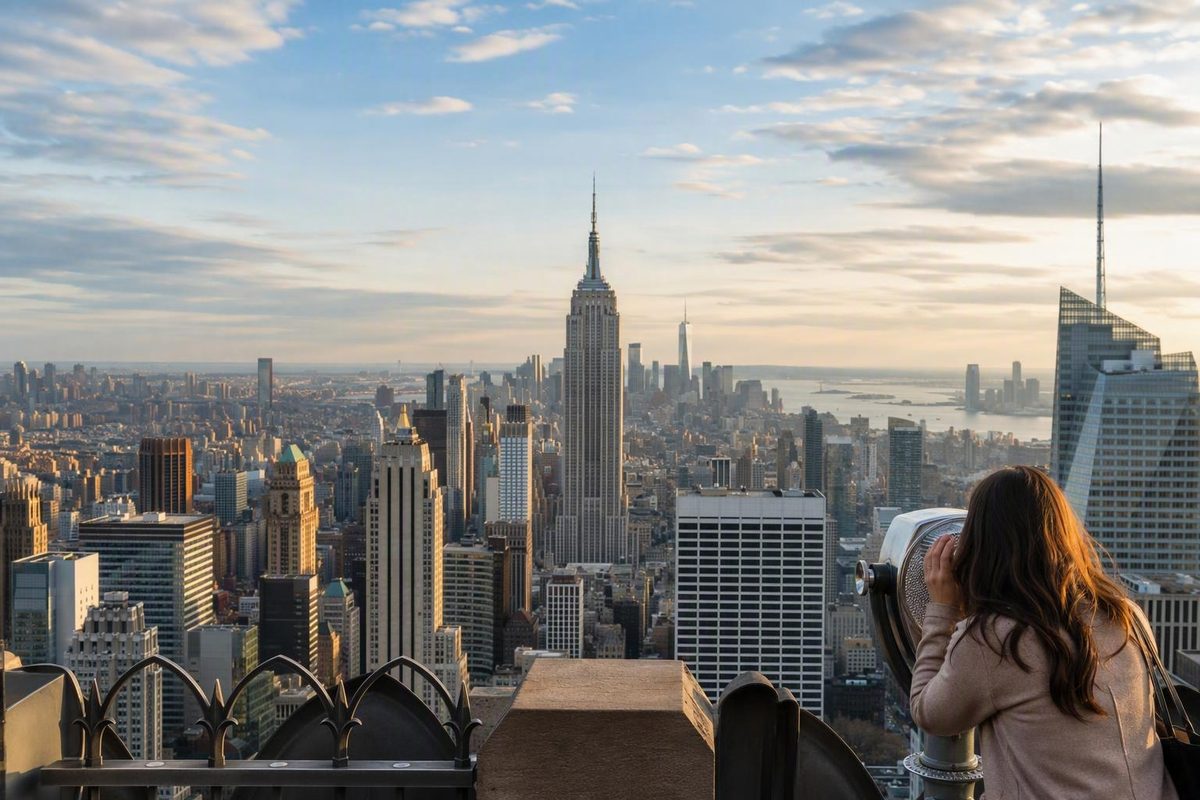
The Empire State Building is a major Art Deco landmark near the southern end of the practical Midtown core. It can be a quick exterior stop or a substantial ticketed experience, depending on whether you enter.
The building rises 102 stories on West 34th Street (Our Escape Clause’s Midtown overview). Its observatory experience includes an outdoor deck on the 86th floor, making it a schedule anchor rather than an incidental stop (New York Pass’s Midtown itinerary).
MoMA
MoMA is the principal full museum commitment in this core list. Its collection covers modern and contemporary art and includes Vincent van Gogh’s The Starry Night.
Even a selective museum visit requires more time and attention than viewing an exterior landmark. If MoMA is a priority, protect a substantial block for it rather than inserting it between several fixed reservations.
A manageable full-day selection rule is:
- Choose one observation deck.
- Choose no more than one major museum or immersive attraction.
- Choose one evening anchor, such as Broadway, dinner or a nighttime skyline visit.
That still leaves room for several public spaces and exterior landmarks without turning the day into a sequence of deadlines.
Follow a low-backtracking Midtown walking route
No route is universally optimal. Starting point, reservations, weather and mobility needs all matter. The sequences below are planning proposals based on geographic clustering; they are not presented as personally tested routes or guaranteed schedules.
Route from Penn Station or Herald Square
- Penn Station or Herald Square
- Empire State Building
- Bryant Park
- New York Public Library
- Grand Central Terminal
- Rockefeller Center and Fifth Avenue
- Times Square and the Theatre District
This sequence first moves north and east, then turns west for the evening. It avoids the inefficient pattern of visiting Times Square early, crossing to Grand Central and later returning to the Theatre District.
The Empire State Building belongs naturally at the beginning because it sits near 34th Street. Bryant Park and the library then provide a compact transition into the 42nd Street corridor. After Grand Central, moving northwest toward Rockefeller Center positions you to finish at Times Square or a Broadway theater.
If you are not entering the Empire State Building, this can remain a largely exterior route. If you have an observatory reservation, build the morning around it and avoid adding another deck later.
Route from Grand Central
- Grand Central Terminal
- Chrysler Building exterior
- Bryant Park
- New York Public Library
- Rockefeller Center
- Fifth Avenue and St. Patrick’s Cathedral
- MoMA, if selected
- Times Square or Broadway
This route works for visitors arriving on the east side or staying in Midtown East. It begins with the eastern architecture cluster and then moves generally west and north.
MoMA should remain optional. Adding it creates a substantial indoor block and carries the route farther north. Without the museum, the afternoon can proceed more slowly, with additional time at Rockefeller Center or along Fifth Avenue before an evening in the Theatre District.
Shorter central loop
Visitors who do not need to begin at a rail terminal can use this compact route:
Bryant Park → New York Public Library → Grand Central → Rockefeller Center → St. Patrick’s Cathedral → Times Square
This is not a perfectly closed loop, and that is an advantage. Ending somewhere different from where you started is often more efficient than returning solely for symmetry on a map.
What to keep optional
Do not force every famous attraction into the route:
- MoMA adds a substantial indoor visit.
- The Empire State Building creates a southern extension when the day begins around 42nd Street.
- Broadway occupies most of an evening.
- An observation deck can involve security, timed admission and time spent enjoying the view.
- Shopping is difficult to predict because browsing can expand to fill the available time.
Published walking routes illustrate how misleading bare walking time can be. One commercial self-guided route connects 10 Midtown sights over 2.5 miles and lists a two-hour duration (GPSmyCity’s Midtown walking tour).
Another published route covers 3.3 miles in an estimated 1.5 to two hours (10Adventures’ Midtown route guide).
Those estimates help establish the scale of an exterior walk, but they do not represent a complete sightseeing day. Meaningful museum visits, observation-deck entry, meals, shopping and performances all extend the schedule.
Choose one directional route and finish near the least flexible evening activity. That follows New York Know’s stated approach of grouping sights by area and building days that make sense on foot rather than repeatedly crossing the city (About New York Know).
Choose a half-day, one-day or two-day Midtown plan
The first distinction to make is between passing a landmark and visiting it. Walking past the Empire State Building, crossing Bryant Park and looking inside Grand Central can fit into a short route. Entering an observatory, touring a museum and attending a performance cannot be treated as equivalent tasks.
Half-day highlights plan
Use one compact corridor:
- Begin at Grand Central Terminal.
- Walk west to the New York Public Library and Bryant Park.
- Continue north to Rockefeller Center.
- See St. Patrick’s Cathedral and part of Fifth Avenue.
- Finish at Times Square.
This works best as an architecture-and-public-space overview. It leaves out the Empire State Building’s southern zone and does not include a substantial museum or observation-deck visit.
If you add a ticketed attraction, remove another stop or accept that the half-day will become tightly scheduled.
One-day plan with one major daytime anchor
Choose either a southern or eastern start. The daytime anchor can be an observation deck, MoMA or another substantial ticketed attraction. A Broadway performance may then serve as a separate evening anchor, but combining both requires schedule slack.
Southern start:
- Empire State Building as the major daytime anchor
- Bryant Park and the library
- Grand Central
- Rockefeller Center and Fifth Avenue
- Times Square
- Broadway, if the performance is the evening anchor
Eastern start:
- Grand Central and the Chrysler Building exterior
- Bryant Park and the library
- Rockefeller Center and Fifth Avenue
- MoMA or a theater-related daytime attraction
- Times Square or Broadway
The important word is or. MoMA, an observation deck and a Broadway performance can each be worthwhile, but stacking all three into one day leaves little flexibility for food, delays or spontaneous stops.
Two-day plan
Separating eastern and southern Midtown from central and western Midtown creates a more comfortable visit.
Day one: eastern and southern Midtown
- Grand Central Terminal
- Chrysler Building exterior
- Bryant Park
- New York Public Library
- Empire State Building or Herald Square
The final move from the 42nd Street corridor to the Empire State Building is a southward extension, so allow for it rather than treating these sights as one tiny cluster.
Day two: central and western Midtown
- MoMA, if it is a priority
- Fifth Avenue
- Rockefeller Center
- St. Patrick’s Cathedral
- Times Square
- Broadway
Starting at MoMA and then moving south toward Rockefeller Center and the Theatre District keeps the second day generally directional.
Substitute according to interest
For architecture: Emphasize Grand Central, the Chrysler Building exterior, St. Patrick’s Cathedral, Rockefeller Center and the Empire State Building.
For arts and performance: Prioritize MoMA and Broadway, then use Bryant Park, the library and Times Square as shorter connecting stops.
For skyline views: Choose one observation deck. Use the remaining time for street-level architecture so the day is not dominated by similar ticketed experiences.
For shopping: Keep Fifth Avenue flexible and reduce the number of reservations. Shopping time is difficult to estimate and should not be squeezed between fixed entries.
A one-day itinerary becomes unrealistic when it includes multiple observation decks, a full museum visit, extensive shopping and a Broadway performance. Even if the walking distance appears manageable, the elapsed time and mental load are not.
Leave unallocated time for meals, security screening, ticket collection, congestion and route changes. There is no responsible promise that every visitor can cover Midtown’s principal attractions in one day. Pace depends primarily on what you enter and how long you stay.
Balance free stops with ticketed experiences
Midtown can be expensive, but visiting the district does not require an attraction pass or tour. Separate access to public spaces from paid commercial products associated with them.
Generally free or low-commitment stops
Subject to current access policies, these can form the basis of a no-ticket day:
- Bryant Park
- New York Public Library
- Times Square
- Grand Central Terminal’s public areas
- Exterior views of the Empire State and Chrysler Buildings
- Rockefeller Center’s exterior spaces
- St. Patrick’s Cathedral, subject to services and visitor policies
- Fifth Avenue window-shopping
- Radio City Music Hall exterior
“Free” does not mean unrestricted at all times. Buildings may apply security procedures, close particular rooms or change visitor access. Religious services and private events can also affect sightseeing.
Commonly ticketed experiences
Expect to book or pay for:
- Observation decks
- MoMA and other museums
- Broadway performances
- Guided tours
- Immersive attractions
- Venue tours
- Shopping and dining
The Empire State Building offers observatory experiences that include its 86th-floor outdoor deck. Top of the Rock, at Rockefeller Center, has observation levels on floors 67, 69 and 70 (Tripadvisor’s Midtown attraction listing). These specifications do not establish that either attraction is universally better.
Its location can make it convenient for an east-side route, but route convenience is only one selection factor.
Choose a deck according to:
- Where it fits in your route
- Whether you prefer an indoor, outdoor or mixed format
- Which buildings you want to see in the skyline
- Your tolerance for wind, cold, heat or uncertain weather
- Whether the format interests you beyond the view
- Current admission and timed-entry conditions
A universal “best deck” ranking overlooks these differences. It can also encourage visitors to cross Midtown solely to follow someone else’s preference.
A simple no-ticket itinerary is:
Grand Central → Bryant Park → New York Public Library → Fifth Avenue → Rockefeller Center exterior → St. Patrick’s Cathedral → Times Square
That route still provides transportation architecture, public space, landmark exteriors, shopping streets and the Theatre District’s visual atmosphere.
Before visiting, confirm current admission rules, hours, timed-entry requirements and disability-access information with the official venue. Avoid relying on undated commercial listings for operational details.
Decide whether Midtown is the right place to stay
Midtown’s strongest case as a base is convenience. Many major landmarks are concentrated within or around the district, while Penn Station and Grand Central provide major transportation anchors. A visitor focused on classic sights may be able to begin several days on foot.
That does not make Midtown the correct base for everyone. Travel writers commonly recommend it to first-time visitors seeking landmark access, but those recommendations are advice rather than an objective rule. The same writers often describe the busiest parts as noisy, crowded, tourist-oriented, expensive or dominated by business activity. One accommodation guide frames Midtown as a convenient choice for major sightseeing while acknowledging the tradeoff in atmosphere (Go Ask A Local’s neighborhood guide).
Staying in Midtown does not require staying directly on Times Square. Another travel writer recommends choosing a hotel several blocks away when you want Midtown convenience without constant Times Square intensity (The Travel Expert’s New York accommodation guide).
Use your plans to choose a subarea:
- Times Square and the Theatre District: Useful for late shows and immediate access to evening activity. Expect the busiest blocks to feel intense.
- Rockefeller Center or central Midtown: Convenient for Fifth Avenue, Rockefeller Center, Times Square and several central landmarks.
- Midtown East or Murray Hill: A practical eastern base for plans beginning around Grand Central or the east side.
- Hell’s Kitchen: A western base with convenient access to the theater area without being identical to Times Square.
- Herald Square or the Penn Station area: Useful when rail access or southern Midtown is central to the trip.
Words such as quiet, local, lively and convenient are comparative. Conditions can change within a few blocks, and a room’s position within a building may matter as much as the neighborhood label.
Before choosing, ask:
- Where do most planned days begin?
- Where will evenings end?
- How late will you usually return?
- How much walking do you want before the first activity?
- Do you value immediate landmark access more than a strongly residential atmosphere?
If you are still comparing bases, use New York Know’s guide to choosing a New York neighborhood for a first trip. It offers a planning framework rather than verification or ranking of individual hotels.
Plan for time, crowds and changing visitor information
The most common Midtown planning error is estimating the day from map distance alone. The blocks may be manageable while the schedule is not.
Security procedures, queues, indoor visits, meals, shopping and fixed theater start times can consume more time than walking between landmarks. An exterior route that fits within a short walking estimate can become a full day after a museum, an observation deck and dinner.
Start by fixing the least flexible reservation. If you have a Broadway performance, work backward from the required arrival time and finish nearby. If you have timed museum or observatory admission, arrange flexible public-space stops around it.
Avoid booking multiple observation decks unless skyline viewing is the principal purpose of the day. Repeating security and entry procedures reduces the time available for street-level Midtown, and uncertain weather can affect several reservations at once.
Bryant Park, the library and Grand Central can function as natural pauses between larger ticketed attractions. Treat them as opportunities rather than guarantees of seating, restroom availability or entry to particular rooms.
For rain, emphasize major indoor destinations already on the route:
- Grand Central
- The New York Public Library
- MoMA
- Shopping
- A performance
- A reserved indoor attraction
Do not assume that the walking connections between them are covered. Carry appropriate weather protection and shorten the route rather than trying to preserve every outdoor stop.
Accessibility details require current, official confirmation. Check MTA and venue information for elevators, step-free station access, accessible entrances, seating, companion policies and other visitor requirements. Do not infer that an entire route is step-free because one station or entrance appeared accessible on an older map.
Prices, hours, theater schedules, restaurant operations, seasonal events and transit service can all change. Verify them close to departure instead of copying operational details from an undated blog, hotel page or booking platform.
A final Midtown planning checklist:
- Define the boundary and zones relevant to your trip.
- Select one substantial daytime paid anchor.
- Choose a route that moves in one general direction.
- Finish near the evening plan.
- Leave slack for meals, security, congestion and changes.
- Verify current access, reservations, accessibility and transit details.
Midtown becomes manageable when you stop treating it as one enormous checklist. Choose the zones that fit your interests, anchor the day with one substantial experience and let the streets between landmarks become part of the visit. You do not need every deck, museum and famous building to understand the district.
Where exactly does Midtown Manhattan begin and end?
There is no universally accepted boundary. For visitor planning, approximately 34th to 59th Streets is a useful working definition, while the east–west boundaries vary by source and purpose (10Adventures’ Midtown guide).
Central Park begins at the northern edge. Hell’s Kitchen, Midtown East and Murray Hill may be treated as subareas or distinct neighborhoods, while Hudson Yards, the High Line and Museum Mile are better considered nearby extensions for a compact itinerary.
Can you see the main Midtown attractions in one day?
You can see the exteriors of several major landmarks in one day by following a directional route through Grand Central, Bryant Park, Rockefeller Center, Fifth Avenue and Times Square.
A comfortable day should not assume room for multiple observation decks, a full museum visit, extensive shopping and Broadway. Prioritize one major daytime attraction, several shorter stops and, if desired, one evening anchor.
What can you do in Midtown Manhattan for free?
Generally free or low-commitment options include Bryant Park, the New York Public Library, Times Square, Grand Central’s public areas, Fifth Avenue window-shopping and exterior views of major buildings.
Access policies can change, particularly inside buildings and religious sites. Check current information if entering a specific room or venue is important.
Is Midtown Manhattan a good area to stay for a first visit?
It can be a convenient base for visitors prioritizing famous landmarks, Broadway and major transportation hubs. The tradeoff is that its busiest sections may feel crowded, noisy, expensive or highly tourist-oriented.
You do not have to stay directly on Times Square. Choose a subarea according to where your days begin, where evenings end and how much street intensity you want outside your hotel.
Is Midtown Manhattan walkable?
Yes. Midtown’s major sightseeing clusters are close enough to connect on foot, but congestion, traffic lights, security, queues and indoor attractions make a sightseeing day much longer than its mileage suggests.
Group adjacent landmarks, walk in one general direction and avoid returning to the starting point merely to create a closed loop. A coherent route through a few connected zones will reveal more of Midtown while consuming less time in transit.