 New York Know
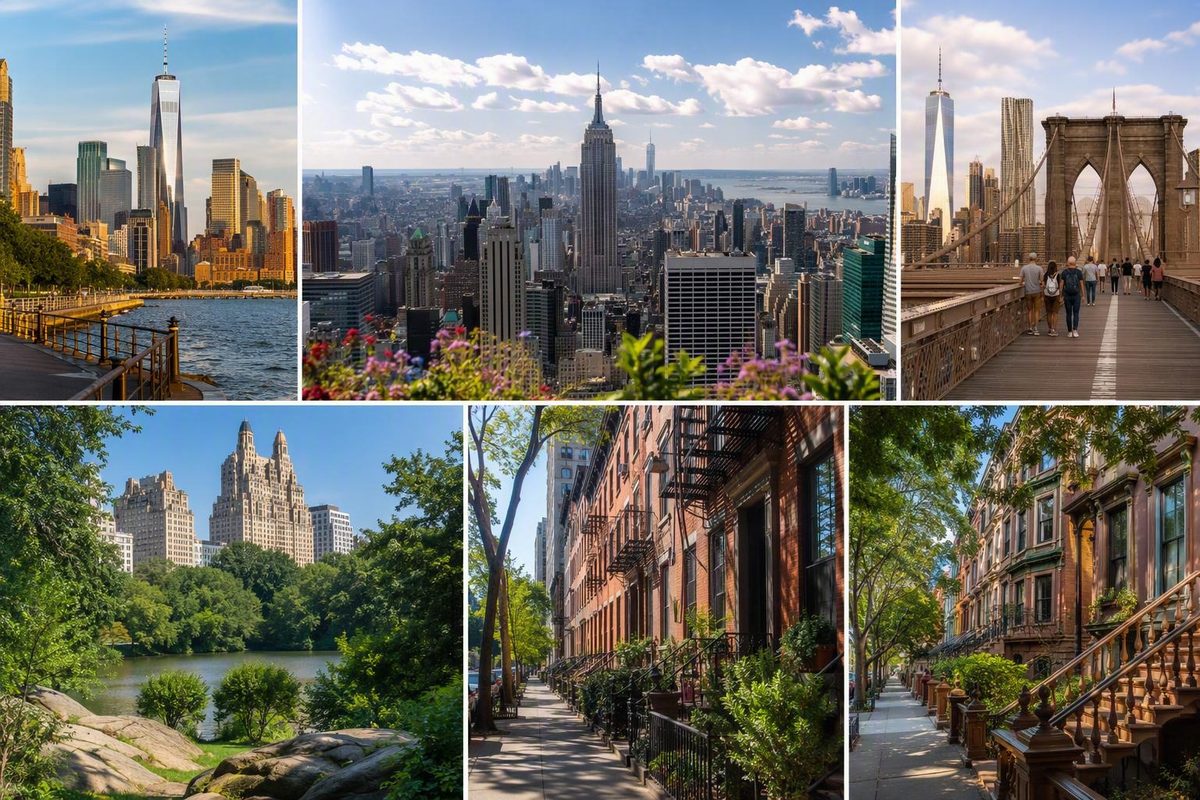
In this guide, “New York” means New York City, not New York State. For a first NYC trip, choose complementary clusters—Lower Manhattan and Brooklyn, Midtown, Central Park and one museum, Chelsea and the West Side, then perhaps one outer-borough area—instead of chasing isolated attractions across the city. Travelers interested in the Hudson Valley, Finger Lakes, Niagara, Adirondacks, or other destinations beyond NYC need a separate statewide guide.
The short answer: 12 places worth considering for a first NYC trip
These 12 choices are unranked. They recur in first-visit recommendations, but their practical value is geographic: each can anchor a coherent day with nearby streets, parks, museums, or landmarks.
| Place | Area and experience | Cost category | Plan ahead? |
|---|---|---|---|
| Central Park | Uptown Manhattan; park and landscapes | Free | Choose a section |
| The Met or American Museum of Natural History | Upper East or Upper West Side; art or natural history | Ticketed | Yes, if a priority |
| Times Square and Broadway Theater District | Midtown West; lights and theater | Mixed | Yes for a show |
| Rockefeller Center | Midtown; architecture and public spaces | Mixed | For ticketed attractions |
| Grand Central, Bryant Park, and the New York Public Library | Midtown East; architecture, park, and civic interiors | Free to explore | Check building access |
| Chelsea Market and the High Line | Chelsea; food hall, shops, and elevated park | Mixed | Usually no |
| Greenwich Village and Washington Square Park | Downtown Manhattan; neighborhood streets and park | Free to explore | Usually no |
| Battery Park and the Financial District | Lower Manhattan; harbor and civic history | Free to explore | Usually no |
| 9/11 Memorial area and Oculus | Lower Manhattan; memorial and architecture | Mixed | Yes for the museum |
| Brooklyn Bridge and DUMBO | Manhattan and Brooklyn; bridge walk and waterfront | Free to explore | Plan the route |
| Statue of Liberty and Ellis Island or Staten Island Ferry | New York Harbor; island visit or harbor ride | Paid island trip or free ferry | Yes for the island trip |
| One observation deck | Manhattan; skyline view | Ticketed | Often useful |
The categories are planning shorthand, not current price quotes. Public parks including Central Park and Bryant Park are among the city’s free outdoor options, while museums and observation decks commonly appear as ticketed experiences (NYC attraction overview).
The High Line is identified as a free public garden and walkway, while Chelsea Market combines shops and food vendors whose purchases vary by visitor (New York City attraction guide).
The Staten Island Ferry is presented as a free harbor option, unlike a dedicated Liberty Island visit (New York city guide). Always verify current admission, reservation, and access policies before visiting.
This is a menu, not a challenge. Do not schedule all 12. Select a few clusters according to your time, interests, budget, mobility, and weather, then leave room for meals and unplanned neighborhood walking. A balanced first visit might include one historic district, one museum, one park, one skyline experience, and one evening event.
Lower Manhattan and the Brooklyn waterfront: history, harbor views, and the bridge
Lower Manhattan works as one walking cluster because its harbor, financial, civic, memorial, and transportation landmarks are concentrated within a relatively small district. Start at Battery Park, continue through Bowling Green to Wall Street and Trinity Church, and then visit the 9/11 Memorial and Oculus.
The 9/11 Memorial has two pools occupying the footprints of the former twin towers. From the memorial area, choose one finish rather than extending the day in two directions: walk east toward South Street Seaport and Chinatown, or cross the Brooklyn Bridge to DUMBO.
The Brooklyn Bridge crosses the East River between Manhattan and Brooklyn and includes a pedestrian path. The World Travel Guy estimates approximately 45–60 minutes for a DUMBO-to-World Trade Center walk, but that is an attributed itinerary estimate rather than a guaranteed duration. Crowds, photographs, weather, construction, and individual mobility can make the trip substantially longer (first-visitor downtown route).
If you cross to DUMBO, let the waterfront and bridge views be the finish. Adding another distant Brooklyn neighborhood usually turns a compact downtown day into a transit-heavy one.
For a lower-walking version, remain in the Financial District and along the Manhattan waterfront. Combine Battery Park, Bowling Green, Wall Street, Trinity Church, the memorial area, and either the Oculus or Seaport. Skip both the bridge crossing and Chinatown rather than treating every possible stop as essential.
Statue of Liberty visit or Staten Island Ferry: choose the experience you actually want
These are not equivalent attractions. The Staten Island Ferry offers an alternative viewpoint; it does not provide the island access, museums, or historical interpretation of a dedicated Liberty and Ellis Islands visit.
| Choose Liberty and Ellis Islands when… | Choose the Staten Island Ferry when… |
|---|---|
| The monument is a central trip priority | You mainly want a harbor ride and passing statue views |
| You want island access and historical interpretation | You want a free experience |
| You can devote a substantial part of the day | You want more time for Lower Manhattan |
| You are prepared to plan around tickets and security | You prefer a flexible downtown addition |
Liberty Island is reached by ferry, and a first-visitor guide states that reservations are required. It also advises buying crown tickets months ahead, although availability and access rules can change. Confirm current options through the official operator before arranging the rest of your day around a particular ticket tier (Liberty Island planning details).
The Staten Island Ferry runs between Manhattan and Staten Island and provides passing views of the Statue of Liberty. It is the better fit when the harbor ride matters more than entering the monument complex. The ferry is free, but it still requires time for boarding, the outbound and return journeys, and any plans at the terminals (New York city guide).
Whichever option you choose, pair it with Lower Manhattan. Starting or finishing around Battery Park keeps the harbor experience within a geographically sensible day.
Midtown: architecture, theater, bright lights, and a skyline view
Choose one direction and keep moving. An east-to-west Midtown route begins at Grand Central Terminal, continues to the Stephen A. Schwarzman Building of the New York Public Library and Bryant Park, moves toward Rockefeller Center, and finishes at Times Square and the Broadway Theater District. Reverse the route if a timed reservation or matinee makes the west side the better starting point.
Grand Central provides the architectural opening, Bryant Park and the library offer a calmer pause, Rockefeller Center introduces another major public complex, and Times Square supplies the illuminated signs and theater energy. This sequence reduces unnecessary backtracking across Midtown’s long avenues.
Treat Times Square as a recognizable city experience rather than an all-day destination. A morning visit is a sensible choice if you prefer lighter crowds; at night, the lights pair naturally with a Broadway performance, but the street environment is more intense.
For a skyline view, choose one observation deck rather than stacking several similar paid experiences. Options include the Empire State Building, Top of the Rock, SUMMIT One Vanderbilt, Edge, and One World Observatory. Location is more useful than a universal ranking: SUMMIT fits a Grand Central day, Top of the Rock fits Rockefeller Center, Edge fits Hudson Yards, One World fits Lower Manhattan, and the Empire State Building fits central Midtown. Compare current admission, weather policies, indoor and outdoor areas, and view orientation before booking.
A Broadway performance creates a fixed endpoint, so plan backward from the curtain time. Leave space for dinner, finding the correct theater, security procedures, and seating. Accessibility varies by theater, including seating locations, restrooms, captioning, interpretation, and other accommodations; accessible inventory may be limited, so confirm arrangements with the specific venue (accessible NYC theater guidance).
Central Park and one museum: build a focused uptown day
Central Park covers 843 acres, which makes “see Central Park” too vague for a workable itinerary. Choose a section and a few destinations—perhaps Bethesda Terrace and the Lake, Conservatory Garden, the zoo area, or a west-side route—then pair the walk with one museum.
Two pairings work particularly well:
- Central Park plus the Metropolitan Museum of Art: choose this for art and material culture. The Met’s collection spans more than 5,000 years, so identify a few departments or galleries rather than trying to cover the entire museum.
- Central Park plus the American Museum of Natural History: choose this for science and natural history, including dinosaur fossils. A west-side park route connects more naturally than crossing the park late in the day.
Neither museum is universally better. Base the choice on your interests, the section of the park you want to see, and how much time you can comfortably spend indoors.
If modern art is the priority, visit MoMA as part of a Midtown day instead. It fits more naturally with Rockefeller Center, Bryant Park, or another central Midtown stop than with an uptown park itinerary.
Chelsea, the High Line, and Greenwich Village: a West Side walking day
Begin at Hudson Yards, walk south on the High Line, and stop at Chelsea Market. From there, choose either a waterfront extension to Little Island or the Whitney Museum, or continue through neighborhood streets toward Greenwich Village and Washington Square Park.
The High Line is a free public garden and walkway built on a former elevated rail line on Manhattan’s West Side. Its linear design simplifies navigation, although entrances, exits, crowding, and exposure to weather can affect the experience. Chelsea Market then offers food vendors and retail shops without requiring you to select a restaurant before arriving.
For a waterfront-focused day, continue from Chelsea Market toward Little Island or the Whitney. For a neighborhood-focused day, head south into Greenwich Village. Washington Square Park includes its arch, fountain, vegetation, and chess tables.
The complete Hudson Yards-to-Greenwich Village route becomes a long day once browsing, meals, photographs, and detours are included. If walking tolerance is limited, choose either the Chelsea waterfront stops or the Village continuation.
For accessibility planning, I LOVE NY’s guide identifies a ramp to Chelsea Market’s main concourse, a gently sloping route to an elevated viewpoint at Little Island, and several accommodations at the Whitney. Services can depend on the entrance, program, or advance request, so verify the arrangements needed for your visit (Chelsea accessibility details).
Go beyond Manhattan: pick one outer-borough day that matches your interests
New York City has five boroughs: Manhattan, Brooklyn, Queens, the Bronx, and Staten Island. This guide concentrates most closely on Manhattan and the Brooklyn waterfront, but the practical question is not which borough “wins.” It is which additional cluster offers something your Manhattan days do not.
DUMBO and the Brooklyn waterfront are the easiest additions to a short first trip. They offer skyline and bridge views and connect naturally to a Brooklyn Bridge crossing.
Williamsburg suits travelers interested in cafés, boutiques, street art, and unstructured neighborhood wandering. Its appeal is atmosphere and browsing rather than a sequence of major landmarks.
Coney Island combines a seasonal boardwalk, beach, amusement attractions, museum, and aquarium. Weather and seasonal operations matter, so treat it as a deliberate excursion rather than an add-on after another Brooklyn neighborhood.
In Queens, Flushing Meadows Corona Park combines World’s Fair remnants, museums, children’s attractions, and outdoor space. Choose a small number of destinations within the park rather than trying to cover every option.
In the Bronx, start with a specific interest such as baseball history, hip-hop history, or Little Italy, then build the day around current venue information.
Staten Island can suit visitors interested in historic attractions, beach views, and global dining. If you intend to travel beyond the ferry terminal, choose a specific destination before crossing.
On a short trip, select one outer-borough cluster. Attempting Williamsburg, Flushing, the Bronx, and Staten Island within the same short itinerary produces more transit than neighborhood time.
Turn the shortlist into a realistic one-, three-, or five-day plan
Use a few anchors per day. The space between them is not wasted: it absorbs meals, queues, weather changes, transit disruptions, slower walking, and places that catch your attention.
| Trip length | Framework | Main choices |
|---|---|---|
| One day | Lower Manhattan | Choose the Staten Island Ferry or 9/11 Museum as the main time-consuming anchor; add Financial District sights, then Brooklyn Bridge and DUMBO if energy permits |
| Three days | Three core clusters | Day 1: Lower Manhattan and Brooklyn waterfront. Day 2: Midtown and Broadway. Day 3: Central Park and one museum |
| Five days | Core trip plus two additions | Use the three-day plan, then add Chelsea and Greenwich Village, followed by one outer-borough day |
For one day, do not assume that the ferry and museum will both fit comfortably. If you choose the 9/11 Museum, make the bridge optional. If you choose the ferry, decide afterward whether you have the time and energy for the Financial District and DUMBO.
For three days, keep each day distinct: downtown history and harbor; Midtown architecture, lights, and theater; then park and museum. With five days, the Chelsea–High Line–Village corridor adds a more neighborhood-led Manhattan day, while one outer-borough cluster broadens the trip.
Use the subway for the long move to each day’s area, then walk locally. The MTA states that the standard fare for most riders is $3 and that riders can tap a contactless card, phone, wearable device, or OMNY Card. MetroCard sales and refills ended on January 1, 2026, while the final acceptance date for existing cards remained time-sensitive. Check real-time service and elevator status before leaving through the MTA subway guide.
Before paying for tickets or a pass:
- Verify official hours, admission rules, entrance locations, and seasonal operations.
- Reserve priority attractions and shows that would be difficult to replace.
- Confirm accessibility requirements with the exact attraction, theater, tour, and subway stations involved.
- Compare the current standalone prices of only the attractions you can realistically visit.
- Check whether a pass requires reservations or excludes the ticket tier you want.
Sightseeing passes can be useful, but advertised maximum savings do not establish value for a particular itinerary. Inclusions, validity periods, reservation requirements, and restrictions differ, so calculate the cost using only the attractions you already intend to visit.
Are the best places in New York mostly in Manhattan?
Many familiar first-trip attractions are in Manhattan, including Central Park, Times Square, Broadway, major museums, Midtown architecture, and Lower Manhattan. But Manhattan is not the complete city.
For a short first visit, a Manhattan-heavy plan is understandable. Add one outer-borough cluster—such as DUMBO, Williamsburg, Coney Island, or Flushing Meadows Corona Park—rather than claiming broad coverage through brief, disconnected stops.
What are the best free places to visit in New York City?
Strong free outdoor choices include Central Park, Bryant Park, Brooklyn Bridge Park, Washington Square Park, and other public parks (NYC parks and attractions overview).
The Staten Island Ferry is another free option.
Free does not mean effortless. These places may involve long walks, crowds, weather exposure, or substantial travel time, so group them geographically.
Do I need to book major New York attractions in advance?
Book ahead when an experience is a trip priority, has limited seating, uses timed entry, or requires a particular accommodation. Broadway performances and Statue of Liberty access are clear examples; some accessibility services also require advance notice.
Do not assume every attraction has the same policy. Confirm current requirements with the official operator, especially for crown access, theater seating, special tours, and accommodation requests.
Is a New York sightseeing pass worth buying?
Sometimes, but only when the pass costs less than the current standalone admission for attractions you can realistically visit. Check whether the exact experience or ticket tier is included, whether reservations are still required, and how long the pass remains valid.
Do not add unwanted attractions merely to create the appearance of savings. A traveler choosing one museum and one observation deck may be better served by separate tickets; someone visiting several included attractions within the validity window may find a pass worthwhile.
The durable planning rule is simple: choose the experiences that matter most, place each inside a neighborhood cluster, and leave enough open time to notice the streets between the headline sights. For most first trips, three coherent days—Lower Manhattan and Brooklyn, Midtown, then Central Park and one museum—provide a stronger starting point than a longer checklist scattered across the city.