 New York Know
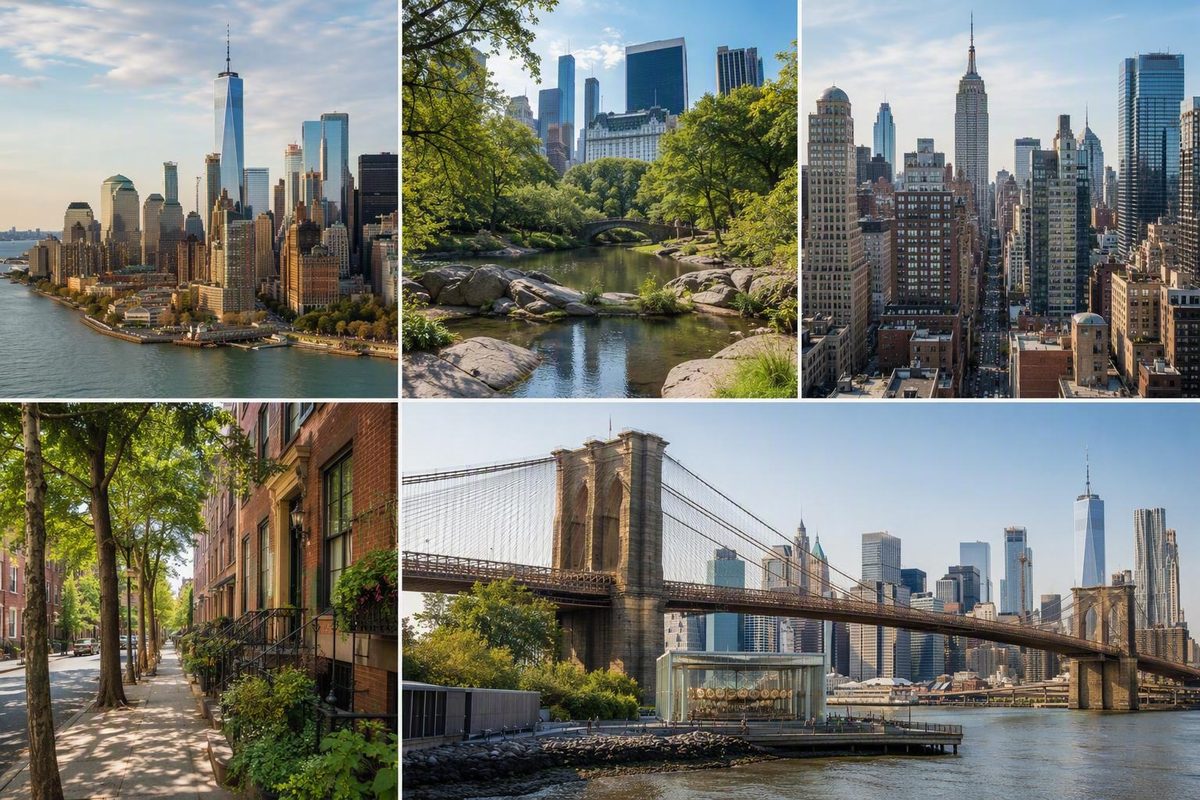
The simplest way to build a practical New York itinerary for 5 days is to assign each day one compact area: Lower Manhattan, Central Park, Midtown, Chelsea and the West Village, then the Brooklyn Bridge and DUMBO. Choose one principal anchor, walk between nearby stops, and use transit for the meaningful journey to or from that day’s cluster.
This is a flexible first-trip framework, not a timed or universally optimal schedule. Reorder it around weather, reservations, arrival and departure times, your accommodation, and your preferred pace. When a day runs long, cut its optional extension rather than crossing the city to preserve an overloaded checklist.
The five-day itinerary at a glance
| Day | Geographic focus | Principal anchors | Likely pace | Easiest element to cut |
|---|---|---|---|---|
| 1 | Lower Manhattan | Waterfront, Financial District, downtown memorial area, Chinatown | Full but adjustable | Staten Island Ferry detour |
| 2 | Central Park | One selected park section or route | Slow to moderate | Evening activity |
| 3 | Midtown | Empire State Building area, Rockefeller Center, Times Square | Moderate to busy | Secondary Midtown stops |
| 4 | Chelsea and West Village | Chelsea walk followed by a West Village finish | Relaxed | One of the two neighborhoods |
| 5 | Brooklyn Bridge and DUMBO | One-way bridge crossing and DUMBO | Moderate to strenuous | Bridge crossing |
The sequence creates five self-contained sightseeing days rather than ranking attractions by fame. The governing rule is to keep each day geographically compact, preserve time for unplanned walking, and avoid more than one substantial transit transition. This follows New York Know’s area-based planning approach, but the five-day order itself is an editorial framework rather than a tested schedule.
Reorder the clusters when there is a practical reason. Put Central Park on the most comfortable outdoor day, align Midtown with theater or observation reservations, and avoid placing an inflexible booking on your departure day. If you are staying in Brooklyn, the bridge and DUMBO day may work well at the beginning or end of the trip.
One anchor plus the surrounding streets will usually withstand delays better than several timed attractions. Decide before each morning which element is essential, which is desirable, and which can disappear without spoiling the day.
Day 1: Walk from the Lower Manhattan waterfront to Chinatown
Principal anchor: the Lower Manhattan walking route.
Default progression: Battery Park → Bowling Green → Wall Street → Trinity Church → downtown memorial and transportation area → eastern waterfront → Chinatown.
Begin near Battery Park. Starting at Manhattan’s southern waterfront gives the route a clear direction: first the harbor edge, then the financial and civic streets, followed by one turn east and a neighborhood finish.
The Staten Island Ferry can be an optional harbor-view detour before the main walk. It is not a ferry to Liberty Island and does not stop there; the travelers in one documented account disembarked on Staten Island before returning to Manhattan (Travel? Yes Please!). Choose it for the harbor journey, not as a substitute for setting foot on Liberty Island.
If you do not want the ferry, start around South Street Seaport instead. That reverses part of the approach by beginning on the eastern side of the district. Choose Battery Park or the Seaport as your starting edge rather than trying to begin at both.
From Battery Park, move through Bowling Green, Wall Street, Trinity Church, and the downtown memorial and transportation area. Treat these as an ordered route, not an instruction to spend a long time at every location. New York Know’s Lower Manhattan walking guide supports this general sequence and the idea of making one eastward turn toward the Seaport or river edge.
After the downtown core, turn east. Pause there if you need a break, then make Chinatown the day’s endpoint. This gives the walk a practical structure:
- Morning: Battery Park and the optional ferry detour.
- Midday: Bowling Green, Wall Street, and Trinity Church.
- Afternoon: The memorial and transportation area, followed by the eastern waterfront.
- Evening: Food and a final walk in Chinatown.
Keep three additions optional: lingering extensively at every historical or memorial stop, taking the round-trip ferry detour, and continuing beyond Chinatown into Little Italy or the Lower East Side. One may fit comfortably. Requiring all three turns the day into a much heavier walking commitment.
Day 2: Give Central Park room instead of treating it as a shortcut
Principal anchor: one deliberately limited Central Park route.
Reserve the morning and a substantial part of the afternoon for the park. Do not squeeze it between downtown and Midtown simply because it appears as one rectangular area on a map. Walking, pausing, and changing pace inside the park are the purpose of this day.
Because the available evidence does not establish a single best entrance, route, distance, or accessible path, use this concrete planning sequence:
- Choose your entrance before leaving. Use the side most convenient to your accommodation or evening plan.
- Select one park section or one-way route. Do not make covering the entire park the objective.
- Choose the exit in advance. This prevents the walk from expanding indefinitely.
- Schedule a real midday stop. Eat or rest rather than treating every pause as lost sightseeing time.
- Leave while you still have enough energy for the return journey.
A third-party first-trip account devoted nearly a full sightseeing day to Central Park. That experience demonstrates that the park can support several hours for visitors who enjoy walking and open space, although it does not establish the right duration for everyone.
Your working schedule can therefore remain simple:
- Morning: Enter from your selected side and follow the first portion of your chosen route.
- Midday: Stop for a proper break.
- Afternoon: Complete the selected section and leave through the predetermined exit.
- Evening: Return toward your accommodation or attend one preselected nearby indoor, cultural, or entertainment activity.
The evening addition should be singular and easy to abandon. Starting another large sightseeing circuit after several hours in the park would undermine the slower purpose of the day.
Weather, entrances, accessibility needs, personal stamina, and time spent pausing can all affect the experience. Verify current conditions and choose the park route accordingly rather than relying on a minute-by-minute schedule.
Day 3: Keep the major Midtown landmarks together
Principal anchor: one paid or timed Midtown attraction.
Default progression: Empire State Building area or chosen reservation → surrounding Midtown streets → Rockefeller Center → Times Square or an evening performance.
Begin around the Empire State Building or whichever Midtown attraction holds your principal reservation. If you want a paid observation experience, make that the day’s anchor rather than assuming every viewing platform must fit into the trip.
Continue in one general direction toward Rockefeller Center. Allow time for the surrounding streets and buildings instead of treating every landmark as an isolated destination requiring another commute. Delays are easier to absorb when the day has one reservation rather than a chain of them.
Use this priority order:
- Principal anchor: Your paid or timed attraction.
- Geographic anchor: Rockefeller Center and its immediate surroundings.
- Evening endpoint: Times Square, a performance, or dinner in the area.
- Optional layer: Any secondary Midtown stop that fits without rushing.
Finish around Times Square if you want to see it after dark or have a performance nearby. Otherwise, treat it as a brief endpoint rather than an automatic all-evening commitment.
If the principal attraction takes longer than expected, remove the secondary layer. Do not risk a timed evening booking to complete optional stops. Check official attraction and performance sources for current hours, ticket procedures, entry conditions, and reservation requirements before finalizing the order.
Day 4: Slow the pace in Chelsea and the West Village
Principal anchor: a street-level walk through two neighboring areas, with the West Village as the endpoint.
Default progression: Chelsea morning → meal or break along the route → West Village afternoon → dinner nearby or return to your accommodation.
Day 4 is deliberately less rigid than the landmark-heavy days. Begin in Chelsea and explore at street level. You may choose one attraction if it strongly interests you, but do not build the morning around a long chain of reservations. The practical goal is to leave room for browsing, pauses, food, and weather-related changes.
Make the transition between neighborhoods the structure of the afternoon rather than leaving the area for a distant attraction. Once there, prioritize side streets, food, and unplanned stops.
Choose meals based on:
- where you are when you become hungry;
- current opening information;
- your budget;
- dietary requirements;
- whether the meal keeps you within the day’s route.
Remain in the same general area for dinner or return to your accommodation. Adding a distant evening district would remove the main advantage of pairing Chelsea and the West Village.
This is also the itinerary’s pressure-release day. If fatigue has accumulated, choose only Chelsea or only the West Village. If poor weather or a delay disrupted an earlier anchor, part of Day 4 can absorb it—but only if the replacement does not create another cross-city marathon.
For a defined shorter version, spend the morning in Chelsea, stop after lunch, and omit the West Village. Alternatively, begin later and make the West Village the sole neighborhood anchor. Either version is more coherent than rushing through both.
Day 5: Choose a Brooklyn Bridge and DUMBO finish that matches your energy
Principal anchor: either the Brooklyn Bridge crossing or DUMBO, depending on stamina and conditions.
Default progression: approach the bridge → cross once toward Brooklyn → continue into DUMBO → keep the afternoon in the same area.
Treat the Brooklyn Bridge as the day’s main walking commitment, not as a casual addition to an already full Lower Manhattan itinerary. After four sightseeing days, accumulated fatigue may be more important than your enthusiasm at the beginning of the trip.
Choose between two versions:
Fuller outdoor version: Approach the bridge in the morning, cross once, and continue into DUMBO. Keep the rest of the afternoon in DUMBO rather than immediately beginning another borough-spanning route. A second bridge crossing is an optional intensive extension, not part of the standard plan.
Lower-walking version: Use transit to reach the Brooklyn side and make DUMBO the main neighborhood anchor, or cross the bridge once and use transit afterward. This preserves either the crossing or the neighborhood exploration without requiring both directions on foot.
There is a practical reason not to attach this automatically to Day 1. Travel? Yes Please! documented a day combining Lower Manhattan, the Staten Island Ferry, the downtown memorial area, the Brooklyn Bridge, and DUMBO, but the travelers also reported being too tired to walk back across the bridge; fatigue affected later walking plans as well (their five-day trip account). That experience does not predict every visitor’s limit, but it illustrates the tradeoff created by stacking major walks.
Leave the final evening open. Have a last meal near your route, finish early, or return to a favorite area if your energy allows. Avoid making the night depend on completing every optional daytime activity.
Before choosing the fuller version, assess the weather, mobility needs, luggage, and how you feel after the previous four days. The bridge walk is not automatically suitable for every visitor or every set of conditions.
Choose a base and use transit to support the route
Choose accommodation by balancing four considerations:
- total lodging budget;
- connections to the five daily clusters;
- where you expect to spend your evenings;
- how late and how often you want to travel back.
One first-trip guide suggests central Manhattan areas such as Flatiron, Herald Square, and Koreatown. Treat those as places to begin comparing properties, not as universally superior locations (Destination Dreamer Diaries’ lodging suggestions). A Brooklyn base or another Manhattan neighborhood may suit you better because of price, evening preferences, or the return journey.
No borough is always the best base, and no neighborhood is universally the safest, cheapest, or most convenient. Compare individual properties and nearby transit connections rather than relying on broad labels.
Within each daily cluster, walk when the streets between stops are part of the experience. Use transit when the next destination is meaningfully farther away, weather deteriorates, you have luggage, stamina is limited, or a timed reservation makes walking impractical. Transit should support the day’s geographic plan rather than justify adding unrelated districts.
Pre-trip verification
Shortly before departure—and again on the day—check official transit and attraction sources for current fares, accepted payment methods, service changes, elevator status, closures, opening hours, ticket procedures, and reservation requirements. Because these details can change, this itinerary does not recommend a transit pass or payment strategy without a current comparison for your party.
How to make the itinerary slower, rain-ready, or easier to walk
For a more relaxed trip, retain one anchor and one neighborhood walk each day. Remove extensions and optional evening activities first rather than dismantling the geographic structure.
| Original day | First stop to cut | Lower-walking adjustment | Nearby indoor substitute to verify |
|---|---|---|---|
| Day 1: Lower Manhattan | Ferry detour | Start at one waterfront edge and finish after Chinatown | A downtown memorial interior, museum, or historic site |
| Day 2: Central Park | Longer park section | Use one entrance, one short section, and a predetermined exit | A museum, performance, or cultural venue near the selected park side |
| Day 3: Midtown | Secondary landmarks | Keep one timed anchor and use transit to the evening endpoint | A Midtown museum, gallery, tour, or performance |
| Day 4: Chelsea/West Village | Second neighborhood | Explore Chelsea or the West Village, not both | A gallery, market, or cultural venue within the chosen area |
| Day 5: Bridge/DUMBO | Bridge crossing | Use transit and make DUMBO the anchor | An indoor market or cultural venue in the same area |
For each indoor substitute, verify that it is genuinely near the route and confirm current hours, admission rules, accessibility, and reservation requirements. A nearby category is not automatically a suitable same-day option.
Preserve the day’s cluster when weather changes. Do not replace an outdoor stop in Central Park with an indoor attraction in Lower Manhattan if doing so creates extra cross-city journeys. The same principle applies to fatigue: remove the ferry on Day 1, shorten the park route on Day 2, drop secondary Midtown stops on Day 3, choose one neighborhood on Day 4, or replace the bridge crossing with transit on Day 5.
Accessibility details, elevator availability, closures, weather exposure, and exact walking distances require current checks with the relevant operator or venue. When luggage, timed entry, difficult weather, or physical fatigue makes a walk impractical, use transit between clusters and shorten the route within them.
Give each day one part of New York, choose one principal anchor, and let nearby streets fill the space around it. Reorder the five clusters around current reservations and weather, but cut optional extensions before sacrificing the itinerary’s geographic logic.
Is the Staten Island Ferry the same as visiting Liberty Island?
No. The route described in the cited Travel? Yes Please! account is a harbor journey that does not stop at Liberty Island. If setting foot on Liberty Island is a priority, treat that as a separate activity and verify current official ticket and departure procedures.
Is five days enough for every first-time visitor to New York?
No single trip length suits every visitor. Five days can accommodate these five geographic clusters, but whether that feels sufficient depends on your pace, interests, mobility, reservations, and arrival and departure times. Use the itinerary to make five days coherent, not to claim that five days can cover everything.