 New York Know
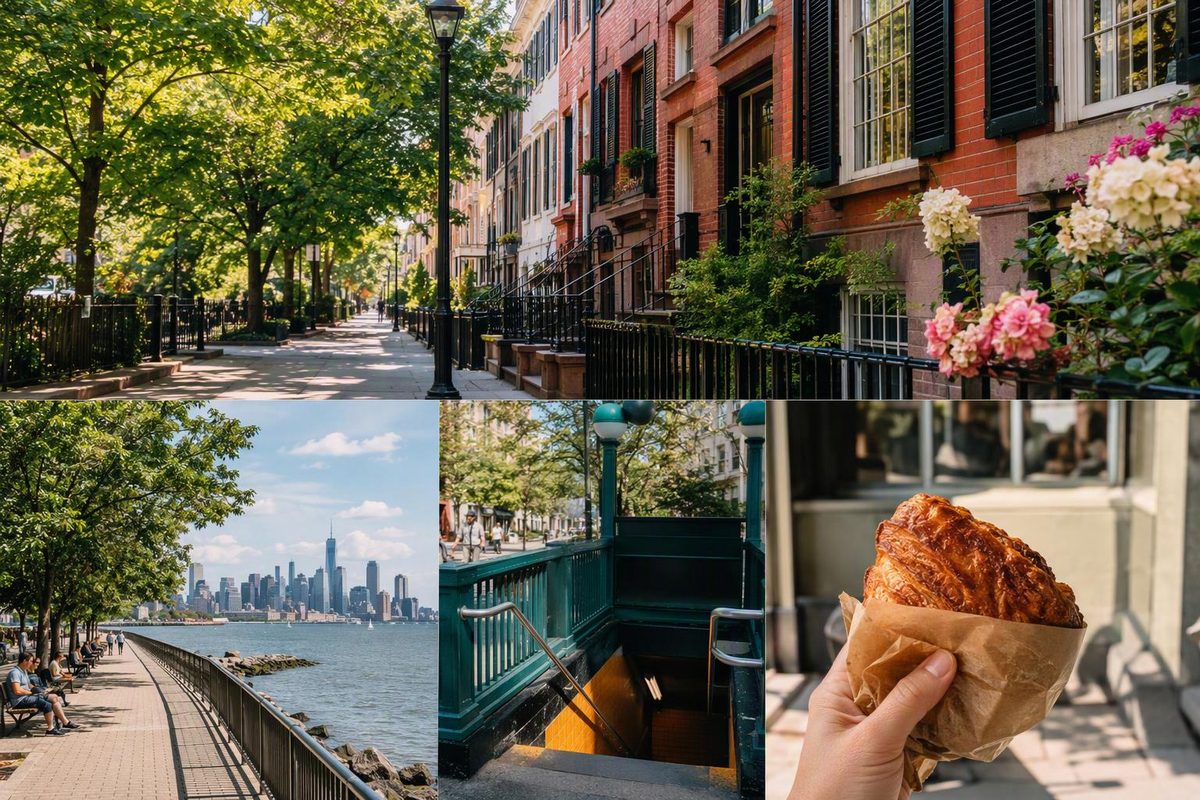
Give the West Village a relaxed half-day rather than fitting it between two distant attractions. A useful first visit connects Christopher Park and Stonewall, the streets around Grove and Bedford, Bleecker Street browsing, and a break beside the Hudson River. Add one meal, not several restaurant queues.
Allow roughly three to four hours, including a history stop and food. The walking itself takes much less time; leave room to stop.
Where is the West Village?
The West Village sits on Manhattan’s west side, beside the Hudson River and south of 14th Street. Its eastern and southern boundaries vary by definition: Greenwich Avenue, Seventh Avenue and Sixth Avenue are all used on the east, while Houston and Christopher Streets appear in different descriptions. For visitors, the street address matters more than settling an exact border. Condé Nast Traveler’s neighborhood guide explains those variations.
For this walk, use Christopher Street as your arrival point and the river as your finish. Treat the Whitney and High Line as nearby extensions into the Meatpacking District, rather than essential West Village stops.
Getting there
Two subway stations make useful starting points:
- Christopher St–Stonewall, on the 1 train: the most direct arrival for Christopher Park and the visitor center. The MTA lists entrances at Christopher Street and Seventh Avenue. This station is not listed as accessible on its 1 train map.
- W 4 St–Washington Sq: useful if an A, B, C, D, E, F or M service fits your journey. The station is on Sixth Avenue, with listed entrances at West 3rd Street and Waverly Place—not directly outside Stonewall. The MTA lists it as accessible; service varies by day and time. See its station and transfer details.
For step-free access at West 4th Street, the street elevator is at the northeast corner of West 3rd Street and Sixth Avenue. Check elevator status before traveling using the links on the MTA’s accessible-stations page.
Check service before leaving, especially on weekends. If you arrive at West 4th Street, the nearby West 4th Street Courts can be a short opening stop before heading west.
A compact West Village walking route
1. Start with Christopher Park and Stonewall
Christopher Park is the small triangle bounded by Christopher, Grove and West Fourth Streets. It provides a clear place to orient yourself before exploring the surrounding streets. The National Park Service identifies its location.
Make this more than a photograph stop. The Stonewall Uprising of June 28, 1969 was a milestone in the LGBTQ+ civil-rights movement, and Christopher Park is central to Stonewall National Monument. NPS explains that historical significance.
The Stonewall National Monument Visitor Center is at 51 Christopher Street, between Waverly Place and Seventh Avenue South. As of October 10, 2026, its operator lists Tuesday–Sunday, 10 a.m.–4 p.m.; closed Monday. Admission is free. Allow about 30–45 minutes as a planning budget, then continue outside. Check the visitor center’s hours before your trip; NPS confirms free admission.
2. Walk Grove Street to Bedford Street
Follow Grove Street toward Bedford Street for a short stretch of neighborhood architecture. The building at the Bedford–Grove corner is the exterior associated with Friends, if that interests you; it need not become the purpose of the walk. The neighborhood guide identifies the television-related location.
Stay on the public sidewalk, keep entrances clear and do not climb residential stoops for photographs.
Grove Street also gives you two nearby food options:
- Buvette, 42 Grove Street: a café-style meal, with croissants, croque madames and other French dishes. Its official page lists all-day service.
- Via Carota, 51 Grove Street: Italian food with a seasonal menu. Its site links to reservations and says walk-ins are welcome.
Choose one if the menu and availability suit you. If a particular restaurant is important, arrange the meal first and fit the walk around it; otherwise, set a limit on how long you are willing to wait.
3. Browse Bleecker Street, then turn toward Hudson Street
From Grove Street, head south on Bedford Street to Bleecker Street, then follow Bleecker north toward West 10th Street. Use this stretch for browsing rather than adding a list of compulsory shops. Turn west on West 10th Street toward Hudson Street, then head south to Christopher Street.
This small loop gives the visit room to breathe between its history stop and waterfront finish. Keep a map handy at turns rather than navigating by numbered streets alone.
4. Finish at Pier 45
Follow Christopher Street west toward the river, using the signalized crossing at West Street. Pier 45 is a useful place to sit rather than immediately starting another attraction.
The park operator lists a large lawn, seating, shade structures and a promenade on the pier. Seasonal programming is a bonus, not something to assume will be happening when you arrive. See Hudson River Park’s Pier 45 page.
If you are returning by subway, allow time to walk back inland; the waterfront finish is not beside either starting station.
What to add—and what to leave for another day
For more walking: continue north along the waterfront toward Gansevoort Street, then join the High Line northbound route. This is a coherent extension, but turns a relaxed half-day into a longer outing.
For an art-focused or rainy-day version: shorten the browsing and waterfront portions and make the Whitney your main destination. The museum is at 99 Gansevoort Street in the Meatpacking District and recommends advance tickets. It normally closes on Tuesdays, so check the Whitney’s visit page for your date before relying on it as a rain alternative.
Avoid adding both a full museum visit and a long High Line walk unless you have most of the day free. In a longer trip, place this outing within a five-day itinerary organized by area, rather than crossing town again for another afternoon stop.
Should you stay in the West Village?
Consider it as a base if neighborhood walks and nearby dinners are central to your trip. Before booking, check the actual accommodation address, the walk to a useful subway station and whether the room faces an evening dining or bar corridor. A neighborhood name alone does not tell you how convenient—or quiet—a particular room will be.
If your short first trip revolves around Midtown landmarks and Broadway, compare the transit tradeoff using our neighborhood-by-trip-priority guide. You can enjoy the West Village as a half-day visit without making it your overnight base.