 New York Know
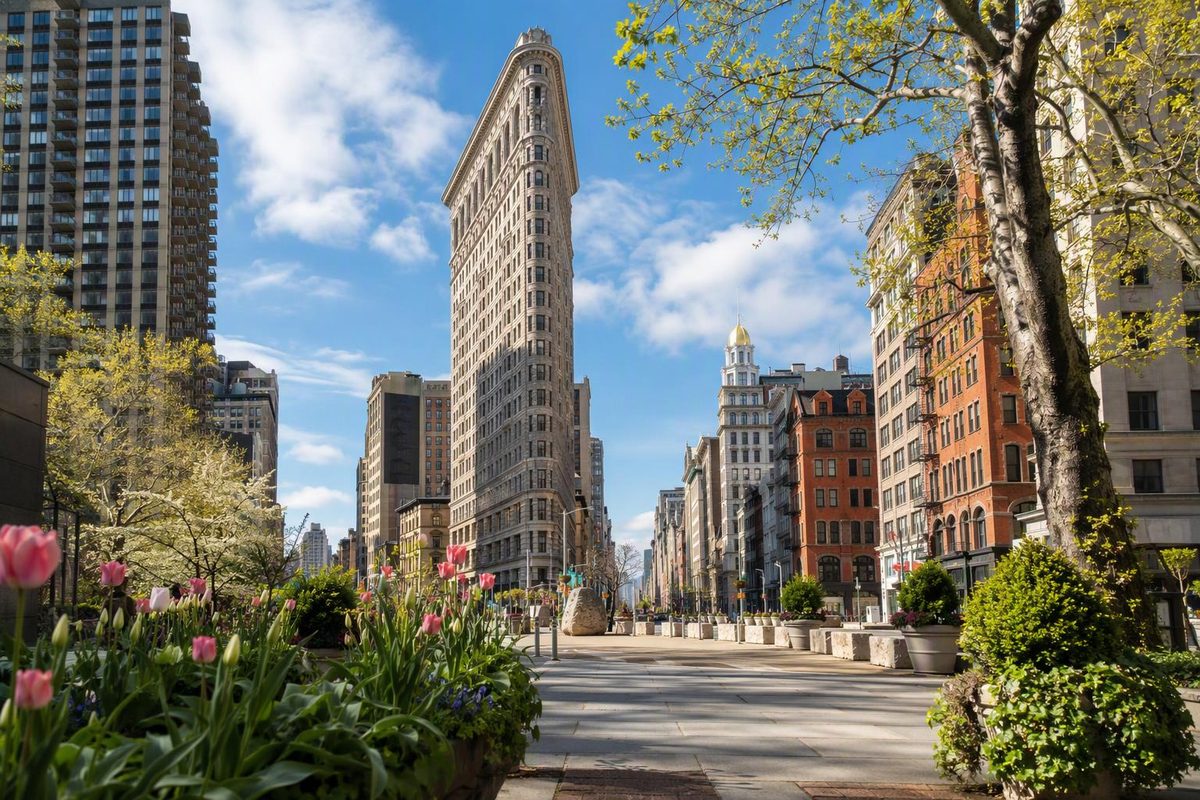
The famous triangular building in New York City is the Flatiron Building, at 175 Fifth Avenue in Manhattan. It stands where Broadway meets Fifth Avenue at 23rd Street, immediately south of Madison Square Park. NYC Tourism confirms the address and location.
Treat it as a short outdoor landmark stop rather than a standalone attraction. Allow 15–30 minutes for the building and photographs, or about 60–90 minutes to include Madison Square Park and a walk south toward Union Square.
Flatiron Building essentials
| Question | Practical answer |
|---|---|
| What is it called? | Flatiron Building; originally the Fuller Building |
| Where is it? | 175 Fifth Avenue, at Broadway and 23rd Street |
| Best viewing point | Flatiron North Plaza, beside Madison Square Park |
| Can visitors go inside? | Not as a general sightseeing visit; plan on viewing the exterior |
| Admission | None for an exterior visit |
| Nearest subway | 23 St on the R and W lines |
| Time to allow | 15–30 minutes, excluding nearby stops |
The MTA’s W line map lists station entrances at East 23rd Street and Broadway, 23rd Street and Fifth Avenue, and East 22nd Street and Broadway. The W is a weekday service, while the R stops here except late at night. Check live service before traveling.
Why the building is triangular
Broadway cuts diagonally across Manhattan’s street grid, creating wedge-shaped lots at several intersections. At 23rd Street, that geometry produced the narrow plot between Broadway and Fifth Avenue that the building fills.
The structure was completed in 1902 and designed by D. H. Burnham & Co. The New York City Landmarks Preservation Commission describes it as an early steel-framed skyscraper on an unusual triangular site. Its prow-like northern end created an impression of unusual height and slenderness, while its resemblance to a cast-iron clothes iron produced the name “Flatiron.” The city designated it a landmark in 1966, according to the original designation report.
Look beyond the pointed end. The limestone, brick and terra-cotta exterior is arranged like a classical column, with a distinct base, shaft and capital. The ornament becomes particularly elaborate near the upper floors, as documented in the building’s National Historic Landmark record.
Where to take the clearest photo
Start in Flatiron North Plaza, across 23rd Street from the building’s pointed end. The Flatiron NoMad Partnership specifically recommends the plaza for the landmark view in its visitor update.
The pedestrian plaza gives you enough distance to show the narrow prow rather than making the building look like a conventional rectangular tower. The city says the Flatiron plazas have movable tables, chairs, umbrellas and seasonal planters, although events can temporarily alter the setup (NYC Flatiron Plazas).
For a second perspective, cross 23rd Street and walk south along Broadway to East 22nd Street, then turn around. From this side, the long Broadway façade makes the lot’s wedge shape easier to understand. Stay on sidewalks and use marked crossings around this busy junction.
Construction and access in 2026
The Flatiron Building is being converted from offices into 38 private residences. Scaffolding removal began in spring 2026, revealing portions of the restored façade, but work on the larger conversion remains active. Visitors making a trip specifically for photographs should check the Flatiron NoMad visitor update for the latest exterior conditions.
The conversion does not turn the building into an observation deck or museum. The building’s visitor information advises treating it as an exterior landmark unless you have confirmed private access or a sales appointment (Flatiron Building visitor page). A ground-floor public café is planned, but no verified opening date is available, so do not build an itinerary around it yet.
A compact Flatiron-to-Union Square walk
This route keeps the landmark within one coherent neighborhood visit:
- Flatiron North Plaza: Spend 10–15 minutes on the head-on view and architectural details.
- Madison Square Park: Cross into the park for benches, landscaping and monuments. The park is free and step-free, but it has no restroom inside; the conservancy identifies a public restroom on Madison Avenue between 23rd and 24th Streets (Madison Square Park visitor information).
- Compare the façades: Return to Broadway, walk to East 22nd Street and come back up Fifth Avenue. This reveals how dramatically the building widens toward its southern wall.
- Optional history stop: Continue south to the Theodore Roosevelt Birthplace at 28 East 20th Street. Admission is free, and lower-floor exhibits are self-guided; seeing the reconstructed upstairs rooms requires a guided tour. It is open Wednesday through Sunday, 10 a.m.–4 p.m., according to the National Park Service.
- Finish at Union Square: Follow Broadway south to 14th Street rather than returning to the Flatiron subway station. From there, continue into Greenwich Village or take the subway to your next neighborhood.
The direct walk from the Flatiron Building to Union Square is roughly half a mile before small detours. It works well as the connection between an uptown morning and a Village afternoon—and makes more sense than crossing Manhattan solely for a quick photograph of the triangle building.