 New York Know
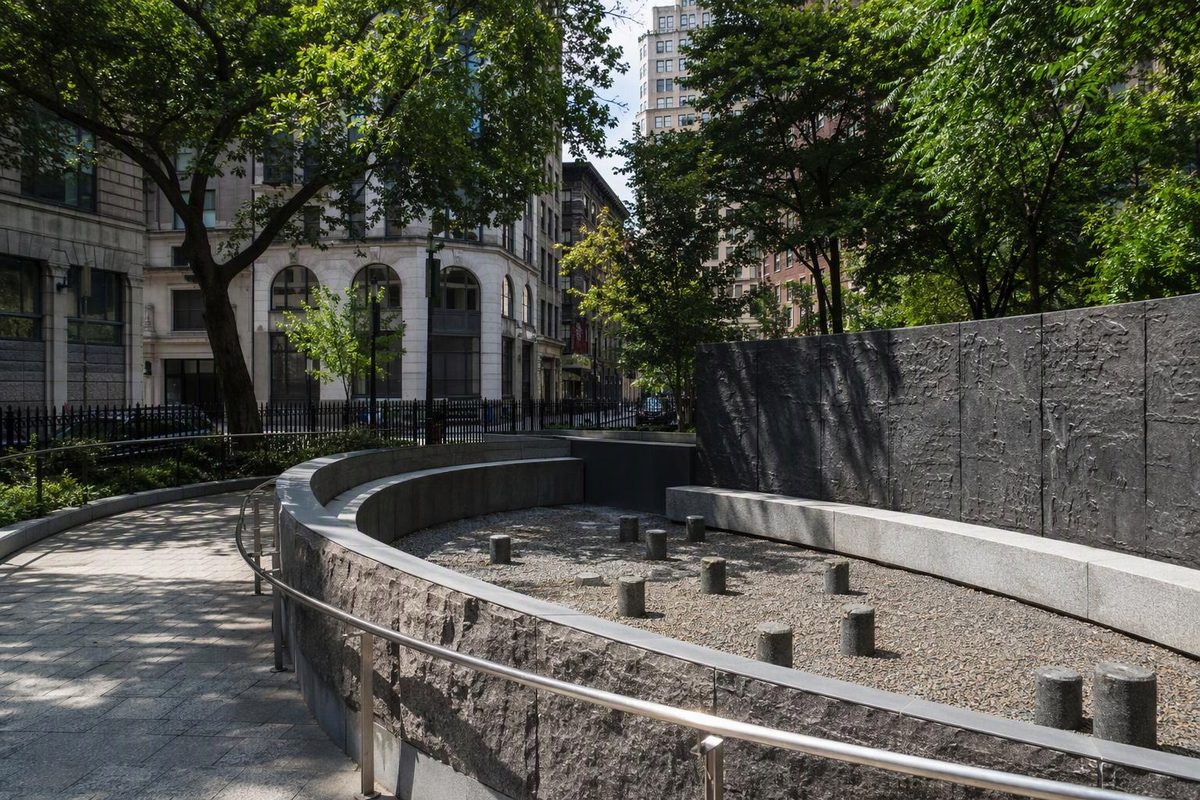
African Burial Ground National Monument is a free National Park Service site near City Hall in Lower Manhattan. Its indoor museum and outdoor memorial interpret the lives of free and enslaved Africans in colonial New York—and the community activism that shaped how the rediscovered burial ground was studied and memorialized.
This is not one building with a single entrance. The visitor center is at 290 Broadway, between Duane and Reade Streets, while the outdoor memorial is around the corner at Duane Street and African Burial Ground Way. The National Park Service warns that Google Maps may direct visitors only to the memorial, so enter 290 Broadway separately when navigating to the museum (NPS directions).
Essential visit information
| Detail | What to know |
|---|---|
| Admission | Free; no entrance pass required |
| Current hours | 10 a.m.–4 p.m. Sunday and Wednesday–Saturday |
| Closed | Monday, Tuesday, Thanksgiving, Christmas Day and New Year’s Day |
| Visitor center | 290 Broadway |
| Outdoor memorial | Duane Street at African Burial Ground Way |
| Planning time | Allow about 60–90 minutes for the museum, film and memorial |
| Restrooms | Inside the visitor center; none at the outdoor memorial |
The museum and memorial keep the same schedule. The outdoor space opens in winter when weather permits. NPS last updated these hours in July 2026; check the official operating-hours page and current alerts shortly before going.
Why the site matters
Shut out of churchyards within the colonial city, Africans used a burial ground beyond its limits beginning around the mid-1630s. The cemetery eventually covered about 6.6 acres. It closed in 1794, and the land was subdivided and sold in 1795. NPS describes the site as the oldest and largest known excavated burial place in North America for both free and enslaved Africans (NPS park overview).
The cemetery was covered by later development and largely forgotten. Construction of a federal office tower brought it back to public attention in 1991. Archaeologists excavated the remains of 419 people—nearly half of them children younger than 12—from a burial ground believed to contain at least 15,000 burials (NPS history and culture). After study at Howard University, the remains were reinterred at the site in 2003. The national monument was proclaimed in 2006 (NPS site history).
That history changes the usual Lower Manhattan story. Nearby streets are commonly interpreted through finance, government and architecture; this site makes African labor, family life, burial practices and community activism visible within the same landscape.
The best order for a first visit
1. Begin inside at 290 Broadway
Starting in the visitor center gives the outdoor memorial necessary context. Exhibits cover archaeology, colonial enslavement and the civic engagement that followed the rediscovery. There is also a 20-minute film, a bookstore, water fountains and restrooms (NPS visitor-center information).
Allow roughly 45–60 minutes indoors if you watch the film. A shorter visit is possible, but the exhibits provide important context for understanding whose burial ground this was and why its rediscovery became contested.
Because the museum occupies the Ted Weiss Federal Building, visitors pass through airport-style screening. NPS says screening may include removing shoes and presenting photo identification. Leave time for security rather than arriving just before the 4 p.m. closing.
2. Continue to the outdoor memorial
From the visitor center, walk north on Broadway to Duane Street, turn right and continue east toward African Burial Ground Way. Treat the memorial as a burial place rather than a photo stop. Food and drinks are not permitted there, and there are no outdoor restrooms (NPS basic information).
Spend 15–20 minutes moving through the space and reading its inscriptions and symbols. The memorial marks only a preserved portion of a cemetery that extended beneath the surrounding streets and buildings; NPS notes that much of the historic burial ground remains below today’s neighborhood.
Ranger-led tours require reservations, but a reservation is not needed for an independent visit. Tour availability and booking links appear on the NPS permits and reservations page.
Getting there by subway
NPS lists several stations within four blocks:
- Chambers Street: 1, 2, 3, A or C
- Brooklyn Bridge–City Hall: 4, 5 or 6
- Chambers Street: J or Z
- City Hall: R
Check live service before leaving, especially on weekends. NPS discourages driving because parking is difficult (NPS directions).
The visitor center and memorial are wheelchair accessible. The memorial’s stairs can be bypassed by a ramp, the theater accommodates wheelchair users, and a wheelchair is available on request (NPS mobility information).
Fit it into a Lower Manhattan day
The monument works best as a meaningful anchor, not a quick detour between unrelated landmarks. Keep the rest of the day nearby:
- African Burial Ground visitor center and memorial — 60–90 minutes.
- City Hall Park and St. Paul’s Chapel — continue south on Broadway.
- World Trade Center campus — walk west from St. Paul’s.
- The Battery and Bowling Green — continue south only if the group still has energy.
Alternatively, turn east after the monument for the Brooklyn Bridge approach, or head north toward Chinatown. Choose one direction rather than trying to add both. That keeps the visit part of a coherent Lower Manhattan walk and leaves enough time to absorb a site whose significance is easy to underestimate from its compact footprint.