 New York Know
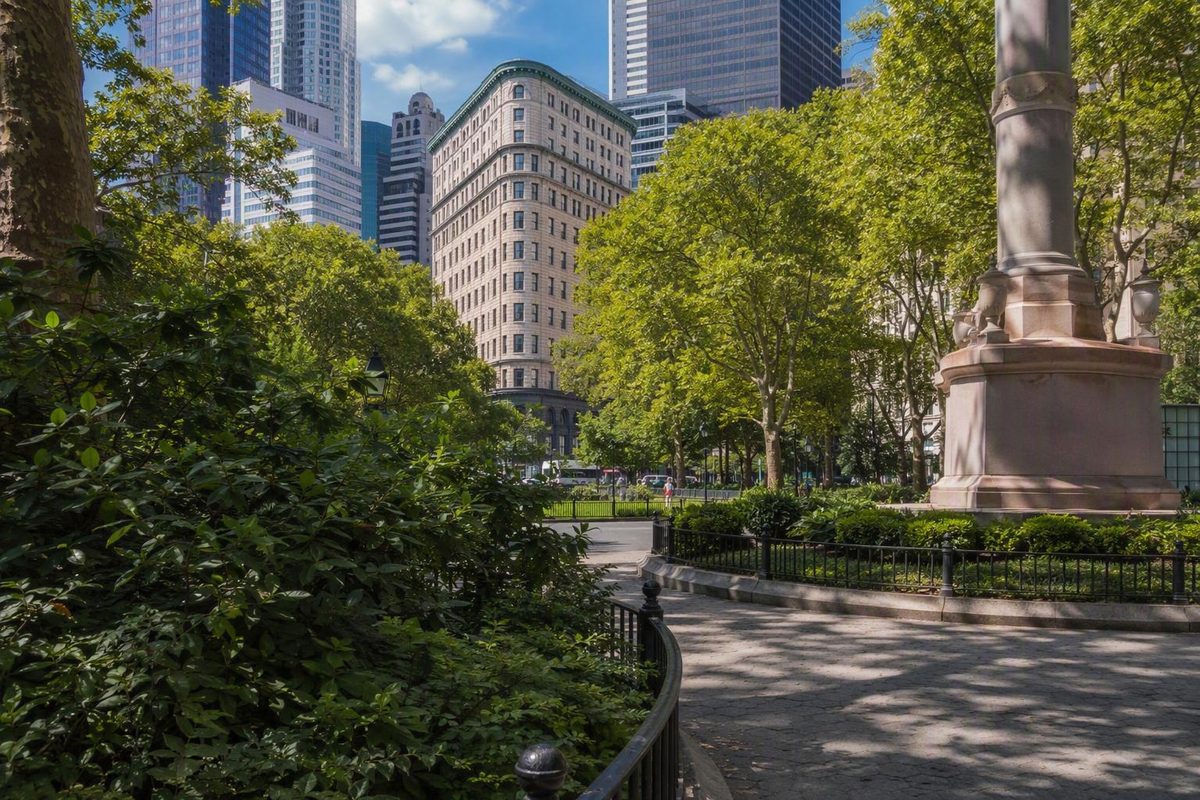
Bowling Green is easy to mistake for several different things. It is not a bowling alley, nor is it a large recreational park filled with lawns, playgrounds, and activities.
Instead, New York City’s Bowling Green is a compact historical hinge at the foot of Broadway. In barely more than an acre, it connects the Battery and the harbor approaches with the Financial District’s oldest streets. Its fence recalls the American Revolution, its fountain occupies approximately the former setting of a royal monument, and its northern end is marked by a modern symbol of financial confidence.
You can cross the park quickly. Understanding what happened here is what turns that crossing into a meaningful stop.
Related: How to Plan a Day Walking Through Lower Manhattan.
Bowling Green at a Glance: Park, Subway Station, and Charging Bull
Bowling Green park sits where Broadway reaches Whitehall Street in Lower Manhattan. When transit directions refer to “Bowling Green,” however, they may mean the subway station rather than the landscaped enclosure. Searching the name without adding “park” can also produce unrelated bowling and entertainment businesses.
For visitors, the simplest distinction is:
- Bowling Green park is the small, fenced public space at the southern end of Broadway.
- Bowling Green station is a nearby subway reference point.
- Charging Bull stands at or immediately north of the park’s northern end, not in the middle of the enclosed green.
- The Battery is the larger waterfront park southwest of Bowling Green.
NYC Parks places Bowling Green at Broadway and Whitehall Street, ZIP code 10004, and classifies the 1.02-acre property as a triangle/plaza. It identifies the Battery as the nearest park, approximately 0.14 miles away. Those figures convey the scale more accurately than the word “park” alone: this is a small urban enclosure rather than a major recreational landscape. Current property information appears on the official NYC Parks profile for Bowling Green.
Bowling Green facts
Detail Information Address Broadway and Whitehall Street, New York, NY 10004 Neighborhood Lower Manhattan, at the southern edge of the Financial District Approximate size 1.02 acres Property form Compact, teardrop-shaped triangle/plaza Northern landmark Charging Bull and Evacuation Day Plaza Southern landmark Alexander Hamilton U.S. Custom House Nearby park The Battery, southwest of Bowling Green Best role in a visit Short historical stop within a wider downtown walk
The layout is straightforward. Approach from Broadway and you will encounter Charging Bull at the northern end or adjacent plaza. Continue south into or alongside the enclosure, where a fountain, benches, trees, flowerbeds, and the perimeter fence create a formal green amid the surrounding streets and towers. Beyond the broader southern end stands the Alexander Hamilton U.S. Custom House.
Bowling Green is landscaped rather than activity-heavy. Benches provide a place to pause, while the plantings soften a setting framed by monumental government and commercial architecture.
Expect Bowling Green to work best as a 15- to 30-minute editorial stop, not as the centerpiece of an entire morning. Its value lies in the layers visible within a very short walk: colonial recreation, royal authority, Revolutionary protest, later urban redesign, and modern financial imagery.
Why Bowling Green Is Called New York City’s Oldest Public Park
Bowling Green is commonly recognized as New York City’s oldest public park, but the claim makes the most sense when tied to the municipal action taken in 1733.
The ground had already entered municipal control under the city charter of 1686, which placed vacant and unappropriated land under city authority. That made the site public property, but it did not instantly create a park in the modern sense. The open ground continued to serve practical civic, commercial, and military purposes.
The pivotal change came in March 1733, when the Common Council authorized the lower-Broadway ground to be leased and improved as a bowling green, with walks and room for recreation. An April order assigned city officials to lay out the site. The initial lease called for an annual rent of one peppercorn, and a 1734 lease placed the fenced green with Frederick Philipse II, John Chambers, and John Roosevelt under the same nominal rent. The council actions and evolving leases are described in Philipse Manor Hall’s account of the creation of the Bowling Green.
A peppercorn rent was a nominal payment rather than an ordinary market rent. It is tempting to conclude that the city chose it specifically to encourage lessees to finance improvements, but the supplied evidence does not establish that purpose as settled policy. What can be said is that the arrangement brought together municipal land, private lessees, physical improvement, enclosure, and recreation.
An 18th-century bowling green was not identical to a present-day municipal park. At Bowling Green, that recreational use existed alongside walks, fencing, and beautification. The name refers to this function, although claims about exactly who introduced the game or first applied the name are less secure.
The terminology therefore requires some care:
- “Oldest public park” is the conventional formulation.
- “Oldest officially established public park” is more precise when explicitly tied to the 1733 council action.
- “Oldest public space” is broader and potentially confusing because the ground had civic uses before it became a formal bowling green.
- “First official park” expresses a similar idea but can imply a modern parks system that did not yet exist.
The strongest conclusion is a bounded one: Bowling Green is commonly recognized as New York City’s oldest officially established public park because the Common Council formally authorized its recreational layout and improvement in 1733. That does not mean the site began its public life that year, or that it operated like a present-day city park.
From Colonial Commons to Modern Landmark: A Bowling Green Timeline
Bowling Green’s importance comes less from one surviving building than from the number of civic identities compressed into the same ground. Following those changes chronologically makes the present landscape easier to read.
Before 1733: an open civic and commercial ground
During the Dutch period, the area was known as “the Plain.” It stood near Fort Amsterdam and at the southern beginning of the route that became Broadway. Documented uses included a parade ground, meeting place, cattle market, and general civic space. The land became public property under the city charter of 1686, decades before its formal development as a recreational green, according to the National Park Service history of Bowling Green.
These uses could overlap. In a small colonial settlement, open ground near the fort might accommodate military display, trade, public assembly, and movement rather than being reserved for one purpose.
Stories about the site extend farther back. Tradition has described it as an Indigenous council ground, and another longstanding story places the alleged 1626 Manhattan transaction involving Peter Minuit here. Neither should be treated as a documented event at this exact location. They belong to Bowling Green’s accumulated lore rather than the same evidentiary category as the municipal records that followed.
1686: the ground enters municipal control
The city charter of 1686 brought vacant and unappropriated land, including this site, under municipal authority. This explains why Bowling Green can be described as public property before it became an officially laid-out recreational green.
It also shows why “oldest public property” and “oldest public park” are not interchangeable descriptions. Legal control came first; formal recreational designation followed decades later.
1733–1734: Bowling Green takes shape
In 1733, the Common Council authorized leasing and improving the ground for a bowling green, walks, and public recreation. Officials were assigned to lay out the site, and leases followed. The initial arrangement specified one peppercorn in annual rent; a 1734 lease again used that nominal rent while placing the fenced green with Frederick Philipse II, John Chambers, and John Roosevelt. The surviving council and lease history also shows that the arrangements changed in later years, rather than remaining fixed from the beginning.
Enclosure was central to the transformation. Bowling, walking, and physical improvement were all part of the concept.
1770: a king in gilded lead
A gilded lead equestrian statue of King George III was erected in 1770, approximately where the park’s fountain now stands. It transformed the green from a recreational setting into a stage for royal authority.
An iron enclosure protected and framed the park. Accounts date it to either 1771 or 1773 and disagree over whether “cast iron” or “wrought iron” is the more accurate description. It is therefore safest to refer to it simply as an 18th-century iron fence.
July 9, 1776: royal imagery comes down
After the Declaration of Independence was read to George Washington’s troops, local Sons of Liberty went to Bowling Green and pulled down the equestrian statue on July 9, 1776. Historical accounts also associate the fence’s altered post tops with the removal of crown-shaped ornaments during the Revolutionary episode. The basic chronology is well supported, although finer details about every participant and the complete fate of the statue remain uncertain. A summary of the statue, toppling, fence, and surviving fragments appears in the historical overview of Bowling Green Fence and Park.
1783: evacuation and return
British troops departed New York on November 25, 1783, remembered as Evacuation Day. A procession led by Washington ended at Bowling Green after the departure. The adjacent plaza at the northern end is consequently known as Evacuation Day Plaza, a relationship explained in this Bowling Green walking-tour introduction.
The association completes a striking Revolutionary arc. Bowling Green witnessed the destruction of royal symbolism in 1776 and then became part of the city’s public celebration when British occupation ended seven years later.
After independence: residential prestige and landscaping
Federal-style townhouses later surrounded Bowling Green, and the area became a fashionable residential address. As Lower Manhattan intensified, that domestic setting gave way to commercial and institutional development.
The green changed as well. Trees and shrubs were introduced during later beautification efforts, reinforcing its role as a landscaped urban refuge rather than an open multipurpose ground. The present combination of enclosure, paths, planting, and neighboring architecture is the result of many phases, not one preserved colonial design.
1939 and 1976–1977: rebuilding the historic landscape
The park was rebuilt in 1939 in preparation for visitors to the New York World’s Fair. A capital renovation in 1976–1977 then sought to restore an 18th-century appearance and included the central fountain. These interventions are part of the official National Park Service chronology.
The dates matter because they prevent a misleading reading of the landscape. Bowling Green is historic, but it is also a repeatedly redesigned public space. The fountain is a later visual reference to the approximate area of the royal monument, not a surviving colonial feature.
1989 onward: Charging Bull arrives
Artist Arturo Di Modica created Charging Bull in 1989 and first installed it without authorization near the New York Stock Exchange. NYC Parks identifies its popularity as the reason it gained this new setting at the park’s northern end.
Its arrival added another symbolic layer. King George III represented imperial power sanctioned from above; Charging Bull arrived as an unsanctioned gesture and evolved into a popular emblem of financial confidence. The two monuments never occupied Bowling Green at the same time, but their contrast helps explain the site’s changing public language.
The King George III Statue and the Fence: What the Evidence Supports
The most dramatic event associated with Bowling Green is also the one most vulnerable to oversimplification.
The secure core is clear: a gilded lead equestrian statue of King George III was erected in 1770, and local Sons of Liberty pulled it down on July 9, 1776, after the Declaration of Independence was read to Washington’s troops. The monument stood approximately near the present fountain. The available evidence does not establish that visitors will find its exact position marked today, so the fountain area should be treated as an approximate historical reference rather than a pinpointed archaeological location.
The fence offers more tangible continuity. An 18th-century iron fence survives around the park, and historical accounts connect its irregular post tops with the removal of crown-shaped ornaments during the Revolutionary episode. That does not establish that every rail, post, foundation element, or repair visible today is original.
Precision matters because the sources differ. They give 1771 and 1773 as installation dates and use both “cast iron” and “wrought iron” to describe the enclosure. The most responsible formulation is therefore that an 18th-century iron fence survives while the extent and technical character of its original fabric remain unresolved.
The fate of the statue’s lead requires the same care. Government and institutional accounts say it was made into musket balls for the Continental Army. The National Park Service gives a total of 42,088 musket balls, but other historical treatments characterize that exact number as disputed or folkloric. Reports of surviving fragments in museum collections also demonstrate why it would be inaccurate to say that the entire statue became ammunition. These conflicting strands are summarized in the documented history and caveats surrounding the statue.
The strongest interpretation separates the symbolic truth from uncertain arithmetic: rebels destroyed a royal monument, and at least some of its lead was reportedly repurposed for the Revolutionary cause. The exact output cannot be stated with the same confidence as the toppling itself.
Documented, disputed, and legendary
Documented
- A gilded lead equestrian statue of King George III was erected in 1770.
- It was pulled down at Bowling Green on July 9, 1776.
- The action followed the reading of the Declaration of Independence to Washington’s troops.
- An 18th-century iron fence survives at Bowling Green.
- Surviving pieces of the statue are reported in museum collections.
Supported but not fully resolved
- The statue stood approximately near the present fountain.
- Crown-shaped ornaments were removed from the fence during the Revolutionary episode.
- Some statue lead was used to make musket balls.
- Parts of the current fence retain 18th-century fabric.
Disputed or uncertain
- Whether the correct fence date is 1771 or 1773.
- Whether “cast iron” or “wrought iron” precisely describes the entire historic enclosure.
- Whether exactly 42,088 musket balls were produced.
- The identity and role of every participant in the toppling.
Traditional or legendary
- That this exact ground is conclusively documented as a precolonial Indigenous council site.
- That the 1626 transaction involving Manhattan definitively occurred here.
This hierarchy does not diminish Bowling Green’s Revolutionary significance. It makes that significance more credible. The fence is compelling precisely because it is a surviving, altered object whose history deserves more care than an “all original” caption would provide.
What to Look For at Bowling Green Today
The easiest way to understand Bowling Green is to move from north to south. That sequence takes you from a modern financial symbol through the enclosed historical landscape to the monumental Custom House.
1. Begin with Charging Bull
Charging Bull stands at the northern end of Bowling Green or in the immediately adjacent plaza. It is closely associated with the park but does not occupy the center of the fenced green.
Arturo Di Modica created the bronze sculpture in 1989 and initially placed it without city authorization near the New York Stock Exchange. The creation and relocation are summarized by NYC Parks.
The bull often attracts more attention than the park behind it. If your priority is history rather than a photograph, step back and notice the larger axis: the sculpture marks the northern end, while the older green extends south toward the Custom House.
The interpretive contrast is useful. The lost royal statue proclaimed loyalty to a monarch; the modern bull projects physical energy and confidence in markets. Both communicate power, but they emerged from very different political and civic circumstances.
2. Identify Evacuation Day Plaza
The area at the northern end is associated with Evacuation Day Plaza. Its name recalls the British departure from New York and Washington’s procession to Bowling Green in 1783.
Modern street activity can easily obscure that connection. Yet the plaza’s name links the northern end to the conclusion of the Revolution in New York, while the enclosed green recalls the public destruction of royal imagery seven years earlier.
3. Study the iron fence
Move toward the enclosure and look closely at the fence posts. Their altered tops are traditionally associated with the removal of crown-shaped finials during the Revolutionary episode.
Keep the central caveat in mind: its historic origin is well supported, but the evidence does not show that every component now in place is original.
The most useful observation is visual. An enclosure designed to define and protect a formal colonial green became part of an attack on royal symbolism. The fence survived, but in an altered state.
4. Read the landscaped green
Inside the enclosure, the teardrop-shaped layout contains trees, flowerbeds, benches, paths, and a central fountain. These features support a short pause, but they are better understood as a formal urban composition than as a program of recreational amenities.
Notice how the narrow northern end opens toward the wider southern base. The low fence and plantings contrast with the scale of the buildings around them, making the green feel like a small outdoor room within the Financial District.
This is an interpretive observation rather than a guarantee of current access or conditions. Closures, maintenance, and crowd patterns can change, so check official notices before a time-sensitive visit.
5. Use the fountain as an approximate historical reference
The fountain occupies approximately the area where the King George III statue once stood. It became part of the landscape during the 1976–1977 renovation rather than surviving from the colonial period.
From the fountain area, look north toward Charging Bull. The park’s two most famous monuments can then be understood along a shared line: the lost gilded king near the center and the bronze bull at the northern end. One represented colonial rule; the other became an image of modern finance.
The fountain should not be described as proof of the statue’s precise footprint. It is a useful point from which to interpret the approximate historical setting.
6. Read the buildings around the park
Bowling Green is as much an architectural room as a patch of greenery. Two neighboring addresses help illustrate Lower Manhattan’s transition from a residential and colonial district into a center of corporate power: the former White Star Line headquarters at 5 Broadway and the former Standard Oil headquarters at 26 Broadway are identified in Frommer’s historic Lower Manhattan walking guide.
You do not need specialist architectural knowledge to appreciate the setting. Compare the park’s low enclosure and formal plantings with the surrounding commercial buildings. The contrast shows how a small historic space persisted while the city around it changed scale and purpose.
7. Finish at the Alexander Hamilton U.S. Custom House
Directly south of Bowling Green stands the Alexander Hamilton U.S. Custom House. Its broad façade closes the view and gives the green a monumental southern boundary.
The building houses the Smithsonian’s National Museum of the American Indian. If you intend to enter, treat the museum as a separate visit and verify its current opening arrangements, entry procedures, and security requirements through the museum’s official information.
Even without going inside, the Custom House completes Bowling Green’s north-to-south sequence. Charging Bull introduces modern financial symbolism; the fence and fountain evoke colonial authority and revolution; the Custom House represents the federal and commercial institutions that later shaped the port city.
Planning a Visit Without Overpromising the Practical Details
Allow approximately 15 to 30 minutes for Bowling Green, the fence, the fountain area, and Charging Bull. That is editorial planning guidance based on the park’s compact 1.02-acre scale, not an official visit duration or a guaranteed touring time.
Fifteen minutes can work if you want to see the bull, inspect the fence, cross the green, and view the Custom House exterior. Thirty minutes allows more room to read any on-site interpretation, wait for a clearer view, sit briefly, or study the neighboring buildings.
Allow substantially more time if you intend to enter the National Museum of the American Indian, continue through the Battery, or use Bowling Green as the beginning of a longer historical walk.
NYC Parks lists eateries and Wi-Fi hot spots for the property, but availability can change. Consult the current official park page rather than building a meal or connectivity-dependent plan around a static listing. The supplied evidence does not support promises about restrooms, vendor schedules, park hours, or step-free paths.
Bowling Green and Whitehall Street–South Ferry are useful nearby transit references. For the day of travel, consult current MTA information for service changes, station entrances, elevator status, and accessible routing. Do not assume that a particular entrance is open or step-free based on a general visitor guide.
The surrounding area mixes commuters, sightseers, museum visitors, harbor passengers, and street-ticket sales. If the sculpture is crowded, see the park first and return to the northern end rather than waiting in one place.
A June 2026 harbor-ticket caution
Reporting published on June 12, 2026 found that some cruises sold on the street near Bowling Green and the Battery circled Liberty and Ellis islands without landing. Some offers also involved transportation to a different departure point. The report described inconsistent sales pitches and visitor confusion, but it does not justify treating every street seller as fraudulent or unlicensed. The specific observations appear in this local report on harbor-ticket sales.
If an island visit matters to you, ask whether the ticket explicitly includes landing on Liberty Island, Ellis Island, or both. “Statue of Liberty cruise,” “harbor tour,” and “island ferry” do not necessarily describe the same experience.
Immediately before purchasing, verify the current official operator, authorized sales channel, departure point, itinerary, and landing privileges through official National Park Service or ferry information. Prices, operators, licensing status, and routes can change.
Before you go
Because operational details change faster than the park’s history, check:
- NYC Parks: current notices, closures, maintenance, and listed amenities.
- MTA: train service, station entrances, elevator status, and accessible routing.
- Museum information: opening days, entry procedures, security requirements, and temporary closures.
- Liberty and Ellis Island transportation: the current official operator, authorized ticket channel, departure location, and whether island landings are included.
- Weather and street conditions: anything that could affect an outdoor route or crowd levels.
This visitor guidance is desk-researched rather than a guarantee of same-day conditions. Plan the fixed historical sequence, then verify the changeable logistics around it.
Three Walking-First Ways to Include Bowling Green
Bowling Green works best as a geographic hinge rather than an isolated attraction. It connects the Battery and harbor edge with Broadway, Wall Street, the oldest Financial District streets, and several transit points.
The following durations are planning estimates, not official or guaranteed walking times. Crowds, crossings, photography, building entry, and individual pace can all extend them.
A 30-minute Bowling Green essentials stop
Choose this version when you have a tight downtown schedule or want to add historical context to a Charging Bull visit.
- Start at Charging Bull and note its position at the northern end rather than in the center of the green.
- Identify Evacuation Day Plaza.
- Look for the altered tops on the 18th-century iron fence.
- Walk through or alongside the enclosure and use the fountain area to imagine the approximate setting of the King George III statue.
- Pause among the trees, flowerbeds, and benches.
- Finish with the exterior of the Alexander Hamilton U.S. Custom House.
- Look toward 5 Broadway and 26 Broadway to place the park within its corporate architectural setting.
The route is short in distance but rich in contrast. It moves from a modern market symbol to Revolutionary physical evidence and then to a monumental federal building.
A 60-minute Bowling Green and Battery option
After completing the north-to-south sequence, continue southwest toward the Battery. NYC Parks lists it at approximately 0.14 miles from Bowling Green, although crossings, crowds, and observation will make the experience longer than the raw distance suggests.
This extension works because the geography remains coherent. Bowling Green developed near the colonial fort and the southern beginning of Broadway; the Battery opens that story toward the harbor. The change from enclosed formal green to broad waterfront space also gives the route a clear visual progression.
Use the hour selectively. See Bowling Green first, then choose one Battery focus rather than attempting every monument, harbor view, ferry facility, and nearby attraction. If you have a scheduled boat, organize the walk around its current check-in requirements instead of the editorial estimate.
For this particular route, beginning near the harbor and moving generally north afterward reduces backtracking. It also allows the geography to unfold from waterfront defense and trade into the commercial street network.
A 90-minute Revolutionary and early New York option
For a history-centered walk, begin at Bowling Green and move north through the older downtown streets toward Wall Street and Trinity Church.
At Bowling Green, concentrate on four elements: Evacuation Day Plaza, the fence, the former royal-statue setting, and the Custom House exterior. Then continue north into the Financial District, allowing the street pattern and changing building scale to become part of the story.
Wall Street extends the narrative from colonial geography into national government and finance.
A northward or eastward progression is more coherent for this proposed itinerary than repeatedly crossing between the Battery, Wall Street, the waterfront, and memorial areas. New York Know’s walking-first Lower Manhattan itinerary similarly groups Bowling Green with the Battery, the older southern streets, Wall Street, and Trinity Church.
If time is limited, choose only one extension:
- The Battery for waterfront space and harbor context.
- Wall Street and Trinity Church for a concentrated historical and architectural sequence.
- An eastward waterfront continuation for a broader downtown walk and a change in atmosphere.
Trying to include all three can turn a compact route into a checklist. Make Bowling Green a priority if you care about colonial or Revolutionary history, historic urban design, architecture, or an efficient Lower Manhattan route. Treat it as optional if you want a large green space, extensive recreation, or a long standalone attraction.
Frequently Asked Questions
Where is Bowling Green in New York City?
Bowling Green is at Broadway and Whitehall Street, New York, NY 10004, at the southern end of Broadway in Lower Manhattan. Charging Bull is at or immediately north of its northern end, the Alexander Hamilton U.S. Custom House stands directly south, and the Battery lies southwest.
When searching for directions, specify “Bowling Green park” if you need the historical landscaped site rather than the nearby subway station.
Is Bowling Green really New York City’s oldest park?
It is commonly recognized as New York City’s oldest public park, with the claim anchored to the Common Council’s 1733 authorization to lease and improve the ground as a bowling green with walks and public recreation.
The land was already under municipal control by 1686 and had civic and commercial uses before it became a formal bowling green. “Oldest officially established public park” is therefore more precise than suggesting that a modern municipal park appeared fully formed in 1733.
Is Charging Bull inside Bowling Green park?
Charging Bull stands at the park’s northern end or on the immediately adjacent plaza, not in the center of the enclosed green. The sculpture is strongly associated with Bowling Green and often dominates visitor attention, but the fenced landscape continues south behind it.
What happened to the King George III statue at Bowling Green?
A gilded lead equestrian statue of King George III was erected at Bowling Green in 1770. Local Sons of Liberty pulled it down on July 9, 1776, after the Declaration of Independence was read to Washington’s troops.
Accounts say some of the lead was made into musket balls, but the often-repeated total of exactly 42,088 is disputed. Surviving fragments are also reported in museum collections, so the entire monument did not become ammunition. The statue stood approximately near the present fountain.
How much time should I allow for Bowling Green?
Allow about 15 to 30 minutes for Charging Bull, the fence, fountain area, landscaping, and Custom House exterior. That is a planning estimate based on the park’s compact scale, not an official visit time.
Allow longer if you intend to enter the nearby museum, examine the surrounding architecture, continue to the Battery, or walk north toward Wall Street and Trinity Church.
A Small Park That Makes Lower Manhattan Coherent
Bowling Green occupies barely more than an acre, yet it concentrates several centuries of Lower Manhattan history: colonial commerce and recreation, royal display, Revolutionary protest, urban redesign, and modern financial symbolism.
See Charging Bull, the altered fence, the fountain area, and the Custom House as one connected sequence. Then continue either southwest to the Battery or north into the Financial District’s historic streets.
Bowling Green is too small to fill a day. Its real strength is that it can make a downtown day feel like one continuous story rather than a collection of unrelated stops.