 New York Know
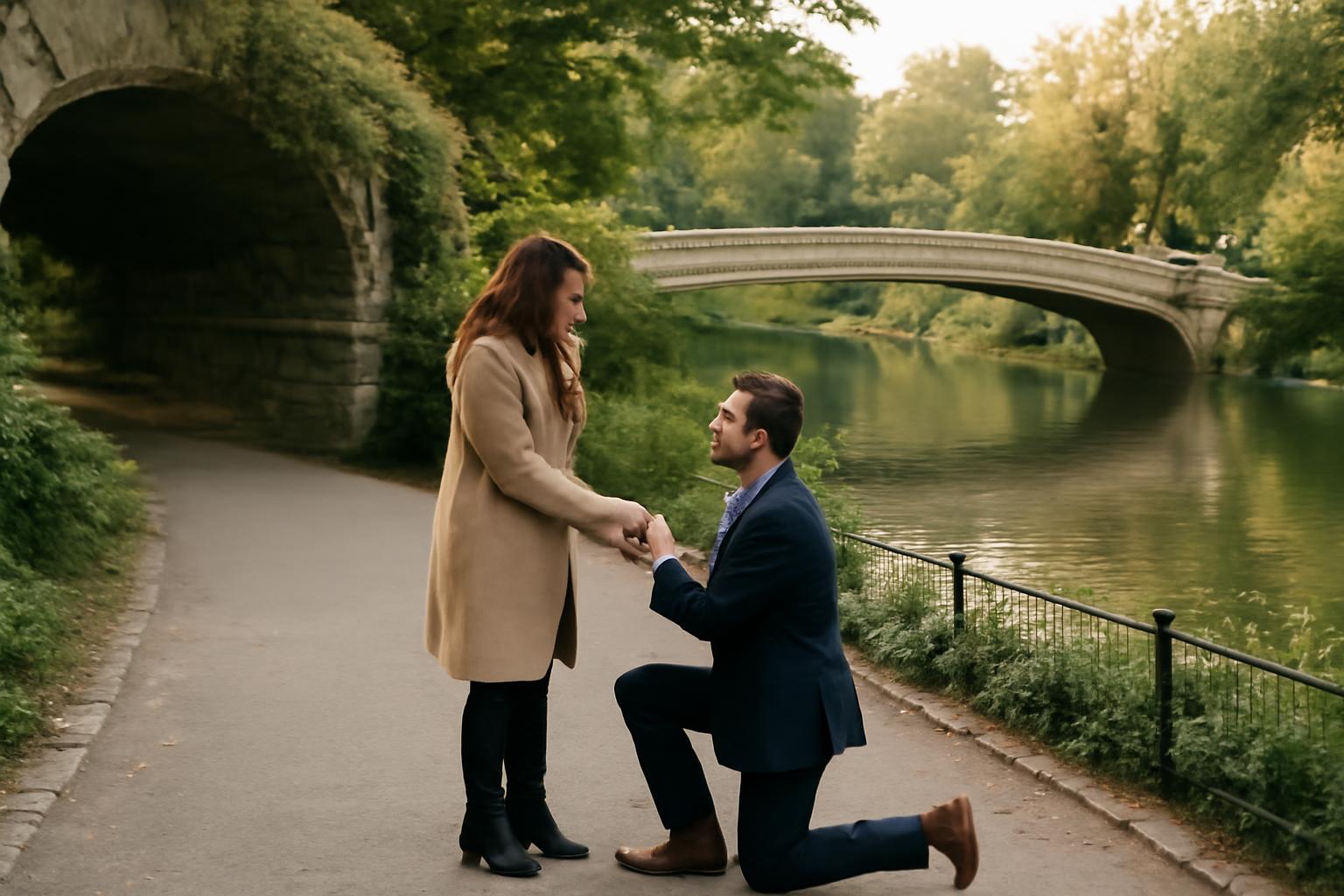
A Central Park proposal can unfold on a recognizable bridge, beneath stone arches, beside the Lake, inside a formal garden, or under a wooden shelter. That variety is useful, but it also means the right choice depends on more than which landmark looks best online.
Start with the experience your partner would enjoy. Then match that feeling to the scenery, likely foot traffic, walking required, weather exposure, and photography plan. The strongest plan is rarely built around one exact mark. It uses a preferred setting, a nearby fallback, and a genuine alternative for conditions that a gazebo or arcade cannot solve.
This guide is primarily an inspiration and contingency-planning resource. The available evidence comes mainly from commercial photographers, proposal planners, and destination services—not current official park-rule pages. Confirm access, permits, restrictions, maps, and location-specific requirements through NYC Parks or the Central Park Conservancy before relying on them.
Start with the person, not the landmark
Before choosing Bow Bridge or Bethesda Terrace, ask a more important question: Would your partner enjoy being proposed to in front of other people?
A public proposal can attract glances, spectators, applause, or someone recording the moment. That may feel joyful to one person and uncomfortable to another. Consider how your partner usually responds to public attention, surprises, staged photographs, and emotionally significant moments in front of strangers. Commercial proposal planners also emphasize this partner-first question, particularly when anxiety or a dislike of public attention may shape the experience (public-proposal planning guidance from Proposal 007).
It helps to think in terms of three proposal styles:
- Public and iconic. You choose an unmistakable landmark such as Bow Bridge, Bethesda Fountain, or Gapstow Bridge and accept that visitors may pass through the scene.
- Semi-private and low-production. You select a quieter-feeling garden, lakeside shelter, wooded path, or gazebo, carry little more than the ring and perhaps a note or bouquet, and remain flexible about your exact position.
- Event-style. You add guests, musicians, chairs, large floral pieces, signs, transport, video, or several vendors. The moment becomes more controlled in concept but substantially harder to coordinate in a public park.
The core tradeoff is straightforward: Central Park’s most recognizable settings are commonly described as some of its busiest. Commercial guides repeatedly characterize Bow Bridge and Bethesda Terrace as iconic but heavily visited, while presenting Wagner Cove, the Dene, Cop Cot, and similar locations as relatively quieter alternatives—not private venues (experience-based comparison of proposal locations).
Evaluate each possible setting against five questions:
- What scenery would mean most: bridge, architecture, skyline, garden, woods, or water?
- How comfortable is your partner with attention from strangers?
- How far, and over what kind of route, will both of you comfortably walk?
- How exposed is the setting to uncomfortable weather?
- Is the location being chosen for the experience itself or primarily for photographs?
Adding guests, musicians, decorations, chairs, or multiple vendors creates more points of failure. People may arrive late, struggle to find the location, expose the surprise, block the photographer, or introduce questions about permissions and setup.
Use this order:
Choose the desired feeling first. Identify two compatible locations second. Only then choose the time and level of professional help.
That sequence prevents a photogenic landmark from dictating an experience your partner may not actually enjoy.
Central Park proposal spots at a glance
The crowd descriptions below are experience-based guidance from commercial photographers and planners, not measured forecasts. Conditions can change with the time, weather, season, events, maintenance, and chance. The fallbacks are editorial suggestions rather than designated proposal sites.
| Location | Primary backdrop | Likely crowd character | Overhead cover | Broad park area | Sensible nearby-style fallback |
|---|---|---|---|---|---|
| Bow Bridge | Cast-iron bridge, the Lake, trees, and surrounding buildings | Frequently recommended and often busy | No | Central Lake area between Cherry Hill and the Ramble | A shore-based Lake viewpoint with the bridge behind you |
| Bethesda Terrace and Fountain | Fountain, Lake views, stone stairs, arches, and tiled arcade | High-energy and commonly busy at peak periods | In the arcade, not the open fountain plaza | Mid-park near the Lake | Move between the fountain area and an arcade frame |
| Gapstow Bridge | The Pond, stone bridge, Plaza Hotel, and Midtown skyline | Popular southeastern sightseeing area; traffic varies | No | Southeastern park near the Pond | Stand beside the bridge and retain it in the background |
| Wagner Cove | Small wooden shelter beside the Lake | Often described as quieter than major landmarks, but it can still be occupied | Some cover beneath the shelter | West side of the Lake area | Another lakeside viewpoint or landing |
| Ladies Pavilion | Covered structure, Lake, and west-side scenery | Relatively quieter feeling, without guaranteed seclusion | Yes, within the pavilion | West side beside the Lake | An open Lake viewpoint nearby |
| Cop Cot | Rustic wooden gazebo and surrounding greenery | Usually presented as a quieter alternative | Some cover beneath the gazebo | Near Central Park South | Another southern park path or wooded frame |
| Shakespeare Garden | Plantings, paths, and garden detail | Generally lower-key than the major bridges; seasonal activity varies | No | West side near Belvedere Castle | Another garden path or Belvedere-area view |
| Conservatory Garden | Formal lawns, flower-lined paths, and structured garden scenery | Can feel calmer than southern landmarks; access and activity vary | No dependable overhead cover | Northeast side | Another accessible section of the garden or a separate northeast-side plan |
| The Dene | Greenery, rustic summerhouse, and east-side landscape | Often described as away from the main paths | Some shelter at the summerhouse | East side | A nearby east-side landscape or path |
| The Pool | Water, waterfall, trees, and weeping willows | Typically presented as a quieter northwest option | No | Northwest area | Another waterside position around the Pool |
Bow Bridge is described as a 60-foot cast-iron bridge over the Lake. Gapstow Bridge offers a southeastern combination of Pond, Plaza Hotel, and Midtown scenery. Conservatory Garden is described as a six-acre formal garden with Italian, French, and English sections (Central Park location details from Local Lens).
Bethesda Terrace needs one important distinction: the fountain plaza is open to the sky, while the arcade provides overhead cover and a tiled architectural interior. Wagner Cove, Ladies Pavilion, Cop Cot, and the Dene offer shelter only within their structures. These are public structures, not complete weatherproof venues.
The Pool is the geographic outlier in this comparison. It may suit couples who value water, a waterfall, and willow scenery more than proximity to the best-known southern landmarks. A commercial destination guide places it in the park’s northwest area and associates it with a waterfall and weeping willows (Central Park proposal-location overview).
Do not choose from the table alone if mobility, terrain, or a short walking route is important. The supplied evidence does not verify step-free approaches, restroom locations, seating, drop-off points, or accessibility ratings. Review a current official map and inspect the actual approach before the day.
For an iconic New York backdrop: Bow Bridge, Bethesda Terrace, and Gapstow Bridge
These locations work well when recognizable New York scenery is part of the point. They also require the greatest acceptance of changing crowds.
Bow Bridge
Bow Bridge is a natural choice for couples who want the Lake and one of the park’s most recognizable structures in the same frame. It is also a place where passersby may stop, cross behind you, or gather nearby.
There are two distinct ways to use it:
- Propose on the bridge. The structure becomes part of the immediate experience, but usable space is limited and people may continue crossing.
- Propose from the shore with the bridge behind you. You keep the recognizable backdrop while gaining more flexibility in positioning and photography.
Photographer Kelly Williams recommends a wood-chip shore vantage point facing Bow Bridge as a practical option for discreet, close-range photography. This is that photographer’s preferred landing and viewpoint, not an officially designated proposal site (firsthand Bow Bridge and Lake planning advice).
Mini-plan
- Arrival approach: Treat the walk as an ordinary park visit and avoid repeatedly checking your phone as you near the Lake.
- Proposal position: Choose either an open part of the bridge or a shore position that keeps the bridge visible behind your partner.
- Nearby alternative: If the bridge is congested, move to a Lake viewpoint instead of waiting indefinitely for a perfect opening.
- Portrait direction: Take a few immediate bridge-and-water portraits, then move toward contrasting wooded scenery if both of you want a longer session.
A shore proposal is not inherently less romantic than proposing on the bridge. As a planning choice, it can provide more room and reduce pressure to occupy a narrow public passage.
Bethesda Terrace and Fountain
Bethesda combines several environments in one area: the open fountain plaza, stone architecture, broad stairs, the tiled arcade, and views toward the Lake. It suits couples who want grandeur and an active park atmosphere rather than the impression of seclusion.
Commercial guides consistently describe Bethesda as especially busy during peak periods and weekends. A morning plan may improve the chance of lighter traffic, but it cannot produce a guaranteed empty scene. The arcade adds overhead cover and a second portrait environment, although it remains a public passage rather than a private venue (commercial photographer’s guide to Bethesda’s architecture and crowds).
Mini-plan
- Arrival approach: Enter the area as part of a casual walk, then assess both the fountain and arcade before committing.
- Proposal position: Use the fountain when an open, energetic background is welcome; use an architectural frame when the arches matter more.
- Nearby alternative: Shift between the fountain level and arcade if one is congested or visually cluttered.
- Portrait direction: Capture the arches, then move toward the fountain, Lake, or a tree-lined path for variety.
The arcade can help with manageable rain, but it may also attract other visitors seeking cover. Treat it as a nearby covered option, not as a substitute for a separate plan when outdoor conditions no longer suit the experience you want.
Gapstow Bridge
Gapstow Bridge is a strong choice when the desired image is distinctly urban: stone bridge, the Pond, the Plaza Hotel, and Midtown buildings. Its southeastern position may also fit a proposal built into a broader day near Central Park South or Fifth Avenue.
Proposing directly on the bridge is not the only option. Photographer Vlad Leto recommends standing near it when more room is needed, preserving the bridge as part of the background rather than making its walkway the stage (commercial photographer’s Gapstow Bridge advice).
Mini-plan
- Arrival approach: Walk toward the Pond without announcing that the bridge itself is the destination.
- Proposal position: Choose a position beside the bridge that balances water, stonework, and skyline, or use the bridge when conditions allow.
- Nearby alternative: Change sides or move away from the crossing while keeping the bridge visually present.
- Portrait direction: Begin with the Pond and skyline, then use nearby southern park scenery for a greener second look.
Gapstow is not a substitute for Bow Bridge; it creates a different New York image. Bow Bridge emphasizes the Lake and park landscape, while Gapstow allows surrounding city architecture to play a larger role.
For a quieter-feeling setting: Wagner Cove, Ladies Pavilion, Cop Cot, the Dene, and the gardens
“Quieter” in Central Park means less exposed or less heavily trafficked under some conditions, not private. Other visitors can arrive at any time, and a shelter may already be occupied by a couple, photographer, performance, or group.
Wagner Cove
Wagner Cove is a small wooden shelter beside the Lake, set away from some major circulation points. It can suit a couple who wants water and trees without making a famous bridge or fountain the center of the experience.
Its small scale can feel intimate when it is open, but it also limits flexibility if somebody else is using it. Treat checking the structure before the approach—and switching calmly to another lakeside position—as part of the plan rather than an emergency.
Ladies Pavilion and Cop Cot
Ladies Pavilion provides a covered structure beside the Lake. It works for couples drawn to decorative architecture and waterfront scenery but who do not need Bow Bridge itself.
Cop Cot is a natural wooden gazebo on a hill near Central Park South. It creates a more rustic visual style than Bethesda’s stonework and can fit a proposal that begins with a southern park walk. A commercial Central Park directory describes both structures and their broad locations, but it does not establish current reservation rights or exclusivity (commercial directory of Central Park proposal settings).
Some commercial pages claim that particular structures can be reserved. The supplied evidence does not verify those claims through a current official rule source. Treat every structure as public unless the responsible park authority confirms otherwise for the exact date and activity.
The Dene
The Dene Summerhouse is an east-side alternative north of the entrance near Fifth Avenue and the mid-60s. Commercial guides describe it as removed from the main paths, making it appealing to couples who want a rustic shelter without traveling to the northwest part of the park.
“Removed from the main paths” does not mean invisible or vacant. The proposer or photographer should inspect conditions close to the arrival time, particularly if a photographer must identify the couple from a distance.
Shakespeare Garden
Shakespeare Garden offers plantings, winding paths, and a more enclosed garden atmosphere on the west side near Belvedere Castle. It is a better conceptual fit for someone who prefers flowers and greenery to skyline views.
Its appearance changes through the year. Do not build the proposal around a promised bloom, exact foliage date, or snow-covered scene. Choose it because garden paths and planting detail suit the couple even when seasonal conditions are less dramatic than reference photographs suggest.
Conservatory Garden
Conservatory Garden is a six-acre formal garden on the northeast side, divided into Italian, French, and English sections. Its lawns, paths, and structured planting can provide several portrait environments without making a bridge or skyline the central feature.
Commercial sources offer unverified claims about photography permits, fees, reservations, and application timing there. Those statements should not be treated as current rules. Confirm access, professional photography, scheduling, and setup requirements through a current official channel before committing to the garden.
The Ramble
The Ramble can create a wooded, privacy-oriented feeling, but it demands more careful navigation. It is a poor fit for a plan that depends on an unfamiliar visitor finding one exact bend in a path at one exact minute.
If you choose it, scout the approach, use an easy-to-identify meeting area, and keep the fallback simple. For couples with limited walking tolerance, consider the complete journey: entrance to proposal point, proposal point to fallback, and any portrait route afterward.
Choose the day and time without promising privacy or perfect light
Across the supplied photographer and planner guides, the broad recommendation is to favor weekday mornings—particularly sunrise or earlier morning periods—for a better chance of lighter crowds at popular locations. Local Lens specifically recommends weekday mornings before 10 a.m. for Bethesda and other morning windows for several well-known locations (Local Lens timing recommendations).
Another commercial photography guide prefers Monday through Thursday and recommends sunrise for heavily visited settings including Bow Bridge, Bethesda Fountain, Bethesda Terrace, Gapstow Bridge, and Cherry Hill. These are professional recommendations, not crowd guarantees (Meghan Lynch Photography’s timing guidance).
Sunrise and later light involve different compromises:
| Time | Potential advantage | Main compromise |
|---|---|---|
| Sunrise or early morning | Better chance of lighter traffic and more time to absorb delays | Early wake-up, potentially cooler conditions, and vendor coordination outside normal routines |
| Midmorning or afternoon | Easier schedule and potentially more comfortable temperatures | More visitors at major landmarks |
| Golden hour or early evening | Warm or directional light may be possible | Popular areas can remain busy, and delays consume the preferred light |
| After sunset | A different atmosphere | Navigation and photography become more complicated where lighting is limited |
A sunrise plan is a possible fit when reducing crowd pressure matters more than convenience. An early-evening plan may better suit a couple who would resent getting dressed and traveling before dawn. The right time balances traffic, light, sleep, weather, and a believable reason for being in the park.
Neither a weekday nor sunrise guarantees privacy. Runners, maintenance, tours, public events, performances, school holidays, seasonal tourism, and other proposals can all affect the scene.
Do not choose a date solely because you expect blossoms, peak foliage, snowfall, or a particular quality of golden-hour light. Those are possibilities, not fixed appointments. The proposal should still make sense if the trees, flowers, or sky look different from the reference photographs.
Commercial photography guidance also notes that parts of Central Park have limited lighting after sunset. If considering a later proposal, verify current access independently and simplify the route rather than relying on old claims about exact operating hours.
Shortly before the proposal:
- Check the latest forecast.
- Confirm sunrise, sunset, and usable daylight for the date.
- Review current park access and maintenance notices.
- Look for scheduled events or performances near the chosen area.
- Reconfirm vendor arrival windows and fallback instructions.
- Decide whether the conditions change clothing, footwear, or the route.
Timing improves probabilities. It does not create control over a public park.
Build a primary plan, a nearby fallback, and a real weather option
Choose one preferred setting and one nearby alternative with a similar visual character. The fallback prevents an occupied shelter, crowded bridge, maintenance barrier, or competing event from turning into a crisis.
Useful pairings include:
- Bow Bridge → nearby shore viewpoint. Keep the bridge and Lake in the composition without relying on a clear bridge walkway.
- Bethesda Fountain → Bethesda Arcade. Shift from an open fountain setting to an architectural frame with overhead cover.
- Gapstow Bridge → a position beside the bridge. Preserve the Pond, stonework, and skyline while creating more room.
- Wagner Cove → another lakeside option. Keep the waterfront character if the shelter is occupied.
The alternative must solve the actual problem. Moving a short distance may solve a crowded proposal position or blocked camera angle. It does not solve weather affecting the entire area, a broad closure, or conditions that make the outdoor experience undesirable.
Bethesda Terrace Arcade, Wagner Cove, Ladies Pavilion, and Cop Cot offer some overhead cover. That cover may still leave the couple exposed to wind, cold, or rain entering from the sides. A genuine weather plan may mean choosing an indoor setting, delaying the proposal, or rescheduling rather than forcing an outdoor plan.
Set three things in advance:
- A decision deadline: the latest point at which you will switch locations or abandon the outdoor plan.
- A communication method: one text message, shared live location, or agreed code that does not require a conspicuous call.
- A visual priority: the feature that matters most—water, bridge, architecture, garden, or skyline—so the fallback preserves the intended feeling.
Allow more travel time than the fastest map estimate suggests. Transit delays, traffic, unfamiliar paths, crowds, and wrong turns can consume a carefully planned photography window.
Special caution for a rowboat proposal
A proposal on the Lake can be personal, especially if boating is part of the couple’s history, but it introduces several additional variables:
- Rowing may be harder or slower than expected.
- Other boats can interfere with positioning.
- Weather is more consequential on the water.
- A photographer on shore may not obtain the intended angle.
- Handling a ring over water creates a loss risk.
- Boat operations and availability may change.
Kelly Williams’s account of photographing Lake proposals specifically notes rowing difficulty, water traffic, weather concerns, and the importance of advance coordination. Confirm current operations, plan how the ring will be carried securely, and establish a shore-based fallback rather than depending entirely on a boat (firsthand rowboat-proposal logistics).
The guiding principle is simple: protect the surprise and your partner’s comfort, not one exact landmark. If the preferred position is unavailable, changing course calmly is more successful than forcing the plan.
Plan the surprise, photography, and optional extras
A hidden photographer needs enough detail to identify the couple and anticipate the moment, but excessive choreography can make the walk feel unnatural.
Use this coordination workflow:
- Agree on the general proposal area and intended position.
- Set an arrival window rather than pretending timing will be exact.
- Share current clothing descriptions for both partners.
- Confirm where the photographer plans to wait and what background they intend to frame.
- Choose one unmistakable proposal signal.
- Decide what happens immediately after the answer.
- Establish the fallback and the signal for switching to it.
As a practical planning suggestion, ask the photographer to arrive before the couple so they can inspect crowds and obstructions. If the couple is delayed, use the prearranged communication method for one brief update. This is not a universal professional standard; individual photographers may use different workflows.
A commercial carriage-proposal service describes one example in which the photographer waits at the selected location, captures the approach and proposal, introduces themselves afterward, and then continues with portraits (example of a hidden-photographer workflow).
Local Lens recommends allowing approximately 5–10 minutes immediately after the proposal for photographs, with a longer portrait session optional. That short first set can preserve the immediate emotion before calls, messages, or the next reservation take over.
Personalization does not have to mean scale. Low-production additions include:
- A handwritten note
- A bouquet
- A small picnic, subject to current rules
- A relationship-specific book, song, or shared activity
- A planned post-proposal meal
- A short portrait session
More elaborate options include a musician, video, carriage ride, boat ride, floral installation, decorative arch, or guests waiting nearby. Each additional element creates another schedule, arrival point, weather policy, and opportunity for the surprise to be exposed.
Event-style elements—such as structures, amplified sound, alcohol, seating, confetti, candles, drones, or a large group—should not be treated like a simple two-person proposal. Their permissions and operational requirements need to be checked individually.
Three levels of help are useful:
Self-planned and low-production
You choose the location, timing, fallback, and route. You carry only what you can manage discreetly and avoid a setup that needs supervision. This provides the greatest flexibility when crowds or weather change.
Photographer-assisted
A photographer helps refine the position, arrival window, visual angle, signal, and portrait plan. This may be valuable when the proposer is unfamiliar with the park or wants the moment documented without asking a friend to hide nearby.
Fully coordinated
A planner or vendor team manages decorations, entertainment, flowers, transport, guests, or several services. This may reduce the proposer’s workload but adds dependencies, setup time, regulatory questions, and cancellation terms.
Do not infer a market-wide budget from individual vendor advertisements. Before booking, request a written description of deliverables, total fees, deposits, cancellation and weather policies, arrival expectations, image turnaround, and what happens if the intended location becomes unavailable.
Verify rules and run the day-of checklist
The supplied sources are predominantly commercial. They can offer useful experience-based logistics, but they do not establish current, authoritative Central Park rules.
There is no responsible universal answer to whether “a Central Park proposal needs a permit.” A private conversation between two people, a professional photo session, a reserved area, a musician, a large guest group, and a decorated installation are different activities. Requirements may depend on the exact location, date, group size, professional involvement, equipment, and setup.
Confirm the plan through current NYC Parks or Central Park Conservancy channels. If published guidance does not clearly address the activity, contact the responsible authority and describe every component rather than asking only whether “a proposal” needs permission.
Ask specifically about:
- Personal or professional photography
- Reserved space or structures
- Bouquets and loose flowers
- Signs and lettering
- Musicians
- Amplified sound
- Chairs or other seating
- Alcohol
- Candles or open flames
- Confetti or material scattered on the ground
- Drones
- Picnics and catered setups
- Arches and other decorative structures
- Large guest groups
- Vendor access and setup
- Location-specific garden or shelter rules
A simple proposal is operationally different from an organized event, but the supplied evidence does not establish where an official or legal threshold falls. Commercial claims that personal photography needs no permit, that shelters can be reserved, or that Conservatory Garden follows one particular application process remain unverified without current official confirmation.
The same limitation applies to practical access information. The evidence does not provide reliable step-free routes, current restroom information, seating availability, accessible drop-off points, or exact walking times. Inspect the latest official map and proposed route if these considerations could determine whether the setting works.
48 hours before
- Review the forecast and current conditions.
- Check access, maintenance, closure, and event notices.
- Reconfirm the photographer and every other vendor.
- Confirm the primary location and nearby fallback.
- Decide whether the non-park or rescheduling option remains workable.
- Charge phones and portable batteries.
- Share updated clothing descriptions.
- Reconfirm the proposal signal and contingency signal.
- Check the ring box and carrying method.
- Review the approach without relying on a fragile minute-by-minute schedule.
Before leaving
- Add a travel buffer.
- Carry the ring in a secure, closed place.
- Bring only props that can be transported and managed discreetly.
- Dress for the actual conditions rather than the hoped-for photographs.
- Send only the prearranged vendor updates.
- Avoid unusual messages or calls that might expose the surprise.
On arrival
If another proposal, performance, wedding, maintenance area, photo shoot, or large group occupies the site, use the fallback. Do not confront visitors, ask strangers to clear a public space, or behave as though a scenic setting is automatically exclusive.
After the proposal, pause before moving into the next activity. Let the moment happen. Photographs, calls, dinner reservations, and announcements can wait a few minutes.
Rules, fees, access, vendor operations, and physical conditions can change. Check them close to the date rather than assuming that an older commercial guide or a previous visitor’s experience still applies.
Frequently asked questions
What is the most private place to propose in Central Park?
No public Central Park location can be promised as private. Wagner Cove, Ladies Pavilion, Cop Cot, the Dene, the Ramble, Conservatory Garden, and the Pool may feel quieter than Bow Bridge or Bethesda Terrace under some conditions, but any of them can be occupied.
For a lower-attention proposal, choose a setting away from the most recognizable landmarks, schedule an early weekday period if practical, keep the setup minimal, and identify a second nearby position. If true privacy is essential, a public park may not be the right venue.
What is the best time to propose at Bow Bridge or Bethesda Terrace?
A weekday morning generally offers a better chance of lighter crowds. Sunrise is frequently recommended by commercial photographers for both locations, while some guides suggest morning periods before 10 a.m. for popular settings.
That timing does not guarantee an empty bridge, fountain, or arcade. Golden hour or early evening may offer attractive light, but the locations can remain busy and delays leave less room to adjust. Choose the time based on your partner’s comfort, the forecast, available daylight, and how believable the outing will feel.
Where can I propose in Central Park if it rains?
Bethesda Terrace Arcade, Wagner Cove, Ladies Pavilion, and Cop Cot offer some overhead cover. The Bethesda arcade is particularly relevant when its architecture already suits the plan.
None should be treated as a complete weather solution. Wind, cold, rain entering from the sides, or crowding beneath the shelter may still make the experience unsuitable. Maintain a genuine indoor alternative or a rescheduling plan rather than depending entirely on a covered park structure.
Do I need a permit for a Central Park proposal, photographer, music, or decorations?
Do not rely on a universal yes or no. Requirements may differ according to the location, professional activity, group size, equipment, sound, reserved space, structures, or decorations involved.
Confirm the exact plan through current NYC Parks or Central Park Conservancy channels. Describe each component separately. Commercial statements about personal photography, reservable shelters, and Conservatory Garden requirements are inconsistent and should not be treated as authoritative.
How should a hidden photographer coordinate a surprise proposal?
Agree in advance on the general area, intended proposal position, arrival window, clothing descriptions, photographer location, one clear signal, and the nearby fallback. Ask the photographer how they handle delays and location changes rather than assuming every service uses the same process.
After the proposal, the photographer can introduce themselves and capture a short set of immediate portraits. Keep the instructions simple enough that a delayed train, occupied location, or change in conditions does not unravel the entire plan.
The complete sequence is uncomplicated: choose the level of public attention your partner would enjoy, select a location for its scenery and practical fit, schedule a lower-traffic window without expecting privacy, and prepare both a nearby fallback and a genuine non-park or rescheduling option. Add only the vendors or extras that carry personal meaning, then confirm current rules and access shortly before the date.
The goal is not to control a public park perfectly. It is to create a flexible plan that keeps attention where it belongs: on the two of you.