 New York Know
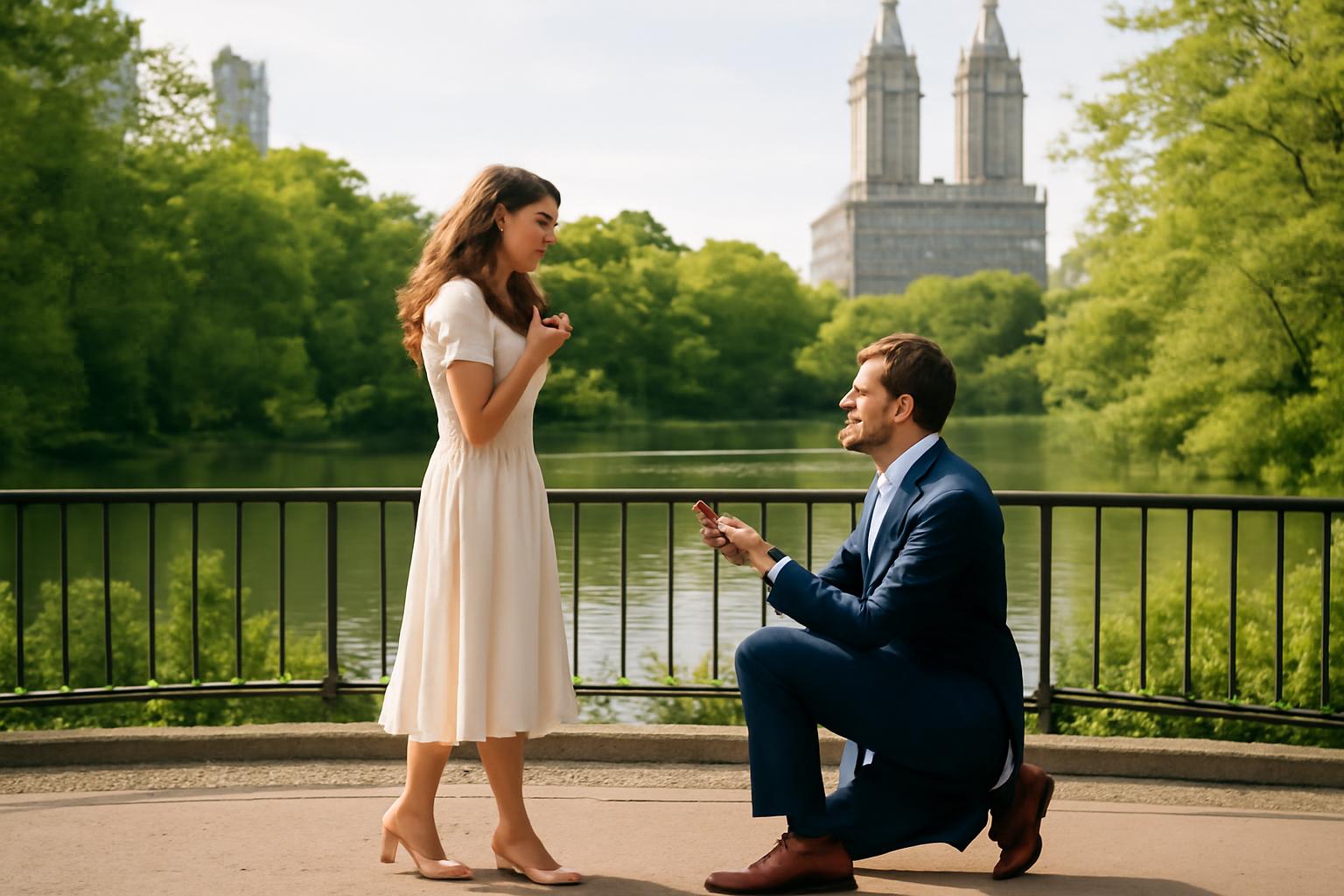
A Central Park marriage proposal works best when the setting, timing, and logistics reflect the couple—not when the plan tries to reproduce someone else’s supposedly perfect moment.
The park offers recognizable bridges, formal architecture, gardens, lakeside shelters, skyline elements, and long walking approaches. Every option also involves trade-offs. Famous landmarks attract visitors. Covered structures provide limited protection rather than indoor conditions. Seasonal scenery changes, and a location that appears empty in photographs may be occupied when you arrive.
The practical goal is not to identify one universally superior spot. Choose a primary location that fits the experience you want, pair it with a workable nearby alternative, establish a genuinely different severe-weather plan, and give collaborators precise instructions.
Start With the Moment You Want, Not a Ranking
Before comparing locations, rank these five criteria:
- Personal significance: Does the setting connect to a shared memory, interest, neighborhood, film, walk, or previous visit?
- Recognizable scenery: Do you want the photographs to read immediately as Central Park or New York?
- Tolerance for bystanders: Would your partner enjoy spontaneous applause, accept a few people nearby, or feel uncomfortable with an audience?
- Weather exposure: Are you willing to continue in wind, cold, heat, or light rain?
- Proposal format: Should the moment feel like an ordinary walk, a discreetly photographed surprise, or a coordinated event?
Personal significance deserves priority. A quiet lakeside place connected to a first date may be more appropriate than a famous bridge chosen because a vendor ranked it first. One photographer’s location guide makes the same point: begin with a place that already matters to the couple, if one exists, rather than defaulting to a generic recommendation. The guide suggests Wagner Cove or parts of the Ramble for relative privacy and Cat Rock for skyline elements, but these are subjective professional recommendations rather than guarantees. See the photographer’s location guidance.
The central trade-off is simple: recognition and privacy often pull in opposite directions. Bow Bridge and Bethesda Terrace repeatedly appear in commercial proposal and photography guides because they provide distinctive scenery. Those same qualities attract other visitors.
Central Park is a public space, so words such as private, quiet, and secluded should always be read comparatively. They may describe a place that feels less exposed or receives less through-traffic than another location. They do not mean it will be empty, available, or shielded from view.
It also helps to define the plan’s complexity early:
- Low-key personal proposal: Two people arrive as ordinary park visitors, one proposes, and they continue their day.
- Proposal with discreet photography: A photographer waits nearby, captures the question, and meets the couple afterward for portraits.
- Event-like proposal: The plan includes furniture, an arch, large flower arrangements, signs, musicians, sound equipment, elaborate props, several guests, or an attempt to control space.
Each additional person or physical element creates another dependency: transportation, timing, setup, current rules, cleanup, weather protection, and communication. An elaborate proposal is not inherently more meaningful. It simply needs more verification and more recovery options.
Complete this worksheet before booking vendors or buying props:
- My one must-have: ________
- My acceptable compromise: ________
- Primary location: ________
- Nearby alternative: ________
- Off-site severe-weather plan: ________
If privacy is the must-have, compromise on landmark recognition or ideal photographic light. If Bow Bridge must appear in the photographs, accept that other visitors may be present. If minimal walking matters, reject any plan that scatters the proposal, portraits, pickup, and celebration across distant parts of the park.
Compare 10 Central Park Proposal Locations by Goal
The following matrix is a preliminary comparison, not a promise of conditions. Most available evidence comes from commercial photographers and proposal planners describing their own experience—not official crowd measurements, shelter ratings, or access guarantees. Crowd and atmosphere assessments are therefore variable and subjective.
| Location | Strongest visual feature | Likely crowd trade-off | Overhead cover | Proposal style | Timing consideration |
|---|---|---|---|---|---|
| Bow Bridge | Lake, bridge, trees, nearby buildings | Frequently active; bystanders likely | No | Iconic landmark or discreet photography | Off-peak periods may improve the odds of fewer people |
| Bethesda Terrace and Fountain | Fountain, stone architecture, lake, tiled arcade | Commonly described as busy | Arcade covered; terrace exposed | Grand architectural or rain-aware plan | Assess the terrace and arcade separately |
| Wagner Cove | Small lakeside setting and wooden shelter | Relatively tucked away but easily occupied | Limited | Low-key, intimate proposal | Check the exact space before the final approach |
| Gapstow Bridge | Water, bridge, nearby buildings, skyline elements | Variable; convenient southern setting | No | Skyline-oriented or shorter park visit | Identify more than one usable viewpoint |
| Ladies Pavilion | Cast-iron structure and Lake view | Intimate in scale but not exclusive | Limited | Architectural lakeside proposal | Confirm access and prepare another lakeside position |
| Shakespeare Garden | Paths and planting | Seasonal and visitor-dependent | No dependable cover | Garden-oriented proposal | Current appearance and access matter |
| Belvedere Castle and Turtle Pond | Castle architecture and open pond view | Variable around a recognizable attraction | Pond-side area exposed | Architectural or wide-backdrop proposal | Use a conservative weather threshold |
| The Mall or Literary Walk | Long approach beneath rows of elms | Open and active, with room to keep walking | No | Natural walking proposal or group reveal | Choose an exact stopping point |
| Cop Cot | Large rustic wooden gazebo | May be occupied; not private | Limited | Covered-structure or small-group plan | Inspect before committing |
| The Pool | Water and weeping-willow character | Less commonly promoted, but still public | No | Quieter-feeling, scenery-first proposal | Plan the approach and exit carefully |
Bow Bridge
Bow Bridge is a strong candidate when the desired image is “classic Central Park”: water, trees, an elegant bridge, and buildings beyond. The practical decision is whether to propose on the bridge or use it as a backdrop.
Proposing on the bridge places the couple directly within the landmark but increases exposure to pedestrian traffic. A nearby lakeside viewpoint may produce a clearer bridge background and give a photographer more working distance, although the viewpoint can still be occupied or obstructed.
Choose the bridge itself if standing on the landmark matters more than controlling the composition. Choose a nearby viewpoint if the bridge’s shape in the background matters more. In either case, agree on a precise mark: a particular end, railing section, path junction, or viewpoint. “Somewhere around Bow Bridge” is not an operational plan.
A sensible fallback is another preselected viewpoint around the same lake-and-bridge area, not an improvised move to a distant landmark. Verify the route in advance because current path conditions and access are not established by the supplied proposal guides.
Bethesda Terrace and Fountain
Bethesda offers several scenes in one area: the open terrace, fountain, lake view, stone stairways, and covered arcade. That variety is useful when you want grand architecture or need to adjust the composition without leaving the area.
The trade-off is activity. Commercial photographer guides commonly describe Bethesda as busy. The open terrace creates a broad public moment; the arcade provides a more enclosed architectural frame and meaningful overhead cover. It does not turn the setting into a private indoor room. Visitors, performers, photographers, or other activity may still be present.
Treat the fountain and arcade as separate proposal options, even though they are in the same complex. Moving beneath the arcade changes the light, sound, background, and level of enclosure. Make sure the recipient would be comfortable with either atmosphere before designating one as the other’s fallback.
Wagner Cove
Wagner Cove suits someone who wants a small-scale lakeside setting rather than a sweeping landmark. A commercial planning guide describes it as a small lakeside area with a covered wooden shelter. The same guide presents it as relatively quiet, but that characterization is experiential and cannot establish privacy or availability. Compare the guide’s location and shelter descriptions.
Its appeal is also its limitation: the usable area is small. Another couple, photographer, or ordinary group of visitors may make the intended position unavailable. The roof may be useful in light rain, but it cannot guarantee a dry, comfortable, or secluded proposal.
Choose another lakeside position before the day and have the first collaborator on-site decide whether to activate it. Do not wait nearby indefinitely for the shelter to clear.
Gapstow Bridge
Gapstow Bridge works when you want park scenery and nearby city architecture in the same composition. It is in the southern park, with water and views toward Midtown elements, including the Plaza Hotel from some perspectives. One commercial photography guide describes it as combining The Pond with Plaza and Midtown views and places it near the park’s southern end. Review its location comparison.
It may suit a shorter park visit because the plan does not have to revolve around the central Lake area. Convenience does not mean low traffic, however. Select more than one acceptable viewpoint around the bridge and water.
The practical fallback should remain around The Pond rather than requiring an unexplained cross-park journey. Confirm the intended entrance, meeting point, and exit before the day.
Ladies Pavilion
Ladies Pavilion provides a distinctive cast-iron structure, a lakeside setting, and overhead cover. It fits a proposal that should feel architectural and intimate without depending on a large decorative installation.
Do not assume the pavilion can currently be reserved merely because commercial pages say it can. The supplied evidence includes no current official procedure establishing availability, reservation rights, or exclusive use. Confirm present access and requirements with the authority responsible for the park before relying on the structure.
Even if some authorization or reservation is available, the evidence does not establish that it supplies barriers, staff, signage, crowd control, or an empty location. Prepare a nearby lakeside position that still works without the pavilion.
Shakespeare Garden
Shakespeare Garden is a strong match for a garden-oriented proposal on the west side near the park’s 79th Street area, as described by commercial location guides. The experience depends less on one monumental object and more on paths, planting, and an enclosed garden atmosphere.
Do not build the emotional premise around a particular flower, color, or bloom date. Seasonal appearance and current access can differ from reference photographs. Review the setting close to the proposal date, choose a precise stopping point, and establish a non-garden alternative nearby.
Belvedere Castle or the Turtle Pond area may form a geographically coherent candidate alternative because the guides place both around the same broad part of the park. Treat that as a pairing to verify, not a guaranteed step-free or direct route.
Belvedere Castle and Turtle Pond
Belvedere Castle offers recognizable architecture and can appear as a backdrop from surrounding areas. Turtle Pond creates a wider, more open composition in which the castle can sit beyond the water.
These are not interchangeable weather options. The pond-side setting is exposed, so it offers no dependable immediate shelter. A castle view may also require careful positioning rather than simply arriving “at Belvedere.”
Decide whether proximity to the architecture or a wider view across the pond matters more. Shakespeare Garden is a candidate alternative in the same broad area, but current routes, slopes, stairs, and access must be checked before using the two as a working pair.
The Mall or Literary Walk
The Mall suits a proposal that should emerge naturally during a walk. Its long promenade and rows of American elms create a formal visual line without forcing the couple to stop at a gazebo or bridge.
A photographer documented one proposal that used identifying photographs, outfit details, and an arrival estimate before following the couple from Bethesda Terrace toward the Shakespeare statue. The proposal occurred on Literary Walk, and the subsequent portrait session included The Mall, Bethesda Terrace, the Lake, and Bow Bridge. Read the photographer’s account of the coordination and portrait sequence.
The lesson is not to copy that route exactly. It is to define the stopping point. “Propose somewhere on The Mall” leaves too much uncertainty for a hidden photographer.
Bethesda Terrace is a plausible candidate fallback or portrait stop because the documented session connected the two areas. Rehearse or review the route rather than assuming a fixed walking time.
Cop Cot
Cop Cot is a large wooden gazebo in the southern part of the park. It can suit a rustic, covered-structure proposal or a plan with a few waiting participants.
Availability is the weakness. It may already contain visitors, and overhead cover does not create an enclosed all-weather room. The supplied evidence does not establish current reservation procedures, so do not rely on claims that it is reservable without official confirmation.
Choose another southern-park position before the day. Gapstow Bridge is also in the southern park, but it should not automatically be treated as a close substitute; verify whether the approach makes sense for your entrance, cover story, mobility needs, and exit.
The Pool
The Pool is a less commonly promoted northwest option near water and weeping willows. It may appeal to someone who values a quieter-feeling landscape over an instantly recognizable landmark.
“Less commonly cited” does not mean private, empty, or operationally easier.
If a suitable nearby alternative cannot be verified, use a second point around the same landscape rather than pairing The Pool with a distant landmark. For severe weather, switch to the off-site plan rather than trying to cross the park.
Match the location to the goal
A concise shortlist looks like this:
- Iconic bridge scene: Bow Bridge
- Grand architecture: Bethesda Terrace or Belvedere Castle
- Relative seclusion: Wagner Cove, Ladies Pavilion, parts of the Ramble, or a northern setting
- Skyline elements: Gapstow Bridge or Cat Rock
- Garden character: Shakespeare Garden
- Covered structure: Bethesda Arcade for more substantial overhead cover; Ladies Pavilion, Wagner Cove, or Cop Cot for more limited protection
- Walking proposal: The Mall or Literary Walk
These are matches by goal, not universal winners.
Choose Timing With Crowds, Light, and Daylight in Mind
Commercial photographer guides commonly recommend early mornings, weekdays, or other off-peak periods at frequently visited locations such as Bow Bridge and Bethesda Terrace. These choices may improve the odds of encountering fewer bystanders, but they cannot guarantee an empty location.
There is also a genuine tension between crowd control and photographic light:
- Early morning is often recommended when limiting bystanders is the priority, particularly at famous landmarks and gardens.
- Golden hour is commonly favored for warmer, lower-angle light, but an attractive time to visit may also attract other people.
- Weekdays may be preferable to weekends, although weather, events, school breaks, and visitor patterns can change conditions.
If the person receiving the proposal would be distressed by an audience, prioritize relative privacy over ideal light. A technically attractive photograph is not worth making the experience uncomfortable.
Avoid unsupported hour-by-hour predictions. “This spot will be empty at 8:15” is not a dependable planning claim. Neither is a promise that the sun will create a particular effect. Clouds, trees, season, weather, and the couple’s exact position all influence the result.
As an illustrative planning template, choose an arrival window rather than one brittle minute:
- Target arrival: within an agreed 15- to 30-minute window
- Photographer: in position before that window begins
- Switch deadline: set before the couple enters the final approach
- Alternative: activated immediately after the deadline
- Delay message: sent before the couple reaches the proposal area
This timing range is an editorial planning model, not a measured park standard. Adjust it to the route, photographer, cover story, and number of collaborators.
Plans near or after sunset require additional preparation. One photographer-planner reports limited lighting in parts of the park, but that is experiential guidance rather than an official lighting or safety assessment. Review the photographer’s timing and lighting observations.
Do not treat candles or portable lighting installations as automatically permitted solutions. Keep the route simple, review it in advance, choose a clear meeting point and exit, arrange transport afterward, and verify any proposed equipment with the relevant authority.
Build a Weather and Seasonal Backup That Is Actually Different
A nearby gazebo is an alternative location. It is not necessarily a severe-weather plan.
Separate the response into two levels:
- Light-rain adjustment: Move to a preselected place with overhead cover if everyone remains comfortable and the route still makes sense.
- Severe-weather or no-go plan: Move the proposal entirely to a confirmed off-site indoor setting.
Bethesda Terrace Arcade provides meaningful overhead cover. Ladies Pavilion, Cop Cot, Wagner Cove, and similar public structures provide more limited protection. Wind-driven rain may enter from the sides, the temperature may still be uncomfortable, and another group may occupy the space.
One photographer who documented Central Park Lake proposals advises arranging a backup outside the park when substantial rain is expected and describes meaningful shelter within the park as limited. The same account highlights the added weather, crowd, and rowing complications of a boat proposal. See the photographer’s weather and lake-planning lessons.
Set a conservative no-go threshold before the day. Heavy rain, lightning, extreme heat, poor air quality, or any condition the couple or collaborators consider unsuitable should activate the indoor plan rather than a search for an available gazebo. This is a planning rule for your group, not a substitute for official weather, health, or emergency guidance.
The indoor alternative needs:
- A confirmed place
- A plausible reason for going there
- A specific proposal position
- A photography plan, if applicable
- Current access or reservation confirmation
- Instructions for friends, musicians, or other collaborators
- A cancellation and change procedure
Do not leave the backup as “we’ll find a restaurant.” The supplied evidence does not establish current hours, reservations, access, or suitability for any particular indoor business, so verify your chosen place directly.
Seasonal scenery also requires restraint. Blossoms, peak foliage, fresh snow, and favorable golden-hour light are variable. Choose a location that still works if the expected feature is absent. A garden should remain meaningful without peak flowers, and a winter proposal should not depend on snow.
For winter, keep the outdoor portion short, choose warm clothing that does not make the surprise obvious, arrange prompt transportation afterward, and move the celebration indoors. Waiting collaborators and schedule delays become more consequential in uncomfortable conditions.
Use an especially conservative weather threshold at exposed locations such as Turtle Pond or in a rowboat. A boat adds weather exposure, rowing effort, congestion, operational uncertainty, and difficulty keeping the couple in a photographable position.
Follow this decision sequence:
The day before
- Review current conditions and applicable public advisories.
- Confirm access to the primary and nearby alternative positions.
- Reconfirm any boat, attraction, or venue operation involved.
- Decide whether the outdoor plan remains reasonable for your group.
- Notify all collaborators of the likely plan.
- Set the final decision time.
On the day
- Check conditions before anyone travels to the setup point.
- Confirm that collaborators received the current plan.
- Have the first person on-site assess the exact position.
- Switch before the couple begins the final approach.
- Do not wait for arrival to improvise a new route.
An early, controlled switch protects the surprise. A last-minute debate at the proposal point usually does not.
Know When a Simple Proposal Becomes an Event-Like Setup
The supplied nonofficial guides make broad and inconsistent claims about permits for simple proposals, photography, large setups, and gatherings. No current official park regulation is included in the available evidence. This article therefore cannot give a dependable yes-or-no answer about whether your plan requires permission.
The useful planning distinction is between an ordinary visit and something that begins to function like an event.
At one end is a person proposing during a normal park walk. At the other are arches, chairs, tables, large flower arrangements, freestanding signs, musicians, sound equipment, flames, tripods, crowd control, commercial activity, or a waiting group. The evidence does not establish which individual elements trigger a current requirement, so do not infer a rule from this list.
Before booking vendors or bringing equipment, describe the complete plan to the official authority currently responsible for the park, location, activity, or service. Ask for current written guidance rather than relying on a photographer’s or florist’s interpretation.
Use this verification list:
- Is the exact location accessible on the intended date and at the intended time?
- Does the group size affect what must be arranged?
- What current rules apply to professional proposal or engagement photography?
- What rules apply to tripods, light stands, reflectors, or other equipment?
- May the plan include chairs, tables, arches, blankets, or picnic furniture?
- May it include floral arrangements, petals, signs, balloons, or freestanding decorations?
- What rules apply to musicians or sound equipment?
- What rules apply to candles, flames, or flame-like devices?
- What cleanup and removal obligations apply?
- Does using a paid vendor or conducting commercial activity change the process?
- Can any approval accommodate a nearby alternative?
- What must happen if weather changes the date, time, or location?
- What, if anything, does an approval provide beyond authorization?
The last question matters because the supplied evidence does not establish that a permit or reservation provides exclusive use, barriers, staff, signage, crowd control, or an empty public location.
Historical wedding information does not settle a current proposal question. A photographer’s guide published in 2022 discussed permits for weddings and elopements as understood at that time, not contemporary rules for a simple marriage proposal. Read the dated wedding-permit context.
Treat commercial claims that Ladies Pavilion, Cop Cot, Wagner Cove, or another structure can be reserved as unconfirmed until the responsible authority explains current procedures and the limits of any arrangement. Keep written confirmation, and make sure vendors understand the approved scope. A vendor’s willingness to install something does not establish that it is allowed.
Coordinate the Surprise Without Making the Day Feel Staged
A hidden photographer needs operational detail, not just a romantic concept. Before the day, provide:
- Recent reference photographs of both people
- Exact clothing descriptions or photographs
- An estimated arrival window
- The entrance and approach route
- A precisely agreed proposal point
- The intended direction each person will face
- A backup contact method
- Instructions for delays, switching, cancellation, and lost contact
“Meet near Bow Bridge” is insufficient. The bridge has different approaches, surrounding paths, viewpoints, and places where visitors may block a sightline. The photographer and proposer can both arrive successfully and still fail to find each other.
Have the photographer arrive first. They should assess whether the intended position is open, whether the planned composition is usable, and whether the alternative should be activated. That decision must occur before the couple reaches the final approach.
Use a subtle message sequence that requires minimal phone handling:
- On time: “We’re starting the walk.”
- Short delay: “Stopping for coffee.”
- Switch location: A pre-agreed neutral phrase such as “Let’s use the second route.”
- Move indoors or cancel: A distinct message that cannot be confused with a delay.
- No signal: Wait until the agreed deadline, then activate the predetermined plan.
Avoid constant texting while walking beside your partner. Send updates at natural moments—before entering the park, during a restroom stop, or while checking directions.
The cover story should be ordinary and sustainable: a walk before a meal, a sightseeing stop, a visit connected to a shared interest, or a return to a meaningful place. A complicated chain of fake appointments and invented emergencies is harder to maintain and may create suspicion or stress.
For friends or family, choose both a waiting point and a reveal route. Decide whether they appear immediately after the answer or meet the couple later. Keep them far enough away that they do not form an obvious cluster, and include the gathering in any official verification of the plan.
Special considerations for a rowboat proposal
A rowboat can create a distinctive Bow Bridge scene, but it adds several dependencies:
- Current seasonal operations and availability
- Weather exposure
- Rowing and steering effort
- Congestion on the water
- Keeping the boat oriented for the proposal
- Coordinating with a photographer on land
- Protecting the ring and personal belongings
- Returning ashore for portraits and the next part of the day
Wood Chip Vantage Point has been suggested by one photographer as a useful land-based camera position near Bow Bridge because of its relationship to the water and potential concealment. Treat it only as that photographer’s suggested position—not an official, guaranteed, reserved, or exclusive shooting location.
The proposer must be able to row and steer without making the positioning feel unnaturally deliberate. If maintaining the intended angle becomes difficult, prioritize the proposal itself over reproducing a reference photograph.
In every format, keep props minimal unless current rules, transport, setup, removal, and weather protection have all been resolved. A small personal object can add meaning. A large installation can turn an adaptable plan into a fragile event.
Create a Walking-First Day-of Route and an Immediate After-Plan
A strong proposal day uses one practical area. Cluster the primary point, nearby alternative, portrait locations, exit, pickup, and celebration rather than crossing the park repeatedly.
This reflects New York Know’s walking-oriented editorial approach: group places geographically, spend less time crossing the city, and create days that work well on foot.
Build the day in this order:
- Arrival point: Choose an entrance that supports the intended approach.
- Natural lead-in: Use a walk, meal, or sightseeing stop that fits the couple.
- Primary proposal point: Mark the exact position.
- Nearby alternative: Choose a position reachable without a conspicuous change of plan.
- Portrait cluster: Select a small number of nearby scenes.
- Exit and pickup: Decide where the couple will leave and how transport will identify them.
- Celebration: Confirm what happens after the park.
- Severe-weather plan: Build a separate indoor sequence.
Use the location profiles as preliminary pairing guidance:
| Primary plan | Candidate nearby adjustment to verify | Main caveat |
|---|---|---|
| Bow Bridge | A preselected lakeside viewpoint with the bridge as backdrop | Viewpoint may also be occupied |
| Bethesda Fountain | Bethesda Arcade | Atmosphere changes; neither is private |
| Wagner Cove | Another preselected lakeside position | Shelter may be occupied |
| Gapstow Bridge | A second viewpoint around The Pond | Sightlines and visitor traffic vary |
| Ladies Pavilion | A nearby lakeside position | Pavilion access and route require confirmation |
| Shakespeare Garden | Belvedere or Turtle Pond area | Verify current route, slopes, and access |
| Belvedere or Turtle Pond | Shakespeare Garden area | Garden conditions and access vary |
| The Mall | Bethesda area or another exact point on the walk | Do not rely on vague stopping instructions |
| Cop Cot | Another southern-park position | Verify whether the switch is genuinely practical |
| The Pool | A second point around the same landscape | Fewer documented fallback options |
These are candidate clusters, not verified itineraries. The supplied evidence does not establish current path conditions, exact entrances, pickup rules, restrooms, surfaces, or step-free routes.
Rehearse the route in person if practical. Otherwise, review it using current maps, recent photographs, and collaborator input. Avoid unsupported promises about walking times or accessibility.
If either person has limited mobility, verify the intended entrance, slopes, stairs, path surfaces, available seating, step-free alternatives, and transport access before committing. A visually attractive backdrop is not the right location if reaching it creates discomfort or uncertainty.
The Mall, Bethesda Terrace, the Lake, and Bow Bridge have appeared together in a documented post-proposal portrait session. That does not establish a standard route or duration. Select only the stops that fit the couple’s energy, clothing, mobility, weather, and celebration schedule.
Plan the first few minutes after the answer as carefully as the approach:
- Give the couple a moment without immediate instructions.
- Secure the ring box and personal belongings.
- Let the recipient absorb what happened.
- Take a few portraits only if both people want them.
- Notify waiting friends or family when the couple is ready.
- Confirm the next destination without rushing away.
The post-proposal plan should be settled before the day. Options include a short portrait walk, a meeting with friends, a meal, a hotel return, or transportation to an indoor celebration. A quiet interval may be more welcome than an immediate surprise party.
Final day-of checklist
- [ ] Ring checked and stored securely
- [ ] Ring box fits safely and discreetly
- [ ] Phones fully charged
- [ ] Portable battery packed if needed
- [ ] Current conditions and relevant advisories checked
- [ ] Primary and alternative access confirmed
- [ ] Any boat, attraction, or venue operation reconfirmed
- [ ] Current rules verified where necessary
- [ ] Photographer, musician, vendor, and participant contacts saved
- [ ] Recent reference photographs shared
- [ ] Clothing descriptions or photographs sent
- [ ] Arrival-update sequence agreed
- [ ] Exact primary proposal point marked
- [ ] Nearby alternative point marked
- [ ] Switch deadline established
- [ ] Off-site severe-weather plan confirmed
- [ ] Waiting point and reveal route set for guests
- [ ] Portrait cluster selected
- [ ] Exit and pickup point confirmed
- [ ] Immediate celebration plan confirmed
- [ ] Cancellation and lost-contact procedure understood
What is the most private place for a Central Park marriage proposal?
There is no reliably “most private” public location. Wagner Cove, Ladies Pavilion, parts of the Ramble, and northern areas are often suggested for relative seclusion, but actual conditions vary. A small shelter can feel intimate and still become unusable when another group occupies it.
If privacy is essential, choose a less recognizable setting, consider an off-peak weekday visit, prepare a nearby alternative, and accept that no public Central Park location can guarantee an empty scene.
Which Central Park proposal location has the most recognizable backdrop?
Bow Bridge and Bethesda Terrace are strong candidates for immediately recognizable Central Park scenery. Bow Bridge emphasizes the Lake, bridge, trees, and nearby buildings. Bethesda provides the fountain, stone architecture, tiled arcade, and lake view.
Choose by proposal style: Bow Bridge for a bridge-and-water scene, or Bethesda for a larger architectural setting. Both may be busy.
Where can I propose in Central Park if it rains?
For light rain, Bethesda Terrace Arcade offers meaningful overhead cover among the commonly recommended locations. Ladies Pavilion, Wagner Cove, and Cop Cot have roofs but provide more limited protection and may already be occupied.
For substantial rain or any condition that crosses your predetermined no-go threshold, move to a confirmed off-site indoor alternative. A public gazebo should not be the sole severe-weather plan.
Do I need a permit for a Central Park proposal or engagement photos?
The supplied evidence cannot establish a current blanket answer. Nonofficial guides make inconsistent claims, and no current official regulation is available in the evidence used for this article.
Describe the complete plan to the official authority responsible for the park or activity before booking vendors or bringing equipment, decorations, music, furniture, flames, or a group. Do not assume that historical wedding guidance or a vendor’s interpretation applies to a contemporary proposal.
How can a photographer capture the proposal without spoiling the surprise?
Give the photographer recent reference photographs, clothing details, the approach route, an arrival window, and an exact proposal point. Have the photographer arrive first and decide whether the position is usable.
Agree on discreet messages for on-time arrival, delays, switching locations, moving indoors, and cancellation. Use a believable cover story, such as an ordinary walk before a meal, and meet the photographer openly only after the proposal. Most importantly, avoid vague instructions such as “somewhere near Bow Bridge.”
Return finally to the five selection criteria: personal significance, recognizable scenery, tolerance for bystanders, weather exposure, and proposal format. Write down the primary spot, nearby alternative, off-site severe-weather plan, switch deadline, and exact communication sequence.
The strongest Central Park proposal is not necessarily the most elaborate. It is the one that reflects the couple, limits unnecessary movement, anticipates changing conditions, verifies unanswered rules, and leaves enough flexibility for the moment to feel personal rather than overproduced.