 New York Know
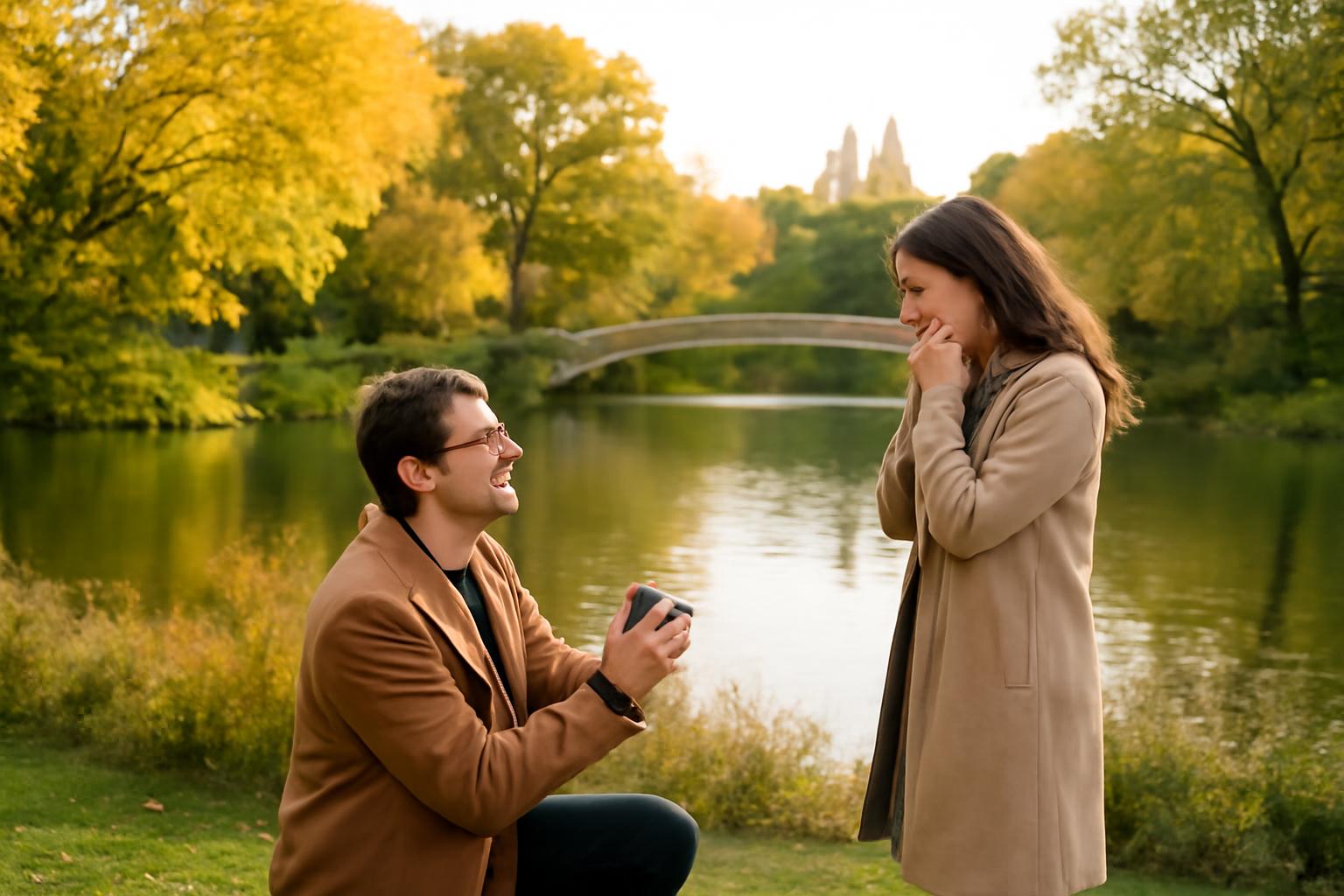
A memorable Central Park proposal does not begin with “Which landmark looks best in photographs?” It begins with a more useful question: “What kind of moment would feel right for us?”
The bridge, garden, wooded path, or skyline view is only the setting. The plan must also suit both partners’ comfort with attention, walking, weather, early starts, and surprises. It should still work if paths are busy, a compact viewpoint is occupied, or the scenery differs from the photographs that inspired you.
The most resilient plan has five parts: an exact proposal point, a nearby crowd backup, a separate response to severe weather, enough transit and walking time, and a fixed procedure if communication fails.
Scope of this guide: Location and crowd observations below come primarily from commercially interested photographers and proposal planners. They are useful for comparing experiences, but they are not official park rules or guarantees. Current permits, reservations, closures, accessibility, facilities, boating, and setup restrictions must be confirmed directly with NYC Parks, the Central Park Conservancy, or the relevant indoor venue before proposal day.
Start With the Experience, Not a List of Famous Spots
Before comparing locations, decide how the proposal should feel. An iconic landmark can create a recognizable background, but it may also bring passersby, performers, photographers, and public attention. A quieter-feeling garden or waterfront point may look less monumental while giving the conversation more room.
Consider your partner first:
- Would they enjoy strangers noticing, applauding, or taking pictures?
- Would runners and visitors feel lively or intrusive?
- Would they prefer a short arrival or enjoy a longer walk?
- Are they comfortable being photographed immediately afterward?
- Would an early start make them tired, suspicious, cold, or underdressed?
Consider your own comfort too. If speaking in front of strangers would make it difficult to say what you have prepared, a famous landmark at a popular time may be the wrong choice. Photographer-authored planning advice recommends matching the setting to both people’s comfort with crowds and public speaking rather than choosing solely for visual impact (proposal-planning guidance from Stine Creative NYC).
Use six criteria to narrow the options:
- Desired scenery: bridge and water, formal architecture, skyline, trees, flowers, woodland, or elevated views.
- Crowd tolerance: comfortable with an audience, willing to accept passersby, or strongly preferring less attention.
- Walking tolerance: how far both people can comfortably walk in their planned clothes and footwear.
- Ease of navigation: whether the exact point can be found without conspicuous phone-checking or stressful wrong turns.
- Weather exposure: open air, partial overhead cover, or a separately investigated indoor alternative.
- Photography and styling: no photographer, discreet photography, minimal personalization, or an event-like setup.
An iconic location and an intimate-feeling one are not necessarily the same choice. Personal meaning can outweigh landmark recognition: consider a route from an early date, a familiar bench area, a shared boating memory, or a regular walking path. The setting should support the story rather than replace it.
Privacy in a public park is a probability, not a bookable feature. An early weekday or a lower-profile path may improve the odds of a lower-attention moment, but visitors, maintenance activity, performers, events, or another proposal can still appear.
It helps to classify the plan into one of three tiers:
- Simple walk and proposal: two people arrive, the question is asked, and they continue their day.
- Proposal with discreet photography or minimal personalization: a photographer waits nearby, or the proposer carries a note or another small personal item.
- Event-like setup: furniture, installations, performers, amplified sound, extensive flowers, signage, lighting, decorations, or an organized group.
Each component adds another dependency: arrival windows, vendor access, setup time, cleanup, weather exposure, and potentially activity-specific rules. The closer the proposal comes to resembling an organized event, the more important it becomes to ask the relevant park authority what restrictions, reservations, insurance conditions, setup procedures, or cleanup responsibilities may apply. Do not infer permission from a vendor portfolio.
Choose a Central Park Proposal Spot by Scenery and Crowd Tradeoffs
This comparison is designed to narrow a shortlist, not rank locations. Crowd descriptions are conditional observations reported by commercial photographers and proposal planners—not forecasts or guarantees.
| Location | Visual character | Reported crowd pattern | Space limitations | Weather cover | Navigation considerations | Portrait option afterward |
|---|---|---|---|---|---|---|
| Bow Bridge | Bridge, Lake, trees, distant buildings | Often described as busy, especially at popular times | Narrow crossing with continual movement | None | Exact side and standing point matter | Lake paths or Bethesda area |
| Bethesda Terrace and Fountain | Fountain, stairs, stonework, Lake, tiled arcade | Frequently described as active, with visitors and performers | Several angles, but activity can interrupt them | Arcade has overhead cover | Distinguish terrace, fountain, stairs, and arcade | The Mall or Lake |
| Gapstow Bridge and the Pond | Stone bridge, water, Midtown buildings | Conditions depend on time and exact position | Usable positions vary around the Pond | None | “At Gapstow Bridge” is not precise enough | Pond, Inscope Arch, nearby rocks |
| The Mall and Literary Walk | Long, symmetrical, tree-lined promenade | Continuous pedestrian movement rather than one confined crowd | Works along a route | None | Define a trigger point along the walk | Bethesda Terrace or Lake |
| Shakespeare Garden | Planted, literary, less monumental | Activity varies with time and garden conditions | Paths and planting constrain positioning | None | Agree on the precise path point | Belvedere area if practical |
| Conservatory Garden | Formal Italian-, French-, and English-inspired areas | Conditions and rules require current verification | Garden use may constrain the plan | Limited | Confirm access and photography requirements | Within a verified garden plan |
| Belvedere Castle and Vista Rock | Elevated architecture and park views | Compact areas may feel congested | Limited positioning in some areas | Do not rely on it as a weather fallback | Route and access complexity require checking | Turtle Pond or nearby paths |
Bow Bridge suits couples who want an immediately recognizable bridge-and-water setting and can accept people passing close to the moment. Photographer guides repeatedly describe it as popular and constrained, often recommending an early weekday attempt without promising an empty bridge (location observations from Michael Silverstone Photography).
“Meet at Bow Bridge” is not a complete plan. Specify the approach, side of the bridge, standing mark, direction the couple should face, and what happens if another group is using the position.
Bethesda Terrace and Fountain provides several distinct backgrounds in one area: the fountain, Lake, stairs, stone architecture, upper terrace, and mosaic-tiled arcade. That variety makes it adaptable, but vendor accounts also describe substantial foot traffic, performers, music, and general activity.
It suits someone who enjoys Central Park’s energy more than someone who needs silence. The arcade can change the composition or reduce direct exposure during light rain, but it should not be treated as a complete severe-weather plan.
Gapstow Bridge offers views across the Pond toward Midtown buildings. Standing on the bridge creates a different background and crowd dynamic from proposing near its base or along the water.
The Pond’s appearance and usable positions can change with water level, mud, vegetation, barriers, seasonal equipment, and people crossing the bridge. One photographer’s account describes adjusting around low water and muddy ground, showing why recent reference images and an exact standing point are more useful than a generic location name (Gapstow Bridge proposal account).
The Mall and Literary Walk is a straight, symmetrical promenade lined with American elm trees. It works especially well as a walk-based proposal rather than a confined destination. A photographer can identify the couple along the route and capture the proposal at a predefined statue, bench area, or path marker.
In one documented proposal, the photographer waited at Bethesda Terrace and followed the couple toward the Shakespeare statue before taking portraits elsewhere in the park. The useful lesson is not to reproduce that proposal, but to define a route, walking direction, and clear trigger point.
Shakespeare Garden offers a planted alternative for couples who prefer flowers and paths to a major bridge or fountain. It feels visually softer and less monumental, but it remains public. Seasonal planting, narrow paths, other visitors, and camera positioning can affect the result.
Conservatory Garden provides formal scenery across Italian-, French-, and English-inspired sections. It may suit a structured botanical aesthetic, but its rules deserve special verification. Supplied commercial sources describe professional-photography requirements, fees, and application procedures inconsistently. Those vendor accounts do not establish current policy, so check official materials before committing to the garden or paying a photographer.
Belvedere Castle and Vista Rock may appeal to couples who want elevated architecture rather than waterfront scenery. Commercial guides disagree about how well it works: some recommend the setting, while others caution that compact space, crowds, and route complexity can undermine the experience. Consider it only after checking the precise approach and deciding whether the route suits both people.
A simple matching guide is more useful than a ranking:
- Choose Bow Bridge for a recognizable bridge-and-water background.
- Choose Bethesda Terrace for architecture and multiple portrait angles.
- Choose Gapstow Bridge and the Pond for skyline-and-water scenery.
- Choose The Mall for a proposal that unfolds during a walk.
- Choose Shakespeare Garden or Conservatory Garden for a planted setting, subject to current access and activity rules.
- Choose Belvedere Castle and Vista Rock for elevated architecture if the route and space suit the couple.
Consider Quieter-Feeling Waterfront, Woodland, and Pavilion Alternatives
“Quieter-feeling” means potentially less concentrated attention—not guaranteed seclusion.
Wagner Cove is a compact waterfront setting with a wooden shelter and dock-like character. Its small footprint creates the central tradeoff: it may feel intimate when available but become effectively unusable if another couple, photographer, or group occupies it. Set a brief decision window and then continue to a predefined lakeside alternative rather than waiting conspicuously nearby.
Ladies Pavilion combines a waterside structure, Lake views, and overhead cover. Its appearance also attracts visitors, so do not make low crowds an assumption.
The Pool is a lower-profile body of water in the park’s northwest area. Commercial proposal guides associate it with willow trees and a nearby waterfall, although vegetation, water appearance, and seasonal conditions vary. It may suit someone who values landscape over landmark recognition, provided the route and exit fit the rest of the day.
Dene Summerhouse is a rustic gazebo with seating and overhead cover. It offers a more informal architectural backdrop than Bethesda Terrace, but its open design does not make it a dependable severe-weather fallback.
Cop Cot is a wooden gazebo near a park entrance and may suit a proposal combining rustic structure with a city-facing atmosphere. Do not assume it can be reserved, decorated, or used for an installation. Describe every intended activity or object to the relevant authority and ask what conditions, if any, apply.
The Ramble replaces formal architecture with winding paths, trees, rocks, and wooded corners. That atmosphere may reduce the sense of being on display, but it creates operational challenges. Vendor guidance specifically notes the difficulty of navigating its winding paths (Central Park location-planning guide).
If using The Ramble, coordinate from a clearly identifiable boundary point or nearby landmark. Save the proposal point and approach photographs offline; do not ask a photographer to “find us somewhere in the woods.”
Other lower-profile possibilities include Harlem Meer, Dene Slope, Oak Bridge, small lawns, rocks, and lakefront landings. Treat these as categories to investigate, not promises about access, crowds, or mobility suitability. Even an unnamed rock with personal significance needs a precise map pin and a recent route check.
For every compact gazebo, landing, or viewpoint, choose a second option in the same sector. The backup should allow the walk to continue naturally rather than forcing a conspicuous pause or a long transfer across the park.
Pick a Time That Balances Light, Crowds, and the Couple’s Comfort
Weekday mornings, particularly near sunrise, are the most consistent recommendation across the supplied photographer-authored sources for improving the odds of softer light and fewer visitors. That is a probability advantage, not an empty-park reservation.
Events, maintenance, performers, runners, tourists, weather changes, and overlapping proposals can disrupt an early plan. Bow Bridge and Bethesda Terrace deserve especially cautious expectations because commercial guides repeatedly describe them as active landmarks.
Think in four broad periods rather than looking for one universally correct hour:
| Period | Potential advantage | Main tradeoff |
|---|---|---|
| Morning | Lower crowd probability and often softer light | Early wake-up, cold, fatigue, or an implausible cover story |
| Midday | Easier scheduling and more natural for a casual walk | More activity and potentially harsher overhead light |
| Late afternoon | Warmer directional light may suit portraits | Popular timing may coincide with heavy foot traffic |
| After sunset | Potentially fewer visitors and visible city lights | Harder navigation and more demanding photography |
These are tendencies, not fixed rules. Photographer preferences vary with season, cloud cover, camera style, and the direction a location faces. One commercial timing guide similarly favors morning for lower activity, describes midday as more difficult for crowds and light, and notes the added challenges of nighttime photography (time-of-day comparison from VladLeto Photography).
Do not force sunrise if it makes the experience worse. An early proposal may look appealing in a portfolio but feel uncomfortable if the partner dislikes mornings, lacks suitable clothing, or would immediately question an unexplained dawn walk. A believable late-morning plan at a lower-profile location may be better than an awkward sunrise at a landmark.
Build substantial buffer time for:
- Subway delays or traffic
- Walking from the park boundary
- Wrong turns and slow pathfinding
- Restroom stops
- A photographer’s setup or repositioning
- A compact location being temporarily occupied
- Slower movement in formal shoes or bulky clothing
Avoid scheduling the proposal immediately before a fixed reservation. If dinner, a concert, or a show follows, keep the proposal point, portrait route, and exit in one coherent sector rather than repeatedly crossing the park. This follows New York Know’s broader area-based, walking-first planning approach.
Do not copy a fixed light window from someone else’s gallery. Ask the photographer for a recommendation based on the exact standing point, date, expected conditions, and desired photographic style.
Build a Compact Primary Plan and Two Backups
A practical proposal plan has three layers:
- Primary proposal point: the exact place you intend to use.
- Nearby crowd or obstruction backup: another point in the same sector.
- Severe-weather response: an indoor alternative whose conditions you have checked, or a postponement plan.
The second point solves a local problem, such as a group occupying a gazebo. It does not automatically solve a weather problem. Likewise, an arcade or pavilion may offer limited cover without being a complete response to severe conditions.
Here are four geographically coherent concepts. They are planning frameworks, not verified turn-by-turn routes.
Iconic central cluster
- Primary area: Bethesda Fountain or the terrace
- Local adjustment: the arcade for a different background, light rain, or a crowded fountain area
- Possible portrait route: The Mall, followed by Bow Bridge if conditions and time permit
- Exit: choose it according to the next reservation
The advantage is visual variety within one broad area. The disadvantage is sustained visitor activity. Treat Bow Bridge as an optional extension, not a required stop.
Southern skyline cluster
- Primary point: a precise Pond position or base area near Gapstow Bridge
- Local backup: another preselected Pond viewpoint
- Possible portrait route: Inscope Arch, a rock overlooking Wollman Rink, and The Mall
- Optional extension: Bethesda Terrace only after validating time, route, clothing, and mobility needs
A photographer’s documented Gapstow proposal used the Pond, Inscope Arch, a rock overlooking Wollman Rink, The Mall, and Bethesda Terrace as portrait settings. That example shows what may be possible, but it does not establish that the entire route is compact or suitable for every couple.
Walk-based Mall cluster
- Photographer orientation point: Bethesda Terrace
- Proposal route: The Mall and Literary Walk
- Exact trigger: a specified statue, path mark, or stopping action
- Possible portrait area: the Lake or Bow Bridge, subject to route checks
This avoids waiting at a narrow landmark and gives the couple something natural to do before the proposal. It requires precise coordination about walking direction and trigger location.
Quiet-water concept
- Primary point: Wagner Cove
- Local backup: another agreed lakeside point in the same sector
- Portrait plan: a short route selected after checking current maps and conditions
- Severe-weather response: indoor relocation or postponement
The supplied evidence does not establish a reliable turn-by-turn route for this concept. Do not rely on an old social-media caption or photographer’s directions as if they were a current access map.
Before using any cluster, verify:
- The intended park entrance
- The complete walking route
- Stairs, slopes, and path surfaces
- Restroom needs
- Current closures or construction
- The planned exit
- Whether optional portrait extensions remain realistic
Accessibility depends on the complete route, not the destination name.
Save screenshots or map pins for:
- The proposal mark
- The photographer’s camera position
- The nearby backup
- The fallback meeting point
- The intended exit
A named landmark may cover a larger area than expected. “Bethesda Terrace” could mean the upper level, stairs, arcade, fountain side, or Lake-facing side. Pair the pin with a recent photograph showing exactly where to stop.
Finally, create a communication-failure plan. For example: the photographer waits at the primary point until a fixed time and then moves to one visible fallback point. The proposer follows the same sequence without needing a reply.
Coordinate the Surprise and Photographer Step by Step
Professional photography is optional. A meaningful setting, prepared words, and reliable logistics remain valuable without it. If you do hire a photographer, coordinate precisely enough that neither person must improvise at the last minute.
The week before
- Confirm the date, target time, and realistic arrival window.
- Agree on the exact proposal mark and direction the couple should face.
- Ask where the photographer will stand and what will appear in the frame.
- Send current reference photographs of both people.
- Share the route, nearby backup, weather response, and fallback meeting point.
- Decide what happens if someone occupies the proposal mark.
- Confirm the short portrait route and end point.
- Exchange backup contact details.
- Recheck any activity-specific rules or reservations.
Avoid broad instructions such as “somewhere near Bow Bridge” or “under the Bethesda arches.” The photographer should be able to describe where the couple will stand, where the camera will be, and which direction everyone will face.
The morning of the proposal
- Send a current clothing description or photograph.
- Confirm that the photographer is on schedule.
- Recheck weather and any current official notices.
- Charge phones and portable batteries.
- Save map pins and reference images offline.
- Carry the ring in a secure pocket or suitable box.
- Avoid posting live plans where the partner might see them.
Same-day clothing images are useful in crowded settings. In one Gapstow Bridge proposal account, the proposer sent current outfit photographs so the photographer could identify the couple as they approached.
During the approach
Send an estimated arrival time and one short update near the final path. Keep it factual: “Entering the final path now; approximately two minutes away.”
The photographer should already know what happens if the couple approaches from the wrong direction or the proposed mark is occupied. The proposer should not need to stand nearby making repeated calls.
Two minutes before arrival
- Put the phone away if possible.
- Use the agreed minimal readiness signal.
- Slow the walk naturally instead of scanning the area.
- Move to the exact mark.
- Face the agreed direction.
- Use one ordinary trigger, such as pausing for a photograph or admiring the view.
Keep the signal simple enough to remember under stress.
During the proposal
Take time to speak. Do not rush because pedestrians are nearby. Keep the ring controlled and focus on your partner rather than trying to restart the moment if someone crosses the background.
Ask the photographer in advance whether there is a preferred orientation or whether you should hold the position briefly after the answer. Instructions should remain simple; the proposal should not become a choreographed production.
Immediately afterward
Allow a few private moments before starting portraits. Then follow the short route selected in advance. This is not the time to debate whether to cross the park or add several distant landmarks.
A believable cover plan makes coordination easier. A walk, brunch, museum day, or ordinary sightseeing plan can explain the location and clothing. The cover should fit the partner’s habits and should not require unnecessary cross-city travel. If formal shoes, an unusually early alarm, or a heavy outfit would seem suspicious, redesign the plan instead of inventing a complicated story.
If either party is delayed or messages stop working, use the fixed fallback procedure. One alternate time and one visible meeting point are usually clearer than a chain of changing contingencies.
Plan for Seasons and Weather Without Promising a Particular Look
Plan by practical effects: temperature, daylight, vegetation, ground conditions, operating facilities, crowd pressure, and clothing comfort.
Spring blossoms, full ponds, green lawns, autumn foliage, snow, and operating fountains vary by date and year. A photographer’s gallery records one particular day; it does not promise the same appearance for yours.
One commercial location guide reports colder-season lawn restrictions and winter changes at Bethesda Fountain, but those conditions are changeable and require current official confirmation. Treat vendor reports as prompts to investigate, not standing operating rules.
Winter considerations
Winter may bring short daylight, cold wind, ice, slush, snow, or difficult paths. A snow-covered setting can look appealing, but the plan still needs appropriate clothing, practical footwear, a short route, and an easy alternative. Do not make an unfamiliar or uncomfortable route essential to the proposal.
Summer considerations
Heat, direct sun, and visitor activity can make long walks uncomfortable. Consider an earlier start, water, shade, breathable clothing, and fewer portrait stops. A compact route is particularly useful if the partner is dressed for a later reservation.
Spring and fall considerations
Variable temperatures and wet ground may matter as much as blossoms or foliage. An extra layer or paved route may be more useful than targeting an uncertain seasonal display. Recent rain can affect mud, standing positions, and the appearance of the Pond.
Use a simple decision framework:
| Conditions | Planning response |
|---|---|
| Comfortable conditions and usable paths | Proceed with the primary plan |
| Minor rain or a temporary local obstruction | Use the nearby adjustment if it remains suitable |
| Conditions unsuitable for the outdoor plan | Move to an indoor option whose venue requirements have been checked |
| Conditions that undermine safety or the intended experience | Postpone |
Bethesda Terrace Arcade offers meaningful overhead cover for light rain. Ladies Pavilion, Cop Cot, and Dene Summerhouse provide only partial shelter. A photographer’s weather guidance recommends having an alternative outside the park because genuinely covered options are limited (Central Park weather-backup discussion).
Do not assume a gazebo will be vacant when rain pushes other visitors toward the same structure. Decide in advance whether poor weather means proceeding with a minor adjustment, relocating indoors, or postponing.
Gapstow Bridge and the Pond deserve a close visual check. Water level, mud, vegetation, barriers, and seasonal equipment may change the standing area and skyline composition. Ask for recent images or scout the position near the proposal date.
Investigate any indoor backup independently. Confirm current admission, reservations, security procedures, opening status, and photography or proposal conditions with the venue. The commercial evidence supplied for this guide does not establish the rules for any indoor location.
Verify Rules, Access, and Final Details Before Proposal Day
The supplied third-party sources conflict on when a casual proposal, professional photographer, reserved area, organized group, or styled setup may require a permit or other permission. Those disagreements cannot be resolved responsibly by inference.
This guide therefore cannot give a reliable blanket yes or no. Before paying nonrefundable vendors or buying setup materials, check current NYC Parks or Central Park Conservancy information for the exact date, location, and activity. Conservatory Garden deserves separate attention because commercial sources provide inconsistent accounts of its professional-photography rules and application process.
When asking for guidance, separate the plan into individual components. Two people walking to a public spot is operationally different from attempting to reserve or control space or bringing:
- An arch or backdrop
- Furniture or rugs
- Musicians or amplified sound
- Candles or decorative lighting
- Petals, confetti, or signs
- Large floral arrangements
- A photographer, videographer, assistant, or lighting equipment
- An organized group
- Equipment requiring delivery, setup, or removal
Do not state or assume that an item is allowed merely because it appears in a vendor’s portfolio. Give the relevant authority a complete list and ask whether the plan is subject to any approval, reservation, insurance, supervision, cleanup, or removal conditions. If permission is available, ask whether it provides any control over the space rather than assuming exclusivity.
Location-access checklist
- Exact park entrance
- Full walking route
- Stairs and slopes
- Path surface and recent ground conditions
- Mobility and rest needs
- Suitable restroom options
- Route to the nearby backup
- Exit after the proposal or portraits
Accessibility is route-specific. A destination name alone does not establish that an approach is step-free or appropriate for a particular person.
Operating-condition checklist
- Current closures and construction
- Garden access
- Fountain status
- Lawn restrictions
- Weather and path conditions
- Sunrise or sunset for the exact date
- Special events
- Boating availability, if relevant
- Temporary barriers or maintenance activity
A rowboat proposal introduces additional dependencies. Confirm current boating operations and weather restrictions with the operator, consider the practical difficulty of rowing, coordinate a shore-based camera position, and keep a land-based proposal ready. A photographer’s account of two lake proposals specifically notes that rowing proved harder than the proposers expected (Central Park Lake proposal guidance).
Final 48-hour checklist
- Reconfirm the photographer and other vendors.
- Check the weather and current official notices again.
- Send updated recognition photographs and clothing information.
- Charge phones and battery packs.
- Save proposal, backup, meeting, and exit pins offline.
- Secure the ring.
- Confirm the fallback time and place.
- Recheck the route and expected transit.
- Leave extra time rather than targeting a minute-perfect arrival.
- Remove elements that add operational risk without adding personal meaning.
A simple, flexible plan is generally easier to execute than a large installation. It also leaves more attention for the conversation itself.
Choose the location that fits the couple—not merely the landmark appearing most often in proposal photographs—and make that choice resilient. The final plan should contain an exact point, a nearby crowd backup, a separate severe-weather response, generous walking and transit time, and clear communication with everyone involved. Privacy, seasonal scenery, access, and operating conditions cannot be guaranteed, so confirm current rules, closures, route details, and setup conditions directly with the appropriate authority before proposal day.
What is the most private place for a Central Park proposal?
There is no reliably private public location in Central Park. A lower-profile waterfront point, garden path, woodland corner, small lawn, or rock may attract less concentrated attention than Bow Bridge or Bethesda Fountain, especially on a weekday morning, but another visitor can always arrive.
Improve the probability rather than searching for a guaranteed private spot: choose a less prominent setting, go early, avoid major events where possible, and keep a nearby backup. Remember that a compact place such as Wagner Cove can become unusable if another party occupies it.
What time of day is best for a Central Park proposal?
Weekday morning near sunrise generally offers the strongest reported chance of softer light and fewer visitors, but it does not guarantee an empty location. It is particularly worth considering for Bow Bridge and Bethesda Terrace.
The right time for the couple may be later. Midday is easier to explain but may bring more activity and harsher light. Late afternoon can offer warmer light alongside substantial foot traffic. After sunset may be quieter but makes navigation and photography more demanding. Match the time to the exact location, season, comfort level, and credibility of the cover plan.
Do I need a permit to propose or hire a photographer in Central Park?
The supplied commercial guidance is inconsistent, so this article cannot support a blanket yes or no. Requirements may depend on the location and whether the plan involves professional photography, equipment, reserved or controlled space, decorations, performers, an organized group, or another event-like component.
List everything you intend to bring or do, then verify the current requirements directly with NYC Parks or the Central Park Conservancy. Check Conservatory Garden separately before committing to professional photography or paying vendors.
Where can I propose in Central Park if it rains?
For light rain, Bethesda Terrace Arcade offers overhead cover. Ladies Pavilion, Cop Cot, and Dene Summerhouse provide partial shelter, but their open sides and public availability limit their usefulness.
For conditions that make the outdoor plan unsuitable, use an indoor location whose admission, reservation, security, and photography requirements have been checked—or postpone. Do not depend on a public gazebo being vacant.
How should I coordinate a surprise proposal with a photographer?
Agree on the exact proposal mark, camera position, direction to face, nearby backup, and fallback procedure. Send current reference images and a same-day clothing photograph, then provide an estimated arrival time and one short update before reaching the location.
Use a natural prearranged signal. Decide beforehand what happens if someone occupies the spot or messages stop working. After the proposal, follow a short portrait route selected in advance so the newly engaged couple can remain present instead of solving logistics.