 New York Know
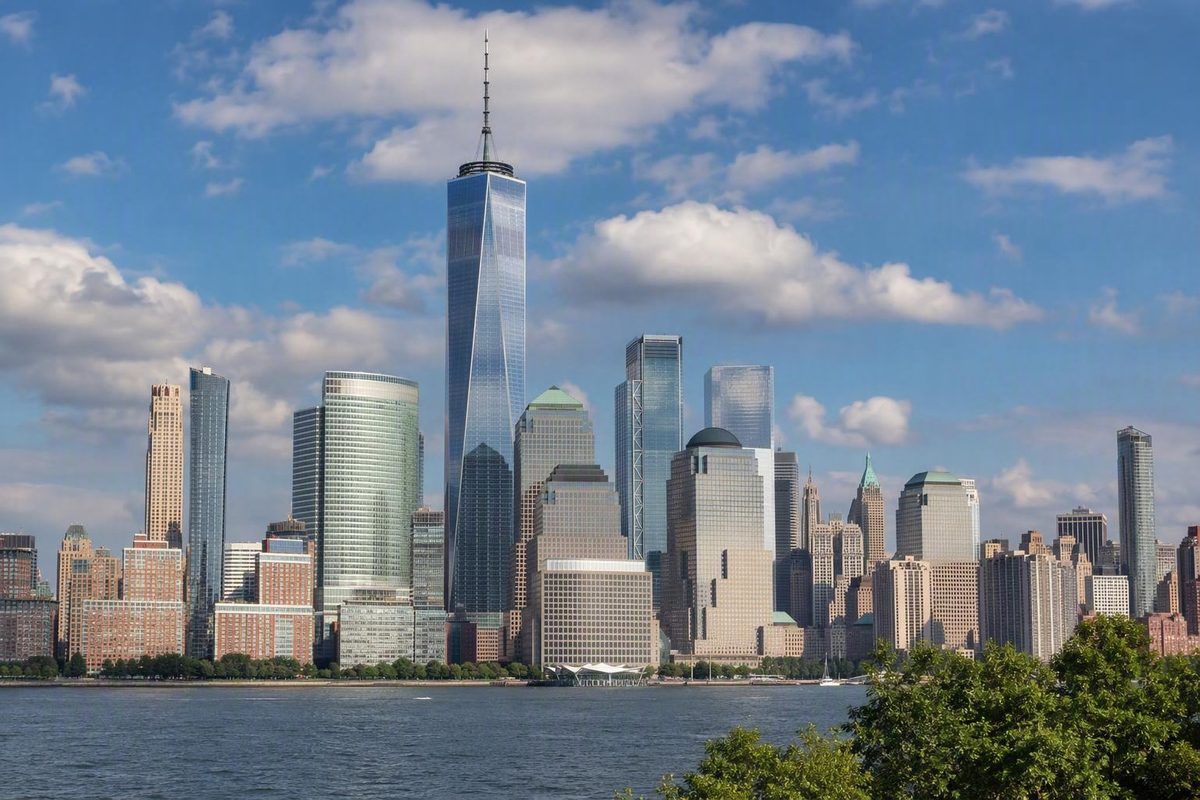
The direct answer: One World Trade Center
One World Trade Center is the tallest building in New York City in the cited Skyscraper Center city ranking. It rises 1,776 feet, or approximately 541 meters, above Lower Manhattan. The specialist database displays the metric figure more precisely as 541.3 meters, a difference caused by rounding rather than a different building height. The Skyscraper Center places One World Trade Center first in its New York City table.
The tower was completed in 2014 and stands in Lower Manhattan near West and Vesey Streets. A New York City tall-buildings reference identifies its height and completion year.
The concise answer is:
Tallest building in the cited New York ranking: One World Trade Center Listed height: 1,776 feet, or about 541 meters Completed: 2014 Location: Lower Manhattan, near West and Vesey Streets
That answer comes with one important methodological limit. The available Skyscraper Center city table identifies One World Trade Center as the city’s tallest building, but the extracted table is not explicitly labeled as a completed-buildings-only ranking and does not provide a visible update date for each entry. It should therefore be read as the result shown by the cited ranking, not as an independently audited August 2026 survey of every current or proposed project.
The same evidence does not justify broader claims about the tower’s present national, Western Hemisphere or worldwide position. Those comparisons would require a consistently dated ranking, a clearly stated development-status filter and a uniform measurement standard.
Why skyscraper height is not as simple as it sounds
“Which building is tallest?” appears to be a simple question, but several different measurements can be associated with one skyscraper:
These labels are not interchangeable. A roof-height figure answers a different question from a total-tip figure, and neither should automatically be compared with a ranked architectural height. A useful skyscraper comparison applies one convention consistently across every building.
The Empire State Building illustrates the problem clearly. It is reported as 1,250 feet to the roof and 1,454 feet to the antenna tip. Both figures describe the same structure, but the tip measurement is 204 feet greater than the roof measurement. The Empire State Building reference reports the roof and total-tip heights separately.
The cited New York city ranking uses 1,776 feet for One World Trade Center. However, its city-table excerpt does not explain how the tower’s spire is classified or provide the underlying height-criteria documentation. It supports using 1,776 feet as the listed comparison figure, but it does not independently establish why every element at the top of the tower is included or excluded.
That distinction prevents circular reasoning. It would not be enough to say that One World Trade Center ranks first “because its spire counts” without first documenting the rule under which the spire is counted. The defensible conclusion is narrower: the cited city ranking lists One World Trade Center first at 1,776 feet.
The available sources also do not establish a separate New York winner measured strictly to the roof, highest occupied floor or total physical tip. Determining those records would require verified, like-for-like measurements for every candidate. Architectural heights cannot simply be repurposed as roof heights.
Story counts are not a reliable shortcut either. A building with more numbered floors is not necessarily taller.
For readers, the practical rule is straightforward: check the label attached to every height. A ranking is meaningful when all entries follow the same convention. If one building is represented by its roof height and another by its antenna tip, the resulting order may look precise while comparing different things.
How One World Trade Center compares with New York’s other supertalls
One World Trade Center anchors the Lower Manhattan skyline, while several other buildings exceeding 1,300 feet stand in Midtown. The following table is a scale comparison using the heights displayed by the Skyscraper Center, not a newly verified August 2026 ranking restricted to completed buildings. The extracted city table can accommodate multiple development statuses without displaying those statuses consistently in the available text. All five listed heights and metric conversions come from the Skyscraper Center city table.
| Building | Listed height | Metric height | Difference from One World Trade Center |
|---|---|---|---|
| One World Trade Center | 1,776 ft | 541.3 m | — |
| Central Park Tower | 1,550 ft | 472.4 m | 226 ft shorter |
| 111 West 57th Street | 1,428 ft | 435.3 m | 348 ft shorter |
| One Vanderbilt | 1,401 ft | 427 m | 375 ft shorter |
| 432 Park Avenue | 1,397 ft | 425.7 m | 379 ft shorter |
The closest comparison in the table is Central Park Tower. Subtracting its listed 1,550 feet from One World Trade Center’s 1,776 feet produces a difference of 226 feet.
The next three buildings occupy a much tighter range. There are only 31 feet between 111 West 57th Street at 1,428 feet and 432 Park Avenue at 1,397 feet. One Vanderbilt, at 1,401 feet, falls within that same compact group.
Location affects how those differences appear in person. Because the buildings are separated geographically and usually viewed against different foregrounds, their relative heights can be difficult to assess from the street. The published measurements provide scale more reliably than casual visual comparison.
The table deliberately stops at five selected buildings. Extending it into a definitive current top ten would require checking the completion status, measurement convention and update date for every entry. Without that additional verification, a longer descending list could imply more certainty than the available data supports.
Central Park Tower is the residential record holder, not the overall tallest
Central Park Tower is listed at 1,550 feet and appears behind One World Trade Center in the cited city comparison. It is one of the most likely alternative answers readers will encounter, but its best-known height claim concerns a particular building category.
Central Park Tower is residential. Its promotional property site calls it the “tallest residential tower ever realized,” gives its height as 1,550 feet and associates the project with Adrian Smith + Gordon Gill Architecture. Because the statement comes from the property’s own marketing site rather than an independent ranking authority, the residential record should retain that attribution. Central Park Tower’s property site presents the residential claim and height.
The category distinction is essential:
Two different records
- Tallest overall in the cited New York city table: One World Trade Center
- Residential distinction claimed by Central Park Tower’s property site: Central Park Tower
“Tallest residential tower” narrows the field according to building use. “Tallest building in New York” compares qualifying skyscrapers regardless of whether they are residential, commercial, mixed-use or another type. A building can lead the residential category without leading the citywide comparison.
That is why search results describing One World Trade Center as New York’s tallest building and Central Park Tower as its tallest residential tower need not contradict each other. They address different categories.
The residential claim should not be expanded into an unsupported roof-height or occupied-floor record. Those are measurement categories, not use categories, and the available evidence does not establish who leads them.
Why the Empire State Building is often mistaken for the tallest
The Empire State Building is not identified as New York City’s tallest building in the cited evidence.
It was the world’s tallest building until the original World Trade Center’s North Tower topped out in 1970. Following the destruction of the World Trade Center in 2001, the Empire State Building again became New York City’s tallest. It retained that city status until One World Trade Center surpassed it in 2012. The Empire State Building history records those changes in height status.
For many readers, it remains the building most closely associated with the traditional New York skyscraper. Recognition, historical importance and height, however, are separate qualities.
The building’s two commonly reported measurements reinforce the need for careful labels:
- Roof height: 1,250 feet
- Total tip height: 1,454 feet, including the antenna
Its observatories are reported on the 80th, 86th and 102nd floors. Those visitor levels are relevant when choosing an observation attraction, but they do not determine the building’s place in a height ranking.
Even the Empire State Building’s larger 1,454-foot tip figure is below One World Trade Center’s listed 1,776 feet. The comparison still requires care because one number is explicitly a total-tip height while the other is the figure used by a city ranking. The strongest conclusion does not depend on mixing those labels: the cited New York ranking no longer places the Empire State Building first.
The meaning behind the 1,776-foot height
One World Trade Center’s defining height was selected as a historical reference. A real-estate article updated in April 2025 explains that 1,776 feet corresponds to 1776, the year associated with the signing of the United States Declaration of Independence. The same article identifies David Childs of Skidmore, Owings & Merrill as the tower’s designer. RentHop attributes the symbolic height and identifies the designer.
The symbolism and the measurement standard are separate issues. The historical reference explains why 1,776 was selected as the tower’s defining number. It does not independently explain how a specialist ranking classifies the roof, spire or other structural components.
Keeping those questions separate avoids overstatement:
- Design question: Why was 1,776 chosen?
- Measurement question: Which physical elements count under the ranking standard?
- Ranking question: How does the resulting figure compare with figures calculated under the same convention?
The cited real-estate article also notes that the building is sometimes called the Freedom Tower. One World Trade Center is its official name and the name used throughout this guide.
The supported symbolism applies to the selected height. It should not be extended into claims about the intended meaning of individual façade, base or spire elements without additional architectural documentation.
Visiting One World Observatory without confusing it with the building’s full height
Visitors can enter One World Trade Center to visit One World Observatory, an attraction inside the building.
A travel guide places the observatory on floors 100 through 102 and describes three observation levels with 360-degree views of New York City. Those floor numbers identify the public attraction’s location inside the tower; they are not another expression of the building’s height. Northleg describes the observatory levels and views.
The official listed address is:
One World Trade Center 117 West Street New York, NY 10007
The official attraction site places the building at West and Vesey Streets and lists daily operating hours of 9:00 a.m. to 9:00 p.m., expressly noting that hours are subject to seasonal change. Because schedules and availability can change, visitors should confirm the current details on the official One World Observatory website before going.
It helps to keep three different concepts separate:
- The building height is the listed measurement used in the city ranking.
- The observatory floors identify where the visitor attraction operates.
This distinction prevents a common misunderstanding in which the full height of One World Trade Center is casually assigned to its viewing areas.
If using timed admission, leave flexibility around the reservation rather than making the rest of the day depend on an unverified schedule. The official attraction site is the appropriate place to check current hours and availability shortly before arrival.
Build the tower into a walking-first Lower Manhattan day
One World Trade Center works naturally as one stop in a compact Lower Manhattan itinerary. There is little reason to alternate repeatedly between downtown and Midtown when the tower can be grouped with nearby waterfront, Financial District, memorial and civic areas.
A practical route begins near the harbor, moves through the Financial District and World Trade Center area, and then continues east or northeast. Depending on personal priorities, the day can finish around the Seaport, Chinatown or the East River.
Useful route anchors include:
- Battery Park and the waterfront edge
- Bowling Green
- Wall Street and its surrounding blocks
- Trinity Church
- The World Trade Center memorial and transportation area
- One World Trade Center and One World Observatory
- The Seaport
- Chinatown or another East River-side finish
Starting near Battery Park gives the route a clear southern edge. From there, Bowling Green, Wall Street and Trinity Church form a coherent progression through the Financial District. The memorial and transportation area then leads naturally toward One World Trade Center.
A timed observatory reservation can serve as the day’s fixed point. With an earlier booking, the harbor and Financial District can come first, followed by the Seaport or another downtown finish. With a later booking, the surrounding neighborhood can be explored before entering the tower. In either case, the route remains concentrated in Lower Manhattan.
Avoid assigning rigid durations to every segment. The appropriate pace will depend on personal interest, weather, crowds and the observatory’s seasonal schedule. The purpose of a walking-first plan is geographic coherence, not an inflexible timetable.
For a more complete sequence, use New York Know’s walking-first Lower Manhattan day. That guide supports the route planning described here; it is not evidence for the tower’s height or ranking.
Approaching the World Trade Center area as part of a broader downtown walk also provides context. The harbor, older Financial District streets, memorial spaces and newer towers become parts of one neighborhood sequence rather than disconnected attractions.
Frequently asked questions
What is the tallest building in New York City?
The cited New York rankings identify One World Trade Center as the city’s tallest building. It stands in Lower Manhattan and has a listed height of 1,776 feet. A real-estate overview updated in April 2025 reaches the same city-level conclusion, although it does not provide a completed-buildings methodology for August 2026. See the dated overview of New York’s tallest buildings.
How tall is One World Trade Center in feet and meters?
One World Trade Center is listed at 1,776 feet, or approximately 541 meters. Some sources round the conversion to 541 meters, while the specialist city table displays 541.3 meters. These figures describe the same listed height.
Does One World Trade Center’s 1,776-foot height include its spire?
The cited city table uses 1,776 feet as One World Trade Center’s listed height, but the available table excerpt does not explain its treatment of the spire. Without the ranking authority’s applicable height-criteria documentation and building profile, this article cannot independently verify why or how the spire is included.
For comparisons, use the listed figure only alongside heights reported under the same ranking convention. Do not compare it directly with another building’s roof-only measurement.
What is the tallest residential building in New York?
Central Park Tower’s property site describes it as the “tallest residential tower ever realized” and lists its height as 1,550 feet. That is a promotional, category-specific claim from the building’s own site rather than independent verification of an overall city record.
In the cited all-building city comparison, Central Park Tower appears behind One World Trade Center.
Is the Empire State Building still the tallest building in New York?
No. The Empire State Building is not first in the cited modern New York ranking. It regained the city title after 2001, but One World Trade Center surpassed it in 2012.
Its historical importance and recognizable profile explain why it remains associated with the record. Its reported roof and antenna-tip heights also show why building measurements must be labeled consistently.
In short, the cited sources identify One World Trade Center at 1,776 feet as New York City’s tallest building, ahead of the 1,550-foot Central Park Tower. That conclusion follows the published city ranking rather than a separate roof-height comparison or a newly audited August 2026 completed-buildings list. The cited overview reports both heights and their city order. For visitors, the practical approach is to include One World Trade Center and its observatory in a compact Lower Manhattan day and confirm current attraction details directly before arrival.