 New York Know
Sleepy Hollow rewards selective planning. The best first visit is not an attempt to collect every mansion, bridge, grave, park, and Halloween event in one sweep. Build the day around the cemetery-and-North Broadway landmarks, then add either one reserved historic property or time beside the Hudson.
That approach matters because “Sleepy Hollow” itineraries often blend the village with neighboring Tarrytown, Pocantico Hills, and Croton-on-Hudson. Some literary landmarks sit close together, but the lighthouse, downtown Tarrytown, nature preserves, and outlying estates add meaningful travel time. A route that looks compact on a regional map can become a long day on foot.
The short answer: five places to prioritize in Sleepy Hollow
For a first visit, prioritize these five places:
- Sleepy Hollow Cemetery — Sleepy Hollow. Visit Washington Irving’s family plot, explore the landscaped grounds respectfully, and look for the cemetery’s Old Style Horseman Bridge.
- Old Dutch Church and Burying Ground — Sleepy Hollow. This historic churchyard is beside the larger cemetery but is a separate site.
- Philipsburg Manor — Sleepy Hollow. Choose it for an interpretive experience focused on an eighteenth-century mill and trading complex, including the history of the enslaved community that lived and worked there.
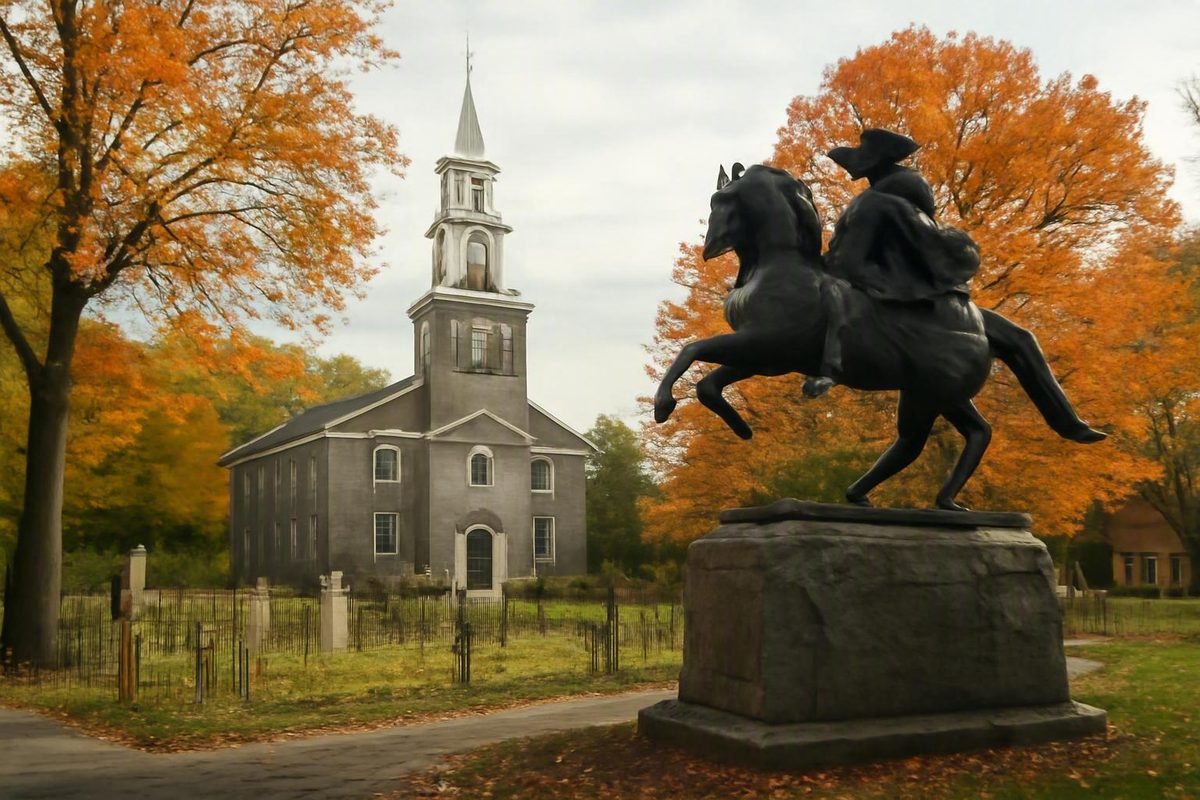
- Headless Horseman sculpture and bridge-related landmarks — Sleepy Hollow. The roadside sculpture, Pocantico River crossing, and cemetery bridge provide recognizable literary photo stops, although none should be presented as Irving’s surviving original bridge.
- Kingsland Point Park and the Sleepy Hollow Lighthouse — Sleepy Hollow. Walk or picnic beside the Hudson and view the 1883 lighthouse from outside; interior access depends on scheduled programming rather than ordinary park admission according to the regional visitor guide.
The cemetery, Old Dutch Church, Headless Horseman sculpture, and Philipsburg Manor form the most efficient historic cluster along or near North Broadway. They are the logical core of a half-day visit. The cemetery and church area can provide a satisfying visit without a major property tour, subject to current access.
The waterfront is a separate commitment. Kingsland Point Park is not simply another five-minute stop beside the cemetery, so do not assume that all five priorities fit comfortably into a short pedestrian outing. If you have a timed tour, limited daylight, or a low tolerance for long walks, use a taxi or rideshare between clusters.
It is also useful to distinguish independent landmarks from scheduled experiences:
- Usually suited to independent viewing when access permits: cemetery grounds, Irving’s grave, the Old Dutch Church area, the roadside sculpture, Beekman Avenue, public park walks, and the lighthouse exterior.
- Dependent on dates, reservations, or programming: Philipsburg Manor admission, guided cemetery tours, lighthouse interiors, estate tours, church interiors, and most Halloween events.
Sleepy Hollow is not exclusively a Halloween destination. Its year-round appeal comes from Washington Irving’s literary landscape, regional history, cemetery architecture, wooded paths, and the Hudson River. October adds atmosphere and programming, but it also reduces flexibility.
Walk the Washington Irving and Headless Horseman landmarks
Begin at Sleepy Hollow Cemetery. Its roughly 90-acre landscape contains Washington Irving’s family plot and the graves of prominent figures including Andrew Carnegie, Walter Chrysler, and Elizabeth Arden. A map is useful because the grounds are much larger than a compact churchyard; available local reporting also notes that visitors may explore independently or reserve a guided tour when offered in its cemetery overview.
Independent exploration is generally the simplest choice when the grounds are open and public access is permitted. Guided daytime and evening tours can provide additional context, but they run on selected dates rather than necessarily every day. Check current cemetery access rules, tour availability, and any route restrictions shortly before traveling.
Allow enough time to walk quietly and read the landscape. Keep voices low around services and mourners, remain on permitted routes, respect barriers, and do not use grave markers as seats or photo props.
The Old Dutch Church and Burying Ground stands beside the cemetery, but the two should not be collapsed into one attraction. The church has its own burial ground; Sleepy Hollow Cemetery is the much larger neighboring landscape. The distinction can be confusing because guides frequently discuss both places together and their literary associations overlap.
Nearby, the Pocantico River provides the geographic thread connecting the church, the legend, and today’s bridge landmarks. Washington Irving’s “The Legend of Sleepy Hollow” was published on March 20, 1820, in an installment of The Sketch Book of Geoffrey Crayon, Gent. according to Visit Sleepy Hollow. The story’s association with this landscape now shapes local signs, sculpture, tours, performances, and seasonal programs.
Understanding the bridge question
Visitors commonly encounter two present-day bridge references:
- The modern roadway crossing near North Broadway: This crossing helps place the legendary pursuit in the local landscape, but it is a contemporary road bridge rather than a preserved storybook bridge.
- The Old Style Horseman Bridge inside the cemetery: This is the more picturesque photographic stop, crossing the Pocantico River within the cemetery landscape.
The bridge from Irving’s tale has not survived in the romantic form many visitors expect. Neither current structure should be advertised as an authenticated original. Treat both as symbolic landmarks that help connect the fiction to the river, road, churchyard, and surrounding terrain.
The roadside Headless Horseman sculpture is another quick stop. Its cut-steel scene of the Horseman pursuing Ichabod Crane makes an effective photograph, but the sculpture stands on a traffic island as documented in a current regional itinerary. Use legal crossings, remain alert to vehicles, and do not enter the roadway for a better angle.
A sensible literary walk follows this sequence:
- Enter Sleepy Hollow Cemetery and orient yourself with a current map.
- Visit Washington Irving’s family plot.
- Continue to the Old Style Horseman Bridge if the route is open.
- Return toward the Old Dutch Church and its separate burying ground.
- See the Pocantico River and modern roadway crossing.
- Stop at the Headless Horseman sculpture.
- Continue toward Philipsburg Manor or Beekman Avenue.
The point is not merely to prove that you reached a particular bridge. The value lies in seeing how river, churchyard, road, wooded ground, and old settlement patterns became the setting for a durable American legend.
Choose one deeper history or art experience
After the literary landmarks, choose one major interpretive experience. The right choice depends on whether you care most about social history, Rockefeller history, art, Washington Irving, or architecture.
Philipsburg Manor — Sleepy Hollow
Philipsburg Manor is the most geographically convenient scheduled addition to the North Broadway route. It belongs in a serious history itinerary, not merely in the background of a Headless Horseman photograph.
The property interprets an eighteenth-century mill and trading complex where an enslaved community lived and worked. Its presentation encompasses the mill, manor landscape, material culture, and the economic and social systems that shaped the site as summarized in this Sleepy Hollow itinerary.
Choose Philipsburg Manor if you want:
- The easiest scheduled property to combine with the cemetery cluster
- Colonial-era social and economic history
- Interpretation of enslavement in the northern colonies
- A mill-and-manor setting rather than a later country estate
Tours, demonstrations, building access, and operating dates can vary. Reserve only after checking what the selected ticket includes, where to check in, and how much time the experience requires.
Kykuit — Pocantico Hills area
Kykuit offers a guided look at a Rockefeller family estate, with experiences associated with the house, gardens, art, terraces, and coach-barn collections. It is a stronger choice for visitors interested in the Rockefeller family, estate landscapes, or art collecting than for those seeking a purely Irving-centered day.
A published visitor account reports that Kykuit is not a casual drive-up attraction and that organized visits depart from the visitor area at Philipsburg Manor. Treat that as a planning prompt rather than permanent policy: confirm the current departure point, transportation arrangement, parking instructions, and check-in procedure directly with the operator.
Choose Kykuit if the estate is the day’s principal reservation. Do not schedule it as a loose extra between the cemetery and lighthouse.
Union Church of Pocantico Hills — Pocantico Hills area
Union Church is the art-focused alternative, noted for stained glass by Marc Chagall and Henri Matisse. It can be a more contained experience than a large estate tour, but “shorter” does not mean “available whenever convenient.” Opening days, entry arrangements, services, and seasonal access require confirmation.
Choose Union Church if stained glass is a higher priority than touring a furnished estate or if you want one focused cultural stop after the cemetery.
Washington Irving’s Sunnyside — Tarrytown area
Sunnyside is the natural choice for visitors whose primary interest is Washington Irving himself. It was Irving’s Hudson Valley home, but it is associated with the Tarrytown area rather than lying inside Sleepy Hollow village.
Pairing Sunnyside with the cemetery creates a coherent Irving day: first his grave and the landscape of the legend, then his home. The tradeoff is transportation. Because Sunnyside lies south of the central Sleepy Hollow cluster, it should replace another distant attraction rather than be added automatically.
Lyndhurst — Tarrytown area
Lyndhurst is the architectural choice, with a Gothic Revival estate setting, grounds, and scheduled interior experiences. It belongs to a broader Tarrytown-area itinerary, not a compact walk around central Sleepy Hollow.
Choose Lyndhurst if architecture and estate grounds matter more than a second literary stop. It can pair well with downtown Tarrytown or a departure from Tarrytown station.
Union Church’s stained glass, Kykuit’s Rockefeller collections, and the broader range of nearby historic properties are summarized in the regional attraction guide, but current admission and seasonal procedures still require direct confirmation with each operator.
The choose-one rule
For most first-time day-trippers:
- Choose Philipsburg Manor for social and colonial history.
- Choose Kykuit for Rockefeller history, gardens, and art.
- Choose Union Church for a concentrated stained-glass stop.
- Choose Sunnyside for Washington Irving.
- Choose Lyndhurst for architecture and estate grounds.
Attempting two or three timed properties in one day creates a brittle itinerary. Entry windows may be limited, operating calendars can be seasonal, and the properties are not all in the same pedestrian cluster. One substantial reservation leaves room for meals, delays, and the independent landmarks that give the destination its atmosphere.
See the Hudson waterfront, lighthouse, parks, and trails
The Hudson is not an afterthought. A waterfront walk provides a useful contrast to the cemetery and historic properties, particularly after several hours indoors or among densely layered historical sites.
Kingsland Point Park and the lighthouse — Sleepy Hollow
Kingsland Point Park is the principal choice for a Sleepy Hollow waterfront visit. Use it for a walk, a picnic where current rules permit, river views, and an exterior view of the Sleepy Hollow Lighthouse.
The lighthouse dates to 1883 and is approached through the park area. Interior access is limited and program-dependent, so arriving at the structure does not mean visitors can enter it. Even without an interior tour, the exterior and Hudson setting can justify the trip.
The important planning issue is distance. The lighthouse and cemetery are not one compact attraction. Adding both creates a longer day, especially if you also intend to eat on Beekman Avenue or attend a reserved tour.
Westchester RiverWalk and riverfront areas — Sleepy Hollow and Tarrytown
The Kingsland Point area serves the Sleepy Hollow lighthouse, while Tarrytown’s waterfront parks and paths are better placed for a route ending near Tarrytown station.
Tarrytown riverfront stops can provide views of the Hudson and the Governor Mario M. Cuomo Bridge. They work particularly well at the end of a north-to-south day, when returning to the cemetery would mean unnecessary backtracking.
Old Croton Aqueduct Trailway — Sleepy Hollow and surrounding communities
The Old Croton Aqueduct Trailway is the most natural way to combine history with a longer walk. Its local route passes the church and cemetery area and crosses the Pocantico River, extending the literary landscape into a broader trail experience.
Choose a defined section rather than assuming you will simply “do the trail” after several hours of sightseeing. Trail time expands quickly, and conditions can differ from those on a paved urban promenade. Wear suitable footwear, monitor daylight, and confirm current detours or closures before making the trail central to the itinerary.
Rockefeller State Park Preserve — near Sleepy Hollow and Pocantico Hills
Rockefeller State Park Preserve is the stronger option for a dedicated nature outing. Its landscape includes woodlands, meadows, wetlands, and lake scenery. Fishing requires a license, horseback riding requires permission, and parking may involve a fee, according to the preserve information summarized by Historic Hudson River Towns.
Treat the preserve as a principal half-day activity rather than a quick add-on after multiple house tours. Confirm current rules, access points, and parking arrangements before departure.
Build an outdoor day around one idea
A coherent outdoor plan might be:
- Cemetery and a defined Old Croton Aqueduct section
- Cemetery cluster plus Kingsland Point Park
- Rockefeller State Park Preserve plus one short historic stop
- Sleepy Hollow waterfront followed by Tarrytown RiverWalk and dinner
An incoherent plan combines a long aqueduct walk, a substantial preserve outing, the lighthouse, two estates, and the cemetery in one day. Decide whether the priority is breadth or depth. A short vehicle transfer between the cemetery and waterfront can preserve time and energy for the parts of the day that matter most.
Use a realistic half-day or full-day itinerary
The easiest way to organize Sleepy Hollow is to think in four clusters:
- Cemetery and North Broadway: Sleepy Hollow Cemetery, Irving’s grave, Old Dutch Church, Pocantico River, cemetery bridge, and Headless Horseman sculpture.
- Philipsburg Manor and Beekman Avenue: the scheduled historic property, village business district, food, and a rest.
- Kingsland Point Park and lighthouse: Hudson waterfront and lighthouse exterior.
- Neighboring attractions: downtown Tarrytown, Sunnyside, Lyndhurst, Kykuit, Union Church, and Rockefeller State Park Preserve.
The first two clusters combine most naturally. The third adds distance. The fourth requires deliberate transportation and should never be treated as though every attraction lies in downtown Sleepy Hollow.
A practical half-day
Best for: First-time visitors focused on Irving and the Headless Horseman, without a major property tour.
- Arrive at Philipse Manor station.
- Walk toward Sleepy Hollow Cemetery.
- Find Washington Irving’s grave using the current cemetery map.
- Continue to the Old Style Horseman Bridge, if accessible.
- Visit the adjacent Old Dutch Church and Burying Ground.
- See the Pocantico River crossing and Headless Horseman sculpture.
- Continue toward Beekman Avenue for food, coffee, or a seated break.
- Return from Philipse Manor or continue south only if time and energy allow.
This is enough for a meaningful visit. Do not weaken it by racing to the lighthouse merely to collect one additional photograph.
A practical full day
Best for: Visitors who want one deeper historic experience plus either the waterfront or Tarrytown.
- Begin at Philipse Manor station.
- Explore the cemetery-and-North Broadway cluster.
- Attend one prebooked experience, preferably Philipsburg Manor for geographic efficiency.
- Take a proper meal or rest break around Beekman Avenue.
- Choose one afternoon direction: - Hudson option: Travel to Kingsland Point Park and see the lighthouse exterior. - Tarrytown option: Continue south for downtown dining, a Tarrytown riverfront walk, and departure from Tarrytown station.
- Leave optional stops optional. If the morning runs long, skip the final detour.
A short taxi or rideshare can protect the afternoon, particularly when moving to the waterfront, reaching an outlying estate, traveling with children, or conserving energy for an evening event.
A history-focused alternative
Instead of the waterfront, combine the cemetery cluster with one of these:
- Kykuit — Pocantico Hills area: Rockefeller history and art
- Union Church — Pocantico Hills area: stained glass
- Sunnyside — Tarrytown area: Irving’s home
- Lyndhurst — Tarrytown area: architecture and estate grounds
This version may involve fewer attractions but more scheduled structure. Put the reservation at the center of the day, then place the cemetery before or after it according to current access hours and realistic travel time.
Walking realities
Central landmarks can be explored on foot, but the entire destination should not be described as effortlessly walkable. A full pedestrian day may include hills, road noise, traffic exposure, long gaps between clusters, and sections where sidewalks feel less comfortable than those in a dense city neighborhood.
A personal north-to-south travel account describes substantial walking and notes a sidewalk gap near the cemetery in its route report. That observation reflects one itinerary rather than a complete accessibility survey, but it is a useful reason to inspect current pedestrian directions rather than relying on the word “walkable.”
Avoid minute-by-minute schedules based on unverified opening hours. Build in:
- Time to orient yourself inside the cemetery
- A seated meal or coffee break
- A buffer before every ticketed admission
- Extra time for hills, crossings, and navigation
- A fallback if a site is closed
- Enough daylight for the final outdoor section
Before adding optional stops, decide three anchors: arrival station, timed attraction, and departure station. The rest of the route should support those decisions.
Get there from New York City and choose the right station
Metro-North’s Hudson Line provides a practical car-free approach from Grand Central Terminal. Train schedules, journey times, fares, platform details, accessibility information, and service changes are operational facts, so obtain them directly from the MTA for the date of travel rather than copying them from an older itinerary.
Choose Philipse Manor for a cemetery-first day
Philipse Manor is normally the more logical arrival station when the first priorities are:
- Sleepy Hollow Cemetery
- Washington Irving’s grave
- Old Dutch Church
- The cemetery bridge
- Headless Horseman sculpture
- Philipsburg Manor
It places you toward the northern historic cluster and reduces the need to begin with a longer northbound walk from downtown Tarrytown.
Choose Tarrytown for downtown and the southern waterfront
Tarrytown station makes more sense when your priorities are:
- Downtown Tarrytown restaurants and shops
- Tarrytown’s riverfront and RiverWalk areas
- A Tarrytown-area property
- A south-to-north route
- A convenient finish after walking south from Sleepy Hollow
It also provides a broader dining cluster near the end of the day.
Use different stations to avoid backtracking
One efficient car-free plan is to arrive at Philipse Manor, walk generally south through the historic cluster and Beekman Avenue, continue into Tarrytown as energy permits, and depart from Tarrytown station.
The northern and southern stations are not interchangeable, however. The fact that both serve the broader area does not mean either is equally convenient for every itinerary.
When to use a taxi or rideshare
Consider a vehicle transfer when:
- You have a fixed admission time
- You are moving between the cemetery and lighthouse
- You are visiting Sunnyside, Lyndhurst, Kykuit, Union Church, or the preserve
- Heat, rain, darkness, or fatigue makes the walk undesirable
- Someone in the group has limited walking tolerance
Availability can fluctuate, especially during large events. Do not leave an essential transfer until the last possible moment.
Driving and accessibility cautions
Drivers should check each attraction’s current parking instructions. Do not depend on finding convenient curbside parking, particularly in October. A property ticket does not necessarily establish where visitors may park or guarantee that space will be available.
Travelers with limited mobility should confirm more than station accessibility. Ask about the complete route: platform access, sidewalks, road crossings, gradients, cemetery terrain, seating and rest opportunities, attraction entrances, and the availability of an accessible local vehicle. The supplied evidence does not support a blanket claim that every route or historic property is wheelchair accessible.
Plan differently for October and Halloween
October changes both the atmosphere and the logistics. It brings a dense concentration of cemetery tours, storytelling, haunted attractions, pumpkin displays, street fairs, markets, parades, and historical programs. It can also bring sold-out tickets, congested roads, crowded sidewalks, scarce parking, and temporary closures.
Commonly promoted examples include:
- Sleepy Hollow Cemetery day and evening tours
- Irving-themed storytelling or theatrical performances
- Sleepy Hollow’s Haunted Hayride
- Pumpkin displays
- Street fairs and seasonal markets
- Tarrytown Halloween celebrations
- The Great Jack O’Lantern Blaze
These are recurring categories and familiar event names, not a guarantee that every program will operate in the same form on your chosen date. Review the current listings on the Halloween in Sleepy Hollow Country page before buying transportation or building the day around an event.
The Blaze is not in Sleepy Hollow
The Great Jack O’Lantern Blaze takes place at Van Cortlandt Manor in Croton-on-Hudson, not within Sleepy Hollow village. Tourism material for the wider “Sleepy Hollow Country” region frequently groups it with Sleepy Hollow activities, which can obscure the additional journey.
Treat the Blaze as a separate destination requiring its own transportation plan. Do not finish a full walking day in Sleepy Hollow and assume you can casually walk to it.
Reserve the main event first
For an October visit:
- Choose the main ticketed event.
- Reserve it before building the rest of the itinerary.
- Confirm its exact municipality and entrance.
- Work backward to determine train and local transportation.
- Add no more than one substantial daytime tour.
- Fill remaining time with independent landmarks near the route.
This protects the experience that would be hardest to replace. The cemetery, sculpture, village decorations, and parks may offer more flexibility, subject to current access, while a missed timed admission may not.
Past October traffic advisories have urged visitors to expect congestion, use Metro-North when practical, check real-time conditions, and arrive with a substantial buffer when preparing for a ticketed visit. Apply those planning principles, but do not reuse historical closure times, detours, or event dates as current instructions.
Follow the individual ticket operator’s late-arrival and refund rules. Do not assume a venue will admit you after your window because traffic was heavy.
If October events sell out
A sold-out evening does not make the day pointless. Build a backup around places that may be viewed independently, subject to current opening and park rules:
- Sleepy Hollow Cemetery and Irving’s grave
- Old Dutch Church area
- Cemetery bridge
- Headless Horseman sculpture
- Beekman Avenue decorations
- Kingsland Point Park and lighthouse exterior
- Tarrytown riverfront
- A meal in Sleepy Hollow or Tarrytown
Check current listings for smaller markets, performances, or historical programs with remaining availability, but do not chase scattered events across several communities.
Consider another season
October offers maximum Halloween atmosphere but minimum flexibility. Spring, summer, and quieter parts of fall may make walking, parking, and independent sightseeing easier. The tradeoff is that historic properties and tours can have narrower operating calendars outside peak periods.
For visitors mainly interested in Irving, cemetery history, architecture, art, or Hudson scenery, a non-event date may be the more satisfying choice.
Food, boundaries, and checks to make before leaving
Beekman Avenue is the principal Sleepy Hollow dining and shopping zone. It is the natural place to pause after the cemetery-and-Broadway cluster, particularly if you plan to continue to Philipsburg Manor or the waterfront.
Available local guides identify a mixture of bakeries, delis, bagel shops, pizzerias, taquerias, taverns, and sit-down restaurants. That range is more useful than naming one establishment as universally best. Hours, menus, prices, reservations, and dietary accommodations can change, so confirm them directly.
Match the meal to the route:
- After the cemetery: Eat around Beekman Avenue.
- Ending near Tarrytown station: Use downtown Tarrytown’s broader dining cluster.
- Visiting the waterfront: Carry a picnic only after checking current park rules, or eat before leaving the business district.
- Attending an evening event: Allow enough time for food before check-in rather than assuming quick service during an October rush.
Keep municipal boundaries straight when reading itineraries:
- Sleepy Hollow: cemetery, Old Dutch Church, Philipsburg Manor, Headless Horseman sculpture, Beekman Avenue, Kingsland Point Park, and lighthouse.
- Pocantico Hills area: Kykuit and Union Church.
- Tarrytown area: Sunnyside, Lyndhurst, downtown Tarrytown, and southern riverfront stops.
- Croton-on-Hudson: Van Cortlandt Manor and the Great Jack O’Lantern Blaze.
These distinctions are practical, not pedantic. They affect which train station to use, whether a taxi is sensible, and how much can fit before sunset.
Pre-trip checklist
Before departure, verify:
- Current opening hours for every intended site
- Timed-ticket availability and check-in instructions
- Seasonal operating dates
- Cemetery and church access
- Lighthouse tour availability, if interior access matters
- Metro-North schedules, fares, service changes, and station accessibility
- Parking rules for each ticketed property
- Event-related street closures and traffic notices
- Route accessibility and pedestrian conditions
- Restroom access at the places you intend to visit
- Weather, heat, rain, and trail conditions
- Sunset time for cemetery, trail, and waterfront plans
- Restaurant hours, reservations, and dietary needs
The available evidence does not establish dependable current restroom locations, guaranteed accessibility, reliable parking availability, or a precise trip budget. Those details are too date- and traveler-specific to infer from older itineraries.
Use the Visit Sleepy Hollow homepage for current local planning links and consult the official operator for every scheduled attraction. An old travel article can help explain geography, but it cannot confirm that a tour, restaurant, parking arrangement, or seasonal event still operates as described.
Frequently asked questions
Is Sleepy Hollow worth visiting outside October?
Yes. The cemetery, Old Dutch Church, Irving landmarks, Hudson waterfront, trails, parks, stained glass, and historic properties are not inherently Halloween-only attractions. Outside October, visitors may encounter lighter crowds and greater flexibility for independent walking.
The tradeoff is programming. Some tours and historic properties operate seasonally or only on selected days, so check schedules before choosing a date. A non-October visit works particularly well for travelers who prioritize history, river scenery, architecture, or a quieter cemetery experience over seasonal entertainment.
Can you visit Sleepy Hollow Cemetery without taking a tour?
Generally, visitors can explore the cemetery independently when it is open and public access is permitted. A current map can help locate Washington Irving’s family plot, the cemetery bridge, and other notable graves.
Guided daytime and evening tours may be offered on selected dates for visitors who want more context. Do not assume that tours run daily, and confirm current access rules before traveling. Whether self-guided or guided, remember that it remains an active cemetery.
Can you visit Sleepy Hollow without a car?
Yes. Metro-North’s Hudson Line makes a car-free day trip practical. Philipse Manor is usually the better arrival station for a cemetery-first route; Tarrytown is more convenient for downtown dining, the southern waterfront, or the end of a north-to-south walking day.
A car-free visit still requires realistic distance planning. The central historic landmarks can be combined on foot, but the lighthouse, outlying estates, preserve, and neighboring communities increase the walking burden. A taxi or rideshare can connect distant clusters or protect a timed reservation.
Which Headless Horseman bridge should visitors see?
See the Old Style Horseman Bridge inside Sleepy Hollow Cemetery if you want the more picturesque photographic stop. You can also view the modern roadway crossing near the Pocantico River to understand the broader landscape associated with the tale.
Neither should be described as Washington Irving’s surviving original bridge. The storybook bridge has not endured in that form; today’s crossings function as symbolic landmarks. If time is limited, prioritize the cemetery bridge as part of the Irving grave and Old Dutch Church route.
Is the Great Jack O’Lantern Blaze actually in Sleepy Hollow?
No. The Great Jack O’Lantern Blaze is held at Van Cortlandt Manor in Croton-on-Hudson. It is commonly marketed as part of the wider Sleepy Hollow Country fall season, but it is not inside Sleepy Hollow village.
If attending, reserve the ticket first and plan transportation to Croton-on-Hudson separately. Do not assume it can be reached on foot from Sleepy Hollow Cemetery, Beekman Avenue, or the Tarrytown waterfront.
The strongest first visit remains straightforward: begin with the cemetery-and-Broadway landmarks, then add either one reserved historic property or the Hudson waterfront. Include Tarrytown, Pocantico Hills, or Croton-on-Hudson only when the additional destination improves the route rather than overloading it.
Use three final decision rules:
- Select one primary geographic cluster.
- Reserve no more than one major daytime tour.
- Add a distant attraction only after accounting for transportation.
Verify every operational detail before departure—especially in October—so the day is shaped by geography, current schedules, daylight, and walking tolerance rather than an unrealistic attraction checklist.