 New York Know
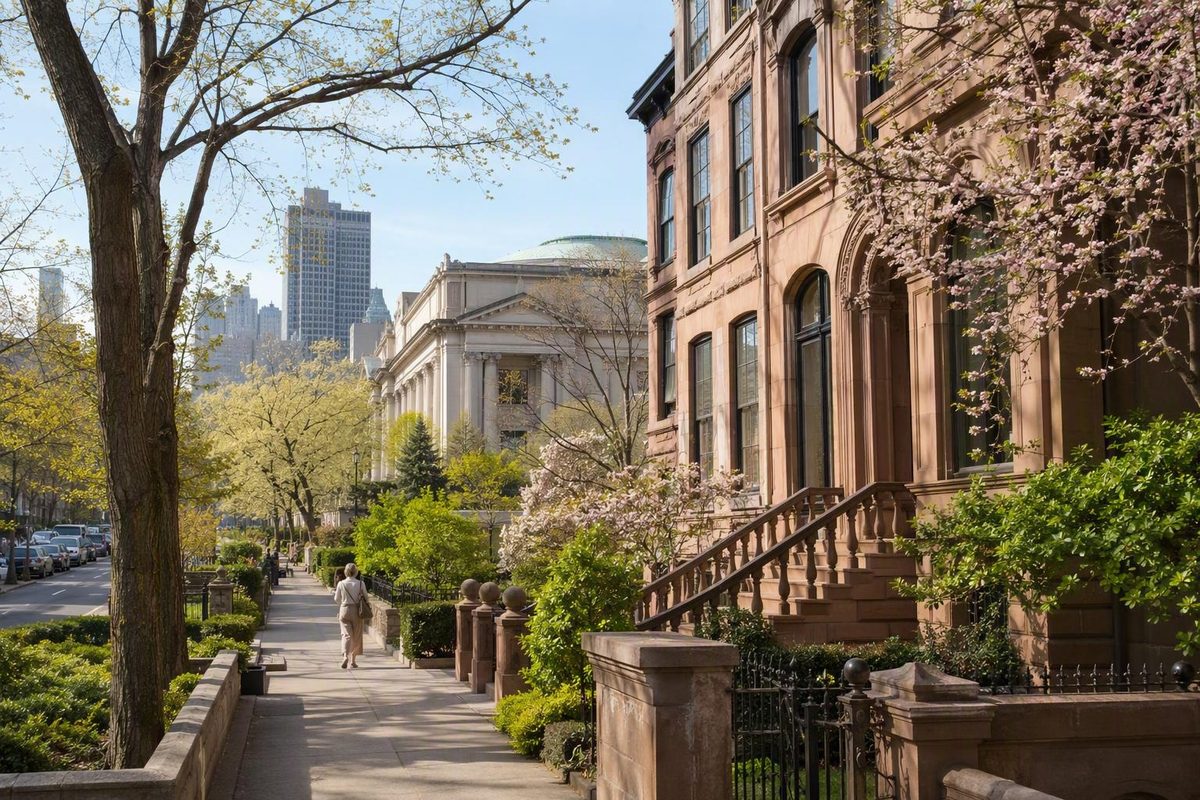
Carnegie Hill makes the most sense on foot. Along its western edge, Fifth Avenue places Central Park opposite several major museums. A block or two east, former mansions now serve as cultural or educational institutions. Continue toward Lexington and Third avenues, and the streets generally become more commercial and transit-oriented.
That compact progression—not a long checklist—is the neighborhood’s appeal. You can pair a museum with historic side streets and a walk near the Jacqueline Kennedy Onassis Reservoir without spending the day crossing Manhattan.
The main complication is geographic: Carnegie Hill has no universally settled neighborhood border. Its commonly understood core lies north of East 86th Street beside Central Park, but broader maps carry parts of it beyond East 96th Street. The legally designated historic district is a separate, overlapping geography. Those distinctions matter when comparing maps, accommodations, transit access, and attraction lists.
Carnegie Hill at a Glance: Where It Fits in Manhattan
Carnegie Hill is a neighborhood within Manhattan’s Upper East Side, not another name for the whole Upper East Side. It borders Central Park on the west and forms part of Manhattan Community District 8. A practical first orientation uses Fifth Avenue as the western edge, East 86th Street as the southern threshold, and an eastern reach toward Third Avenue. The northern boundary varies by source. Apple Maps identifies Carnegie Hill as an Upper East Side neighborhood in Community District 8 and describes the broader, irregular boundary.
For a visitor, the simplest mental map is:
- West: Fifth Avenue, Central Park, and Carnegie Hill’s portion of Museum Mile
- Center-west: Madison Avenue shopping, dining, and services
- Center: Park Avenue and substantial residential buildings
- East: Lexington and Third avenues, with more everyday retail, traffic, and transit
- South: East 86th Street, a major commercial and transportation threshold
- North: East 96th Street for a compact planning area, though broader definitions extend partly toward East 98th Street
This avenue-by-avenue pattern is approximate. A side street may feel more residential than the avenue it meets, and storefront concentration changes from block to block. Still, the framework explains why two accommodations marketed as being in “Carnegie Hill” may suit different trips. A base near Fifth Avenue favors museums and Central Park; one farther east may shorten the walk to everyday shopping or a subway entrance.
Fifth Avenue also forms part of the larger Museum Mile corridor. Not every Museum Mile institution is in Carnegie Hill: the corridor extends beyond the neighborhood, and wider Upper East Side itineraries often combine attractions from Carnegie Hill, Lenox Hill, East Harlem, and adjacent blocks.
Carnegie Hill should not be confused with Carnegie Hall, the concert venue near West 57th Street in Midtown. Check the full place name before selecting a map result or directing a driver.
The most useful visitor definition is therefore functional rather than absolute: Carnegie Hill is a compact Upper East Side district where the park edge, museums, historic institutions, and residential architecture can be combined in one walk.
Where Does Carnegie Hill Begin and End? Why Maps Disagree
New York neighborhood boundaries are conventions rather than universally fixed legal lines. Carnegie Hill illustrates the problem clearly: sources broadly agree on its location but differ over its northern and eastern limits.
For trip planning, East 86th to East 96th streets, from Fifth Avenue toward Third Avenue, works well as an editorial planning core. Corcoran uses the same rectangular description, extending from East 86th to East 96th Street and from Central Park to Third Avenue. That definition is useful and legible, but it is not an official polygon.
A broader interpretation extends part of Carnegie Hill north to East 98th Street. Apple Maps describes a northern line that reaches East 98th Street, continues just beyond Park Avenue, turns south to East 96th Street, and then proceeds east toward—but not including—Third Avenue. Its place listing notes that the description links to Wikipedia, so it is best treated as one mapped interpretation rather than a final authority.
The disagreement is most noticeable north of East 96th Street. Some descriptions include selected blocks there; others use East 96th Street as the practical dividing line. The label “Upper Carnegie Hill” also appears, particularly in real-estate usage, for territory north of East 96th Street.
| Source or planning lens | Southern edge | Northern edge | Western edge | Eastern edge | Best use |
|---|---|---|---|---|---|
| This guide’s planning core | East 86th Street | East 96th Street | Fifth Avenue | Toward Third Avenue | Compact routes and accommodation comparisons |
| Corcoran neighborhood guide | East 86th Street | East 96th Street | Central Park/Fifth Avenue | Third Avenue | A simple rectangular explanation |
| Apple Maps place description | East 86th Street | East 98th Street in part | Fifth Avenue | Irregular edge approaching, but excluding, Third Avenue | Understanding why some northern addresses carry the Carnegie Hill label |
| Carnegie Hill Historic District description | East 86th Street area | Just north of East 98th Street in part | Generally Fifth Avenue | Varies between Madison and Lexington avenues | Preservation and landmark questions |
| “Upper Carnegie Hill” usage | Usually north of East 96th Street | Variable | Variable | Variable | Informal real-estate geography |
The last two rows account for much of the confusion. The neighborhood and the Carnegie Hill Historic District are not identical. They overlap substantially, but the historic district’s eastern boundary varies between Madison and Lexington avenues rather than extending uniformly to Third Avenue. A location can therefore be described as part of the broader neighborhood without being inside the designated historic district.
Because the supplied evidence does not include an official Landmarks Preservation Commission map, use the historic-district description as orientation rather than as a parcel-level legal determination. For landmark status, renovation questions, or property research, consult the current city designation map and records before relying on a neighborhood guide.
When a location sits near East 96th Street, east of Lexington Avenue, or along the irregular northern edge, precise language is more useful than insisting on one “correct” border. Describe it as:
- inside the practical Carnegie Hill core;
- within a broader Carnegie Hill interpretation;
- inside the Carnegie Hill Historic District, if confirmed through current city records; or
- near Carnegie Hill in the wider Upper East Side.
This is particularly useful when choosing accommodations. The exact intersection, route to the park or museums, and walk to a suitable station matter more than the neighborhood name attached to a listing.
How Andrew Carnegie and Preservation Shaped the Neighborhood
The neighborhood takes its name from Andrew Carnegie’s former home at Fifth Avenue and East 91st Street. The mansion now houses Cooper Hewitt, Smithsonian Design Museum, making the namesake building both a historical anchor and a visitor destination.
The supplied sources associate 1901, 1902, and 1903 with the mansion. Wikipedia uses 1901, Corcoran says Carnegie moved into the newly built house in 1902, and CityNeighborhoods.NYC gives 1903. The defensible point is that Carnegie established his residence there around the turn of the 20th century.
The mansion also demonstrates one of Carnegie Hill’s defining patterns: adaptive reuse. Former residences now accommodate museums, schools, libraries, and academic or cultural organizations. Their new uses make the area’s domestic architecture unusually visible, even though not every building admits the public.
The Carnegie Hill Historic District was designated in 1974 and expanded in 1993, according to the supplied neighborhood history. Its boundaries do not match those of the broader neighborhood. Zoning, economics, lot patterns, and buildings constructed before designation also shape what stands today.
Local advocacy forms another part of this history. Carnegie Hill Neighbors says it has served the area since 1970 and lists work involving education, beautification, safety, tree care, historic preservation, and community-building. The association also reports that more than half of neighborhood streets are in historic districts and that 28 buildings are individually designated landmarks. Those are the organization’s own figures rather than an independent inventory.
For visitors, the preservation story is visible in:
- townhouse rows that still read as ensembles;
- prewar apartment buildings with detailed entrances and cornices;
- former freestanding mansions among later development;
- institutions occupying buildings created as private homes;
- and side streets where materials, widths, rooflines, and setbacks change quickly.
The Carnegie Mansion provides the neighborhood’s name, but the fuller story emerges block by block: private domestic architecture has been retained, repurposed, and set beside apartment houses, schools, museums, and newer buildings.
What the Streets Look Like: Architecture and Avenue-by-Avenue Character
Carnegie Hill’s streetscape is more varied than the shorthand “brownstone neighborhood” suggests. Documented building types include brownstones, rowhouses and townhouses, prewar apartment buildings, co-ops, condominiums, and a limited number of mansion-scale residences. The evidence does not establish that any one form dominates the entire neighborhood.
Published neighborhood descriptions associate the area with Beaux-Arts, Italianate, Queen Anne, Romanesque Revival, Neo-Georgian, and Art Deco architecture. These labels describe the neighborhood’s range; they should not be used to identify a particular façade without building-specific documentation. From the sidewalk, it is often more useful to notice masonry, bay windows, stoops, cornices, entrances, and rooflines.
Fifth Avenue: park and museum frontage
Fifth Avenue gives Carnegie Hill its clearest visitor-facing edge. Central Park lies to the west, while museums and former mansion properties occupy prominent sites on the east.
For a first visit, Fifth Avenue is a practical north–south spine. It also makes it easy to alternate indoor museum time with an outdoor break in Central Park.
Madison Avenue: shopping and dining
Madison Avenue is broadly associated with boutiques, dining, and personal services. It can serve as a parallel route when you want a meal or practical break without continuing as far east as Lexington Avenue.
The pattern is not uniform, and some blocks retain residential or institutional uses. Because businesses change, select shops and restaurants from current first-party information rather than treating an old neighborhood list as permanent.
Park Avenue: substantial residential scale
Park Avenue is associated with larger apartment buildings and a broad residential streetscape. Its median and avenue width create a different visual rhythm from the narrower townhouse blocks.
For an architecture walk, use Park Avenue as a contrast rather than the whole route. A turn onto an east–west side street quickly reveals changes in building width, height, and use.
Lexington and Third avenues: practical, active edges
Lexington and Third avenues generally carry more everyday retail, food businesses, services, traffic, and transit activity. Lexington is especially relevant for subway access, while Third Avenue often functions as the eastern edge in simplified neighborhood descriptions.
The transition is gradual. There is no marked neighborhood line; storefront frequency, traffic, and building scale simply shift as you move east.
Side streets: detail in the transitions
The most revealing architecture walk uses the avenues for orientation and the side streets for detail. Along east–west blocks, large apartment buildings can give way to narrower houses, schools, former residences, and small institutional properties within a short walk.
An unusual exterior stop is the pair of preserved wood-frame houses at 120 and 122 East 92nd Street. Their material and scale stand apart from the masonry façades more commonly associated with the area.
East 93rd Street adds mansion-scale and institutional examples. A user-created Clio historic walking tour identifies the George F. Baker Jr. Houses at 67, 69, and 75 East 93rd Street and the William Goadby Loew House at 56 East 93rd Street, now used by the Spence School. Clio is a useful lead for an architecture walk, but it is not an official building inventory; confirm details independently if they are central to your visit.
Adaptive reuse gives these blocks much of their interest. Former homes now serve as museums, schools, libraries, and academic or cultural institutions. But reuse does not imply public access. Museums can be planned as interior visits; schools, private homes, and other institutional properties should be treated as exterior stops unless the institution currently advertises public entry.
Museums, Central Park, and the Stops Worth Building a Day Around
The strongest Carnegie Hill itinerary combines one primary museum, perhaps one shorter cultural stop, and outdoor time. Attempting every nearby museum in one day works against the area’s compact, observant style of walking.
Cooper Hewitt, Smithsonian Design Museum
Cooper Hewitt is the most complete expression of the Carnegie Hill story: a design museum in Andrew Carnegie’s former mansion at Fifth Avenue and East 91st Street. The site links the neighborhood’s name, mansion history, institutional reuse, and Museum Mile setting.
Choose Cooper Hewitt if design and decorative arts are priorities or if you want the interior visit to complement the architecture outside. Check the museum’s official site shortly before visiting for current hours, admission, timed-entry rules, bag policies, and accessibility information.
The Jewish Museum
At Fifth Avenue and East 92nd Street, the Jewish Museum is a natural companion to Cooper Hewitt and requires little detour. Its location in a former mansion continues the adaptive-reuse theme while offering a different cultural focus.
Scheduling both museums can work if one visit is intentionally brief. Otherwise, choose one interior and treat the other building as an exterior stop; museum fatigue can obscure the neighborhood contrasts that make the route worthwhile. Verify current visitor arrangements through the museum itself.
Solomon R. Guggenheim Museum
It is both a museum and an architectural destination, with a curved form that contrasts sharply with the masonry mansions, townhouses, and rectilinear apartment buildings farther north.
The Guggenheim belongs to the wider Museum Mile context, but Museum Mile extends beyond Carnegie Hill. Use the corridor as an itinerary spine, not as evidence that every institution on Fifth Avenue occupies the same micro-neighborhood. Consult the museum’s official visitor information before arrival.
Central Park and the Reservoir
Central Park is more than scenery beside the museum route. It provides a useful change of pace after indoor galleries and a quieter finish near the western edge of the neighborhood. Visitors can enter from Fifth Avenue, pause near the park edge, or continue toward the Jacqueline Kennedy Onassis Reservoir.
A complete reservoir circuit is not necessary for this itinerary. A partial walk or overlook may leave more time for the residential side streets. Gates, paths, surfaces, construction, and temporary conditions can affect the best approach, so anyone who needs step-free access or a specific entrance should consult a current official park map before setting out.
92NY and other cultural institutions
92NY, historically associated with the 92nd Street Y name, broadens the neighborhood’s cultural offering beyond museums to talks, performances, education, and community programming. Because schedules, tickets, program locations, and building access change, plan it as a specific event destination rather than assuming walk-in access.
Architecture-focused visitors can also use the Clio tour as a supplementary list of exterior stops, including the George F. Baker Jr. Houses and William Goadby Loew House. Private residences and school properties should remain sidewalk-viewing stops unless current public access is expressly advertised.
Before leaving, verify hours, admission arrangements, timed entry, bag rules, and accessibility directly with each museum or institution. Do not build the route around an old list of restaurants or shops; select a current option near Madison, Lexington, or Third Avenue when you know where a break will fit.
A Compact Half-Day Carnegie Hill Walking Route
This route groups nearby attractions and reserves transit for the beginning or end of the outing. That approach follows New York Know’s broader advice to plan a walking day by area rather than repeatedly crossing the city.
One small reversal is unavoidable if you want to follow the requested sequence from the Guggenheim to the Jewish Museum and then Cooper Hewitt: the Jewish Museum is at East 92nd Street, while Cooper Hewitt is one block south at East 91st Street. The trade-off is worthwhile if the Jewish Museum is your northern Fifth Avenue marker before turning into the side streets. If strict one-way movement matters more, visit Cooper Hewitt before the Jewish Museum.
Core sequence
-
Begin outside the Guggenheim on Fifth Avenue. Make it an interior visit only if it is your chosen main museum. Otherwise, view the exterior and continue north.
-
Walk north on Fifth Avenue to the Jewish Museum at East 92nd Street. Central Park remains on your left and the Museum Mile frontage on your right.
-
Walk one block south on Fifth Avenue to Cooper Hewitt at East 91st Street. Enter if design is your main interest; otherwise, treat the mansion as an exterior stop and use only those grounds currently open to visitors.
-
Return north to East 92nd Street and turn east. Cross Madison Avenue and then Park Avenue. This side-street segment shifts the walk from museum frontage to residential architecture.
-
Continue to 120 and 122 East 92nd Street. View the preserved wood-frame houses from the public sidewalk. They are private properties, not attractions with routine public entry.
-
Walk west or east as needed to the nearest avenue, turn north one block to East 93rd Street, and approach the documented residences by address. The George F. Baker Jr. Houses are at 67, 69, and 75 East 93rd Street. The William Goadby Loew House is at 56 East 93rd Street.
-
Return west along East 93rd Street toward Fifth Avenue. From there, finish in Central Park or continue toward the Reservoir using an entrance and path suitable for your current mobility needs and park conditions.
The route reveals three connected layers:
- Museum Mile, where major institutions face Central Park;
- adaptively reused mansions, where domestic architecture now supports cultural or educational uses;
- residential side streets, where narrower buildings and varied materials alter the scale of the walk.
Shorter exterior-focused version
For a shorter visit, keep every building as an exterior stop:
- Guggenheim exterior
- Fifth Avenue northbound
- Cooper Hewitt and Jewish Museum exteriors
- East 92nd Street wood-frame houses
- East 93rd Street historic residences
- finish at Fifth Avenue or continue east toward Lexington Avenue
This version prioritizes streetscape and architectural contrast and avoids dependence on museum schedules.
Museum-plus-park version
For a fuller half day:
- choose one interior museum: the Guggenheim, Jewish Museum, or Cooper Hewitt;
- see the other two as exterior architecture stops;
- add the East 92nd and East 93rd Street residential loop;
- finish in Central Park or near the Reservoir.
If you want two museum interiors, make one intentionally focused and leave flexibility. Entry procedures, galleries, security, rest breaks, and ticket arrangements can lengthen the outing.
Reverse version
The route also works north to south. Begin near the Reservoir or the northern park edge, visit the East 93rd and East 92nd Street architecture stops, continue to the Jewish Museum and Cooper Hewitt, and finish at the Guggenheim. This direction may suit onward plans south of Carnegie Hill and removes the need to return north after the final museum.
No exact duration or step-free promise applies to every visitor. Walking pace, museum entry, crossings, weather, construction, park surfaces, and rest needs all matter. Confirm station elevators, curb conditions, museum entrances, and park access shortly before travel if step-free movement is required.
Getting There and Moving Around Without Overstating Convenience
Carnegie Hill has no universally best station because the area stretches from Central Park to the eastern avenues. Choose according to the first or last address on your route.
Lexington Avenue subway service at East 86th Street is a commonly cited approach to southern and central Carnegie Hill. A Fifth Avenue museum still requires a westward walk across several avenues, which can serve as a neighborhood introduction but should be included in the plan.
Near East 96th Street, Lexington Avenue service or the Q on Second Avenue may be relevant, depending on the destination.
A practical decision framework is:
- Fifth Avenue around East 86th–92nd streets: compare the walk from Lexington Avenue service with a bus or transfer that suits the wider trip.
- Lexington Avenue destinations: Lexington Avenue subway service will generally align more directly with the address.
- East 96th Street near Second or Third Avenue: the Q may be more relevant.
- Addresses north of East 96th Street under a broader definition: compare both the street number and avenue.
- Multiple neighborhood stops: arrive at one edge and leave from another rather than returning to the same station.
The walk from Fifth Avenue to a station can differ materially from the walk from Third Avenue, even at the same latitude. “Near the subway” is therefore less useful than a full address and mapped walking route.
North–south and crosstown buses also form part of the transit picture. Route numbers, stopping patterns, diversions, and accessibility can change, so this guide does not reproduce an unverified route list.
Before traveling, check current official MTA information for:
- lines serving the station;
- planned work and real-time disruptions;
- entrance locations;
- elevator or escalator status where relevant;
- and current bus routing.
Avoid treating transit as universally convenient or inconvenient. A visitor near Lexington Avenue may find the subway straightforward; someone staying by Fifth Avenue may accept a longer station walk in exchange for immediate park and museum access. Mobility needs can produce a different conclusion based on elevators, transfers, and entrance locations.
Is Carnegie Hill a Good Place to Stay or Live? Fit and Trade-Offs
Carnegie Hill is best suited to visitors who prioritize Central Park, museums, historic architecture, residential streets, and compact Upper East Side days. It may be a less natural fit if the trip revolves around late-night venues, frequent journeys to far-off neighborhoods, or having a subway entrance immediately outside the accommodation.
Who is likely to enjoy staying here
Consider Carnegie Hill if you want:
- Central Park in your morning or evening routine;
- walking access to the Guggenheim, Jewish Museum, or Cooper Hewitt;
- architecture to be part of the journey between attractions;
- a residential setting rather than a concentrated hotel district;
- a day that combines indoor culture with outdoor time;
- or a base where the immediate neighborhood is itself an attraction.
Exact location remains decisive. Western blocks favor the park and museums. Eastern blocks generally place everyday retail and some subway options closer. Northern blocks may shorten the trip to East 96th Street stations while increasing the distance from the southern museum stops.
Housing and street form
The documented housing mix includes prewar apartments, co-ops, rentals, condominiums, brownstones, townhouses, and occasional mansion-scale properties. Major avenues tend to contain larger residential buildings, while side streets often show smaller-scale historic fabric.
These categories come with different ownership structures, building rules, costs, and accessibility conditions. Prospective residents should assess the individual property, financial requirements, alteration rules, maintenance arrangements, entrance, and transit walk rather than relying on a general neighborhood profile.
Dynamic listing counts and brokerage averages are not reliable guides to the neighborhood as a whole. Published numbers may combine sales and rentals, co-ops and condos, asking and closing prices, or different boundary definitions. A current, property-specific search within a fixed map is more useful than one purported “Carnegie Hill average.”
Atmosphere: impressions rather than findings
Real-estate and first-person guides often describe Carnegie Hill as “quiet,” “elegant,” “family-friendly,” or “village-like.” These are recurring impressions, frequently from promotional sources, not objective conditions that apply to every block.
The built environment helps explain those impressions: many interior streets are residential, historic fabric is extensive, and Fifth Avenue borders Central Park. Yet East 86th Street, Lexington Avenue, Third Avenue, major intersections, school dismissal periods, and construction sites may feel busy. Visit at the times that matter to you before treating a broad adjective as a neighborhood-wide fact.
Limited nightlife is likewise a commonly reported trade-off, not a measured condition. A museum-focused traveler seeking a lower-key evening may see that as an advantage. Someone expecting numerous late-night venues outside the door may not. The wider Upper East Side offers additional choices, but reaching them can require an eastward or southward walk.
Schools require address-specific research
Public-school rules may depend on the exact home address and current policy, while selective and private institutions use their own processes.
Prospective residents should verify current requirements with the relevant official education authority or school. Proximity on a map does not guarantee attendance.
A practical decision checklist
Before choosing Carnegie Hill as a base or home, ask:
- Walking environment: Do I want park-edge and residential walks, or continuous commercial activity?
- Primary attractions: Will I use Central Park and the nearby museums enough to value proximity?
- Evenings: Do I prefer lower-key nights, or dense nightlife outside the door?
- Transit: Which station serves my regular destinations, and what is the actual walk from the address?
- Avenue: Am I prioritizing Fifth Avenue museums, Madison Avenue commerce, Park Avenue residential scale, or Lexington and Third avenue practicality?
- Mobility: Are the needed station, building, and park entrances suitable under current conditions?
- Housing: Am I comparing the same property types within the same mapped area?
- Schools: Have I checked current address-based and admissions rules through official channels?
Carnegie Hill works best when its museum-and-park orientation matches the trip. Its edges remain flexible, and convenience changes by block; choose the exact location rather than the label alone.
Frequently Asked Questions
Is Carnegie Hill part of the Upper East Side?
Yes. Carnegie Hill is generally understood as a neighborhood within Manhattan’s Upper East Side. It is a smaller district rather than a synonym for the entire Upper East Side, and mapped descriptions place it in Manhattan Community District 8.
What streets are considered Carnegie Hill?
For practical visitor planning, use East 86th to East 96th streets, from Fifth Avenue toward Third Avenue, as the compact core. A broader mapped interpretation extends part of the neighborhood to East 98th Street and uses an irregular northeastern edge. These are informal neighborhood conventions, not one universally official border.
Is the Carnegie Hill Historic District the same as the neighborhood?
No. The historic district and neighborhood overlap but have different boundaries. The district reaches beyond East 96th Street in part, while its eastern boundary varies between Madison and Lexington avenues. Confirm legal landmark status through current city records rather than relying on a general neighborhood map.
What is Carnegie Hill known for?
Carnegie Hill is known for its Central Park edge, Museum Mile institutions, former mansions, historic townhouses and apartment buildings, and residential side streets. Its principal cultural anchors include Cooper Hewitt in the former Carnegie Mansion, the Jewish Museum, and the Guggenheim. The Reservoir and the adaptive reuse of residences by cultural and educational institutions add to its appeal.
Which subway should visitors take to Carnegie Hill?
It depends on the destination. Lexington Avenue service at East 86th Street is a common approach to southern and central blocks. Service near East 96th Street can suit northern destinations, while the Q on Second Avenue is generally more relevant to northern or eastern addresses than to Fifth Avenue museums. Check the exact address, current MTA service, disruptions, entrances, and accessibility before choosing.