 New York Know
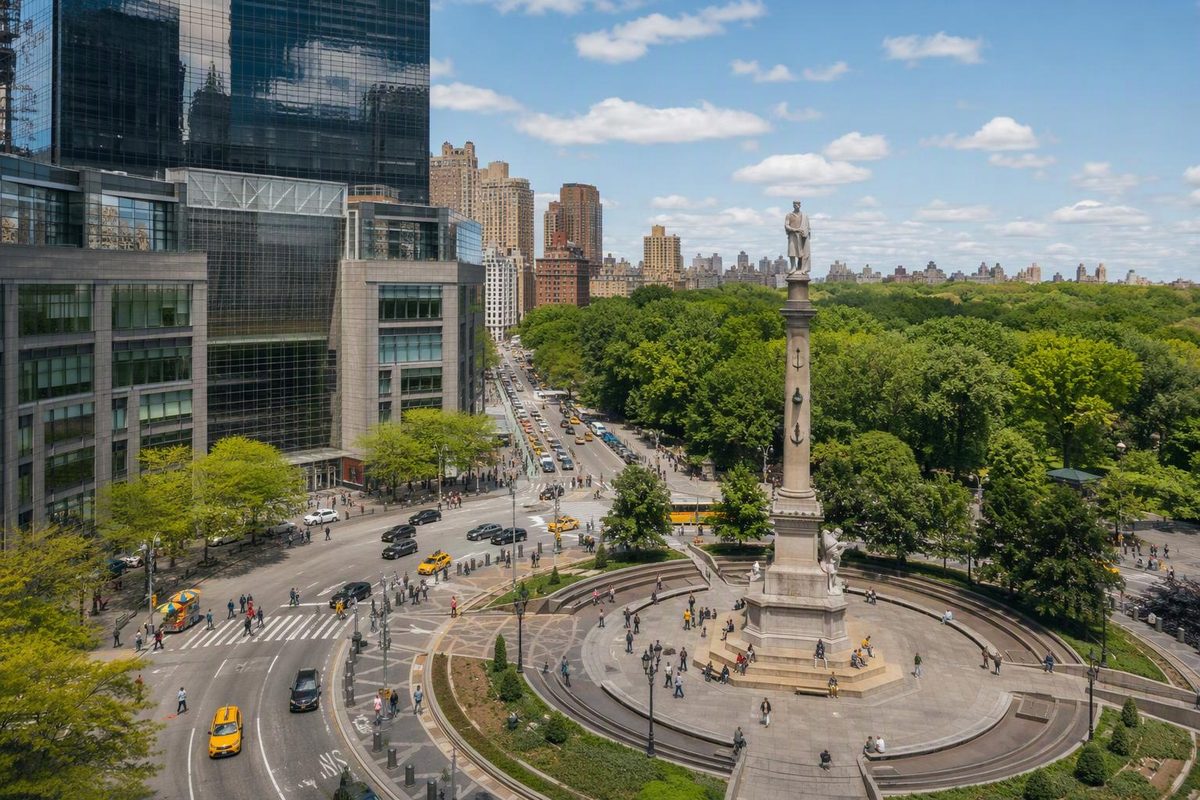
Columbus Circle in Manhattan is best treated as a well-connected starting point, not a destination that fills a day. Allow 20 to 30 minutes for the circle itself, 60 to 90 minutes with the short Central Park loop below, or half a day when adding the Museum of Arts and Design or Lincoln Center.
Pick your available time and main interest; the planner will suggest the best route.
Build a Columbus Circle Route
Choose how long you have and what you most want to see.
Circle and Umpire Rock Loop
See the circle, enter Central Park at Merchants’ Gate and walk to Umpire Rock before returning.
This is a short park sample, not a route to Bethesda Terrace, the Ramble or Belvedere Castle.
Timing figures are the planning allowances stated in this guide; venue schedules and location facts come from the official sources linked in the article.
What You’ll Find at Columbus Circle
Columbus Circle sits where Broadway, Eighth Avenue, Central Park West and 59th Street meet, beside Central Park’s southwest corner. From here, you can enter the park, visit a focused design museum, walk north to Lincoln Center or continue south through Midtown without backtracking.
The central plaza holds the 76-foot Columbus Monument, designed by Gaetano Russo and dedicated in 1892. Its marble figure stands above a rostral column and pedestal. Italian American donors led by newspaper publisher Carlo Barsotti funded it.
The surrounding plaza was expanded and redesigned with fountains, trees and benches in a project completed in 2005 (NYC Parks). Use marked crossings and signals to reach the center; this remains a large, active road junction rather than a traffic-free square.
The main stops around the circle are:
- Central Park at Merchants’ Gate: The park’s southwest entrance and the natural starting point for a walk.
- Museum of Arts and Design (MAD): A manageable museum at 2 Columbus Circle, useful when the weather turns or you want one focused cultural stop.
- The Shops at Columbus Circle: The retail and dining complex inside Deutsche Bank Center at 10 Columbus Circle.
- Jazz at Lincoln Center: Its Frederick P. Rose Hall venues are inside Deutsche Bank Center despite the Lincoln Center name. The Appel Room overlooks Columbus Circle and Central Park (Jazz at Lincoln Center).
- Lincoln Center’s main campus: A separate complex several blocks north, around Broadway and West 62nd to 66th Streets.
Follow a Compact Route From the Circle
Start on the South Side
Begin outside the Museum of Arts and Design. From this side, you can look across the traffic circle toward the twin-towered Deutsche Bank Center and the trees of Central Park.
Cross to the central plaza if you want a closer look at the monument. If not, the perimeter provides a better view of how Broadway, Eighth Avenue and Central Park meet.
MAD is an optional extension rather than a quick look inside. Allow roughly 60 to 90 minutes for a focused visit. As of September 29, 2026, the museum is open Tuesday and Thursday through Sunday from 10 a.m. to 6 p.m., Wednesday from noon to 8 p.m., and closed Monday.
General admission is $20. Admission is pay what you wish from 5 to 8 p.m. on the first Wednesday of each month, with those tickets sold in person. Check the museum’s current visit page before going because schedules and prices can change.
Enter Central Park at Merchants’ Gate
Walk toward the park entrance at West 59th Street. The information kiosk just inside the gate provides directions and tour information when staffed. The Central Park Conservancy calls this the park’s most popular entrance (Central Park Conservancy).
For a short sample of the park, continue to Umpire Rock near 63rd Street. This exposed Manhattan-schist outcrop overlooks Heckscher Playground and the ballfields, creating a quick change from the hard surfaces and traffic around the circle (Central Park Conservancy). Return toward Merchants’ Gate to complete the compact loop.
This route does not reach the park’s major interior landmarks. If Bethesda Terrace, the Ramble or Belvedere Castle is your goal, use Columbus Circle as the beginning of a longer Central Park visit instead of turning back after 20 minutes.
Central Park is open daily from 6 a.m. to 1 a.m., although individual facilities follow their own schedules (Central Park Conservancy).
Finish Indoors or Continue North
For an indoor break, enter The Shops at Columbus Circle. The complex includes more than 40 retailers, over 10 restaurants and bars, and a Whole Foods Market.
As of September 29, 2026, its posted center hours are 10 a.m. to 8 p.m. Monday through Saturday and 11 a.m. to 7 p.m. Sunday. Restaurants and other tenants may keep different hours (The Shops at Columbus Circle).
For a more substantial continuation, walk north on Broadway to Lincoln Center. This keeps the route moving in one direction instead of sending you east into Midtown and back again.
The main campus begins several blocks north. David Geffen Hall has public spaces open daily even without a performance ticket (Lincoln Center). The Lincoln Square walking guide continues farther north without retracing your steps.
Choose One Nearby Pairing
Central Park Suits a First Visit
Choose Central Park when the weather is good and you want outdoor time. Columbus Circle is a straightforward entrance for travelers arriving from the west side or Times Square.
The short loop to Umpire Rock works when you have 60 to 90 minutes. For Bethesda Terrace, the Ramble or other interior landmarks, continue deeper into the park and treat that as the main outing.
MAD Provides a Focused Indoor Stop
Choose the Museum of Arts and Design for design, craft and contemporary material culture. Its 60-to-90-minute planning allowance makes it easier to fit into a partial day than a large museum visit.
MAD is also the most direct pairing when rain, heat or cold makes the park less appealing. Check the museum’s schedule before committing, particularly on Monday or around its Wednesday hours.
Lincoln Center Extends the Route North
Choose Lincoln Center in the late afternoon if you have an evening performance, want to see its plazas or prefer architecture and performing arts to a longer park walk.
Jazz at Lincoln Center is not on the main Lincoln Center campus. Its venues are inside Deutsche Bank Center at Columbus Circle, while the main campus lies north around West 62nd to 66th Streets.
Midtown Works Only When It Is Already Next
Continue south when your next stops are along Broadway, Seventh Avenue or in western Midtown. Columbus Circle can begin a broader Midtown Manhattan route, but pairing it with Lower Manhattan or Brooklyn in the same outing adds unnecessary travel.
Use the Subway Exits to Get Oriented
The 59 St–Columbus Circle station serves the 1, A, B, C and D lines, although service patterns vary by day and hour. The MTA identifies the station as accessible. Street elevators are at the northwest corner of Columbus Circle and Central Park West and the southwest corner of Eighth Avenue and Columbus Circle (MTA accessible-stations guide; MTA 1-line map).
Check live service and elevator status before leaving, especially at night or on weekends. Several station exits open onto different sides of the junction, which can make the first minute above ground confusing.
Use these landmarks to orient yourself:
- Central Park: northeast side of the circle
- Deutsche Bank Center and The Shops: west side
- Museum of Arts and Design: south side
- Broadway toward Lincoln Center: northwest
- Eighth Avenue toward Midtown: south
If your first stop is Central Park, follow signs toward Central Park West or the northwest side of the circle. For MAD, emerge on the southern side rather than crossing the junction unnecessarily.
Columbus Circle Works Best as a Connected, Busy Base
Columbus Circle is a strong place to stay for access to Central Park, Lincoln Center, the Upper West Side and western Midtown. Its subway lines also make it flexible for days elsewhere in the city.
The tradeoffs are busy streets, heavy foot traffic and surroundings that feel more like a transportation and commercial hub than a quiet residential pocket. The immediate circle is convenient, but it does not provide the same neighborhood atmosphere as streets farther into the Upper West Side.
Before booking a hotel described as “near Columbus Circle,” check its street address. A property several blocks south may function more like a Midtown West base, while one north of the circle may feel more connected to Lincoln Square or the Upper West Side.
Choose the address according to the sights that will anchor most of your days rather than relying on the neighborhood label alone.