 New York Know
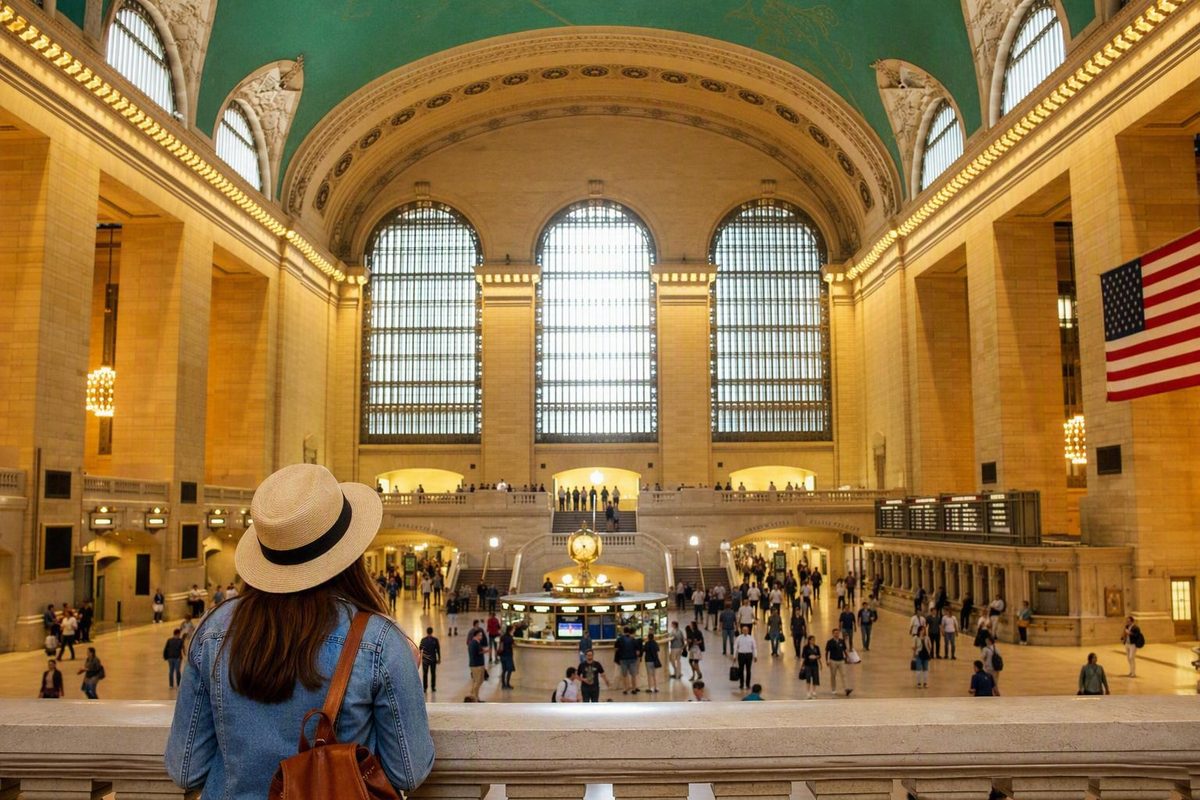
You can walk Grand Central Terminal’s public halls on your own, with no train ticket and no paid tour. The order that works is outside to inside, then down: read the 42nd Street facade from the sidewalk, enter, cross the Main Concourse for the celestial ceiling and the Information Booth clock, then follow the signs to the lower level and finish at the Whispering Gallery beside the Oyster Bar. One third-party guide puts that focused circuit at about 30 minutes. The final leg is conditional: if the lower-level public passage is closed, redirected or blocked when you arrive, end in the Main Concourse. Nothing in this route touches platforms, Track 61, tunnels or staff areas, and none of the guides cited below replace the operator’s current word on entrances, hours or security checks.
Pick your format, today’s lower-level status and your exit direction; the route and time update beside them.
Set up your visit
FormatAccessibility option
Your route
About 30 minutes, focused (third-party estimate)
- 42nd Street and Park Avenue facade — three arched windows, clock, Minerva, Mercury and Hercules
- Edge of the Main Concourse — orient before entering the crowd
- Celestial ceiling — move to a second spot to see the whole zodiac
- Information Booth four-faced clock
- Signed route to the lower level and Oyster Bar area
- Whispering Gallery — diagonal corners, speak softly
Pick a direction to add the continuation.
Times are guides' or sellers' figures, not official: ~30 min quick circuit (StoryHunt), 50 min / 16 stops (Clio Muse Tours), 90 min (Untapped New York). Access, hours and lower-level status change; confirm on the day.
Independent Does Not Mean Unconditional
Several tourism publishers present the facade, Main Concourse, ceiling, Information Booth clock and Whispering Gallery as stops on a visit you make yourself, and one self-guided Grand Central route covers both the exterior and the commonly visited interior features. That supports treating the terminal as an architectural landmark rather than only a place to board a train.
It does not establish that every entrance, hall or lower-level connection will be open on your date, or that no visitor check or security procedure applies. Skipping a commercial tour is one thing; assuming no authorization of any kind is another. Only the first is supported by the sources here.
Keep the walk to the exterior around 42nd Street and Park Avenue, the Main Concourse and other visibly open public halls, the public circulation toward the lower level, and the commercial-area passages open at the time. If a passage is closed, a sign redirects pedestrians or staff restrict access, shorten the route rather than looking for an unofficial way round.
Grand Central Terminal, the Subway Station and Grand Central Madison Are Different Places
“Grand Central” covers several connected facilities with different jobs. Grand Central Terminal is the landmark building in this guide and the terminal for Metro-North commuter trains. Grand Central–42nd Street is the connected subway station; subway trains pass through rather than terminating in the Main Concourse. Grand Central Madison is the connected facility used by Long Island Rail Road service. A third-party overview draws the same three-way distinction (Northleg).
Physical connections do not make them interchangeable. Follow signs for the facility you need, especially if the architectural walk comes before a rail or subway journey. “Grand Central Station” is common in conversation, but it blurs the line between the terminal building and the subway station, so this guide sticks to Grand Central Terminal.
Six Stops From the 42nd Street Facade to the Whispering Gallery
-
42nd Street and Park Avenue facade. Start on the 42nd Street side so you read the building before the busy interior. Look for the three tall arched windows and the large clock surrounded by the sculptural group of Minerva, Mercury and Hercules. The present terminal opened on February 2, 1913, with the design attributed to Reed & Stem and Warren & Wetmore, according to the same third-party history. Step back where the sidewalk allows, take in how the arches, clock and sculpture relate, then approach a visibly open entrance. Do not plan around one particular doorway unless its availability is confirmed for your date; starting on the facade side still works if the entry point moves.
-
Edge of the Main Concourse. Inside, stop at the edge of the hall rather than in the middle of it. From the side the room reads as a whole: a broad central floor framed by circulation routes, the Information Booth below, the ceiling above. Note where you came in and where the public signs to the lower level appear. If it is crowded, observe from the side and stay out of the main pedestrian flow.
-
Celestial ceiling. Look up at the turquoise ceiling and its zodiac constellations, then move to a second point in the hall; the composition’s scale is clearer from more than one spot. Visitor accounts disagree about the map’s orientation, with some calling it an error and others calling it intentional. The sources here do not settle that, so treat the orientation as something to notice rather than a fact to repeat.
-
Information Booth clock. Walk toward the booth and look at the four-faced clock above it. The booth and clock form a human-scale focal point under a monumental ceiling, which is what makes the hall feel organized despite corridors and passenger flows on every side. The popular claims about the clock’s value or timekeeping are not needed to understand its role; concentrate on proportion.
-
Lower level and the Oyster Bar area. Follow the signs currently displayed for the lower level or Oyster Bar. Ignore old online descriptions of a specific staircase, ramp or elevator; routes, elevator status and access arrangements change. The broad concourse gives way to a lower, more enclosed network of passages and commercial space. Continue only if the route is clearly open to the public. If you need step-free circulation, confirm a complete usable route before making the Whispering Gallery the planned endpoint; an elevator or ramp somewhere in the complex does not prove that this whole route is accessible today.
-
Whispering Gallery. Visitor guides place it beside the Oyster Bar area. Two people stand at diagonally opposite corners, face into the corners and speak softly; the arched, tiled space carries the sound across. Keep the test brief and leave the passage usable. If the area is closed, crowded, reserved for another use or behind a barrier, finish in the Main Concourse. This stop is an optional ending, not a reason to bypass an access control.
Vanderbilt Hall, Grand Central Market, shops and dining can be added when open, but check their hours separately. No part of the architectural visit requires entering a rail platform or a transport-only passage.
Quick Circuit, Audio App or Live Guide: What Each Adds
Choose by how much interpretation you want. The independent circuit covers the visible highlights; audio adds self-paced narration; a live guide adds historical context and the chance to ask questions.
| Format | Advertised time | Best for |
|---|---|---|
| Independent circuit | About 30 minutes (StoryHunt) | Fitting Grand Central into a Midtown walk |
| Slower independent visit | Flexible | Architecture, photography, shopping, dining |
| App-based audio | 50 minutes, 16 stops (Clio Muse Tours) | Narration without a group |
| Live guided tour | 90 minutes (Untapped New York) | Deeper architecture and history |
The 30-minute figure is not an official duration. It fits a focused look at the facade, Main Concourse and Whispering Gallery with the lower-level passage open and no shopping, dining or extended photography added. If architecture is the point, add time here rather than adding distant Midtown stops.
The audio product in the table advertises downloadable narration and maps, but its listing carries inconsistent details. Recheck the duration, access method, phone requirements and whether the price is per person or per device before paying. A charged phone, headphones and an advance download may all be needed. Separately, NYC Tourism lists a location-triggered Grand Central audio experience designed to play as you move through the terminal. It is a bookable third-party product; its presence on the destination-marketing site is not confirmation of terminal access, MTA approval or entry to transportation-controlled areas.
The live operator in the table describes its product as a walking tour rather than a train ride and says no additional transit ticket is required for it. Prices, schedules, meeting points, cancellation terms and accessibility arrangements remain booking details to reconfirm with the seller.
Access Details That Change Before Your Date
The architecture is durable; the operating conditions are not. For your date, confirm that the principal public halls are open to visitors and what the current public hours are, using the operator rather than an undated third-party schedule. Find out which street entrances are open and whether any closure affects the approach from 42nd Street, and ask whether reservations, visitor checks or security measures apply.
For the lower level, confirm that public circulation to the Oyster Bar area and Whispering Gallery is available. If you cannot use stairs, get current elevator locations and operating status, and ask about provisions for mobility, visual or hearing needs; for a commercial tour, put the same question to the seller. Confirm current rules for luggage, tripods, filming and organized groups, and check separate hours for any market, restaurant or shop you plan to visit.
Third-party guides give different commuter rush periods, so there is no evidence here of a guaranteed quiet window. Planning outside the busiest weekday commuting periods is reasonable, but crowd levels still vary. Keep the route flexible enough to pause at the edge of the Main Concourse or drop the lower level if close observation becomes impractical.
Leave Grand Central East or West, Not Both
Grand Central works best as the hinge of a compact Midtown plan. After the Main Concourse or Whispering Gallery, pick one direction based on your next reservation, hotel or evening plan.
For an east or southeast continuation, return to street level and view the nearby Chrysler Building exterior, then continue generally south toward the Morgan Library & Museum if it fits your interests and schedule. That keeps the day on Midtown’s east side instead of sending you west and back again.
For a westward continuation, leave toward 42nd Street and walk to the New York Public Library’s Stephen A. Schwarzman Building and Bryant Park, a compact run of civic architecture and public space along one westbound line.
Treat the two as alternatives. Trying to cover the Chrysler Building, Morgan Library, the library building and Bryant Park in one short extension produces the backtracking that a walking-first day is meant to avoid.