 New York Know
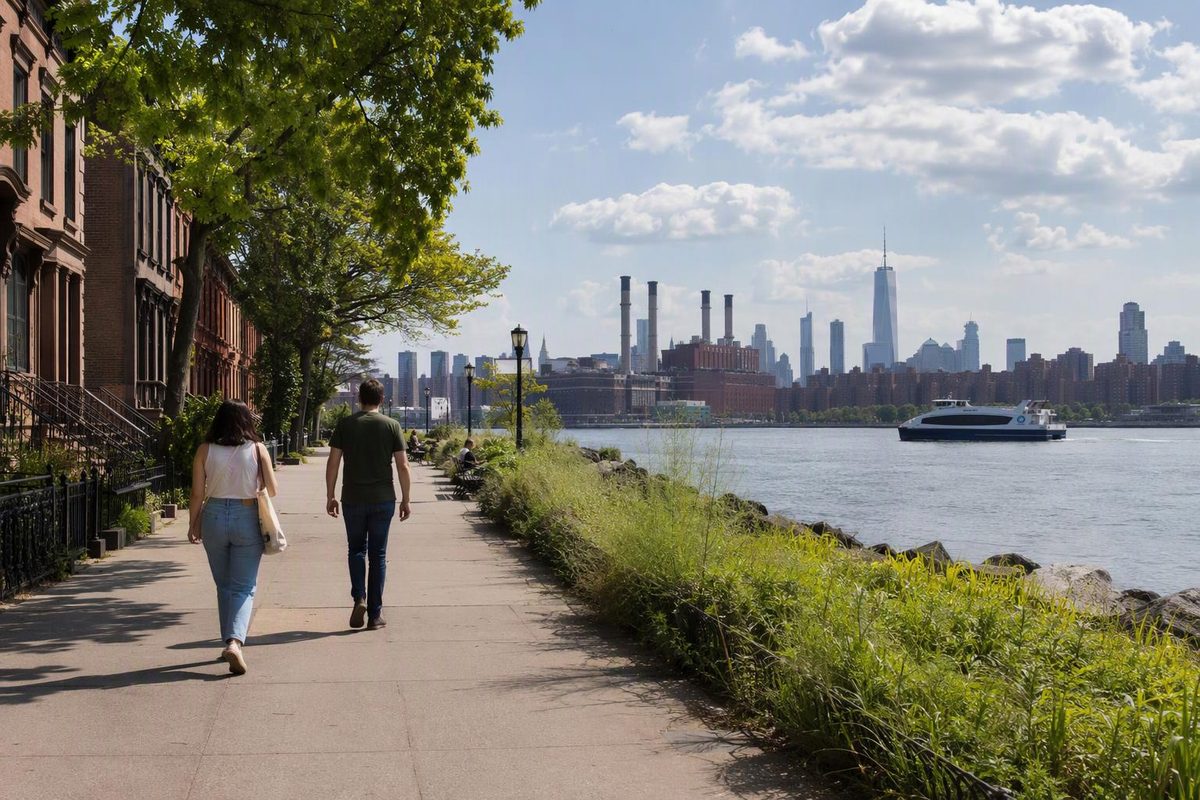
Greenpoint is worth visiting for a slow half-day of residential streets, Polish businesses, independent shops and East River views. Allow three to five hours, including a meal, and expect roughly two to three miles of walking if you follow the full route through McGolrick Park, the historic district and WNYC Transmitter Park.
Pick your time, stair needs and exit; the planner adjusts the route.
Build Your Greenpoint Half-Day
Full Walk With a Ferry Finish
Start at Nassau Avenue G, include McGolrick Park and the historic loop, then finish at Transmitter Park and walk north to the India Street ferry.
- McGolrick Park and its available public restrooms
- Manhattan Avenue with time for a meal
- Franklin, Calyer, Guernsey, Noble and Milton Streets
- Transmitter Park, followed by the India Street ferry landing
Route basis: the guide’s three-to-five-hour range and information from NYC Parks, the MTA G line map, the Landmarks Preservation Commission and NYC Ferry. Ferry service and venue hours can change.
Greenpoint Rewards a Slow Half-Day
Greenpoint works better as a connected neighborhood walk than as an attractions checklist. There is no single landmark around which to build the visit. Its appeal comes from moving between parks, commercial streets, historic houses and the waterfront without spending much of the day in transit.
It particularly suits repeat visitors, but it can also replace a busier Williamsburg or DUMBO outing on a first trip. For a wider comparison, see the guide to Brooklyn neighborhoods.
The built landscape reflects Greenpoint’s industrial past. The city’s historic-district report describes the neighborhood as one of the country’s major 19th-century shipbuilding areas. Frame houses on Milton and Noble Streets were built for shipyard workers, while Franklin Street became an early commercial center (Landmarks Preservation Commission).
Successive groups of immigrants settled in the neighborhood. NYC Parks records Irish, English, Russian, Italian and Polish migration and notes that more than a third of residents were Polish immigrants or of Polish descent by the 1990s (NYC Parks). Polish restaurants and businesses remain part of Greenpoint, although the neighborhood is not frozen in that period.
Start in Quiet McGolrick Park
Begin at Monsignor McGolrick Park, between Nassau and Driggs Avenues and Russell and Monitor Streets. Its large trees, 1910 pavilion and monuments provide a quieter introduction than nearby McCarren Park. NYC Parks lists public restrooms here, although facilities can close temporarily (NYC Parks).
The closest subway is the Nassau Avenue G station, several blocks west. It has stairs and is not listed as accessible. The Greenpoint Avenue G station has elevators, but it is farther from McGolrick Park. If stairs are a barrier, start at Greenpoint Avenue and omit the park rather than adding a long out-and-back (MTA G line map).
From McGolrick Park, leave on Nassau Avenue and walk west. Cross McGuinness Boulevard carefully. The route passes low-rise homes and corner businesses before reaching Manhattan Avenue.
Follow Manhattan Avenue to the Lunch Stop
Turn right on Manhattan Avenue and walk north. This is Greenpoint’s practical retail spine, mixing everyday services with restaurants, cafés and neighborhood shops.
Peter Pan Donut & Pastry Shop, at 727 Manhattan Avenue, is directly along the route rather than a separate detour. The family-run shop says it has served the neighborhood for more than 60 years. Its posted hours begin at 4:30 or 5:30 a.m., depending on the day (Peter Pan Donuts). It therefore works best as an early stop rather than something to save for the end.
Continue north toward Greenpoint Avenue. For a substantial Polish meal, Karczma, at 136 Greenpoint Avenue, serves pierogi and other Polish dishes in a deliberately rustic dining room. As of September 2026, it lists a noon opening every day; confirm current hours before making it the fixed lunch stop (Karczma).
A meal is already included in the suggested three-to-five-hour schedule. A long wait or leisurely lunch may require shortening the historic side-street loop rather than rushing the waterfront.
Loop Through the Historic District
From Manhattan Avenue, walk west on Greenpoint Avenue to Franklin Street. A compact loop follows this sequence:
- Walk south on Franklin Street to Calyer Street.
- Turn east on Calyer Street and continue to Guernsey Street.
- Walk north on Guernsey Street to Noble Street.
- Turn west on Noble Street and return to Franklin Street.
- Continue north on Franklin Street to Milton Street, then turn west toward the waterfront.
Look for narrow frame houses, brick row houses, cornices and stoops rather than one headline building. The Greenpoint Historic District was designated in 1982. Its irregular boundaries extend around parts of Franklin Street, Manhattan Avenue and adjoining residential blocks.
With only three hours, keep the loop compact and avoid adding distant food stops. With four or five hours, spend more time on Milton, Noble and Guernsey Streets before continuing west.
Finish With East River Views
Follow West Street south and enter WNYC Transmitter Park near Greenpoint Avenue. The former radio-transmission site opened as a public park in 2012. Its lawn, esplanade and recreational pier face the East River and Manhattan skyline (NYC Parks).
NYC Parks lists a playground and fishing facilities but not a public restroom at Transmitter Park. Use the facilities at McGolrick earlier in the walk rather than counting on finding one at the waterfront.
The park is a natural late-afternoon finish, but it is not directly beside either departure point. The Greenpoint Avenue G station is several blocks east. The NYC Ferry landing is several blocks north at India Street.
Food Stops Work Best as Flexible Options
Greenpoint has enough bakeries and restaurants that no single stop should control the day.
- Early breakfast: Peter Pan on Manhattan Avenue.
- Polish lunch or dinner: Karczma on Greenpoint Avenue.
- Contemporary bakery: Radio Bakery at 135 India Street, near the ferry landing. It lists daily hours of 7:30 a.m.–3:30 p.m. or until sold out. Everything is offered first-come, first-served, with no preorders (Radio Bakery). Treat it as an option rather than a guaranteed final stop.
- Most flexible approach: Explore Franklin Street and choose what is open instead of crossing the neighborhood for one famous venue.
Check same-day hours, particularly on holidays. If a particular restaurant is essential, confirm its schedule before deciding whether to begin at McGolrick Park or Greenpoint Avenue.
Use the G Train or Leave by Ferry
The G train serves Nassau Avenue and Greenpoint Avenue. It runs through Brooklyn and Queens rather than directly into Manhattan, so riders coming from Manhattan normally need a transfer. Connections are available at Court Square and other stations, but weekday, weekend and late-night service patterns can differ. Check current service before leaving.
For a scenic exit, walk north from Transmitter Park to the Greenpoint NYC Ferry landing at India Street. Greenpoint is on the East River route. During weekday peaks—7–10 a.m. and 4–7 p.m.—and on non-winter weekends, the operator divides the route into East River A and B. Greenpoint is served by East River B during those periods, so check the specific departure rather than assuming every East River boat stops there (NYC Ferry).
As of September 2026, a standard one-way ferry ticket is $4.50. NYC Ferry uses its own tickets, available through its app or landing machines; the fare is not an MTA subway transfer (NYC Ferry ticketing).
McCarren Park is roughly a 15- to 20-minute walk south from the waterfront area, and Williamsburg is the logical extension if you still have time. DUMBO or central Brooklyn is better saved for another day. Greenpoint is more rewarding when it remains the main neighborhood rather than a brief stop between distant sights.