 New York Know
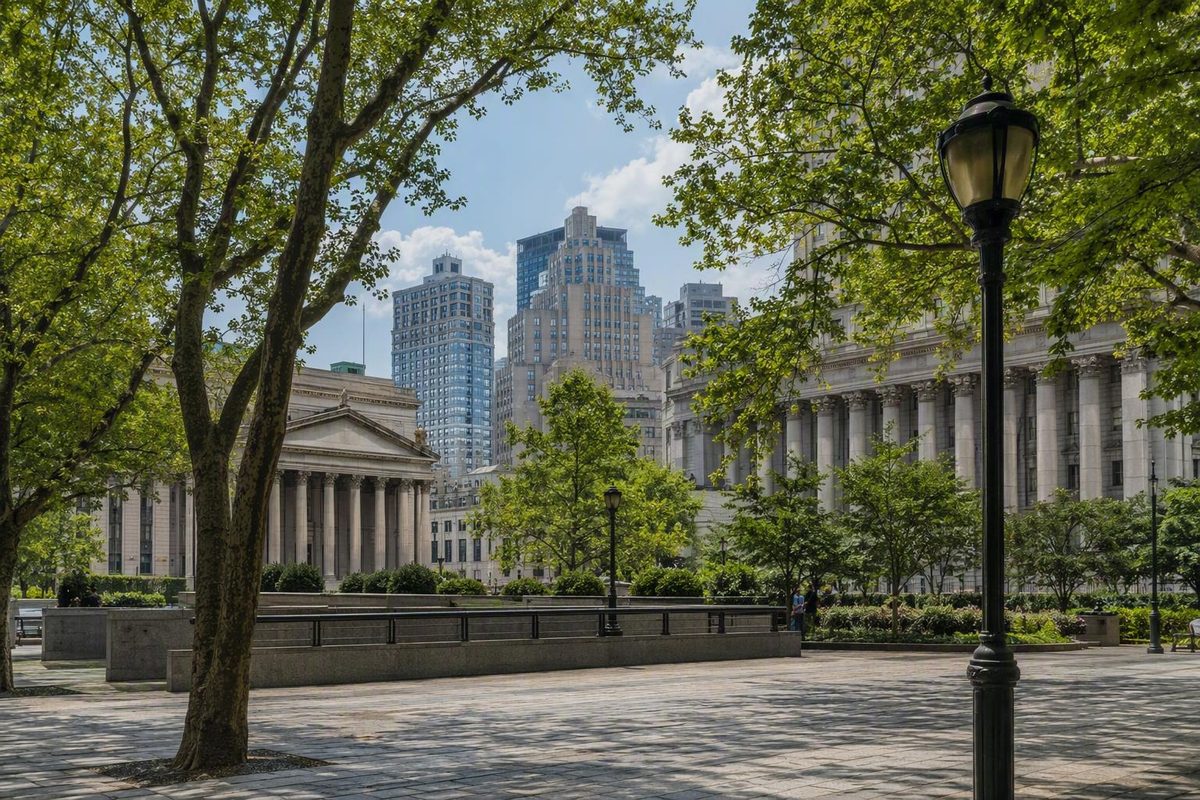
Searches for “new york foley square” usually point to a civic plaza and courthouse district in Lower Manhattan. It is not a conventional attraction with one entrance, ticket desk, or fixed visitor route. Instead, it is a public space framed by major government buildings, layered history, public art, and streets leading toward Chinatown, Tribeca, City Hall, and the African Burial Ground National Monument.
For a visitor, Foley Square works best as one meaningful stop within a Lower Manhattan walk. You can study the courthouse architecture, pause in Thomas Paine Park, look for historical markers, and then continue into a nearby district. For someone reporting to court, attending an appointment, or joining an event, the priorities are different: identify the correct building, confirm its entrance and rules, and allow time for security.
The important first step is therefore to decide what Foley Square means for your day. Are you sightseeing, exploring New York history, photographing civic architecture, attending court, or navigating a public gathering? The location is the same, but the right plan changes with your purpose.
What new york foley square means
Foley Square is a public civic space in Manhattan’s Civic Center. The name may refer narrowly to the plaza and street intersection or more broadly to the cluster of courts and government buildings surrounding it. Worth Street, Centre Street, and Lafayette Street generally frame the space, which sits south of Chinatown and east of Tribeca. Thomas Paine Park occupies the green-space core within the wider square, rather than being a separate distant attraction.
That distinction matters when using a map. A search result may place a pin in the park, at an intersection, beside a courthouse, or at a building whose address includes “Foley Square.” Those pins can all refer to the same general district without identifying the same destination.
A civic space rather than a single attraction
The visual identity of Foley Square comes from the relationship between open space and monumental buildings. Courts at different levels of government stand close together, giving the area a formal, institutional character. The New York County Courthouse at 60 Centre Street and the Thurgood Marshall United States Courthouse are among the most recognizable buildings around the square. Federal facilities also extend toward Pearl Street.
This concentration of courts is not accidental. The civic district developed as government institutions expanded north from the area around City Hall Park. A federal judiciary program on the history of the square highlights buildings at 60 Centre Street, 40 Centre Street, and 500 Pearl Street as distinct parts of that development—not interchangeable addresses for one courthouse complex. The Second Circuit’s Foley Square history program outlines those separate buildings and the district’s evolution.
For casual visitors, this means the exterior ensemble is the attraction. You do not need to enter a courthouse to understand the square. In fact, courthouse interiors should never be treated like ordinary tourist spaces: access, screening, identification requirements, device rules, and permitted activities can vary by building and purpose.
Thomas Paine Park and Foley Square are related, but not identical
Thomas Paine Park is the public park within Foley Square. It lies between Lafayette, Worth, and Centre Streets and provides an open foreground to the surrounding government architecture. The parcel was acquired by the city in 1913, transferred to the Parks Department in 1930, and renamed for Thomas Paine in 1977. Later changes unified adjacent parcels into the present civic space. NYC Parks describes the site’s history and its relationship to Foley Square.
This explains why different guides use “Foley Square” and “Thomas Paine Park” almost interchangeably. In practical terms, the park is where a visitor can pause, orient themselves, and view the surrounding buildings. Foley Square is the broader civic setting.
The name can also create confusion. Thomas Paine Park honors the political writer Thomas Paine, but Foley Square was named for Thomas F. “Big Tom” Foley, a Tammany Hall district leader and local saloon owner. They are two different people attached to two overlapping place names.
Several historical landscapes overlap here
Modern Foley Square sits within a landscape shaped by multiple periods of New York history. Before the courthouse district, the wider area was associated with wetlands and Collect Pond. It later became part of the Five Points landscape, known for dense settlement, poverty, immigration, and a substantial Black population, including formerly enslaved people. Later redevelopment replaced much of that neighborhood with civic buildings and streets.
These historical footprints are related but not identical. The precise boundaries of Collect Pond, Little Collect Pond, Five Points, Foley Square, and the African Burial Ground do not all match. It is more accurate to think of them as overlapping layers than as successive names for one fixed parcel.
The African Burial Ground is particularly important to understanding the district. Historical markers in and around the square connect the civic landscape to the burial ground used by African and African-descended New Yorkers during the colonial period. The nearby national monument is a separate destination; it should not be described as if the entire burial ground lies within Thomas Paine Park.
A stage for both authority and dissent
Courthouses make Foley Square a visible symbol of government authority. At the same time, its open public space has long made it a gathering point for demonstrations, marches, speeches, and civic events. That combination is central to its character: people assemble outside the institutions whose actions they may be supporting, challenging, or asking to change.
Public art has also shaped the square. Richard Serra’s site-specific sculpture Tilted Arc stood there from 1981 until its removal in 1989 after a highly contentious public dispute. Although the work is gone, its former location remains relevant to discussions about public space, artistic control, and the obligations of people who use government plazas.
A visit can therefore be read on several levels at once: as architecture, urban history, legal geography, public park, memorial landscape, or protest space. Foley Square is most rewarding when you choose one or two of those lenses instead of expecting a conventional list of attractions.
How new york foley square works
Foley Square has no admission gate or prescribed sequence. Streets, pedestrian paths, park space, courthouse entrances, and government security zones meet around a relatively compact area. Your experience depends heavily on why you are there and what is happening that day.
Arriving and getting oriented
Brooklyn Bridge–City Hall is a principal subway station for the square. A federal court directions page says one of its exits brings passengers directly into Foley Square, although individual exits, elevators, and service patterns should be checked against current conditions before travel. The Southern District of New York provides transit directions for the Foley Square courthouse area.
Once above ground, do not assume the first large courthouse you see is your destination. Look at the full street address in your appointment, summons, calendar entry, or event instructions. Pay particular attention to the difference between:
- 60 Centre Street;
- 40 Centre Street or 40 Foley Square;
- 500 Pearl Street;
- other federal and municipal buildings nearby.
The architecture can make the district feel like one large governmental complex, but its buildings have different jurisdictions, entrances, and operating procedures. A pin marked “Foley Square” is not enough for an appointment.
If you are sightseeing, orientation is simpler. Find the open plaza or Thomas Paine Park, identify Centre Street and Worth Street, and use the courthouse facades as visual anchors. From there, you can decide whether to move toward City Hall, the African Burial Ground, Chinatown, or Tribeca.
Visiting as a sightseer
A sightseeing visit is primarily an outdoor experience. Walk the perimeter slowly enough to notice how the formal courthouse entrances face the public space. Look for markers and public art, then compare the open plaza with the denser blocks beyond it.
You can gain more from the square by treating it as a sequence:
- Read the space. Notice the scale of the buildings, broad approaches, steps, columns, and security boundaries.
- Find the park. Use Thomas Paine Park as a pause point rather than walking straight through.
- Look for historical interpretation. Markers can help connect the visible civic district with the landscapes that preceded it.
- Identify the institutions. Read building names instead of assuming every courthouse has the same function.
- Continue to a related stop. The African Burial Ground, City Hall area, Chinatown, and Tribeca each extend a different part of the story.
Foley Square can occupy a short stop or a more deliberate history walk. The longer version makes sense if you enjoy architecture, law, government, urban planning, or layered city history. If none of those interests is central to your trip, it is better used as a transition between nearby neighborhoods than as a major standalone destination.
Arriving for court or official business
An official visit requires more preparation. Start with the exact building name and address, then consult that institution’s current website or your official notice. Confirm:
- the correct public entrance;
- arrival time;
- required identification or documents;
- accessibility arrangements;
- restrictions on phones, cameras, recording equipment, food, and bags;
- whether guests or observers may enter;
- any instructions specific to your proceeding.
Do not generalize one courthouse’s rules to another. The federal court page for the area, for example, instructs certain visitors to use a Worth Street entrance and warns that security screening takes additional time. The page’s labeling and directions also appear to mix references to more than one federal courthouse, reinforcing the need to verify the address independently rather than relying on a generic Foley Square search.
Build a margin into the journey. Subway delays, finding the correct entrance, queues, and screening can all affect arrival. If the appointment is consequential, route planning should be based on the required check-in time, not merely the scheduled start time.
Visiting during demonstrations or public events
On an ordinary day, movement through the square may be straightforward. During a rally, march, official ceremony, major proceeding, or heightened-security period, pedestrian routes can change quickly. Barriers may redirect access, crowds may fill the plaza, and some entrances may be more controlled.
A visitor interested in observing a public event should leave space around courthouse doors, emergency routes, workers, media areas, and organized groups. Someone trying to reach an appointment should avoid assuming that the most direct path across the plaza will remain open.
If a demonstration is not part of your plan, use the edge of the district rather than pushing through a crowd. It may be easier to approach from another street, postpone the sightseeing stop, or continue toward Chinatown, City Hall, or Tribeca.
Leaving the square
Foley Square is well positioned as a transition point. A visitor moving south can continue into the City Hall and Financial District portions of Lower Manhattan. Moving north or east leads toward Chinatown. Moving west brings the street pattern toward Tribeca.
This makes the square useful in a walking-first itinerary: it connects districts rather than forcing an out-and-back detour. The best onward direction depends on the mood you want next. Chinatown introduces food and active street life; Tribeca offers a different architectural scale; City Hall continues the civic theme; the African Burial Ground deepens the historical one.
The main approaches
There is no single correct way to visit Foley Square. Compare the following approaches according to your interests, available time, mobility, and obligations.
The quick orientation stop
Choose this approach if Foley Square is on the way between two larger destinations. Enter the plaza, identify Thomas Paine Park and the principal courthouse facades, read one or two markers, and continue.
Best for:
- first-time visitors with a full Lower Manhattan day;
- people walking between Chinatown and City Hall;
- travelers more interested in the district’s atmosphere than detailed history;
- anyone who wants to avoid turning every landmark into a long stop.
Tradeoff: You will understand the square’s visual role but may miss the deeper connections to Collect Pond, Five Points, African American history, public art, and civic protest.
The architecture and legal-district walk
This approach treats the buildings as the main subject. Compare their entrances, materials, scales, setbacks, columns, and relationships to the plaza. Read names and addresses carefully so that state and federal institutions do not blur together.
The district’s development can be understood as part of the movement and expansion of government functions beyond City Hall Park. Historical material collected by the New York Courts includes the original courthouse design process and the broader shift of civic buildings toward Foley Square. The Historical Society of the New York Courts gathers several resources on Foley Square’s legal and architectural history.
Best for:
- architecture enthusiasts;
- law students and legal-history readers;
- photographers interested in monumental civic buildings;
- visitors who want to compare multiple institutions within a small area.
Tradeoff: Courthouse exteriors can be studied from public space, but interior access should not be assumed. Security rules also make spontaneous entry less practical than at a museum or church.
The layered-history walk
This is the strongest approach for someone who wants to understand why the square matters. Begin with the environmental landscape of Collect Pond, then consider the development of Five Points, the African Burial Ground connection, civic redevelopment, and the later role of the plaza in public art and protest.
Avoid reducing Five Points to crime folklore. Sensational retellings can obscure the neighborhood’s immigrant communities, Black residents, poverty, overcrowding, and political complexity. The modern courthouse district did not simply replace an empty or irredeemable neighborhood; it emerged through major changes in land use, governance, and urban development.
A useful sequence is:
- Thomas Paine Park;
- Foley Square’s historical markers;
- courthouse exteriors;
- the African Burial Ground National Monument;
- the City Hall area or Chinatown.
Best for:
- history-focused visitors;
- teachers and students;
- people interested in how physical landscapes retain traces of displaced communities;
- travelers who prefer one coherent story over disconnected landmarks.
Tradeoff: Some of the most important history is no longer physically obvious. You will need markers, maps, or interpretive material to imagine former wetlands and neighborhood streets beneath the present civic district.
The civic-space and public-art approach
Here, the central question is how a government plaza is used and who gets to shape it. Courthouse ceremony, ordinary pedestrian movement, public art, protest, policing, and security all compete for space.
The former presence of Tilted Arc offers a strong case study. Because the work was designed for its particular site, its removal raised issues beyond whether individual passersby liked its appearance. The controversy asks who defines a public place: artists, government agencies, workers, judges, residents, or the wider public.
Best for:
- art and design students;
- visitors interested in public-space policy;
- people attending or studying demonstrations;
- anyone curious about the tension between authority and dissent.
Tradeoff: This approach is more conceptual than scenic. The most famous artwork associated with the debate is no longer there, so the value comes from interpretation rather than viewing the original object.
The practical courthouse approach
This is not a sightseeing plan. It is for a juror, litigant, witness, attorney, family member, journalist, or observer with a specific reason to enter a building.
The sequence should be:
- Confirm the official building name and address.
- Read instructions from that court or agency.
- Determine the permitted entrance.
- Check current security and device rules.
- Bring only what you need.
- Arrive early enough to clear screening.
- Ask authorized staff for directions if anything is unclear.
Best for: Anyone whose arrival has legal, professional, or personal consequences.
Tradeoff: Efficiency takes priority over exploration. Schedule sightseeing after the obligation, not before it, unless you have a large and reliable time margin.
A practical process
A sound Foley Square plan can be built in a few steps.
1. Define the purpose of the visit
Write down your main reason for going:
- See the courthouse architecture.
- Understand the area’s history.
- Pass through during a Lower Manhattan walk.
- Visit the African Burial Ground nearby.
- Attend court or an agency appointment.
- Observe or participate in a public event.
If you have more than one purpose, rank them. An official appointment should govern the route and timing. A casual history stop can remain flexible.
2. Pin the correct destination
For sightseeing, pin Thomas Paine Park or the center of Foley Square and then choose an approach street.
For official business, pin the complete address from the issuing institution. Do not substitute a search result for the address on your notice. Save the building name, street number, entrance instructions, and a phone number or official contact page if available.
Screenshots can help if mobile service becomes unreliable, but they should be taken shortly before the visit so that old directions are not carried forward indefinitely.
3. Choose the arrival side
Your approach should match what comes before and after Foley Square.
- From City Hall or the Financial District: approach from the south and let the civic buildings gradually come into view.
- From Chinatown: enter from the north or east, producing a sharp transition from commercial streets to monumental government space.
- From Tribeca: approach from the west and use the square as a bridge toward Chinatown or City Hall.
- From the subway: orient yourself by street names before choosing a courthouse or onward route.
A walking-first Lower Manhattan day works best when Foley Square lies on a continuous line rather than requiring you to retrace your steps. New York Know’s Lower Manhattan walking itinerary offers a broader framework for keeping nearby districts together.
4. Set a realistic visit length
Use your interests, not a generic sightseeing quota.
A quick pass works if you only want to see the setting. A focused exterior walk needs more time because you will be stopping to identify buildings and markers. A layered-history visit becomes longer when it includes the African Burial Ground or City Hall. Official business requires a separate arrival buffer for locating the entrance and completing screening.
Avoid measuring the stop only by distance. Foley Square is compact, but understanding it depends on pausing and looking. Conversely, a traveler with little interest in legal or urban history does not need to force a long visit simply because the square appears on a landmark list.
5. Build a simple walking sequence
A practical sightseeing sequence might be:
- Enter near Brooklyn Bridge–City Hall.
- Pause at the edge of the square for a wide view.
- Walk toward the New York County Courthouse facade.
- Cross into or around Thomas Paine Park.
- Look for historical interpretation and public art.
- Identify the federal courthouse buildings.
- Continue toward the African Burial Ground.
- Finish in Chinatown, Tribeca, or near City Hall.
This is a framework, not a turn-by-turn guarantee. Barriers, construction, official activity, and events may alter the easiest path.
6. Check current conditions
Historical facts change slowly; operating conditions do not. Shortly before leaving, verify:
- subway service and the most suitable station exit;
- weather;
- planned demonstrations or street closures;
- accessibility needs;
- courthouse entrances and hours;
- identification and device policies;
- the operating status of any indoor destination;
- whether construction affects the plaza.
Do not rely on an old travel article for a current court rule or market schedule. Use the relevant operator or institution for day-specific information.
7. Prepare for the character of the space
Foley Square is exposed and institutional. Shade, seating, temporary barriers, and pedestrian flow may not match what you expect from a neighborhood park. Dress for the weather and wear shoes suited to stone pavement and continued walking.
Photography from ordinary public areas may be part of a sightseeing visit, but photography inside or immediately around sensitive government facilities can be subject to rules and staff instructions. Never infer interior permission from what is allowed outdoors.
8. Decide where the route ends
A good itinerary has a clear finish.
Choose Chinatown if you want food, busy sidewalks, and a strong contrast with the civic district. Choose Tribeca for a quieter architectural transition. Choose City Hall and the Financial District if you want to continue the government and institutional theme. Choose the African Burial Ground if historical interpretation is the main reason for your visit.
Do not add all four merely because they are nearby. Pick the direction that supports the rest of your day.
Common mistakes and tradeoffs
Foley Square is easy to reach but surprisingly easy to misunderstand. Most problems come from treating a complex civic district like a single conventional attraction.
Mistaking the square for one building
A map search can return a courthouse address, park pin, intersection, or general district label. This is harmless for sightseeing but serious for an appointment.
Better approach: Match the complete address and institution name. Distinguish 60 Centre Street, 40 Foley Square or 40 Centre Street, and 500 Pearl Street.
Treating Thomas Paine Park as the whole square
The park is the landscape component within Foley Square, while the broader square includes streets, plaza space, and relationships with surrounding buildings.
Tradeoff: Using the names interchangeably is convenient in casual conversation, but it can make directions and historical explanations less precise.
Expecting a major recreational park
Thomas Paine Park provides open space, but Foley Square’s dominant identity is civic rather than recreational. It is not the best choice if your main goal is a long green-space break, playground time, or a park-centered afternoon.
Better approach: Visit for architecture, history, orientation, or a short pause, then continue to a destination better suited to extended recreation.
Trying to enter a courthouse casually
A monumental staircase may look like a natural visitor entrance, but the public entrance may be elsewhere. Security and access rules vary.
Better approach: Treat every courthouse as a separate operating institution. Follow posted signs and current official instructions rather than architectural intuition.
Underestimating security time
A route planner may show only the travel time to the square. It does not account for finding an entrance, waiting in line, screening, or resolving a problem with a prohibited item.
Better approach: For time-sensitive business, add a substantial margin and minimize unnecessary belongings.
Building a visit around outdated logistics
Market schedules, transit exits, courthouse rules, construction, and event conditions can change. Even official pages may contain confusing or stale directions.
Better approach: Separate the stable historical plan from the changeable logistics layer. Learn the history in advance, but verify transportation and access shortly before departure.
Repeating Five Points mythology as settled history
Accounts of Five Points often emphasize gangs, disease, and violence. Those subjects are part of its history, but dramatic storytelling can flatten a complicated neighborhood into a spectacle.
The area also included immigrants, Black residents, formerly enslaved people, families, workers, and communities living under severe economic and housing pressures. The Downtown Alliance’s overview connects Collect Pond, Five Points, and the later legal district, but some of its language reflects the sensational framing often applied to the neighborhood. Its Foley Square history provides a useful outline when read with that limitation in mind.
Better approach: Separate verified developments—environmental change, settlement, poverty, demolition, and civic redevelopment—from colorful claims that may have grown through repetition.
Conflating nearby historical sites
Foley Square, Collect Pond, Five Points, and the African Burial Ground overlap historically, but they are not the same site with different names.
Better approach: Imagine a series of partially overlapping maps. This preserves the connections without erasing differences in geography and time.
Overloading the day
Because Foley Square sits near many famous places, it is tempting to combine it with the Brooklyn Bridge, Chinatown, Tribeca, the Financial District, the World Trade Center area, the waterfront, and several museums in one continuous march.
Tradeoff: You cover more ground but understand less of each neighborhood.
Better approach: Pick one direction after Foley Square. A compact route generally creates a more coherent day than repeated crossings between unrelated stops.
Visiting at the wrong time for your goal
A weekday may provide the strongest sense of an active court district, but it can also bring more official traffic and security activity. Quieter periods may be better for exterior photography, yet the area can feel less animated. A demonstration can reveal the square’s civic role while making movement less predictable.
Better approach: Choose according to purpose. There is no universally best time independent of what you want to experience.
How to choose the next step
The right next step follows from a simple decision: is Foley Square your destination, a historical chapter, or a transition point?
If you mainly want a recognizable New York sight
Plan a short exterior visit. See the principal courthouse facades, pause in Thomas Paine Park, and continue toward City Hall or Chinatown. Do not devote a large part of the day unless the architecture or history catches your interest.
If you want to understand Lower Manhattan
Use Foley Square as a central chapter in a longer walk. Approach through City Hall or Chinatown, study how the government buildings reshape the street pattern, then visit the African Burial Ground nearby. This turns a collection of structures into a story about land, communities, law, and public authority.
A useful theme is “overlapping New Yorks”:
- the environmental landscape of Collect Pond;
- the residential landscape of Five Points;
- the history represented by the African Burial Ground;
- the civic landscape of courts and government;
- the public landscape of art, protest, and assembly.
This approach creates depth without requiring a huge geographic area.
If architecture is the priority
Prepare a short list of buildings and addresses before arriving. Compare them from the public plaza rather than trying to enter each one. Pay attention to how entrances, steps, columns, and open space establish institutional authority.
The New York County Courthouse is commonly associated with the 60 Centre Street address, and a New York Law School visitor guide identifies it as a prominent Foley Square landmark. The school’s Lower Manhattan guide places the courthouse and square at 60 Centre Street.
Finish by walking toward City Hall, where you can compare another generation and arrangement of civic architecture.
If you are going to court
Stop planning Foley Square as an attraction. Your next action should be to open the official communication for your case, summons, appointment, or proceeding and confirm:
- the court or agency;
- the building’s full address;
- the public entrance;
- check-in time;
- identification requirements;
- current security and electronics rules;
- accessibility arrangements;
- the route plus a delay margin.
If any detail conflicts with a general web page, follow the current instructions from the institution handling your matter or contact it directly.
If a demonstration or major proceeding is expected
Decide whether the event is the purpose of your visit. If it is not, reroute or return at another time. If it is, arrive with an understanding that access and movement may be controlled and that conditions can change.
Keep your plan flexible. Identify an alternate subway entrance and a meeting point outside the densest part of the square. Respect barriers, posted rules, and instructions from authorized personnel.
If you are building a Lower Manhattan day
Choose only one strong continuation:
- Foley Square to Chinatown for history followed by food and active street life;
- Foley Square to Tribeca for architecture and a slower neighborhood walk;
- Foley Square to City Hall and the Financial District for a continuous civic and institutional theme;
- Foley Square to the African Burial Ground for a focused historical sequence.
Then set a concrete action: pin the square, select the next neighborhood, and check current transit or access conditions on the morning of the visit. That is enough planning for a useful stop without turning a compact civic space into an overengineered itinerary.
What should a beginner know about new york foley square?
A beginner should know that Foley Square is a civic plaza and courthouse district, not a single ticketed attraction. Thomas Paine Park sits within the broader square, and the surrounding buildings belong to different state and federal institutions.
For sightseeing, focus on the exterior architecture, historical markers, and the square’s relationship to nearby City Hall, Chinatown, Tribeca, and the African Burial Ground. For official business, ignore the generic map pin and verify the exact building, address, entrance, and security instructions.
The square is compact enough to be a short stop but historically dense enough to support a focused walk. Its value comes less from entertainment and more from understanding how environmental, neighborhood, legal, and political histories overlap in one place.
What are the main risks of new york foley square?
The most consequential risk is going to the wrong courthouse or entrance. Similar-looking buildings stand close together, and “Foley Square” may appear in an address, district name, or map label. Always use the complete address from the relevant court or agency.
Other practical risks include underestimating security time, carrying an item prohibited inside a courthouse, relying on outdated transit information, or encountering barriers during a demonstration or major proceeding. Weather exposure and a lack of predictable visitor amenities may also make a longer outdoor stop less comfortable than expected.
For historical understanding, the main risk is oversimplification: treating Thomas Paine Park as the entire square, treating all courts as one institution, or repeating sensational Five Points stories without recognizing the communities and structural conditions behind them.
How do you evaluate new york foley square options?
Evaluate the options by purpose, time, and what comes next.
Choose a quick stop if Foley Square is on the route between neighborhoods. Choose a history walk if you want to connect Collect Pond, Five Points, the African Burial Ground, and civic redevelopment. Choose an architecture walk if the courthouses are the main draw. Use a strictly logistical plan if you have official business.
Then assess the tradeoffs:
- A short visit is efficient but offers little historical depth.
- A longer visit provides context but requires interpretation because much of the earlier landscape is no longer visible.
- A weekday may show the civic district in action but can involve more security and foot traffic.
- An event day may reveal Foley Square’s role as a public forum but make access unpredictable.
- Adding several surrounding neighborhoods increases variety but can weaken the coherence of the day.
For most first-time visitors, the sound next step is simple: include Foley Square in a compact Lower Manhattan route, spend enough time to identify what surrounds you, and continue in one direction rather than zigzagging across downtown.