 New York Know
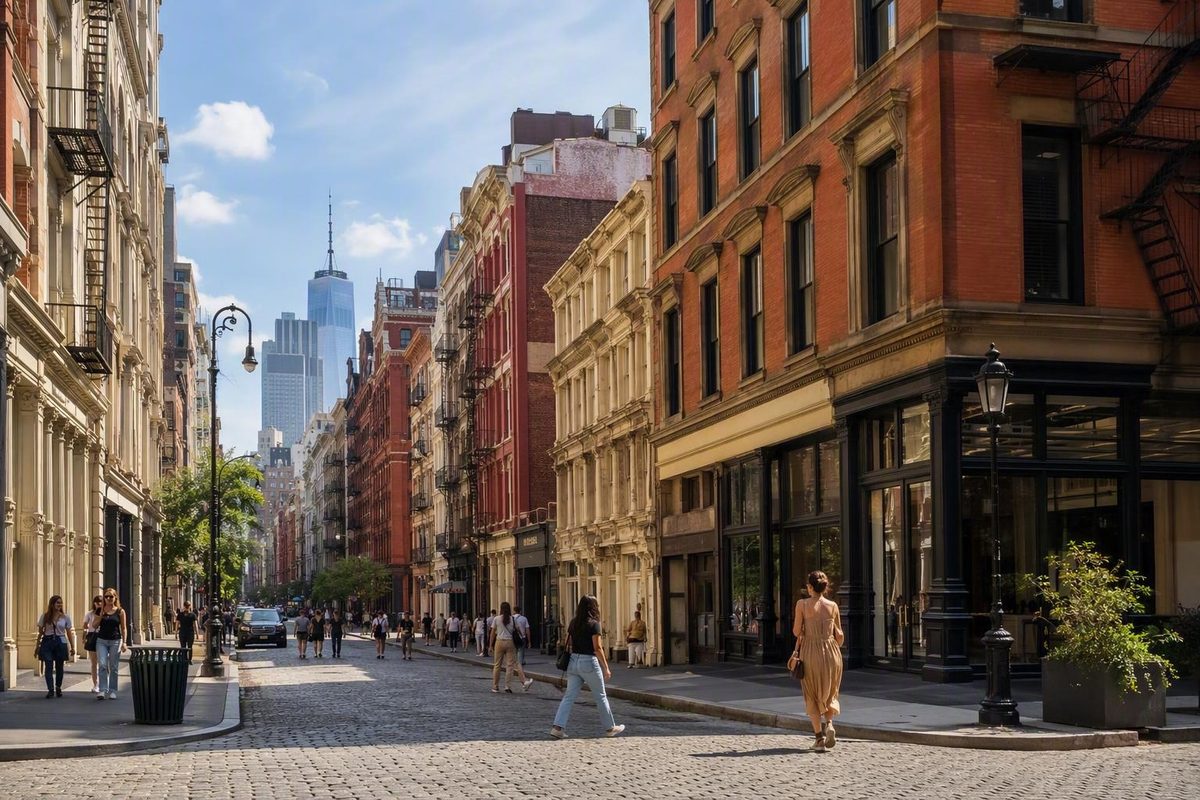
SoHo at a glance: location, name, and present-day character
SoHo is a neighborhood in Lower Manhattan. Its name abbreviates “South of Houston Street,” but the phrase is shorthand rather than a complete boundary: not every block south of Houston belongs to SoHo.
Secondary neighborhood histories commonly credit urban planner Chester Rapkin with introducing the name in connection with a 1962 study. Because the available evidence does not include Rapkin’s original study or another primary record, it is safest to treat that account as a widely repeated attribution rather than a conclusively documented origin story (CityNeighborhoods.NYC’s SoHo history).
For a first-time visitor, SoHo’s most visible feature may be shopping. Broadway and the surrounding streets contain major brands, upscale boutiques, independent-designer outlets and design stores. Yet the stores occupy an older setting of cast-iron façades, former commercial and industrial loft buildings, tall windows and historic street surfaces. Galleries, restaurants, cafés and boutique lodging contribute to the present-day mix.
The balance has changed over time. SoHo is no longer primarily the art district with which it was associated in the 1970s and 1980s. Retail and dining now have a much larger public presence, although galleries and visual culture remain part of the neighborhood’s identity (NYC Tourism’s overview of SoHo).
That shift is central to understanding the neighborhood. The shops are not incidental to contemporary SoHo, but neither are they the whole story. The buildings now containing stores, offices and expensive residences were created for earlier forms of commerce and industry. Their changing uses reflect the neighborhood’s passage through industrial activity, artist occupation, preservation, gentrification and adaptive reuse.
This guide therefore uses streets and architecture as its organizing framework. Businesses appear only as examples of possible pauses, not as ranked or permanent recommendations. A bookstore can move, a gallery can change its public hours and an exhibition can close. The relationship among Broadway, the side streets and the loft buildings is more durable.
Before visiting, check every planned indoor stop directly. Confirm its current address, operating status, hours, admission rules and accessibility. The named venues below have not been independently verified against first-party information for this article and should not be treated as confirmed current listings.
Where SoHo begins and ends—and why maps disagree
Houston Street and Canal Street are the most consistently cited northern and southern limits of SoHo. The eastern and western edges vary. Some sources use Crosby Street in the east, while others extend the neighborhood to Lafayette Street. West Broadway appears as a western boundary in narrower definitions; broader descriptions reach Sixth Avenue.
These differences produce substantially different maps. A boundary running from Crosby Street to West Broadway encloses a much narrower area than one extending from Lafayette Street to Sixth Avenue.
For visitors, the most useful response is not to declare one disputed outline correct. Instead, use a practical visitor core centered on Broadway and the blocks around Prince, Spring, Broome, Greene, Mercer, Wooster and Crosby Streets. This is not a legal boundary. It is a compact area in which SoHo’s retail character, loft architecture and historic streetscape can be compared on foot.
Use three labels when evaluating maps, hotels and venue lists:
- SoHo core: Broadway and the central blocks around Prince, Spring and Broome Streets, including Greene, Mercer and Wooster Streets.
- Disputed edge: blocks between the narrower and broader definitions, particularly toward Lafayette Street, Sixth Avenue, West Broadway and Canal Street.
- Adjacent neighborhood: a location clearly presented as being in Nolita, Hudson Square, Greenwich Village, Chinatown, Little Italy or another neighboring district.
This labeling does not imply that a disputed-edge business is inconvenient. It simply acknowledges that not every map places it inside SoHo.
The commonly understood neighborhood is also not geographically interchangeable with the SoHo–Cast Iron Historic District. The historic district is a legally designated preservation area associated with SoHo’s architectural identity. Informal neighborhood definitions may be broader or narrower, while the district follows its own legal boundary. A collaborative overview likewise distinguishes the neighborhood’s disputed edges from those of the historic district (background on SoHo’s geography and historic district).
Boundary awareness matters when comparing hotels, restaurants and tours. “SoHo” in a property or product name can indicate proximity, style or marketing rather than an uncontested location. A Hudson Square hotel may provide convenient access to SoHo without being inside every definition. A Nolita restaurant can fit naturally into a walking day without becoming a SoHo restaurant.
Commercial walking tours also combine SoHo with Chinatown, Little Italy, Greenwich Village or the former Five Points area. It does not make those places part of SoHo.
For practical route planning, the clearest transitions are the uncontested ones. To the east and west, the transition depends on which definition you use: Crosby or Lafayette in the east, and West Broadway or Sixth Avenue in the west.
From industrial lofts to artists’ studios and luxury retail
SoHo’s history is often compressed into a simple sequence: factories, artists, galleries and luxury stores. That outline is useful, but it can obscure the overlapping roles of commerce, manufacturing, changing land use, preservation and gentrification.
Secondary histories describe Broadway and the surrounding area as a major nineteenth-century commercial district, including dry-goods and textile activity. As commercial patterns changed, parts of the area increasingly served manufacturing, warehousing and light industry. The resulting loft buildings offered large interiors, high ceilings and tall windows suited to commercial or industrial work.
Those same qualities later appealed to artists. Large floors could accommodate both the creation and storage of substantial work, while declining industrial demand made loft space available for adaptation. Availability, however, did not necessarily mean that residential occupation complied with the manufacturing zoning then in place.
According to secondary neighborhood accounts, artists began occupying industrial lofts during the 1960s, sometimes through conversions that conflicted with existing zoning. The same accounts describe a 1971 Artist-in-Residence zoning change as one step toward permitting qualifying artists to live and work in certain lofts. They also connect opposition to the proposed Lower Manhattan Expressway with the wider preservation effort that protected the district’s architectural fabric (CityNeighborhoods.NYC’s historical account).
These points should not be read as legal guidance. The available evidence does not establish the full text, geographic reach or current effect of the zoning rules, nor does it show that every early conversion became lawful at one moment. The change was part of a longer transition involving land use, building adaptation and neighborhood advocacy.
Preservation helped retain the cast-iron façades and loft buildings that make SoHo visually distinctive. Yet preservation did not freeze the area in its artists’ era. As the neighborhood became more desirable, galleries increasingly shared space with—or yielded space to—boutiques, offices, major brands and expensive residences. Some gallery activity shifted to Chelsea.
That transformation is not an uncomplicated success story. Preservation retained a significant architectural environment, and adaptive reuse allowed old buildings to serve new purposes.
The artistic legacy nevertheless remains visible. Galleries, design businesses, cultural organizations and the language of loft living all draw on it.
Walking makes these layers easier to understand. A building may have begun as commercial or industrial space, later accommodated artist work or gallery use, and now contain retail below offices or residences. The façade is not simply decoration behind the shops. It is the durable layer connecting several different versions of SoHo.
How to read SoHo’s cast-iron streetscape
SoHo’s architecture becomes easier to appreciate when you stop treating each storefront as a separate destination and begin reading the block as a repeated system.
Look for façades organized into vertical bays, with columns separating rows of tall windows. Decorative capitals, arches and horizontal bands create rhythm across several floors. Some fronts are relatively restrained; others use elaborate classical-looking ornament. The repetition is often easiest to see from across the street or from an intersection.
Tall windows and broad loft floors reflect the buildings’ former commercial and industrial purposes. Those proportions later suited studios, galleries, offices, stores and residential conversions. The exterior can therefore remain recognizably historic even when the interior use has changed several times.
Greene, Mercer, Wooster and Crosby Streets are useful for comparing loft scale, façade detail and historic paving. No one street needs to be declared the “best.” Light, traffic, construction and pedestrian congestion can make one block easier to study than another on any particular visit.
Broome, Spring, Prince and Grand Streets work well as east-west connectors. They allow you to move between the north-south side streets and Broadway while observing changes in commercial intensity. The side streets often provide more room to pause and look upward.
“Cobblestone streets” is common travel shorthand, but Belgian block is a more precise description for at least some of the historic surfaces: shaped stone blocks used as paving rather than naturally rounded cobbles. The terminology is less important than recognizing the effect. The stone contributes texture and historical character, but it can also create an uneven walking surface.
The most useful interpretive idea is adaptive reuse. Buildings created for commerce and industry later accommodated different combinations of activity:
- industrial floors became artist live-work lofts;
- lofts became galleries, studios, offices or showrooms;
- ground floors became stores and restaurants;
- upper floors became offices or expensive residences;
- industrial scale became part of the marketing language of luxury property.
To see this process, look above the signs. Street-level branding is designed to command attention, but the upper floors usually reveal the building’s repeated structural rhythm more clearly. Notice whether a shop occupies only the base of a much larger building. Compare the scale of its entrance with the rows of windows above.
Photography can encourage slower observation. Frame a line of upper windows, a decorative column or the meeting point between historic paving and a contemporary storefront. The contrast—not either element alone—is often the most revealing subject.
Historic surfaces also have practical consequences. Belgian block, uneven sidewalks and crowded crossings can slow some visitors. Treat walking estimates as planning minimums, not promises. Check the accessibility of individual entrances separately; the appearance of a historic building does not establish whether it has a step-free entrance, working elevator or accessible restroom.
A short self-guided SoHo walk
A first SoHo walk should be flexible enough to survive a congested block, construction or a closed indoor stop. The goal is not to trace every possible boundary. It is to compare Broadway with several side streets and see how the neighborhood changes within a compact area.
Begin around Broadway and Prince Street, then use this framework:
- Walk a short stretch of Broadway to establish SoHo’s contemporary retail character.
- Turn west on Prince Street.
- Turn south on Greene, Wooster or Mercer Street.
- Cross on Spring or Broome Street.
- Add a second north-south side street if time and energy permit.
- Finish near Broadway or toward the southeastern side of the neighborhood.
This is a framework rather than a turn-by-turn route. It has not been presented as a recently measured or field-audited circuit. If one street is crowded or obstructed, use the next parallel block. If architecture is your priority, shorten the Broadway portion and spend more time on Greene, Wooster and Mercer Streets.
Broadway and Prince Street
Broadway introduces present-day SoHo as a busy retail district. It is generally louder, faster and more commercially concentrated than the side streets. Do not spend the entire walk there, but do not omit it: the contrast between Broadway and the surrounding blocks is part of the neighborhood’s story.
Prince Street offers the transition. It combines shopping, food, pedestrian activity and views into the north-south streets. As you walk west, pause at one or two intersections and look both north and south before deciding where to turn.
Greene, Wooster and Mercer Streets
Turning south onto Greene, Wooster or Mercer shifts attention toward the loft buildings. Walk slowly enough to study the upper floors. Repeated bays, tall windows and decorative columns become easier to see away from Broadway’s main flow.
You do not need to cover all three streets from end to end. Choose one for the principal southbound section, cross on Spring or Broome, and return along another. This controlled zigzag is more revealing than a straight walk from Houston Street to Canal Street because it encourages comparison.
Spring and Broome Streets
Spring Street returns you to mixed activity: retail and food stops alongside prominent loft façades. Broome Street provides another useful cross-section and can carry you toward Crosby Street and the southeastern side of the visitor core.
A hotel-produced guide published on February 26, 2025 listed the MoMA Design Store, McNally Jackson and the Drawing Center among nearby design, book and cultural stops. Treat those as historical examples from that guide—not confirmation that each venue is currently operating at the listed address or under the same visitor arrangements (The Manner’s neighborhood guide).
If independently confirmed before your visit, the examples fit these geographic and thematic categories:
- MoMA Design Store — SoHo core: a possible design-oriented pause associated by the cited guide with Spring Street.
- McNally Jackson — SoHo core: a possible bookstore pause associated by the guide with Prince Street.
- The Drawing Center — SoHo core in the cited visitor guides: a possible visual-culture stop.
The walk does not depend on any of them. You can substitute photography, another independently verified gallery, a café or no indoor stop at all.
How long to allow
The street circuit can be covered relatively quickly if you do not stop. For a mixed first visit, roughly two to four hours is a reasonable planning range rather than a guaranteed duration. That allows time for architecture, browsing, photography, food and perhaps one indoor stop. Published multi-neighborhood walking estimates can be substantially shorter because they measure movement rather than a full SoHo visit (a commercial route example linking Greenwich Village and SoHo).
Two hours suits a focused walk with one brief pause. Four hours permits a slower route, more browsing and a meal. Weather, queues, crowds, mobility needs and street conditions can extend either plan.
Wear comfortable, broken-in footwear. Historic paving can be tiring even when the route looks short on a map. Above all, avoid searching for one definitive street. SoHo becomes meaningful through comparison: Broadway with Greene Street, Prince with Broome, and polished storefronts with the industrial proportions above them.
What to do in SoHo besides luxury shopping
SoHo can be worthwhile even if designer retail is not your priority. Shopping remains a major part of the contemporary neighborhood, ranging from upscale boutiques and independent-designer outlets to national and international chains. But architecture, art, design, books, photography, food and street life can occupy most of a visit.
Architecture
For an architecture-focused walk, make a slow loop through Greene, Mercer, Wooster, Crosby, Broome and Spring Streets. Rather than collecting famous addresses, look for recurring features:
- repeated façade bays;
- tall loft windows;
- decorative metal columns;
- broad industrial proportions;
- former loading and work-space forms;
- historic stone paving;
- contemporary uses inside older buildings.
Walk one north-south street, cross on Broome or Spring and return along another. Changes in light, traffic and storefront treatment can make similar buildings look very different. Use Broadway as an orientation point rather than the entire route.
Art and visual culture
SoHo is no longer primarily the gallery district associated with the 1970s and 1980s, but its artistic identity has not disappeared. Visitor guides have named the Drawing Center and Jeffrey Deitch as examples of cultural stops. Their current exhibitions, public hours, admission rules, addresses and accessibility are not established here and require direct confirmation.
For geographic planning:
- The Drawing Center — SoHo core in the cited guides: a possible drawing and visual-culture stop if current details are confirmed.
- Jeffrey Deitch — SoHo listing in the cited travel guides: verify the current address before assigning a precise core or edge label.
Art can also be approached more broadly. Look at gallery windows, temporary displays, design installations and the way stores borrow the staging techniques of exhibition spaces. In contemporary SoHo, visual culture extends beyond conventional galleries.
Books and design
Bookstores and design shops can provide indoor pauses without turning the day into a luxury-shopping itinerary. McNally Jackson and the MoMA Design Store appeared in the 2025 hotel guide as examples, but their inclusion here is neither a ranking nor current operating confirmation.
If you verify either venue directly, pay attention to the space as well as the merchandise. High ceilings, wide interiors and open floor plans can preserve some sense of a building’s loft scale even when its present use is entirely contemporary.
Photography
SoHo rewards photography that looks beyond logos. Possible subjects include:
- rows of upper-floor windows;
- ornament on cast-iron columns;
- repeated façade modules;
- long views along stone-paved streets;
- older loading forms adapted as entrances;
- reflections of historic façades in modern glass;
- subdued upper floors above bright retail signs.
Intersections often provide better perspective than standing directly beneath a building. Keep entrances and pedestrian routes clear, and remember that these remain working streets rather than open-air sets.
Food and cafés
SoHo contains restaurants and cafés, but a durable guide should not claim that a static list identifies the current “best” choices. Businesses, menus, prices, reservation policies and hours can change.
A practical approach is to decide what kind of break you want—coffee, a quick lunch, a sit-down meal or dessert—and then find a currently verified option near the expected endpoint of your walk. This avoids repeatedly crossing the neighborhood for a fashionable address and allows the route to develop naturally.
Classify the location before committing:
- SoHo core: convenient to the main walking loop.
- Disputed edge: potentially convenient, but not inside every map’s definition.
- Adjacent neighborhood: suitable as an extension, not a SoHo venue.
People-watching and street life
Broadway and Prince Street provide a concentrated view of contemporary public-facing SoHo: shoppers, workers, deliveries and visitors moving between nearby neighborhoods. Side streets offer a slower rhythm and clearer views of the buildings.
Spending a few minutes at an intersection may reveal more than rushing through another store. Watch how older building forms accommodate current commercial activity and how pedestrian intensity changes from Broadway to the parallel streets.
A lower-spend SoHo visit
A SoHo visit does not require a luxury-shopping budget. A lower-spend plan can include:
- a self-guided architecture loop;
- upper-façade and streetscape photography;
- browsing one independently verified bookstore or design shop;
- checking the admission arrangements for one gallery;
- choosing a single food or coffee stop.
The streetscape is the central experience. Retail can be observed as evidence of the neighborhood’s transformation rather than treated as an instruction to buy.
Turning SoHo into a half day or a longer downtown route
The right amount of time depends on your interests, not the number of map pins you can collect. Three formats work well: a short architecture loop, a mixed two-to-four-hour visit and a longer route continuing into one adjacent neighborhood.
Short architecture loop
Begin near Broadway and Prince Street, walk west on Prince, turn south on Greene, Wooster or Mercer, and cross on Spring Street to return toward Broadway.
This compact version includes:
- Broadway’s contemporary retail character;
- Prince Street’s mixed activity;
- one strong side-street view of loft buildings;
- a cross street for comparing façades;
- a natural endpoint without attempting every boundary.
Keep indoor stops optional. “Short” refers to distance, not a guaranteed duration; photography, congestion and uneven paving can add time.
Two-to-four-hour mixed visit
For a longer visit, add one independently verified cultural, book or design stop and one unhurried meal or café break.
A workable sequence is:
- establish the retail context on Broadway;
- walk west on Prince Street;
- turn south and use two side streets in a controlled zigzag;
- make one verified indoor stop;
- finish with food near the endpoint.
Avoid scheduling several timed entries. SoHo works best when you can change streets in response to congestion or spend longer looking at a building that catches your attention.
Longer route with one adjacent neighborhood
For a longer day, continue in one general direction rather than repeatedly crossing Manhattan.
Toward Chinatown and Little Italy: Finish on the southeastern side of the SoHo core and continue east or southeast. Under a narrow definition, you may leave SoHo at Crosby Street; under a broader one, Lafayette Street is the clearer transition. Once east of Lafayette—or south of Canal—you are outside even the broader SoHo outline used in the supplied neighborhood sources. Little Italy and Chinatown are separate neighborhoods.
Toward Greenwich Village: Walk north and cross Houston Street. That crossing marks the clearest departure from SoHo under the commonly used northern boundary.
From Greenwich Village into SoHo: Reverse the sequence by approaching from the north, crossing Houston Street and using Prince Street as an entry corridor. Published multi-neighborhood routes demonstrate this connection, but their full walking times cover movement through several districts and should not be applied to a leisurely SoHo visit.
Toward Nolita: Move east toward and beyond Lafayette Street. Because some maps use Crosby Street as SoHo’s eastern edge and others use Lafayette, the blocks between them should be treated as a disputed transition. Nolita remains an adjacent neighborhood.
Toward Hudson Square: Move west. West Broadway marks the edge under a narrower definition, while Sixth Avenue is used by a broader one. A property west of the selected boundary can still be convenient to SoHo without being inside it.
Commercial tours commonly combine SoHo with Chinatown, Little Italy, Greenwich Village or the former Five Points area. Tour marketplaces show that these combinations are common, but their durations, prices, availability and ratings are dynamic and should not be treated as fixed measures of the neighborhoods themselves.
Route-only walking estimates omit the activities that make the route worthwhile: looking at architecture, browsing, eating, visiting exhibitions, waiting at crossings and taking photographs. They also cannot account for individual mobility needs.
For a broader downtown day, follow an area-based principle: choose one direction and one adjacent district instead of bouncing among unrelated attractions. New York Know’s walking-first Lower Manhattan day applies that general approach farther downtown, although it does not provide SoHo-specific route or venue evidence.
Practical cautions before visiting
Verify every planned indoor stop directly. Promotional neighborhood guides and business directories can remain online after addresses, schedules or admission arrangements change. Check a venue’s own current information if it is important to your day.
Treat advertised walking times as estimates. A map measures movement more readily than experience. Crowds, traffic signals, uneven paving, browsing, meals and photography can substantially expand a route.
Wear comfortable, broken-in shoes. Commercial walking-tour guidance also warns that SoHo-area routes may include historic paving and uneven sidewalks, although marketplace descriptions do not establish conditions on every block (GuruWalk’s SoHo tour overview).
Do not infer accessibility from distance or building appearance. The available evidence does not establish current step-free subway access, reliable public-restroom locations, the accessibility of every venue or comprehensive street conditions. Mobility-conscious visitors should check station access, entrances, elevators, restrooms and anticipated surfaces individually.
Be cautious with neighborhood branding. “SoHo” in a hotel, restaurant, tour or business name does not prove that its address lies inside every accepted definition. Check the street and classify the location as SoHo core, disputed edge or adjacent neighborhood.
Do not build the day around dynamic marketplace information. User rankings, review counts, hotel walking times, tour prices and booking-platform scores can change and may reflect commercial incentives rather than stable measures of quality or geography.
A compact pre-walk checklist:
- Choose a focus: architecture, visual culture, browsing, food or a balanced mix.
- Select a small street circuit rather than trying to cover every claimed boundary.
- Verify one or two indoor stops directly.
- Allow more time than the route alone appears to require.
- Wear suitable shoes.
- Decide which adjacent neighborhood, if any, will provide the natural finish.
SoHo’s public identity may now be dominated by retail, but its streets still reveal the longer transformation. Commercial and industrial buildings became artist lofts, galleries, offices, stores and expensive residences, while preservation retained the architectural setting in which those changes occurred. Choose a few blocks, look above the storefronts and let the buildings—not a shopping checklist—explain the neighborhood.
What does SoHo stand for in New York City?
SoHo stands for “South of Houston Street.” Secondary accounts commonly credit urban planner Chester Rapkin with introducing the name in connection with a 1962 study, but that attribution is not established here through primary documentation (collaborative history of SoHo).
What are the boundaries of SoHo?
Houston Street and Canal Street are the most consistently cited northern and southern limits. The east and west vary: sources use either Crosby Street or Lafayette Street in the east and either West Broadway or Sixth Avenue in the west.
For a first visit, use Broadway and the blocks around Prince, Spring, Broome, Greene, Mercer, Wooster and Crosby as a practical core. The informal neighborhood and the legally designated historic district are related but not geographically identical.
How long should a first-time visitor spend in SoHo?
Allow roughly two to four hours for a mixed visit involving architecture, browsing, food, photography or one cultural stop. This is planning guidance, not a guaranteed duration; published route estimates often measure walking without allowing substantial time for stops (commercial route timing example).
For a shorter visit, prioritize Prince Street and one or two of Greene, Wooster and Mercer Streets. For a half day, add one directly verified indoor stop and a meal or café break.
Is SoHo worth visiting if you do not want to shop?
Yes. SoHo offers cast-iron façades, former industrial loft buildings, historic street surfaces, galleries, design, books, photography and street life. Shopping is prominent, but buying anything is optional.
A lower-spend visit can focus on a self-guided architecture loop, upper-façade photography, browsing and one selectively chosen gallery or food stop.
Can you walk from SoHo to Chinatown, Little Italy, or Greenwich Village?
Yes. Continue east or southeast for Little Italy and Chinatown, or cross Houston Street to go north toward Greenwich Village. Pace, street conditions and mobility needs will affect the practical length of the walk.
These are adjacent neighborhoods, not parts of SoHo. Choose one extension and continue generally in that direction rather than turning the day into a cross-city checklist.