 New York Know
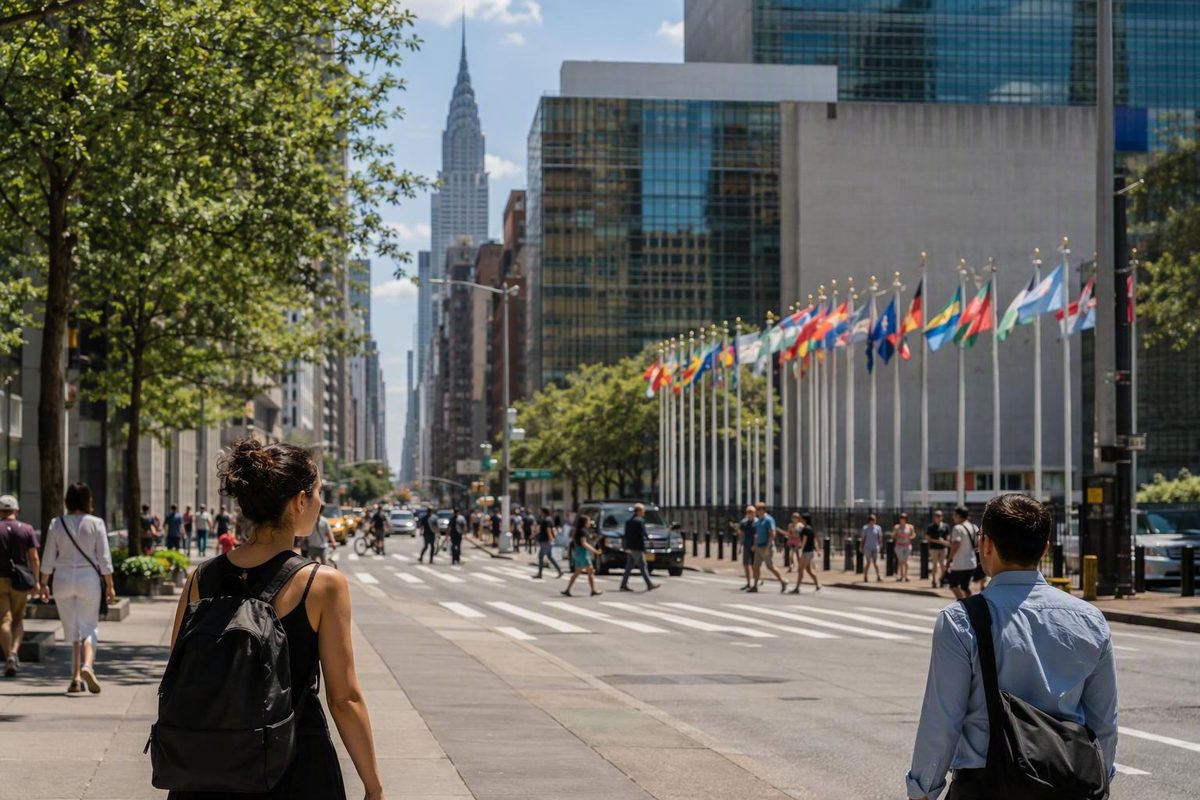
Avoid driving near United Nations Headquarters during the busiest 2026 General Assembly period. Use public transportation to reach Midtown East, make the final approach on foot and keep the day on one side of the affected area where possible. First Avenue between East 41st and East 48th Streets is the core reported disruption zone, but rolling security operations can interrupt movement elsewhere on the East Side.
The short answer: avoid driving through the UN area
Midtown East action plan
- Avoid driving near United Nations Headquarters.
- Use public transportation to reach the general area, then walk.
- Allow extra time for temporary pedestrian and vehicle holds.
- Check official alerts immediately before departure.
Last checked: September 19, 2026. Plans remain subject to operational changes.
Motorcades can also produce rolling restrictions beyond those blocks as delegations travel around the East Side. ABC7 identifies the principal UN-area closures and wider motorcade effects.
Walking is usually more practical than trying to drive through the area, but it is not an unrestricted bypass. Police may temporarily hold pedestrians while secured vehicles pass. Build enough flexibility into the day to wait or use another crossing rather than depending on one corner at one exact time.
The simplest visitor rule is to avoid repeatedly crossing the security zone. If your morning plans are west of Second Avenue, keep the rest of that part of the day west where practical. If you must visit the UN area, complete nearby appointments before moving to another neighborhood instead of weaving in and out of Midtown East.
Four different date ranges—and what each one means
The General Assembly session, the busiest traffic dates and the periods used in closure reporting are not interchangeable. Treat them as separate planning markers rather than combining them into one continuous closure window.
| Date | What it describes | What it means for visitors |
|---|---|---|
| September 8–28 | The broader 81st UN General Assembly session listed by NYC311 | This is an institutional session period, not a street-by-street closure schedule. |
| September 20 | A practical final planning checkpoint before the Gridlock Alert period | Reconfirm appointments, entrances and routes before the busiest traffic days begin. |
| September 21–25 | NYC DOT Gridlock Alert Days | Expect exceptional congestion, but do not read these dates as a complete list of closed streets or operating hours. |
| September 22–28 | The assembly period used in local closure reporting | Restrictions may be tied to meetings and security operations rather than running continuously on every block. |
NYC DOT designated September 21 through September 25 as Gridlock Alert Days and advised people to favor transit, walking or biking over driving. Gridlock Alert Days indicate unusually severe traffic; they do not function as a closure map. NYC DOT’s September 10 announcement explains the designation and travel advice.
Local closure reporting uses September 22 through September 28 as the assembly period. That date range still does not establish a universal daily start time, a guaranteed reopening time or continuous closure of every affected block. NBC New York’s report distinguishes the assembly period from the operating qualifiers attached to individual streets.
For visitors, September 21 through September 25 is the period when a car-dependent Midtown itinerary is least resilient. Check conditions before each trip instead of assuming that all restrictions begin and end together.
Reported closures around United Nations Headquarters
NBC New York’s closure reporting identifies the following recurring restrictions. This is a practical summary of the immediate UN area, not a complete citywide map.
| Location | Reported restriction | Timing qualifier | Practical consequence |
|---|---|---|---|
| First Avenue, East 41st to East 48th Streets | Closed to general traffic | Exact operating periods may change | Do not plan to drive past the UN or depend on a First Avenue curbside stop |
| East 44th–East 47th Streets, First to Second Avenues | Closed around the assembly | Access and reopening can depend on security operations | Approach nearby venues from outside the affected blocks |
| East 42nd Street, First to Second Avenues | Closed while meetings are in session | Potentially until about 9 p.m.; this is approximate | Do not make East 42nd Street your only east-west crossing |
| FDR Drive East 42nd Street exit | Blocked while meetings are in session | Tied to meeting and security operations | Choose another exit before reaching East 42nd Street |
| Other portions of the FDR Drive | Intermittent closures possible | No complete fixed highway schedule | Avoid building a time-sensitive journey around one FDR route |
These recurring restrictions differ from rolling motorcade closures. A motorcade may temporarily stop vehicles or pedestrians along a route outside the immediate UN zone, then release movement after it passes. A fixed map showing only the blocks beside the UN therefore cannot predict every interruption.
If a restaurant, hotel, attraction or meeting is inside the affected area, contact it directly before setting out. A venue may remain open even when its normal vehicle approach or curbside stop is unavailable. Ask which entrance guests should use and whether you should approach from a particular direction.
A walking-first decision table for your Midtown day
The right response depends less on the broad label “Midtown East” than on whether you actually need to enter or cross the blocks next to the UN.
| Your situation | Best approach | Avoid |
|---|---|---|
| Fixed appointment near the UN | Take public transportation to the vicinity, walk the final blocks, allow extra time and check alerts that morning | Timing a taxi or app car to arrive at the door |
| Flexible Midtown East sightseeing day | Move the cluster outside the busiest period or choose one compact day in another neighborhood | Repeatedly crossing between the UN area and central or west Midtown |
| Hotel inside or beside the affected zone | Use the hotel as an anchor, group plans on the same side of the restricted blocks and confirm the preferred entrance | Assuming a vehicle can reach the usual curb or driveway |
| Route merely crossing Midtown East | Reroute before reaching the immediate UN area and keep an alternative east-west crossing available | Depending on East 42nd Street as the only workable route |
For a fixed appointment, transit plus a final walk is the most adaptable plan. Choose an arrival point outside the immediate perimeter and allow for the possibility that the last few blocks will take longer than their map distance suggests.
If the day is flexible, moving it may be simpler than repeatedly adapting it. Lower Manhattan is one possible substitute: begin near the harbor, move through the Financial District and civic center, and finish around the Seaport or Chinatown. That is an itinerary alternative, not an official traffic detour, and current conditions should still be checked before departure.
Visitors staying near the UN do not necessarily need to abandon the neighborhood. Instead, make the hotel the anchor for the day. Group meals, appointments and evening plans geographically, and avoid scheduling activities that require several trips across the restricted blocks.
If you are only passing through Midtown East, reroute before reaching the immediate First Avenue area. A slightly longer route with several fallback crossings is more reliable than a theoretically direct route that depends on one controlled block.
What the First Avenue Tunnel and Tudor City exceptions mean
Passenger vehicles and bicycles are reported able to continue north through the First Avenue Tunnel. The tunnel also contains a permanent protected bicycle lane. NBC New York reports the northbound tunnel access for passenger vehicles and bicycles.
A route that remains technically available can still be a poor choice for a tightly timed appointment.
The city’s security briefing says vehicles requiring access to Tudor City can enter via East 41st and East 43rd Streets. For a Tudor City destination, do not choose an approach solely from a general closure list. Confirm the preferred pedestrian or vehicle entrance with the building, hotel or venue on the day of travel, then follow police instructions on the street. This is more dependable than assuming a particular cross street will remain convenient throughout the day.
Arrange a meeting point with the destination and be prepared to walk from a location outside the restricted blocks.
Drivers using the FDR Drive should select an alternative to the East 42nd Street exit while meetings are underway. Because other portions of the highway may also be interrupted, check the complete route before entering the FDR rather than waiting until the affected exit is close.
Check conditions again before every trip
Enroll in Notify NYC by texting NOTIFYNYC to 692-692. City officials recommend public transportation where possible, additional travel time and real-time alerts. They have also warned that ferry service could be disrupted without identifying specific routes or terminals in advance. The city’s General Assembly security briefing provides the official travel and alert guidance.
Immediately before leaving:
- Check official alerts. Review Notify NYC, NYC DOT, NYPD and 311 notices for current restrictions.
- Check the transit trip. Use current MTA trip information instead of assuming that the planned journey is unchanged.
- Confirm the venue entrance. Ask the hotel, restaurant or appointment site whether its normal entrance and vehicle approach are available.
- Allow for the final walk. Leave time to walk from outside the affected blocks and wait through a temporary pedestrian hold.
- Keep a fallback crossing. Do not make one east-west street the only workable link in the day.
- Recheck the return journey. Conditions may differ by the time an appointment or meal ends.
Advance lists cannot capture every motorcade, protest-related restriction or security adjustment. If your visit does not require being near the UN, keep that day away from the First Avenue security zone. If it does, approach by transit, finish on foot, avoid repeated crossings and check official alerts immediately before departure.