 New York Know
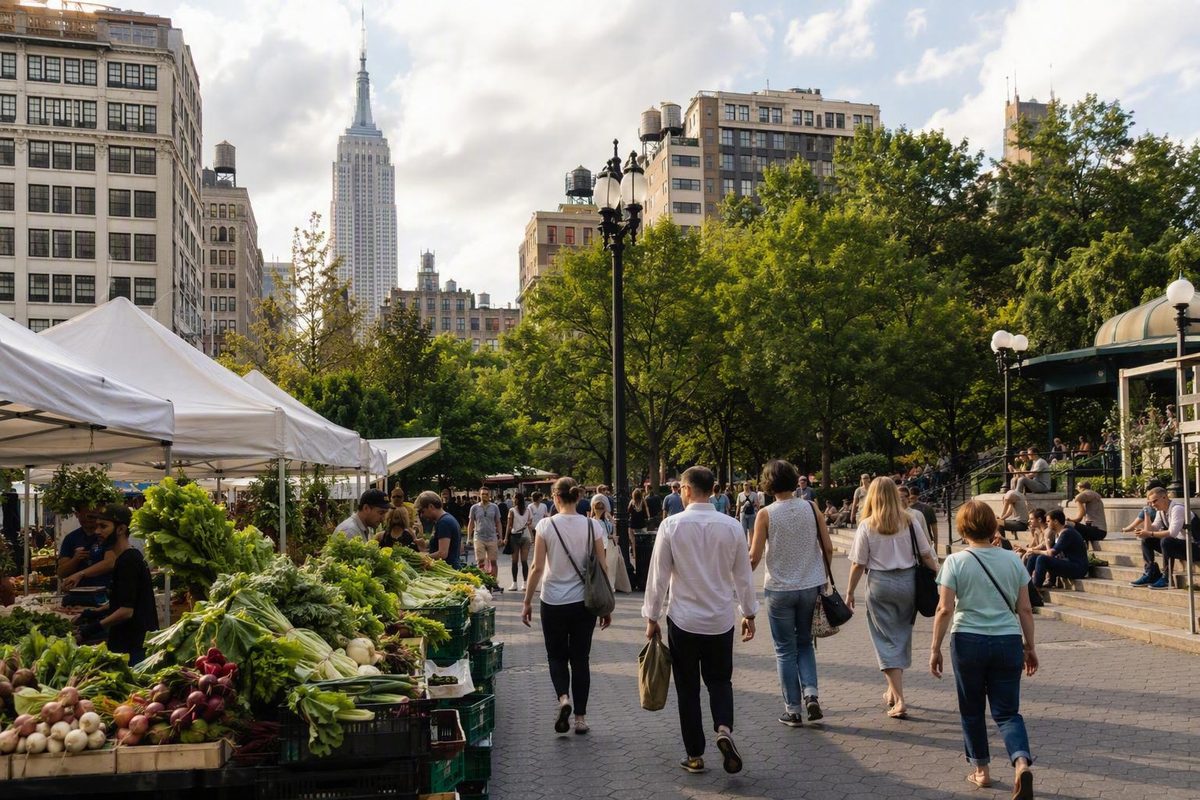
Union Square NYC makes more sense as a meeting point than as a conventional attraction. Within a few blocks, a public park, farmers market, subway complex, monuments, public art, neighborhood commerce, and a long tradition of civic assembly overlap.
The best approach is not to collect every statue or nearby business. First understand what “Union Square” means. Then walk one deliberate loop, pause long enough to see how people use the space, and continue south into Greenwich Village or north toward Madison Square Park.
Union Square at a Glance: Park, Neighborhood, or Station?
“Union Square” can mean three related but distinct places:
- Union Square Park: the defined public park at the center.
- The Union Square neighborhood: an informal name for the surrounding blocks, without one universally accepted official boundary.
- 14th Street–Union Square station: the subway complex beneath the square.
The park is the easiest of the three to locate. NYC Parks describes it as a 6.51-acre community park extending from East 14th Street to East 17th Street and from Broadway to Fourth Avenue. Union Square West runs along the Broadway side, while Union Square East follows the Fourth Avenue side. NYC Parks provides the official park boundaries, features, and current notices.
The wider neighborhood is less exact. Some definitions cover only the blocks facing the park; others extend toward Fifth Avenue, Irving Place, or nearby numbered streets. These are useful descriptions, not legal borders.
That ambiguity reflects Union Square’s position among several familiar areas. The transitions happen block by block rather than along one universally recognized line.
This makes Union Square a useful hinge between downtown and Midtown. It is compact enough for a short stop but connected enough to organize a longer walking day.
Union Square NYC at a glance
- Location: East 14th to East 17th Streets, between Broadway and Fourth Avenue
- Greenmarket days: Monday, Wednesday, Friday, and Saturday; confirm current hours and the day’s vendors before traveling. The published four-day schedule is also documented in a self-guided Manhattan walking route.
- Major sights: the Greenmarket, monuments to George Washington, Abraham Lincoln, the Marquis de Lafayette, and Mohandas Gandhi, the Independence Flagstaff, perimeter plaques, and adjacent Metronome
- Facilities listed by NYC Parks: playgrounds, public restrooms, eateries, Wi-Fi hot spots, and dog-friendly areas; current access and availability are not guaranteed
- Quick visit: an editorially suggested 20–30 minutes for the southern plaza, several monuments, and a brief market pass-through
- Standard visit: allow roughly an hour for an unhurried loop, understanding that this is a suggested format rather than a measured duration
- Longer visit: combine the park with Greenwich Village or Madison Square Park
- Before leaving: check current park information, market details, events, transit service, and any accessibility requirements with the responsible operator
Getting There and Orienting Yourself
The subway station serving the square is 14th Street–Union Square. Do not rely on a static list of subway services for day-of-travel planning. Routes, planned work, station entrances, elevators, and step-free options can change, so consult the MTA’s official trip-planning and service information immediately before departure.
Once above ground, the street grid provides a simple mental map:
- 14th Street forms the southern edge.
- 17th Street forms the northern edge.
- Broadway and Union Square West define the western side.
- Union Square East and Fourth Avenue define the eastern side, with Park Avenue South approaching from the north.
- Broadway continues north toward the Flatiron area.
- University Place provides a logical southbound route toward Greenwich Village.
If your subway exit leaves you facing an unexpected direction, find a numbered cross street first. At 14th Street, you are on the south side; at 17th Street, you are on the north. The park is compact enough to reorient around its perimeter.
On Greenmarket days, stalls occupy the north and west plazas. The most direct route may therefore become a browsing aisle, and the perimeter can feel more like a marketplace than an open plaza. When arranging to meet someone, choose a specific monument, corner, or entrance rather than saying only “at the market.”
Travelers who need elevators or step-free travel should confirm the route shortly before leaving. The supplied evidence does not establish which entrances or elevators will be operating during a particular visit.
Travel times are similarly variable. Your origin, transfers, service changes, walking pace, and chosen exit all affect the journey, so a fixed time estimate would be misleading.
The Best Things to Do in Union Square Park
The central experience is not one landmark. It is the combination of market activity, public life, monuments, historical details, and surrounding architecture within a short walk.
Browse the Greenmarket
On operating days, the Greenmarket occupies the northern and western sides of the park. It can be part of the visit without becoming its entire purpose: walk one aisle, notice what is being sold, and then return to the park loop.
A farm or item seen during a previous visit may not appear on the day you go.
Watch the square function as public space
Union Square is a place to observe as well as traverse. Depending on the day, the park may contain commuters, shoppers, conversations, chess games, public expression, performances, or people taking a break.
Rather than treating this activity as background between monuments, pause at the edge of the park for a few minutes. The open southern plaza, greener interior, and market plazas do not all function in the same way, and noticing those differences is part of understanding the square.
Find the four principal monuments
The park’s permanent monuments honor:
- George Washington
- Abraham Lincoln
- The Marquis de Lafayette
- Mohandas Gandhi
Together, they create a compact walk through different layers of political memory.
Look for the Independence Flagstaff as well. These permanent features should be distinguished from temporary artworks, performances, and seasonal installations, which may disappear between visits.
Look down as well as up
Historical medallions and plaques appear around the park’s perimeter. Because they are integrated into an outdoor circuit rather than arranged like a museum exhibition, they are easy to miss. A documented personal walking account shows several of these perimeter plaques and medallions.
Treat them as details that reward a slower walk, not as a scavenger hunt. Finding a few is enough to add historical context to the larger monuments.
Use Metronome as a visual anchor
From the southern side of the park, look across toward One Union Square South. The building contains Metronome, a large wall artwork and digital display.
That distinction helps explain Union Square’s broader visual identity: the experience includes not only the formal park but also the façades and plazas around its edges.
Check what is temporary
A striking artwork, performance, or organized program may be temporary. If a particular installation is central to your visit, confirm its dates and exact location before going.
This is especially important when older photographs or neighborhood publicity are the reason you expect to see something. Permanent monuments provide reliable orientation; temporary programming does not.
Treat listed facilities as possibilities, not guarantees
NYC Parks lists playgrounds, public restrooms, eateries, Wi-Fi hot spots, and dog-friendly areas among the park’s facilities. The available information does not establish:
- current facility hours;
- the precise restroom location;
- whether a restroom will be open;
- the accessibility of each facility;
- whether Wi-Fi will be working;
- or the dog rules applying at the time of your visit.
If a restroom, playground, accessible route, or other facility is essential, verify it separately and keep an alternative in mind.
How to Plan a Union Square Greenmarket Visit
GrowNYC operates the year-round Union Square Greenmarket on the north and west plazas. Its reported operating days are Monday, Wednesday, Friday, and Saturday. The published product mix includes produce, meat, cheese, regional wine, flowers, and other farm and food goods. The Union Square Partnership summarizes the market’s location, schedule, and product range.
Confirm exact hours and day-specific vendor attendance through GrowNYC’s official Greenmarket information before traveling. The evidence supports the four-day schedule, but it does not establish that every vendor attends every session or that the same goods are available throughout the year.
The Partnership associates more than 140 vendors with the market. That is an overall vendor claim, not evidence that more than 140 stalls appear simultaneously at every market session.
A useful market visit has three parts:
- Make an initial pass without buying. This lets you see the day’s selection before carrying purchases around the park.
- Choose purchases that fit the rest of your day. Flowers and perishable food may be inconvenient if you still have several hours of walking ahead.
- Exit deliberately into the park. Continue toward the monuments and interior paths instead of allowing the market aisles to become the entire visit.
Avoid planning around claims about bargains, free samples, predictable crowd levels, or a universally best arrival time. Prices, attendance, product availability, and individual impressions vary.
They are separate markets with different periods of operation and layouts. Check the relevant organizer if you are visiting during the holiday season, when temporary stalls may affect movement around the park.
A straightforward market-day loop begins at 14th Street, crosses the southern plaza, proceeds north through the west-side stalls, turns across the northern plaza, and returns south through the park interior or along the eastern edge. This keeps the market in context as one layer of Union Square.
A One-Hour Union Square Walking Loop
This route is an editorial suggestion, not a guaranteed duration. An hour can work for a steady circuit with short pauses, but shopping, street crossings, events, photography, crowds, and mobility requirements can extend it.
1. Begin at the southern plaza
Start near East 14th Street and locate the George Washington statue. It provides an immediate visual reference and introduces the square’s commemorative landscape.
Before moving, look across the park. The open southern side feels different from the interior paths and from the market plazas farther north.
2. Follow the western perimeter
Walk north along Union Square West. Watch for historical plaques and medallions near the park boundary instead of looking only for large statues.
If the Greenmarket is operating, this side may be filled with stalls. Browse at your own pace, but continue north unless shopping is the principal purpose of your visit.
3. Cross the northern plaza
At East 17th Street, move through or alongside the northern market area. This edge opens toward Broadway, Fifth Avenue, and the Flatiron area.
It is also the natural decision point for a longer walk. To complete the Union Square loop, turn east and remain with the park; to extend the route north, continue toward Broadway.
4. Return along the eastern edge
Walk south beside Union Square East and study the buildings across the street. The columned former Union Square Savings Bank, now identified with the Daryl Roth Theatre, contributes to the formal architectural character of this side of the square. That identification is documented in a walking account of the park and its surrounding buildings.
Also notice the building at 201 Park Avenue South, associated with W New York–Union Square. NYC Tourism describes it as the 1911 Beaux-Arts-style Guardian Life building. Its Union Square guide identifies the building and its setting.
These are exterior observations, not assurances about current access or venue operations. The purpose is to read the bordering architecture as part of the square.
5. Re-enter the park for the remaining monuments
Cut through the interior or continue along the perimeter to find the monuments to Lincoln, Lafayette, and Gandhi. Their exact sequence matters less than the contrast between formal commemorative art and everyday activity around it.
Look for the Independence Flagstaff as well. If other art is present, determine whether it is permanent or temporary rather than assuming every installation belongs to the park’s fixed collection.
6. Finish facing One Union Square South
Return to the 14th Street side and look toward Metronome at One Union Square South. Finishing here reconnects the park to the surrounding streets and leaves you well placed to continue south, east, west, or back to the subway.
A shorter 30-minute variation
If you have only half an hour, use this compressed editorial route:
- Begin at the Washington statue.
- Cross the southern plaza.
- Pass several principal monuments.
- Make a brief west-side market pass if it is operating.
- Finish with the view of Metronome.
This is an introduction, not a comprehensive tour. Skip the attempt to locate every plaque or browse every stall.
Neither version should be described as fully accessible without current confirmation of entrances, gradients, surfaces, construction, and surrounding crossings. Travelers with particular mobility requirements should verify conditions before depending on the route.
Why Union Square Matters: A Short Civic History
Union Square’s name does not commemorate the American Union. It refers to the meeting—or “union”—of major roads, historically Broadway and the former Bowery Road/Fourth Avenue alignment. The site appeared as public space in early-19th-century planning, became associated with the name Union Place, and developed into the park that opened in July 1839. A historical overview documents the name and early chronology.
The square’s importance comes from continuity rather than one founding event.
Compact Union Square timeline
- Early 1800s to July 1839: The junction of major roads shaped the site; it appeared in city planning, became known as Union Place, and developed into the park that opened in July 1839.
- 1839, 1872, 1882, and 1970: The park opened in 1839; Frederick Law Olmsted and Calvert Vaux redesigned it in 1872 in part to accommodate large gatherings; the first Labor Day parade proceeded to Union Square in 1882; and the park was associated with New York’s first Earth Day observance in 1970. NYC Parks documents these milestones in its official history.
- 1997: Union Square received National Historic Landmark designation. The designation date is recorded in the square’s historical summary.
It is accurate to describe Union Square as important to labor and civic history. Calling it the definitive birthplace of an entire movement would go further than the evidence supports. Labor history, political organization, and public protest developed across many organizations, neighborhoods, and cities.
The physical layout makes this history easier to understand. The plazas are not merely empty areas between monuments. They help explain why generations have used Union Square to gather, argue, organize, celebrate, and be seen.
Extend the Walk South or North
After circling the park, choose one direction. Walking south and then doubling back north can turn a coherent route into unnecessary mileage.
If you are still deciding where Union Square belongs in a larger trip, New York Know’s guide to choosing a New York neighborhood for a first visit suggests matching your base and itinerary to your preferred walking range. Its companion advice on planning New York days by area supports grouping nearby sights instead of repeatedly crossing the city.
South to Greenwich Village and Washington Square Park
From Union Square, follow University Place south toward Washington Square Park. One published self-guided route measures this park-to-park segment at approximately 0.4 miles. The same route measures the northbound segment from Union Square to Madison Square Park at approximately 0.4 miles; actual distance and walking time depend on your chosen streets, crossings, diversions, and endpoints. See the route connecting Washington Square, Union Square, and Madison Square.
The southbound option creates a gradual transition into Greenwich Village. The street pattern and atmosphere begin to change after 14th Street, while Washington Square Park provides a clear destination without requiring a complicated route.
A simple southbound plan is:
- Union Square park loop;
- University Place;
- surrounding Greenwich Village streets;
- Washington Square Park;
- then continue within the Village rather than returning north.
This direction is also the more coherent choice when the rest of your day is oriented downtown.
North to Madison Square Park and Flatiron
For the northbound option, follow Broadway toward Madison Square Park. This route emphasizes Broadway’s diagonal movement through the grid and leads naturally into the Flatiron area.
A simple northbound plan is:
- Union Square park loop;
- Broadway;
- Flatiron-area streets and exterior architecture;
- Madison Square Park;
- then continue north only if the rest of your itinerary points that way.
The appeal is the progression between public spaces rather than a sequence of disconnected businesses.
East and west alternatives
The East Village and Gramercy are also nearby, without requiring one fixed definition of the Union Square neighborhood.
Head southeast if you want the East Village to become the main focus of the walk. Move east or northeast if Gramercy is the next area. Chelsea lies west of the square, though reaching it calls for a more deliberate westbound route because Union Square’s clearest walking axes run north and south.
Whichever direction you choose, continue into that area rather than treating Union Square as a base for repeated out-and-back walks.
Practical Limits: What to Verify Before You Go
Union Square changes from day to day. Market stalls, demonstrations, temporary art, seasonal retail, construction, maintenance, and transit work can alter both what is visible and how people move through the space.
Use this concise pre-visit checklist:
- NYC Parks: Check current notices, facilities, rules, and event information.
- GrowNYC: Confirm Greenmarket hours, operating dates, and the day’s vendor lineup.
- MTA: Check current service, station entrances, planned work, elevator status, and step-free options.
- Event organizer: Confirm dates and locations for any temporary artwork or program central to your visit.
- Weather and walking conditions: Adjust the route to your needs rather than treating an estimated duration as a target.
The available evidence does not verify current park hours, restroom hours, elevator status, exact accessibility conditions, dog rules, event schedules, or the least-crowded visiting times. A facility listed by NYC Parks may not be available at every hour or during every visit.
Temporary art and neighborhood projects require especially careful date checking. The Union Square Partnership’s 2026 material has promoted changing art projects and broader neighborhood initiatives, but publicity for a project does not prove that it is installed or available on your visit. The Partnership’s Bead Maze announcement is one example of such time-sensitive programming.
Apply the same caution to commercial directories and traveler reviews. A listing may show the kinds of businesses found nearby, but it does not establish that a venue is currently open, affordable, or appropriate for every visitor. Comments about crowds, prices, and atmosphere are individual experiences rather than universal planning rules.
Most importantly, do not overbuild the stop. Union Square works because its market, monuments, plaques, public expression, and surrounding architecture reveal themselves within a compact area.
Union Square NYC FAQ
What days is the Union Square Greenmarket open?
The reported operating days are Monday, Wednesday, Friday, and Saturday, and the market operates year-round on the north and west plazas. Confirm exact hours and the day’s vendors with GrowNYC before traveling. The published schedule is summarized by the Union Square Partnership.
Which subway goes to Union Square NYC?
The station is 14th Street–Union Square, beneath the square. Subway routes, planned work, entrances, and elevator availability can change, so use the MTA’s official live trip-planning information rather than a static route list.
How long should I spend at Union Square?
As an editorial planning suggestion, allow 20–30 minutes for a quick look at the southern plaza, several monuments, and part of the market. Allow roughly an hour for a fuller loop.
Add time if you plan to shop, study the plaques, attend an event, rest in the park, or continue toward Greenwich Village or Madison Square Park. These are itinerary formats, not guaranteed durations.
Why is it called Union Square?
The name refers to the union or junction of major roads, particularly Broadway and the former Bowery Road/Fourth Avenue alignment. It was not named to commemorate the American Union.
Is the Union Square holiday market the same as the Greenmarket?
No. The Greenmarket is the year-round farmers market reported on Monday, Wednesday, Friday, and Saturday. The holiday market is a separate seasonal operation. Check the relevant organizer for current dates and layout.
Make Union Square the Start of the Walk
Union Square is best understood as a connective place, not a box to check. Walk through the market, notice the monuments and civic history embedded in the plazas, and spend a few minutes watching the park function as shared public space.
Then continue in one direction: south into Greenwich Village or north toward Madison Square Park. Before setting out, verify live market, park, event, accessibility, and transit details through GrowNYC, NYC Parks, the event organizer, and the MTA.