 New York Know
First, clarify what “Brooklyn Chinatown” means
It is a long sequence of shops, restaurants, markets, and community institutions woven into surrounding residential streets.
Published descriptions vary, but they generally place the core corridor between the low 40s and the mid-60s streets. Some routes begin around 40th or 41st Street; others use 44th or 45th Street as a practical northern edge. A useful visitor’s definition is Eighth Avenue from approximately 41st to 65th Streets, with the understanding that the commercial transition is gradual rather than official. A January 2026 family guide similarly described the district as extending roughly from 40th to 65th Streets.Mommy Poppins describes the approximate Eighth Avenue corridor
Sunset Park was Brooklyn’s first Chinatown, but it is not the borough’s only substantial Chinese enclave. Chinese commercial and residential communities also developed in Bensonhurst and around Avenue U in the Sheepshead Bay–Homecrest area. These are geographically separate districts, not one continuous Chinatown stretching across southern Brooklyn.This overview distinguishes the Sunset Park, Bensonhurst, and Avenue U enclaves
A simplified orientation looks like this:
| Area | Approximate Brooklyn position | Visitor orientation |
|---|---|---|
| Sunset Park Chinatown | Western Brooklyn | Centered on Eighth Avenue, approximately from the low 40s through the mid-60s streets |
| Bensonhurst Chinese enclave | Southeast of Sunset Park | A separate community spread across several commercial streets |
| Avenue U Chinese enclave | East and southeast of Bensonhurst | Centered around Avenue U in the Sheepshead Bay–Homecrest area |
Map reading note: This table is schematic rather than to scale. It distinguishes three separate areas and does not imply fixed neighborhood boundaries.
For a first visit, Sunset Park is the easiest of the three to approach as a linear walk. Eighth Avenue provides a clear north–south spine, while numbered cross streets let you monitor your progress without depending on restaurants or vendors that may change.
The rest of this guide focuses on Sunset Park because that is the place most commonly intended by searches for “Chinatown Brooklyn.” That focus should not be mistaken for a claim that Sunset Park represents all Chinese life or food in the borough. It is one important enclave within a broader Brooklyn geography.
What to expect along Eighth Avenue
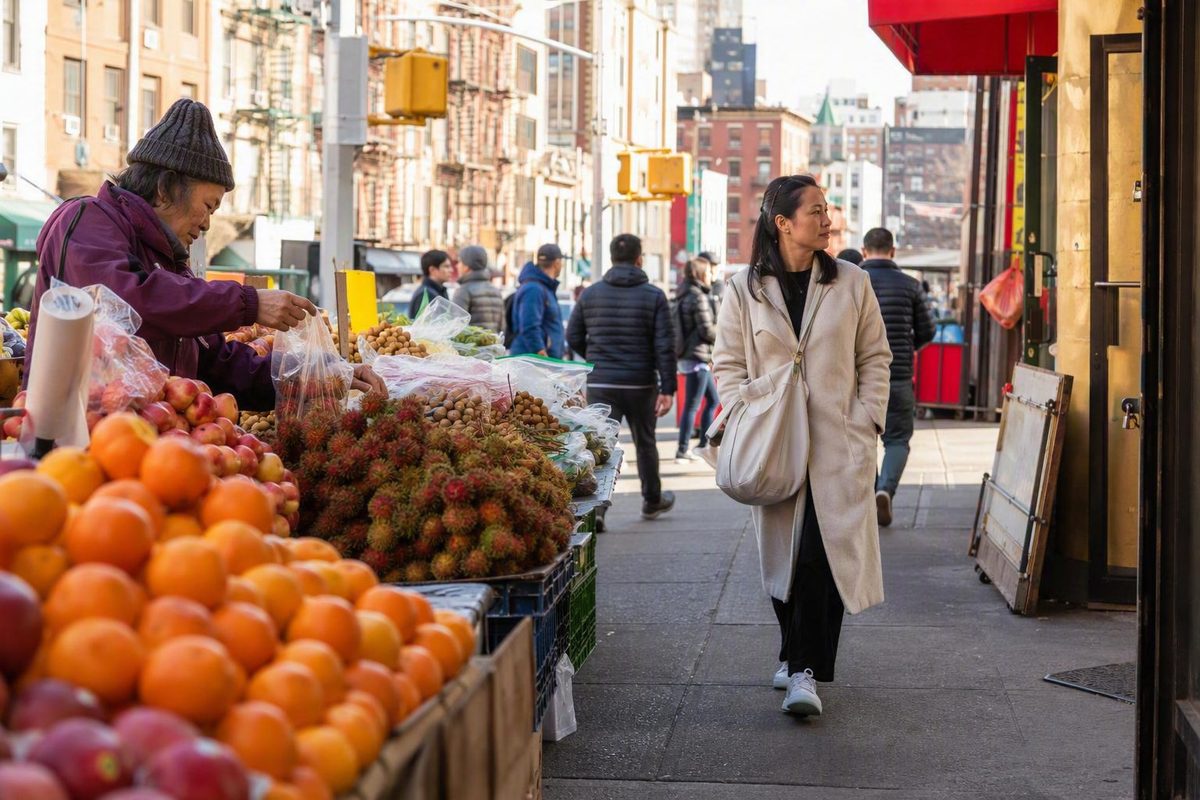
Eighth Avenue is a working residential and commercial corridor, not a purpose-built sightseeing district. People come here to buy groceries, collect prepared food, work, meet family, and move between homes and neighborhood businesses. The visitor experience grows from that everyday activity.
At street level, expect a recurring mix of:
- Chinese-language signs and menus
- Produce displayed near storefronts
- Seafood and grocery markets
- Chinese bakeries
- Roast-meat counters
- Dim sum and banquet restaurants
- Noodle, dumpling, and snack shops
- Tea and dessert counters
- Household-goods stores and everyday retail
- Food trucks, carts, and other mobile vendors
One visitor writing in October 2023 reported seeing produce, seafood, dry goods, homemade snacks, skewers, and fried noodles while hearing Cantonese, Hakka, Mandarin, and Hokkien. That is one traveler’s snapshot rather than a formal linguistic survey, but it illustrates the variety that may be visible and audible during a walk.Tripadvisor collects dated visitor descriptions of the Eighth Avenue corridor
The corridor makes sense through accumulation: bakery windows, hanging roast meats, boxes of vegetables, restaurant entrances, tea counters, and busy market aisles. Walking slowly is more useful than assembling a long checklist.
Travel writers and visitors often describe Sunset Park as less oriented toward visitors than Manhattan Chinatown or Flushing. Treat that as a recurring impression, not a measurable fact. Sunset Park receives visitors and contains destination restaurants, but much of Eighth Avenue is arranged around local shopping and everyday services rather than sightseeing.
That distinction should shape the day. Do not expect every block to provide a formal attraction. Some stretches contain dense clusters of shops and restaurants; others feel quieter or more residential. A satisfying visit leaves room to browse without requiring each block to produce a scheduled stop.
The corridor can also feel busy and practical. Produce boxes, shopping carts, deliveries, sidewalk displays, and people entering narrow storefronts may compete for limited space. Conditions vary by block, weather, day, and time, so these features should not be turned into broad claims about crowding, cleanliness, accessibility, or safety.
Finally, avoid building the entire visit around one cart, displayed product, or social-media dish. Mobile vendors may not appear at an older reported location, and bakery cases can sell out. Restaurant names, menus, and service formats can also change. The walk works best when substitutions are treated as part of the experience.
How Sunset Park became Brooklyn’s first Chinatown
Before Eighth Avenue became associated with Chinese immigration, historical summaries connected it with a prominent Norwegian community. The avenue was described as part of “Little Norway,” and the older commercial strip was sometimes called Lapskaus Boulevard.
Chinese families began settling in Sunset Park in substantial numbers during the 1980s, followed by Chinese-owned groceries, restaurants, and community organizations. Accounts describe Cantonese roots followed by a stronger association with migrants from Fuzhou and the wider Fujian region. They also identify lower costs relative to Manhattan Chinatown, housing pressure in Manhattan, and later Fujianese migration as contributors to the enclave’s growth rather than as one definitive explanation.The historical overview traces the area’s Norwegian past and Chinese development from the 1980s
This history should not be simplified into a complete replacement of one community by another. A strong Fuzhou identity can coexist with Cantonese institutions and with a wider environment in which Mandarin, Hakka, Hokkien, and other languages or regional backgrounds are present. A restaurant’s menu also does not necessarily reveal the identity of every owner, employee, or customer.
For visitors, that complexity helps explain why “Chinese food” is too broad a description for the corridor. Cantonese roast meats and dim sum, Fujian-linked snacks, Sichuan dishes, Yunnan rice noodles, Taiwanese drinks, and other traditions can appear during the same walk. Vietnamese businesses and food from elsewhere in East and Southeast Asia add further layers.
Sunset Park remains a living immigrant community rather than a preserved historical exhibit. Its earlier Norwegian identity and later Chinese development provide context, but Eighth Avenue is not frozen at any one stage. Businesses change, residents move, and new generations use the corridor in different ways.
A walking-first route through the Eighth Avenue corridor
The simplest route is to start around 41st or 44th Street and walk south on Eighth Avenue toward the low or mid-60s. The endpoints are flexible. Beginning farther north creates a gradual transition into the commercial corridor; beginning around 44th Street produces a more compact version.
Before leaving, consult an official MTA website or app for current train service, station entrances, planned work, and elevator conditions. Static attraction listings and old walking estimates cannot establish day-of-travel transit conditions.
Use three street-number clusters rather than a list of mandatory restaurants:
| Route cluster | Approximate streets | What to do |
|---|---|---|
| Northern approach | Low-to-upper 40s | Begin browsing; compare portable snacks with possible sit-down meals |
| Central corridor | 50s | Look for bakeries, roast meats, noodles, restaurants, tea, and markets |
| Southern stretch | Low-to-mid 60s | Continue for additional markets, dim sum, snacks, and everyday retail |
| Optional park detour | West of the northern corridor | Add open space before or near the beginning of the Eighth Avenue walk |
These ranges are planning tools, not formal subdistricts.
Northern approach: low-to-upper 40s
Starting around 41st Street allows the corridor to reveal itself gradually. The northern blocks have appeared in food walks for dumplings, bánh mì, bakeries, and small restaurants, but the better strategy is to look before buying everything that appears appealing.
Use the first few blocks to answer three questions:
- Which food is easy to carry?
- Which dish deserves a seated meal?
- How much appetite do you want to preserve for the 50s?
Many first-time food crawls become difficult because the group orders a full portion at the first counter. Sharing one early purchase leaves room for a contrasting dish later.
Watch how the commercial rhythm develops as you move south. Signs and food windows recur, and grocery shopping becomes increasingly visible. A walk recorded in November 2020 followed Eighth Avenue from approximately 44th to 64th Street, demonstrating how naturally the numbered streets divide the corridor into manageable sections.The ActionKid walking video documents the block-by-block route
Central corridor: the 50s
The 50s are the most useful planning core. Dated guides locate roast-meat shops, regional noodle restaurants, bakeries, tea counters, hot pot, and other food businesses in or near these blocks. Even if a named example from an older guide is unavailable, the concentration gives you alternatives within a direct walk.
This is the logical place for the substantial dish in your crawl. If you want roast meat over rice, noodle soup, or a seated restaurant meal, choose one rather than scheduling several full portions. Follow it with a pastry, tea, or small snack only if you still have room.
The central blocks are also a good place to enter a grocery store. A short market browse breaks up the eating and reveals more of what the corridor supplies to residents. Keep entrances and checkout areas clear, and remember that products displayed for sale are not exhibits.
A shorter version of the route can end in the upper 50s. You will still have experienced the transition from the northern approach into the central commercial blocks without committing to the entire avenue.
Southern stretch: low-to-mid 60s
Continue toward the low 60s for additional markets, banquet-style restaurants, and possible snack vendors. Older coverage has documented rice-noodle carts and other mobile sellers around this part of the avenue, but their former locations should be treated as areas of possibility rather than appointments.
A larger dim sum or banquet restaurant may suit a group, especially when several dishes can be shared. Confirm the current service arrangement before making one restaurant the endpoint, because dim sum periods and ordering formats can differ from general restaurant hours.
The longer route can continue toward approximately 65th Street. Stop sooner if the group is full, tired, or no longer enjoying the browse. The numbered streets make progress easy to understand, and turning around early does not diminish the visit.
Optional detour: Sunset Park itself
For open space, detour west to Sunset Park, between 41st and 44th Streets and Fifth and Seventh Avenues. A 2021 NYC Tourism itinerary reported views toward Manhattan and the Statue of Liberty and recommended beginning the Eighth Avenue walk around 41st Street.NYC Tourism locates the park and outlines the southbound corridor route
The cleanest sequence is either:
- Visit the park first, then move east to Eighth Avenue and walk south; or
- Begin on Eighth Avenue, detour west near the northern end, and return before continuing south.
Avoid leaving the park until after completing the full corridor unless you are comfortable retracing part of the route. Skip the detour when weather, mobility needs, or fatigue make it impractical. The park should provide a useful change of pace, not become another obligation.
Build a food crawl by dish, not by rankings
Build the crawl around contrast, not claims about which restaurant is “best” or “most authentic.” Choosing food categories before businesses makes the route more resilient when a restaurant closes, changes hours, or stops offering an expected item.
A practical formula is:
- One substantial dish: roast meat with rice, noodles, dim sum, or hot pot
- One portable savory item: dumplings, a rice-noodle roll, tofu pudding, or bánh mì
- One bakery item or drink: an egg tart, bun, fruit tea, or dessert
Share portions where appropriate. Ordering a full meal at every stop quickly turns a neighborhood walk into an endurance exercise.
The businesses below are dated examples from coverage published between 2020 and 2026, not confirmations of present operation. Before visiting, check current business channels for status, location, hours, menus, payment policies, and service periods.
Cantonese roast pork, chicken and duck
Roast-meat counters are among the corridor’s most recognizable food stops. Look for windows displaying pork, chicken, or duck, then decide whether you want one meat over rice, a mixed portion, or something packed to take home.
A November 2020 guide featured Roast 28 at 5124 Eighth Avenue for Cantonese-style roast meats, including roast pork and soy-sauce chicken over rice. The same guide also documented nearby Yunnan noodles, hot pot, Taiwanese drinks, Sichuan dishes, rice-noodle rolls, tofu pudding, egg tarts, and Vietnamese bánh mì.Resy’s 2020 guide records these businesses and dishes as dated examples
A January 2026 family guide identified King’s Kitchen near 60th Street as another reported example associated with Cantonese roast meats and clay-pot dishes.The 2026 family guide includes King’s Kitchen among its food suggestions
Treat those names and locations as leads to recheck. A business can remain open while changing its menu, service style, ownership, name, or accepted payment methods.
Dim sum
Dim sum often works better for a small group than for a solo visitor attempting a larger crawl because several dishes can be shared. Older guides have identified Park Asia and Bamboo Garden among the corridor’s banquet-style options.
The relevant detail is not simply whether the restaurant is open. In a May 2024 food-tour video, participants reported that Bamboo Garden’s dim sum service had ended before 2 p.m. during filming; that was a time-specific observation, not a present-day cutoff.The 2024 food-tour video records its dim sum and bakery stops
If dim sum is the main reason for your visit, ask the restaurant specifically about that day’s dim sum hours and format. General opening hours may not answer the question.
Dumplings and street snacks
Dumplings are a manageable portable stop, particularly when one order can be divided among several people. Kai Feng Fu Dumpling and Great Taste Dumpling have appeared in dated food walks, but their reported prices and portions should not be carried forward as current information.
The May 2024 food-tour video included Great Taste Dumpling, while earlier walking coverage documented Kai Feng Fu near the northern part of the route. These appearances establish them as past examples, not verified current recommendations.
Street-food coverage has also described steamed rice-noodle rolls and tofu pudding from carts or mobile vendors. Such stops can be memorable because they connect directly with the avenue’s commercial activity, but they are poor fixed route anchors. If a hoped-for vendor is absent, continue walking and choose another counter-service item rather than waiting at an old mapped location.
Yunnan noodles and Sichuan dishes
Regional restaurants help break down the overly broad category of “Chinese food.” The 2020 Resy guide associated Yun Nan Flavour Garden with Yunnan rice noodles, including crossing-the-bridge noodles and cold rice noodles, and featured Chuan Tian Xia for Sichuan dishes.The guide documents its Yunnan and Sichuan examples
These foods are better candidates for the substantial-meal slot than for a quick bite. Noodle soups are awkward to carry, while many Sichuan dishes make more sense shared at a table. If your group wants one sit-down meal, choose it first and arrange lighter bakery or snack stops around it.
Ask about spice levels and ingredients when necessary, but do not assume that one restaurant’s preparation represents an entire province. Regional labels identify culinary traditions; they do not make every kitchen or dish uniform.
Bakeries, egg tarts and desserts
Chinese bakeries are easy to include because they allow flexible portion sizes. Cases may contain buns, sponge cakes, rolls, savory pastries, and custard tarts. Pointing can be practical when product names are unfamiliar, but step aside if you need time to decide at a narrow counter.
Xin Fa has repeatedly appeared in visitor coverage for Portuguese-style egg tarts. Availability is not guaranteed: a food-crawl article published in August 2025 reported that the egg tarts were sold out during the writer’s visit.The Frugal Foodies records the 2025 sellout as a dated observation
Carry a backup category rather than a second “must-buy” item. If egg tarts are gone, consider another pastry, a bun, or a drink. A sellout is not evidence that the walk has failed.
Taiwanese drinks and snacks, hot pot and bánh mì
Dated guides show that the corridor’s food landscape extends beyond Cantonese, Fujianese, Sichuan, and Yunnan traditions. Reported examples include Taiwanese fruit tea, brown-sugar drinks, popcorn chicken, hot pot with multiple broth options, and Vietnamese bánh mì.
These foods fit different kinds of visits:
- Fruit tea or bubble tea works as a walking drink, although carrying it can make market browsing less convenient.
- Taiwanese fried snacks can fill the portable savory role.
- Hot pot is a seated group meal rather than a quick crawl stop.
- Bánh mì is portable but substantial enough to replace a full rice or noodle meal.
The aim is not to consume something from every tradition. It is to recognize that Sunset Park’s corridor cannot be reduced to one regional cuisine.
Do not plan around old prices
Dated coverage often portrays Eighth Avenue food as inexpensive, but reported prices belong to particular visits. Figures from 2020, 2021, 2024, or 2025 are historical snapshots, not present-day budgets. The same caution applies to portion sizes, set menus, and all-you-can-eat arrangements.
Check current menus when available and carry a flexible budget. Verify card minimums, cash policies, and ordering systems directly rather than assuming that an earlier visitor’s experience still applies.
Look beyond restaurants and snack counters
Food may motivate the visit, but the corridor becomes more legible when you notice the infrastructure of daily life. Grocery stores, seafood markets, produce stands, bakeries, and household-goods shops reveal what residents buy regularly—not only what visitors photograph or eat.
Enter stores when you have genuine interest and enough room to browse without obstructing customers. Keep bags close in narrow aisles, step aside when employees are stocking shelves, and avoid handling unfamiliar produce or packaged goods unnecessarily. Buying fruit, tea, pantry goods, or baked items can broaden the visit beyond prepared food.
Xi Fang Temple
A 2021 tourism itinerary identified Xi Fang Temple at 5101 Eighth Avenue and described a vegetarian restaurant associated with the building.NYC Tourism reports the temple address and its historically associated restaurant
Treat the temple as a religious and community landmark, not as an attraction with guaranteed public access. Before planning an interior visit, confirm whether visitors are currently welcomed, which areas are open, and whether any restaurant operation continues.
If access is available, follow posted rules, keep voices low, and ask before photographing people or religious activity. The temple contributes to understanding the neighborhood even if you observe only the exterior.
Seasonal celebrations
The same older tourism coverage documented Lunar New Year activity along Eighth Avenue and Mid-Autumn traditions near the southern end of the corridor. That establishes a history of seasonal celebration, but it does not provide reliable dates, routes, or operating plans for a future visit.
Consult current announcements from event organizers, community groups, or city agencies. On an event day, street closures, performances, crowds, and temporary vendors may alter the ordinary walking route.
Sunset Park as an open-space addition
Sunset Park is the most natural non-food addition because it lies a few avenues west of the northern corridor. It provides a change of scale—open lawns and wider views after narrow storefronts and market aisles.
Add it when the weather is comfortable and your group wants a pause before or near the beginning of the food walk. Skip it when the priority is a shorter corridor-focused visit.
Options for families
A January 2026 family guide reported crane games, arcades, shops, an indoor play space, and nearby playgrounds around the broader district. Named examples included TESO, Ebisu, and Max Funland, but every business, machine, facility, age policy, and admission arrangement requires current confirmation.
For a family route, choose one non-food activity instead of taking children through a long sequence of stores. Pair it with a simple snack and either the park or a playground when current access and weather cooperate. Establish an exit point after the central blocks.
Do not infer that the entire corridor is stroller-friendly or accessible. Sidewalk displays, narrow entrances, and individual building layouts create varying conditions. Confirm access directly when it is essential.
Japan Village and Industry City
Japan Village at Industry City can complement a broader Sunset Park day for visitors interested in a Japanese marketplace, food hall, and shops. It is not part of the core Eighth Avenue Chinatown corridor.
Combining the two areas adds a separate destination and more travel. If the purpose of the day is to understand Brooklyn Chinatown on foot, staying with Eighth Avenue and the nearby park produces a more coherent visit.
Practical planning for a flexible visit
The best route is modular. Decide beforehand what would count as a satisfying short visit, then add blocks only while the group remains interested.
A practical structure is:
- Short visit: Begin in the low-to-mid 40s, continue through the central blocks, and finish in the upper 50s.
- Longer visit: Continue south toward the low or mid-60s.
- Open-space version: Add Sunset Park near the northern end.
- Family version: Select one play or shopping stop, one food stop, and a clear turnaround point.
- Meal-led version: Reserve appetite for one seated meal, then add only a bakery item, snack, or drink.
Check official live transit information on the day of travel. Subway service, planned work, station entrances, and elevator conditions can change. Save the relevant official page or app before leaving rather than relying on an old screenshot.
Eighth Avenue may feel congested because shopping activity reaches toward the sidewalk and many storefronts are narrow. The 2026 family guide suggested Seventh and Ninth Avenues as quieter parallel alternatives in places and listed possible restrooms at Sunset Park and Leif Ericson Playground. Treat those restroom references as leads only: seasonal hours, maintenance closures, and actual access must be checked before relying on them.
Use cross streets as your navigation system:
- Northern entry: low-to-upper 40s
- Central food and retail blocks: 50s
- Southern extension: low-to-mid 60s
This framework remains useful even if every named business changes.
Restaurant details deserve direct confirmation, especially for dim sum, breakfast foods, and banquet restaurants. A venue can be open while the service you want has ended. Menus, prices, card minimums, cash policies, and seating arrangements may also change independently of opening hours.
Street carts are less predictable still. Treat older mapped locations as places where a vendor was previously reported, not as promises. Carry a backup food plan: another pastry if a bakery item sells out, a counter-service snack if a cart is absent, or a second restaurant category if the preferred meal is unavailable.
Other useful preparations include:
- Bring a reusable bag if you may buy groceries or bakery boxes.
- Dress for an outdoor linear walk rather than one indoor attraction.
- Keep a second payment option available, according to your own security preferences.
- Save addresses with cross streets, not business names alone.
- Choose a meeting point if the group separates inside a market.
- Check the weather before adding the park.
- Confirm accessibility directly for needs specific to your party.
The goal is not to eliminate uncertainty. It is to prevent one closure, sellout, or absent vendor from disrupting the entire day.
Visit as a guest in a working neighborhood
Eighth Avenue primarily serves people who live, shop, eat, and work in and around Sunset Park. That should remain visible in how visitors move through it.
Keep doorways clear. If your group needs to compare menus or discuss the next stop, move away from the entrance. Inside narrow stores, avoid forming a line across the aisle. On the sidewalk, do not stop suddenly in front of produce displays, deliveries, or people pushing shopping carts.
Ask before photographing identifiable people. The same applies to vendors at close range, employees preparing food, and activity inside religious or community spaces. A market display visible from the sidewalk is not automatic permission to photograph the person working behind it.
Avoid using “authenticity” as a ranking system. A storefront does not become more meaningful because it uses less English, appears unfamiliar, or resists a visitor’s expectations. Businesses and customers should not be treated as spectacles.
Polite questions are reasonable when employees have time, but no one owes a visitor an explanation of every ingredient, custom, or sign. Observe first, read posted information, order clearly, and step aside when the business is busy.
Consider spreading purchases among several businesses rather than queuing only for one viral item. A bakery purchase, drink, and market item may create a more varied visit than concentrating the entire day at one widely publicized counter.
Older food coverage repeatedly highlights low prices, but Sunset Park should not be framed solely as a bargain source. Prices reflect ingredients, labor, rent, and operating costs. A current business should not be judged against an old video or blog post.
Respectful observation differs from checklist tourism. The purpose is not to claim every famous dish, photograph every market, or enter every institution. It is to notice how the corridor combines commerce, migration history, regional food traditions, and ordinary community life.
Frequently asked questions
Where is Chinatown in Brooklyn?
The place most commonly called Brooklyn Chinatown is along Eighth Avenue in Sunset Park. For planning purposes, think of it as an informal corridor running approximately from the low 40s to the mid-60s streets rather than a district with official boundaries.
Start around 41st or 44th Street and walk south. Use the numbered cross streets to monitor the route, then decide in the 50s whether to continue toward the 60s.
Does Brooklyn have more than one Chinatown?
Yes. Sunset Park was Brooklyn’s first Chinatown, but substantial Chinese communities also developed in Bensonhurst and around Avenue U in the Sheepshead Bay–Homecrest area.
They are separate districts rather than one continuous commercial zone. This guide focuses on Sunset Park because Eighth Avenue is the place most commonly intended by the phrase “Brooklyn Chinatown.”
What foods can visitors try in Sunset Park’s Chinatown?
Dated guides document Cantonese roast pork, chicken, and duck; dim sum; dumplings; rice-noodle rolls; tofu pudding; Yunnan noodles; Sichuan dishes; Taiwanese drinks and snacks; hot pot; Chinese bakery items; Portuguese-style egg tarts; and Vietnamese bánh mì.
A manageable first crawl combines one substantial dish, one portable savory item, and one bakery item or drink. Check current business status, menus, hours, payment policies, and service periods before visiting.
Can families visit Brooklyn Chinatown?
Yes, but a family route works best when it is short and modular. Combine a manageable Eighth Avenue walk with one or two food stops and, if appropriate, one park, playground, shop, or indoor activity.
Set an early turnaround point, and do not assume universal stroller access, public-restroom availability, or suitability for every age. Match the route to current conditions and your family’s specific needs.
Can Brooklyn Chinatown be combined with Sunset Park?
Yes. Sunset Park lies a few avenues west of the northern Eighth Avenue corridor, making it the most natural open-space addition.
Visit the park before beginning the southbound route or make the detour near the start and then return to Eighth Avenue. If weather, time, or energy is limited, prioritize the corridor and leave the park for another day.
Brooklyn Chinatown is best approached as a long neighborhood corridor rather than a single attraction. Choose a flexible stretch of Eighth Avenue, sample a few contrasting foods, and leave room for markets and unplanned discoveries. Remember that the boundaries are approximate, Brooklyn has other Chinese enclaves, and live transit information, business details, vendor locations, institutional access, and event schedules should be checked before departure.