 New York Know
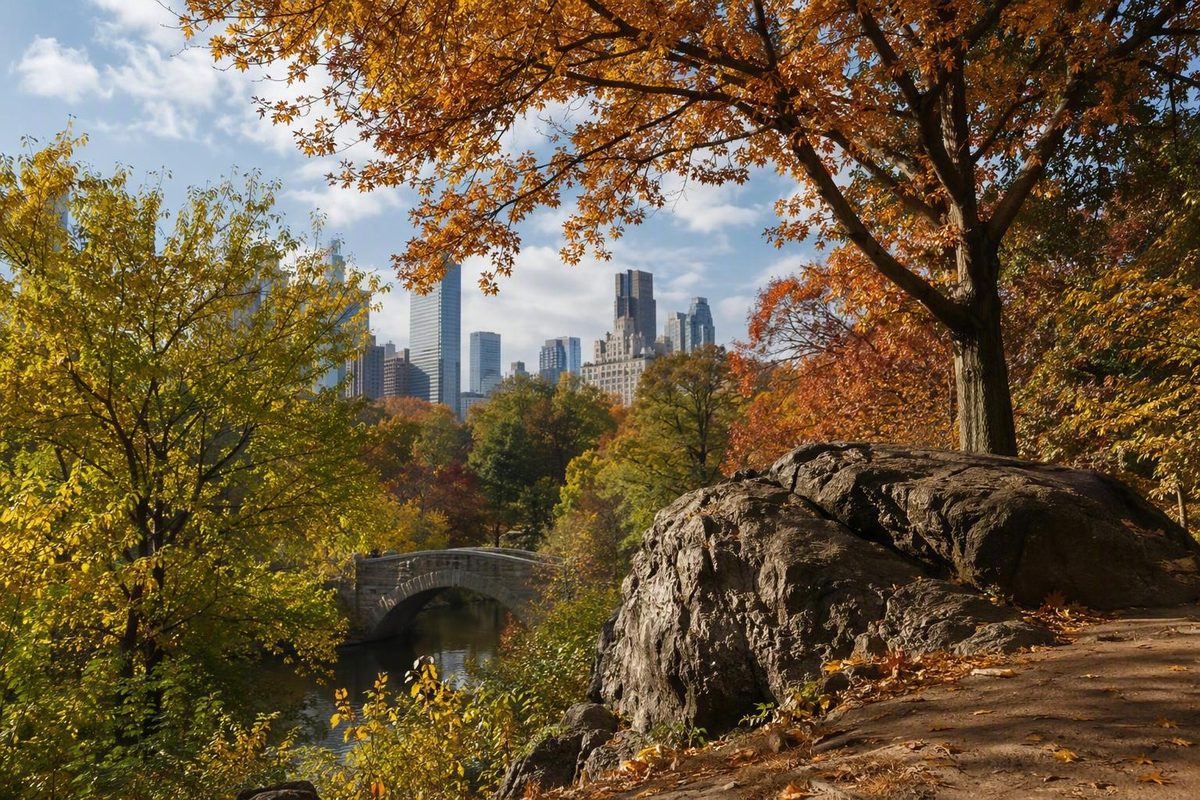
A rewarding fall walk in Central Park depends less on finding one supposedly perfect peak day than on making three practical choices: check current foliage conditions, choose one section of the park, and decide which kind of scenery matters most to you.
That might mean the yellow elm canopy of the Mall, bridges reflected in water, an elevated view from Belvedere Castle, the open skyline around the Reservoir, or the enclosed paths of the Ramble and North Woods. Each offers a different autumn experience. Trying to collect all of them in one visit can turn a relaxed walk into a day of long crossings, detours, and backtracking.
The routes below are landscape frameworks, not turn-by-turn directions or measured trails. Check a current official park map and any closure notices before setting out, then adapt the sequence to weather, access, foliage, daylight, and your walking pace.
When Fall Color Reaches Central Park
Fall color is generally visible in Central Park from October into early November. Late October through early November is frequently cited as the typical high point, but that is a planning range rather than a guaranteed peak week in any particular year. Current observations are more useful than the calendar alone (typical Central Park foliage timing).
A simple way to think about the season is:
- September: The park may still look predominantly green, especially when seasonal change is running late.
- October: Color generally increases, although the timing and intensity can vary across the month.
- Early November: Strong foliage may remain, but conditions are increasingly variable.
- Later in November: Some trees may retain color, while others may already be bare.
These are broad tendencies, not a schedule. Annual weather, tree species, light exposure, and local conditions all affect what visitors see.
For a visit close to peak season, use the Central Park Conservancy’s separate arborist-approved foliage tracker. It is intended to indicate both when color is developing and where to find it. Location matters because the southern, central, and northern landscapes do not necessarily change at the same rate.
Central Park can also turn later than other parts of New York. Even inside one section, an open shoreline can receive different light from a shaded woodland path.
That is why “peak” is best understood as a period of broad visual interest, not a moment when every tree reaches maximum color simultaneously. On the same day, one tree may be yellow, another may remain green, and a third may already be losing leaves.
The biology is more complicated than a short visitor guide can fully explain. In broad terms, as chlorophyll decreases, other pigments become more visible and contribute to yellow, orange, and red tones. The Conservancy provides a concise explanation in its fall-foliage guide.
For planning purposes, the lesson is simple: do not judge Central Park only by a general New York foliage forecast. Check the park’s current conditions, note which section is showing the color you want, and remember that mixed or muted foliage can still work well with bridges, water, architecture, woodland paths, and skyline views.
Choose a Walk by Landscape, Not by Landmark Count
Central Park is large enough that an itinerary built from disconnected attractions can involve more walking and backtracking than expected. A more coherent approach is to choose a landscape type and remain within a connected zone.
Three route structures work particularly well:
- A compact southern walk for recognizable bridges, formal paths, architecture, and water.
- A moderate central walk for major landmarks, woodland paths, and an elevated outlook.
- An extended northern walk for woodland, moving water, gardens, and a less landmark-centered experience.
| Route type | Ordered stops | Dominant scenery | Approximate park zone | Why choose it |
|---|---|---|---|---|
| Compact southern walk | The Pond → Gapstow Bridge → the Mall → Bethesda Terrace; optional Bow Bridge extension | Water, bridge views, elm canopy, architecture | Southern edge to the lower central park | Several distinct compositions in one connected section |
| Moderate central walk | Bethesda Terrace → Bow Bridge → the Ramble → Belvedere Castle → Turtle Pond | Lake views, bridge, woodland paths, elevated outlook | Central park | A balance of recognizable landmarks and enclosed foliage |
| Extended northern walk | The Pool → North Woods → the Loch → Conservatory Garden → Harlem Meer | Woodland, waterfalls, formal gardens, tree-lined water | Northern park | A nature- and garden-focused alternative to central landmarks |
The labels compact, moderate, and extended are intentionally relative. They describe route complexity rather than promising a precise distance or completion time. Path choices, photography, closures, weather, rest stops, and individual pace can materially change the outing.
Choose the Mall for a canopy. Its American elms line a broad promenade and are associated with a yellow autumn ceiling. The straight path creates a formal visual rhythm that contrasts with the winding woodland routes farther north.
Choose the Pond or Lake for bridges and water. Gapstow Bridge belongs to the smaller Pond landscape near the southern edge. Bow Bridge crosses the Lake in the central park. Both combine foliage, architecture, and water, but they fit different routes and produce different compositions.
Choose Belvedere Castle for elevation. It creates a natural visual climax on the central route because the experience shifts from enclosed woodland paths to views toward Turtle Pond and the Great Lawn.
Choose the Reservoir for openness and skyline views. Published path measurements vary: one itinerary gives approximately 1.58 miles, while AllTrails lists the Reservoir Running Path at about 1.7 miles. If the distance matters, identify the particular path being measured rather than treating every “Reservoir loop” figure as interchangeable.
Choose the Ramble or North Woods for woodland. The Ramble fits naturally into a central landmark walk. North Woods supports a more extensive northern outing in which woodland and water are the main attractions.
Choose Conservatory Garden for formal structure and seasonal planting. Its organized garden rooms and fall chrysanthemums provide a deliberate contrast to the naturalistic appearance of North Woods.
If you have only part of a morning or afternoon, select one zone. Moving from Gapstow Bridge to the Reservoir, back toward Bow Bridge, and then north to Conservatory Garden may produce a longer list of place names, but not necessarily a better walk. A connected sequence gives each landscape time to register.
A Compact Southern Route: The Pond to Bethesda Terrace
This route provides recognizable Central Park scenery without requiring an attempt to cover the entire park. Move generally north in this order:
- Enter from the Central Park South area.
- Visit the Pond.
- View Gapstow Bridge from the shoreline.
- Continue north toward the Mall.
- Follow the Mall to Bethesda Terrace.
- If energy and conditions allow, extend the walk to Bow Bridge.
The Pond sits near Central Park South between Fifth and Sixth Avenues. Its appeal comes from the combination of water, surrounding trees, Gapstow Bridge, and buildings beyond the park. Farther north, the Mall runs approximately from 66th to 72nd Streets, while Bow Bridge is around 74th Street (southern and central fall locations).
The Pond supports several kinds of views. You can photograph the bridge as the main subject, place it within a wider foliage frame, look for trees reflected in the water, or emphasize the contrast between the park and the surrounding city.
Walk around the available shoreline rather than assuming the first viewpoint will be the strongest. Glare, wind, vegetation, maintenance work, and other visitors can all change the composition. If reflections matter, assess the water in front of you rather than planning around a shot that conditions may not provide.
From the Pond, continue generally north toward the Mall. The exact connecting path matters less than keeping the route within the southern zone instead of leaving for an unrelated attraction and returning later.
The Mall’s broad promenade is lined with American elms whose branches create a high canopy. In autumn, the trees are commonly associated with yellow color. The Pond is layered and irregular; the Mall is linear and formal. That contrast is one reason the two landscapes work well in a single walk.
Continue toward Bethesda Terrace, where the emphasis changes from trees and promenade to stonework, fountain, water, and open views. The terrace overlooks Bethesda Fountain, the Lake, and surrounding trees, giving the route a clear scenic finish rather than an arbitrary endpoint.
If the relevant areas are open, explore more than one level or viewpoint. Wider views emphasize the relationship between architecture and landscape, while closer perspectives bring out details in the terrace, fountain, and leaves.
Optional extension: Bow Bridge
Continue toward Bow Bridge if you want another bridge-and-water composition. The extension is geographically logical, but it changes the character of the outing. You will need to navigate around the Lake and decide whether to return toward the south or continue into the central landscapes.
Treat Bow Bridge as an optional invitation to meander, not a compulsory extra. Stopping at Bethesda Terrace preserves the compact structure of the route.
This southern walk is particularly suitable for visitors who value:
- Recognizable architecture
- Broad promenades
- Water and bridge views
- Several visual settings in a connected area
- A route that can end before entering the central woodlands
Avoid assigning it a fixed completion time. A continuous walker and a photographer waiting for clear sightlines are taking fundamentally different outings. Crowds, path choices, rest stops, weather, mobility, and the Bow Bridge extension will all affect the duration.
A Central Landmark Walk: Bethesda, Bow Bridge, the Ramble, and Belvedere
The central route combines recognizable landmarks with a woodland experience. Follow this general sequence:
- Begin around Bethesda Terrace.
- Continue to Bow Bridge.
- Enter the Ramble.
- Work north toward Belvedere Castle.
- Finish around Turtle Pond.
Bethesda Terrace provides an open, legible starting point. You can orient yourself around the fountain and Lake before moving toward Bow Bridge. The route therefore begins with formal architecture and long water views rather than enclosed paths.
Bow Bridge crosses the Lake near 74th Street. It can be treated as the main subject of a photograph or placed within a wider frame containing water, trees, and shoreline. The view changes as you approach, cross, and move away from it, so it works better as a short progression than as a single photo stop.
After the bridge, the character of the walk shifts. Sources describe the Ramble as an approximately 36-to-38-acre woodland located roughly between 73rd and 79th Streets; the Conservancy uses the 36-acre figure. Belvedere Castle is near 79th Street and was designed as a lookout with views toward Turtle Pond and the Great Lawn (Conservancy landscape guide).
Inside the Ramble, efficiency should not be the main objective. Its winding paths create a more enclosed experience than the open spaces around Bethesda Terrace and Bow Bridge. That contrast is the reason to include it.
Instead of concentrating only on broad foliage views, notice smaller woodland elements:
- Leaves underfoot
- Tree trunks and branching patterns
- Rock and ground texture
- Shoreline glimpses
- Paths disappearing around bends
- Patches of light within shaded areas
The Ramble is also associated with birdwatching, although no particular sighting should be expected. Binoculars can be a useful addition if birding is already part of your interest, but the route still works without them.
Use a current map if you need to emerge on a particular side. If you prefer a looser walk, keep the broad objective of moving north toward Belvedere Castle instead of attempting to follow every possible turn. Distances that look short on a map may feel less direct within a winding path network.
The correct name is the Ramble. From there, continue toward Belvedere Castle. Its elevated outlook creates another strong transition: after enclosed woodland, the landscape opens toward Turtle Pond and the Great Lawn.
Turtle Pond is a natural final stop because it returns the route to water without simply repeating the Lake. Depending on your position, the pond, rock, foliage, castle, and surrounding landscape can appear in different combinations.
The route’s visual progression is its main strength:
- Bethesda Terrace: open architecture and formal views
- Bow Bridge: a defined bridge-and-lake composition
- The Ramble: enclosed woodland and winding paths
- Belvedere Castle: elevation and a broader outlook
- Turtle Pond: water below the overlook
Treat this as a slower and more exploratory outing than the southern route. It occupies a relatively concentrated section of the park, but navigating the Ramble and stopping at several viewpoints changes the pace. Rushing it would remove much of what distinguishes it from a landmark checklist.
A Northern Fall Route: The Pool, North Woods, Conservatory Garden, and Harlem Meer
For a more nature-focused alternative, build an extended route across the northern park:
- Begin at the Pool on the northwest side.
- Continue into North Woods.
- Explore the Ravine and the Loch.
- Cross toward Conservatory Garden on the east side.
- Finish at Harlem Meer in the northeast corner.
This is a landscape framework rather than a turn-by-turn route. The Pool and North Woods are on the west and northwest sides, while Conservatory Garden is on the east. The cross-park transition is a substantial part of the outing, not a short connection.
The Pool lies approximately between 100th and 103rd Streets on the west side. It provides a still-water setting before the route becomes more wooded. Calm conditions may produce reflections; wind may instead add texture to the surface.
North Woods occupies the northern park around 101st to 110th Streets and is described by the Conservancy as Central Park’s largest woodland. Its defining landscape is the Ravine, which contains the Loch and three waterfalls. Conservatory Garden is on the east side around 104th to 106th Streets and consists of three gardens, with chrysanthemums among its fall plantings (northern landscape locations).
North Woods is not simply a larger version of the Ramble. It belongs to a different route context. In the central park, the Ramble sits among Bethesda Terrace, Bow Bridge, Turtle Pond, and Belvedere Castle. In the north, the woodland connects conceptually with the Pool, moving water along the Loch, formal gardens, and Harlem Meer.
The northern route can therefore include:
- Still water at the Pool
- Enclosed paths in North Woods
- Moving water along the Loch
- Formal planting at Conservatory Garden
- A waterside finish at Harlem Meer
After exploring North Woods and the Loch, turn east toward Conservatory Garden. Do not treat the garden as though it were immediately beside the west-side woodland. Preserve enough energy and daylight for the cross-park portion, and check a current map before choosing the connection.
At Conservatory Garden, the visual language changes. Organized planting, axes, and garden rooms replace the more naturalistic woodland appearance. Instead of looking for winding paths and tangled branches, you can concentrate on arranged color, symmetry, shape, and texture.
Access conditions and facilities can change, so confirm current information before making the garden the non-negotiable centerpiece of the day. If access is limited, the Pool, North Woods, the Loch, and Harlem Meer can still support a northern outing.
Harlem Meer occupies the northeast corner around 106th to 110th Streets and is surrounded by trees, making it a logical waterside finish (Central Park fall-location guide). When light and wind cooperate, the water may also support reflections.
This route should not be sold as empty or guaranteed to be quiet. Visitor levels vary with weather, events, date, and location. It is more accurate to describe the route as less centered on the park’s frequently promoted bridges and terraces.
Choose it when woodland, gardens, and water are the priorities. If time or energy is limited, divide it into two possible outings: the Pool and North Woods on the west side, or Conservatory Garden and Harlem Meer on the east.
Where to Photograph Canopies, Reflections, Bridges, and Skylines
There is no universally best place to photograph fall in Central Park. A landscape that suits a wide skyline image may be poorly suited to an intimate woodland detail. Choose according to the visual effect you want.
For a tree-lined canopy: the Mall
The Mall’s American elms create a long, symmetrical corridor associated with yellow fall color. The straight promenade supports centered compositions, repeating trunks, figures beneath the canopy, and layers of leaves extending into the distance.
This is fundamentally different from photographing a woodland path. The visual strength comes from order: a broad route, repeated trees, and a clear axis.
For a low bridge over water: Gapstow Bridge
Choose Gapstow Bridge when you want a bridge integrated into the smaller Pond landscape near the southern edge. Depending on your position, the frame can include shoreline trees, water, the bridge, and buildings beyond the park.
Because the Pond belongs to the southern route, it is practical for a compact walk. It also works when you want the surrounding city to remain visible rather than trying to conceal the urban setting.
For a bridge crossing a lake: Bow Bridge
Bow Bridge offers a different scale and form. It crosses the Lake and fits naturally into a route connecting Bethesda Terrace with the Ramble. Photograph it from the shoreline, from the approach, while crossing, or as part of a wider lake view.
Gapstow Bridge and Bow Bridge are not interchangeable. Gapstow belongs to the Pond and southern skyline setting; Bow Bridge belongs to the Lake and central landscape.
For reflections: choose water that fits your route
Potential reflection settings include:
- The Pond
- The Lake
- Turtle Pond
- The Reservoir
- The Pool
- Harlem Meer
Water does not guarantee a clean reflection. Wind, ripples, glare, cloud cover, light direction, and activity on the surface all influence the result. Check the conditions in front of you rather than arriving with one predetermined image in mind.
The Pond and Lake work well with bridges. Turtle Pond can incorporate Belvedere Castle and the surrounding landscape. The Reservoir offers greater visual openness. The Pool and Harlem Meer fit naturally into a northern outing.
For skyline views: the Reservoir
Choose the Reservoir when the goal is to combine autumn trees with a broad skyline. Its open water creates distance between the viewer and surrounding buildings, producing a more panoramic effect than the tighter southern water bodies.
Decide whether the skyline view itself is the objective or whether you actually want to complete a circuit. The two plans require different amounts of walking, and published path measurements are not identical.
For an elevated panorama: Belvedere Castle
Belvedere Castle emphasizes height rather than distance across open water. Views toward Turtle Pond and the Great Lawn can place foliage within a broader park landscape. The location works particularly well as a change of perspective after walking through the Ramble.
Current access, weather, vegetation, or temporary closures may affect what is available, so keep the view as part of the route rather than its only purpose.
For woodland details: the Ramble or North Woods
Use the Ramble when you want woodland close to central landmarks. Choose North Woods when the woodland itself is one of the main reasons for the outing.
In both places, look beyond sweeping foliage scenes. Possible subjects include:
- Curving paths
- Individual leaves and tree trunks
- Layers of branches
- Rock and ground texture
- Water glimpsed through foliage
- Contrasts between colored leaves and shaded areas
The experience is less about reaching one designated viewpoint than responding to details as the path changes.
For structured gardens: Conservatory Garden
Conservatory Garden suits photographs based on symmetry, organized planting, seasonal flowers, and the relationship between foliage and garden design. Fall chrysanthemums provide concentrated seasonal color, while the formal layout offers a different kind of framing from the Ramble or North Woods.
Avoid building the visit around unsupported promises about sunrise, sunset, golden hour, or crowd-free periods. Assess the actual forecast, foliage stage, cloud cover, wind, and access conditions. Overcast weather may support subtle woodland details, while clear conditions may strengthen skyline contrast. Neither is inherently better; they create different pictures.
Add One Seasonal Activity Without Overloading the Day
Walking and photography are the simplest foundations for a Central Park fall outing. They remain flexible and let you respond to the foliage and weather you find.
If you want more, add one secondary activity that supports the route rather than controlling the entire day.
Birdwatching
The Ramble and North Woods are associated with birdwatching. This is an easy activity to add because it does not require leaving the walking route. Bring binoculars if birding is already an interest, but do not plan around guaranteed sightings.
The Ramble fits a central landmark route. North Woods is the more coherent choice when the whole outing is focused on northern landscapes.
A picnic or landscape break
A picnic or simple rest can keep the day from turning into a continuous photo assignment. Choose an open landscape that suits the route, then remain flexible about the exact location. Weather, ground conditions, events, current rules, and maintenance can affect where stopping is practical.
A break can be particularly useful before the cross-park portion of the northern route or after leaving the Ramble.
A Conservancy-led foliage walk
Conservancy-led fall foliage walks may suit visitors interested in tree identification and landscape interpretation. Check the Conservancy’s current schedule and availability close to the intended date.
A guided walk works best as the day’s one fixed commitment. Place a compact self-guided route before or after it rather than combining it with several other reservations.
Rowing
Rowing can complement a Lake-centered walk, but availability, hours, prices, weather restrictions, capacity, and reservation procedures can change. Verify current details directly with the operator.
If rowing is important, keep the surrounding route simple—perhaps Bethesda Terrace, the Lake, and one nearby landscape. Combining it with a long northern walk and another timed activity makes the day more vulnerable to delays.
Seasonal ice skating
Skating may be available during part of the fall, but annual opening dates and operating arrangements should not be assumed. Check the rink’s current schedule, ticketing requirements, and weather policies for the date you plan to visit.
A nearby museum
A museum can provide one indoor anchor or a bad-weather alternative, particularly if your route finishes near it. Admission, tickets, exhibitions, and opening hours vary, so confirm the details directly with the museum.
Match the museum to your chosen park zone rather than using it as another reason to cross Manhattan repeatedly.
Central Park entry is free, while optional rentals, tours, skating, food, and nearby attractions may involve separate charges. Individual attractions can also have their own seasonal hours and admission arrangements (Central Park walking overview).
The practical rule is to choose one scheduled or paid activity. A day organized around rowing, a guided walk, a museum ticket, a meal reservation, and skating can become difficult to adjust. A walk with one fixed element remains more resilient when weather, foliage, or pace differs from expectations.
A Day-of Checklist for Weather, Delayed Color, and Changing Operations
Use this sequence before setting out.
1. Check the current foliage stage
Review the Conservancy’s foliage tracker rather than relying on a generic statewide forecast or an undated article. Note both the reported color and its location. If one section appears more promising than another, adjust the route rather than remaining committed to the original plan.
2. Review the weather
Check temperature, precipitation, wind, and changing conditions across the period you expect to be outside. Wind is especially relevant when you hope to photograph reflections.
Treat these as variables rather than guarantees. A windy forecast does not make the park pointless; it may simply shift the visual emphasis from reflections to canopies, architecture, or woodland details.
3. Confirm current closures and access
Review current official park notices and a current map for closures, construction, events, or restricted areas. Conditions can change after any itinerary is published.
Do not rely on an undated third-party listing for current information about boats, skating, restaurants, tours, garden facilities, or restrooms.
4. Verify paid or seasonal activities directly
If the day includes rowing, skating, a tour, dining, or a museum, confirm:
- Operating date
- Opening hours
- Current price
- Reservation or ticket requirements
- Weather policy
- Cancellation terms
- Entrance or meeting location
This matters most when the activity determines the timing or direction of the route.
5. Pack for a walking day
Useful basics include:
- Comfortable walking shoes
- Layers that can be added or removed
- A jacket appropriate to the forecast
- Rain protection
- Water and personal essentials
- A small day bag
- A charged phone or current paper map
These essentials are also reflected in published fall packing guidance for Central Park visits (autumn packing guidance).
6. Choose a delayed-color fallback
If the leaves are less developed than expected, prioritize features that remain visually interesting without peak color:
- Bethesda Terrace
- Gapstow Bridge or Bow Bridge
- The Pond, Lake, Reservoir, or Harlem Meer
- Skyline views
- Belvedere Castle
- Conservatory Garden’s formal structure
- Woodland paths in the Ramble or North Woods
Green, mixed, or partly bare trees can still produce a strong seasonal landscape when combined with water, architecture, and texture.
7. Choose a bad-weather fallback
If conditions deteriorate, shorten the walk to one zone. The southern route is easier to trim than an extended west-to-east northern plan. In the central section, you can remain around Bethesda Terrace and the Lake instead of continuing through every planned stop.
A nearby museum may be useful, but check current admission, ticketing, and operating information before redirecting the day.
8. Plan around your actual needs
Visitors with mobility, accessibility, stroller, terrain, or service requirements should consult current official park information before selecting a route. Do not assume that every path is paved, level, step-free, or suitable simply because two attractions appear close together on a map.
Apply the same caution to restrooms and other facilities. Confirm current options close to the visit rather than building the route around an old listing.
9. Identify what you will omit
Before entering the Ramble, North Woods, or an extended northern route, decide what you will drop if the weather changes or energy declines.
For the southern route, Bow Bridge is the obvious extension to omit. On the central walk, reduce time on side paths rather than rushing every stop. For the northern route, remember that the west-to-east crossing makes Conservatory Garden and Harlem Meer a meaningful extension rather than a quick add-on.
Frequently Asked Questions
When is peak fall foliage in Central Park?
Late October through early November is often given as the typical peak range, but no particular week is guaranteed. Timing varies by year, weather, tree species, light exposure, and location within the park.
September may remain mostly green, October generally brings increasing color, and November can range from strong foliage to substantial leaf drop. Check current conditions close to your visit instead of relying exclusively on historical timing.
Where can I check current Central Park foliage conditions?
Use the Central Park Conservancy’s arborist-approved foliage tracker. It is intended to show when and where color is developing, making it more useful than a fixed annual date.
Check shortly before the visit and again on the day if practical. Color may differ between the southern, central, and northern sections.
Can I see good fall scenery on a short Central Park walk?
Yes. Enter near Central Park South, visit the Pond and Gapstow Bridge, continue north to the Mall, and finish at Bethesda Terrace. This creates a connected sequence of water, bridge views, an elm canopy, and architecture.
Add Bow Bridge only if you want a longer, more meandering finish. When time is limited, stopping at Bethesda Terrace produces a more coherent walk than rushing through the extension.
Which northern Central Park locations are worth including in fall?
The Pool, North Woods, the Loch, Conservatory Garden, and Harlem Meer create a varied northern framework. Together they offer still water, woodland, waterfalls, formal planting, fall chrysanthemums, and another tree-lined water setting.
Because the Pool and North Woods are on the west side while Conservatory Garden is on the east, the complete route is an extended cross-park outing. If time is limited, choose either the west-side woodland section or the east-side garden and Meer section.
Is visiting Central Park in fall free?
Entry to Central Park is free, so walking, casual photography, birdwatching, and resting in the park can form a no-admission-cost outing.
Optional additions may involve fees, including rentals, guided tours, skating, food, and nearby museums. Confirm current prices, hours, reservations, and seasonal operating dates directly with the relevant operator.
Build the Walk Around the Day You Find
A flexible, connected route is more dependable than an itinerary built around one supposed peak date, perfect reflections, or several seasonal reservations. Check current foliage, choose the park zone that offers the scenery you value most, and leave room to change course.
A walk through a few contrasting landscapes—perhaps water, a canopy, architecture, and woodland—will usually make more sense than racing between every famous autumn viewpoint.