 New York Know
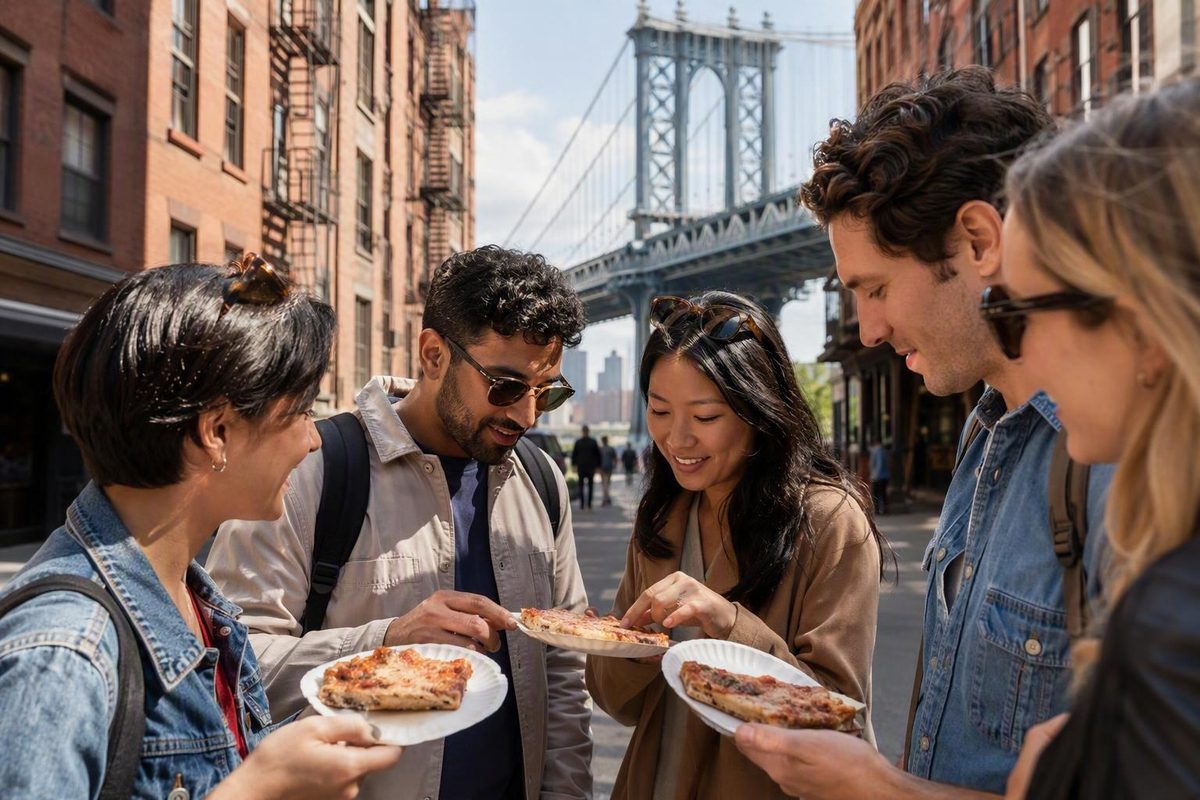
Start With the Neighborhood, Not a “Best Tours” Ranking
The simplest way to narrow down NYC food tours is to choose the neighborhood or cuisine that fits the rest of your day, then compare tours within that compact area. A heavily promoted tour is not especially convenient if reaching it requires an unnecessary trip across the city.
The neighborhood is therefore part of the purchase—not merely the space between restaurants.
Greenwich Village and Chinatown/Little Italy appear most consistently across the operator and marketplace listings reviewed for this comparison. That repeated presence indicates broad availability and a choice of formats. It does not prove that either area has the highest-quality, most authentic, or best-value tour.
One-neighborhood planning also makes a tour easier to integrate with sightseeing. A Greenwich Village route can fit between Washington Square Park and an evening downtown. Chelsea can pair with the High Line. Chinatown can become the final stop on a Lower Manhattan day. In each case, clustering the day leaves more time for eating and walking instead of traveling between unrelated parts of the city.
Large marketplaces illustrate both the number of choices and the limitations of their rankings. Tripadvisor displayed 131 food-tour-related results and says commercial factors—including revenue, clicks, review activity, popularity, and seasonal trends—can affect ordering. GetYourGuide displayed 130 results and says its rankings consider popularity, ratings, performance, availability, diversity, and revenue, including supplier commissions. Neither ordering should be treated as an objective quality league table. (Tripadvisor; GetYourGuide)
Use marketplaces to discover possibilities, filter by date, and compare formats—not to assume the first result is the best. Labels such as “top pick,” “featured,” or “best seller” are marketplace or operator designations rather than independent comparative findings.
This is an editorial comparison of third-party listings, organized according to the site’s walking-first, neighborhood-based planning approach.
All prices, schedules, durations, ratings, review totals, routes, and availability are therefore snapshots or operator-advertised details. Restaurant partners, tasting menus, tour times, fees, and checkout totals may change. Verify the specific departure directly before booking.
At-a-Glance Comparison of Advertised NYC Food Tours
The table normalizes representative offerings by operator so that related routes remain easy to scan. Prices are advertised starting prices unless otherwise stated. A listed stop count does not guarantee that the same restaurants, dishes, or quantities will appear on every departure.
| Neighborhood | Operator | Advertised starting price | Operator-stated duration | Advertised stops or tasting structure | Public/private format | Schedule or group cap when supplied | Important limitation |
|---|---|---|---|---|---|---|---|
| Chelsea Market/High Line; Nolita; Greenwich Village; Chinatown; Original Greenwich Village/West Village area | Foods of NY Tours | $89 for each listed NYC route | 3 hours | Curated neighborhood tastings; exact counts not established | Public; private tours also advertised | All ages; private tours advertised for 1–48 people | Exact menus, fees, accessibility, dietary procedures, and the handling of Nolita’s wine element for minors require confirmation |
| Greenwich Village; Lower East Side; Astoria | Nice Guy Tours | From $94 per route | 3 hours | At least 6 stops | Public; private and corporate options from $99 | Village and Lower East Side: weekdays and weekends; Astoria: Fridays | Dietary labels are route-specific and do not establish allergen safety or an unchanging menu |
| Greenwich Village; Chinatown and Little Italy | Secret Food Tours | $89.99 per route | Village: 2.5–3 hours; Chinatown/Little Italy: 3–3.5 hours | 6 stops | Public; private options advertised | Maximum 12 guests; Spanish-language Chinatown/Little Italy option linked | Exact food inclusions, fees, dietary procedures, and current businesses require confirmation; an optional drinks upgrade is advertised |
| Lower East Side; West Village | Sidewalk Food Tours | From $79 | 3 hours | Neighborhood tastings; exact count not supplied | Public; private options from $109 | Lower East Side: Sunday and Monday, 11 a.m.–2 p.m.; West Village: Friday and Saturday, 11 a.m.–2 p.m. | Portions, public group size, accessibility, and dietary procedures are not established in the supplied listing |
| Brighton Beach; Flushing; Elmhurst; Bay Ridge; Manhattan Chinatown | Ethnojunkie | $95 cash per person, food included | Usually 3–4 hours | Shared foods from restaurants, bakeries, vendors, and markets | Request-based | Usually starts around 1 p.m.; date arranged by email | No fixed public calendar; generally not offered in wintry weather; stops and dishes may vary; ingredient details cannot be guaranteed |
| Chinatown/Little Italy; Greenwich Village; Chelsea/Meatpacking/High Line; Brooklyn | GetYourGuide marketplace examples | Displayed from $83–$103 for selected Chinatown/Little Italy listings; $85 for Greenwich Village; $94 for Chelsea/Meatpacking/High Line; $69 for Brooklyn | 2–3 hours in the selected listings | Listing-specific; one Chinatown/Little Italy product advertised 6 tastings | Public; some private options | Date-dependent | Marketplace placement and labels are not endorsements; current operator, route, price, availability, and checkout total require verification |
The GetYourGuide entries are marketplace snapshots rather than a controlled operator comparison. They are useful for establishing the range of displayed formats and prices, but the exact product page should be checked before relying on any listing.
The table is a starting point, not a substitute for checkout. For the intended date, compare the final amount, food inclusions, meeting point, ending point, walking requirements, cancellation terms, and relevant dietary or accessibility policies.
Match the Classic Manhattan Routes to Your Interests
The classic Manhattan routes are not interchangeable, even when their advertised prices and durations look similar. Match the neighborhood to your interests and surrounding plans rather than trying to identify a citywide winner.
Greenwich Village and the West Village offer the broadest operator choice among the examples. The cited listings include several general neighborhood tasting walks, multiple three-hour formats, a shorter 2.5-to-3-hour option with six stops and a 12-person cap, and a specialized pizza, beer, and history outing with three pizza samples and two beer tastings. The advertised starting prices in the comparison table run from $79 to $94 for the selected Village routes. (Foods of NY Tours; Sidewalk Food Tours)
Choose the Village if you want several operators and formats to compare, or if a pizza-oriented experience is a priority. Pay attention to the exact meeting point and endpoint: “Greenwich Village” and “West Village” can describe overlapping but not identical routes, and the neighborhood name alone does not tell you where the tour finishes.
Chinatown and Little Italy support several structures. The evidence includes two-hour marketplace listings, three-hour products advertising six tastings, operator-led walks centered on neighborhood businesses, and an identified Spanish-language Secret Food Tours option. Some products combine both neighborhoods; others concentrate mainly on Chinatown.
Do not book solely because a listing shows one appealing dish or names a particular restaurant. A business may close for the day, a menu may change, or the operator may substitute a stop. Compare the overall culinary emphasis, duration, walking route, and amount of historical context instead.
The Lower East Side is the clearest match for travelers interested in recurring advertised themes such as pastrami, bagels, pickles, sweets, immigrant history, and long-running Jewish food institutions. The comparison includes a Nice Guy Tours route from $94 with at least six advertised stops and a Sidewalk public tour from $79, listed for Sundays and Mondays from 11 a.m. to 2 p.m. (Nice Guy Tours)
Those operating-day differences may matter more than the base-price gap. If only one tour fits the itinerary, the theoretically cheaper alternative is not practically useful.
Chelsea makes sense when Chelsea Market and the High Line are already priorities. The cited comparison includes a three-hour Foods of NY route at $89 and a marketplace listing combining Chelsea Market, the Meatpacking District, and the High Line for three hours from $94. The more meaningful distinction may be route design and expected outdoor time rather than the small difference between displayed starting prices.
Chinatown can also complete a geographically coherent Lower Manhattan day. A walking-first route can begin near the harbor, pass through the Financial District, and finish in Chinatown or nearby without repeated cross-city travel, as illustrated by this compact Lower Manhattan itinerary.
In short:
- Choose Greenwich Village or the West Village for multiple operator choices and pizza-oriented options.
- Choose Chinatown/Little Italy for Chinese and Italian neighborhood routes or the identified Spanish-language option.
- Choose the Lower East Side for Jewish and immigrant-food themes.
- Choose Chelsea for a market-and-High-Line combination.
Look Beyond Central Manhattan: Astoria, Flushing, Elmhurst, Brighton Beach and Bay Ridge
Outer-borough food tours expand the available cuisines and neighborhood settings. They are not inherently more authentic, less touristy, or better than Manhattan tours. Their practical distinction is that the neighborhood generally needs to become a central part of the day.
In Queens, Nice Guy Tours advertises its Astoria route for Fridays. The three-hour tour starts at $94, is labeled vegetarian-friendly, and uses examples spanning Brazilian, Greek, Middle Eastern, and dessert stops. These examples indicate the advertised range rather than a guaranteed menu.
Ethnojunkie’s request-based tours use a different model. Flushing emphasizes regional Chinese foods, with Japanese and Taiwanese possibilities also mentioned. Elmhurst is described through foods associated with several Asian communities. In Brooklyn, Brighton Beach focuses on Eastern European and Central Asian foods, while Bay Ridge emphasizes Middle Eastern food alongside other neighborhood influences.
As summarized in the cited table, those Ethnojunkie routes are listed at $95 cash per person with food included. They are arranged by email for a mutually convenient date, usually begin around 1 p.m., generally last three to four hours, and are normally not offered in wintry weather. This request-based arrangement is not equivalent to choosing an instant-confirmation departure from a marketplace calendar.
GetYourGuide also displayed a three-hour Brooklyn culinary listing from $69. Treat that as a discovery lead rather than a settled plan: the current route, operator, inclusions, operating dates, and final price need verification.
Transit is the main planning tradeoff. The time required to reach Astoria, Flushing, Brighton Beach, or Bay Ridge will depend on the starting point and service conditions. That travel can be worthwhile when the neighborhood itself is a trip priority. It is less practical as an improvised addition between distant Manhattan reservations.
For an outer-borough day:
- Estimate travel time to the meeting point for the relevant day and hour.
- Ask where the tour ends, not only where it starts.
- Build in a delay buffer.
- Add one or two nearby activities rather than returning immediately to Manhattan.
- Avoid scheduling a timed attraction across the city directly afterward.
As an editorial planning rule, place the outer-borough tour at the center of the day. Let the journey, neighborhood walk, food, and nearby sightseeing form one continuous plan.
Understand the Format: Fixed Tastings, Flexible Ordering, Private Tours and Specialty Experiences
“Food tour” covers products that are materially different. A conventional neighborhood tasting walk should not be compared directly with a cocktail outing, cooking class, dinner cruise, downloadable itinerary, food-truck tour, or vehicle-based excursion.
The most recognizable format is the fixed-tasting walk. Some operators advertise six stops or at least six stops, with the route and tastings largely selected in advance. This reduces decisions for the guest, but the stop count does not establish an unchanging restaurant lineup, fixed portion sizes, or the same dishes on every departure.
Flexible ordering works differently. Food On Foot describes public tours using either a food credit or a pay-as-you-go model. Guests choose what and how much to eat, while the stops remain a surprise. The operator says the two ticket types cover the same tour but carry different cancellation options. This provides more control over ordering, although it makes the total cost and food quantity harder to compare with an all-inclusive tasting tour. (Food On Foot)
Private tours may suit families, corporate groups, or parties that need a particular start time. Foods of NY advertises private options for groups of 1–48 people, with flexible starts and approximate durations of 2.5–3 hours. Sidewalk lists private tours from $109 and corporate tours from $118.42, while Nice Guy Tours lists private and corporate options from $99. These are advertised starting prices or broad offer descriptions, not quotes for a particular group.
A public tour with a defined cap occupies the middle ground. Secret Food Tours advertises a maximum of 12 guests on its displayed Greenwich Village and Chinatown/Little Italy routes. A cap identifies the advertised upper limit; it does not reveal how many people will attend a specific departure.
Specialty products require equally careful classification:
- Sidewalk’s pizza, beer, and history tour advertises three pizza samples and two beer tastings.
- Its downtown and Midtown food-truck products are listed as private-only.
- Its cocktail experience and cooking classes are culinary activities, but not standard neighborhood tasting walks.
- Secret Food Tours advertises an optional drinks upgrade.
- Marketplace themes include dumplings, cookies, gluten-free food, nightlife, and mafia history.
Before comparing value, identify the actual transaction. Does the ticket include fixed tastings? Does it provide a food credit? Will food be purchased separately? Is alcohol included, available as an upgrade, or excluded? A lower admission price may be less competitive if most food costs extra, while a higher inclusive price may cover more—but exact quantities still require confirmation.
What NYC Food Tours Cost—and What Starting Prices Leave Out
A reasonable planning range for many representative standard walking tours in the cited comparison is approximately $79–$103 per person, with advertised durations of roughly 2.5–4 hours. This is not a universal NYC market price. Private tours, cocktail outings, cooking classes, cruises, vehicle-based products, and promotional marketplace listings can fall outside that range.
Representative advertised examples include:
- Sidewalk public neighborhood tours from $79.
- Foods of NY public routes at $89.
- Secret Food Tours routes at $89.99.
- Nice Guy Tours routes from $94.
- Ethnojunkie tours at $95 cash per person with food included.
- Selected marketplace listings around $83–$103.
These figures come from the cited operator and marketplace rows above and were checked on August 18, 2026. They should still be reconfirmed for the intended date.
“From” and “starting at” are important qualifiers. The initially displayed amount may not be the amount presented at checkout. Depending on the product, date, and booking page, possible additions or differences may include taxes, booking charges, drinks, upgrades, separately purchased food, or gratuities. Do not assume that any particular item is included unless the booking page confirms it for the selected departure.
Base price alone cannot establish value. The available descriptions do not consistently document portion sizes, total food quantity, beverage inclusions, or whether each stop provides a full serving or a shared sample. Six stops can represent very different amounts of food on two different tours.
Food On Foot says its tour replaces a meal, but that is an operator-specific assertion rather than a market-wide standard. It should not be generalized to every NYC food tour.
Use the same questions for every candidate:
- What is the final checkout total for the intended date?
- Is food included, covered by a credit, or purchased separately?
- How many tastings or stops are advertised?
- Are drinks included, optional, or extra?
- How long is the experience?
- What is the public price for every traveler in the party?
- What would a private booking cost for that exact party size?
- Are any expected gratuities excluded from checkout?
Private tours may become attractive as a group grows, but the evidence is insufficient to calculate a universal break-even point. Operators may price by person, group size, route, or customization. Compare the current public-ticket total with a private quote for the actual party.
Check Dietary Needs, Children, Mobility, Language and Weather Before Paying
Tour pages often devote more space to dishes and neighborhood stories than to practical constraints. Use a pre-booking checklist instead of assuming that a general label applies to every departure.
Confirm:
- Final checkout price and accepted payment method
- Included food and drinks
- Optional alcohol costs
- Exact start and end points
- Total walking distance and expected pace
- Stairs, curbs, narrow interiors, or uneven surfaces
- Time spent standing
- Seating at tasting stops
- Restroom access
- Public group size or private capacity
- Cancellation and rescheduling rules
- Rain, snow, and extreme-weather procedures
- Possible restaurant or menu substitutions
- Dietary procedures and cross-contact limitations
- Language of the selected departure
- Arrangements and pricing for children or minors
The dietary claims in the evidence are narrow. Nice Guy Tours labels Greenwich Village and Astoria vegetarian-friendly and lists gluten-free and dairy-free options for the Lower East Side. These labels do not establish that every tasting is suitable, that substitutions are always available, or that cross-contact can be prevented.
Ethnojunkie is more explicit about uncertainty. The operator says it cannot guarantee ingredient details involving allergens, gluten, salt, sugar, or other concerns and tells participants to manage their own dietary restrictions. Travelers with allergies should review the operator’s warning and seek direct clarification before committing.
Foods of NY marks several routes as suitable for all ages. However, the supplied Nolita description mentions wine without fully explaining how that element is handled for minors. Families should ask what children receive instead, whether strollers are practical, and whether child pricing differs.
Secret Food Tours links a Spanish-language Chinatown and Little Italy experience. That establishes one identified non-English option, not comprehensive language coverage across the market. Confirm that the required language is available on the selected date.
Accessibility information is particularly incomplete. A broad marketplace filter or general operator statement cannot establish that a particular route works for a wheelchair user or someone unable to stand for long periods. Ask route-specific questions about distance, pace, stairs, narrow interiors, seating, and accessible restrooms.
Schedules and weather practices also vary. Astoria is listed for Fridays. Sidewalk assigns its public Lower East Side and West Village tours to particular days. Ethnojunkie says its tours generally do not operate in wintry weather because much of the eating occurs outdoors.
Anyone with a severe allergy or significant mobility requirement should obtain clear answers from the operator before purchasing. A neighborhood label, dietary icon, or general tour description is not a safety assurance.
Guided Tour or DIY Food Walk?
Guided and self-guided food walks solve different planning problems. Neither format is automatically better.
A guided tour reduces preparation. The operator establishes the route, coordinates the tasting sequence, and may provide neighborhood history, cultural context, establishment stories, architecture, or local recommendations. This can be particularly useful on a first visit or when the group does not want to research hours, ordering strategies, and backup stops.
The tradeoff is reduced control. Departure time, pace, group dynamic, and tasting structure are largely fixed.
A DIY food walk provides more control over pacing, orders, and spending. You can skip a long wait, linger over one dish, add a nearby sight, or stop when everyone is full. The route can also be integrated more closely with a personal sightseeing plan.
That flexibility requires preparation. You need to research current businesses, opening hours, likely waits, payment methods, dietary issues, and backup stops. You also lose the guide’s commentary unless you research the neighborhood independently.
A practical DIY structure is:
- Pick one neighborhood or one culinary theme.
- Research current venues using several sources.
- Plan approximately five to seven nearby tastings.
- Order snack-sized or signature items instead of full meals at every stop.
- Share portions when appropriate.
- Include backups in case a venue is closed or crowded.
- Leave room to carry leftovers.
The five-to-seven-stop model is experiential guidance rather than a rule, but it reflects the compact structure described in Stephanie Yoder’s DIY food-tour planning advice.
A historical Chinatown example illustrates how a compact DIY route can work: five walkable stops featuring dumplings, noodles, a sesame pancake, and ice cream. The author reported spending less than $30 and taking leftovers home. However, the year is unclear, one price is internally inconsistent, and the reported addresses, menus, prices, and operating status may have changed. Use the five-stop Chinatown account as a structural example—not as a current under-$30 itinerary.
Paid self-guided products offer a middle option. Eat Your World lists downloadable Queens tours for Flushing at $29.99 and Jackson Heights at $41.95. The complete routes are not disclosed on the sales page, and the supplied information does not establish what food, if any, is included. Buyers should determine whether they are paying for directions and recommendations, food, or both. (Eat Your World)
Compactness matters even more without a guide. One published challenge proposes walking Manhattan from Inwood to Battery Park in about 12 hours. The direct distance is described as roughly 13 miles, while the author reported walking approximately 22 miles after detours. That full-day Manhattan food walk is an unusually strenuous challenge, not a standard visitor itinerary.
Choose guided when context, curation, and fewer logistical decisions matter most. Choose DIY when flexible timing, ordering control, and customization matter most. In either case, keep the route geographically compact.
There is no evidence-supported single winner among NYC food tours. Start with the neighborhood that fits the day, then choose between fixed tastings, flexible ordering, a private experience, or a self-guided route. Before paying, confirm the total cost, food inclusions, dietary handling, walking demands, accessibility, schedule, language, cancellation terms, and possibility of changing stops. A coherent neighborhood day will generally serve a visitor better than a promoted tour that requires unnecessary travel across the city.
Frequently Asked Questions
How much do NYC food tours usually cost?
Many representative standard walking tours in the cited comparison are advertised around $79–$103 per person and last approximately 2.5–4 hours. That is a planning range, not a universal market price.
Private tours, cocktail outings, cruises, classes, and specialty products may cost more, while marketplace promotions may display lower starting prices. Always compare the final checkout amount for the intended date and identify whether food, drinks, upgrades, fees, or gratuities are included.
Do NYC food tours include enough food to replace a meal?
Sometimes, but it should not be assumed. Food On Foot specifically says its tour replaces a meal, while the other operator descriptions do not consistently quantify portions or make the same promise.
Ask how many tastings are included, whether portions are shared, and whether drinks or additional food must be purchased. If the operator cannot describe the approximate quantity, keep the next meal flexible rather than relying on the tour as a full lunch or dinner.
Can NYC food tours accommodate allergies or dietary restrictions?
Some operators advertise vegetarian-friendly, gluten-free, or dairy-free options, but those labels do not guarantee that every tasting is suitable or that cross-contact can be prevented. Other operators explicitly warn that ingredient details cannot be guaranteed.
Travelers with severe allergies should contact the operator before booking, identify the specific allergen, and ask how each stop handles it. If the answer remains unclear, do not treat a general dietary label as a safety assurance.
Is a guided NYC food tour better than a self-guided route?
A guided tour is a stronger fit when you want a planned route, neighborhood context, curated tastings, and fewer logistical decisions. A self-guided route is a better fit when flexible pacing, control over orders, and integration with personal sightseeing matter most.
Whichever format you choose, focus on one neighborhood or theme. A compact route is generally more practical than trying to sample unrelated parts of the city in one day.
Are NYC food tours available outside Manhattan?
Yes. Advertised examples include Astoria, Flushing, and Elmhurst in Queens, plus Brighton Beach and Bay Ridge in Brooklyn. Marketplaces also display broader Brooklyn culinary listings.
Outer-borough tours may require substantial transit time from a Manhattan hotel. Choose one when the neighborhood itself is a priority, place the tour at the center of the day, and combine it with nearby activities rather than repeatedly crossing the city.