 New York Know
First, Which “Bridges NYC” Are You Looking For?
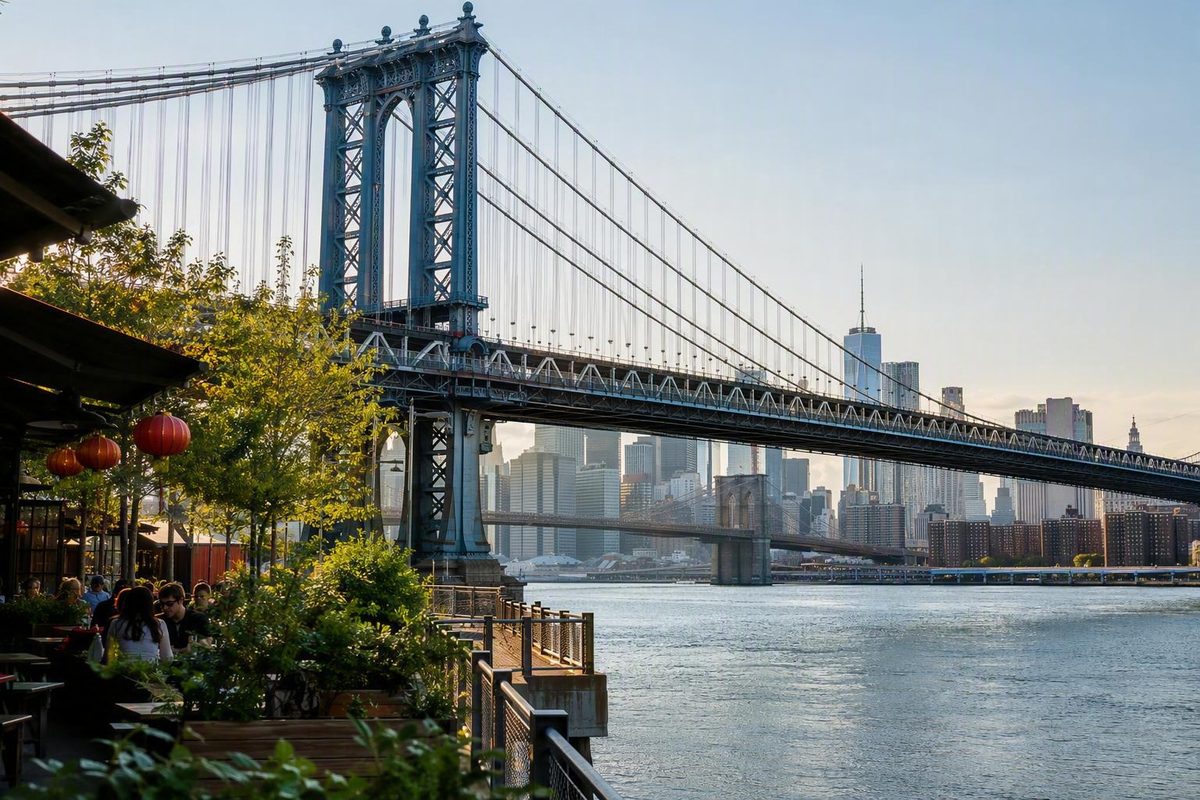
The phrase can also refer more generally to New York City landmarks such as the Brooklyn, Manhattan, and Williamsburg bridges.
This guide focuses first on the restaurant. Before making plans, check:
- Location: 9 Chatham Square, New York, NY 10038
- Hours: listed as 5:30–10 p.m. daily as of August 31, 2026, but subject to change
- Reservations: handled through Resy
- Walk-ins: designated bar seats and booths may be available, but are limited
- Cuisine: contemporary European cooking with French and Basque influences is the most useful synthesis of the differing guide descriptions
- Price: platform dollar signs conflict, so they should not be treated as a dependable bill estimate
- Menu: named dishes in reviews may no longer be available
If you meant the city’s landmarks, jump to If You Meant New York City’s Bridges: A Quick Visitor Guide. For most first-time visitors, the Brooklyn Bridge is the classic walk. The Manhattan Bridge is a practical alternative if you want views of the Brooklyn Bridge and can accept train noise, vibration, and fencing.
Bridges at a Glance: Location, Hours, and Official Booking Route
MICHELIN lists the restaurant at that address, classifies the cooking as Contemporary, assigns a $$$ price category, displays one star, and reports service from 5:30 p.m. to 10 p.m. daily. Those operational details were last checked on August 31, 2026 and should be reconfirmed before a visit because hours and distinctions can change. (MICHELIN Guide)
The restaurant’s website directs reservation requests to Resy. Start with the official Bridges website, where the navigation includes Menu, Events, Info, Reserve, and Explore. The homepage itself does not publish hours, contact details, or menu prices, so use it as a route to the restaurant’s current pages rather than assuming every planning detail appears there.
Resy also lists the Chatham Square address, categorizes Bridges as French and $$, and says designated bar seats and booths are held for walk-ins and serve the full menu. The classification and price symbols are Resy’s platform labels, while the walk-in statement appears in the venue’s operational “Need to Know” section. (Resy)
Bridges planning facts
Detail What is reported How to use it Address 9 Chatham Square, New York, NY 10038 A relatively stable navigation detail Neighborhood Chinatown Useful for planning nearby activities and transit Reservations Resy Follow the Reserve link from the restaurant’s website Listed hours 5:30–10 p.m. daily Last checked August 31, 2026; confirm before traveling Walk-ins Designated bar seats and booths are reportedly held back Limited possibility, not guaranteed seating Menu The restaurant website has a Menu section Check what the page currently displays before visiting Prices Not stated on the homepage Do not infer a bill from platform dollar signs alone Ratings and availability Time-sensitive Treat as a snapshot, not a permanent measure
Hours may change for holidays, events, or operational reasons. Reservation availability is even more volatile: an open table today says nothing about another date, while a fully booked dining room does not necessarily establish whether a walk-in seat will be offered that evening.
For a time-sensitive visit, verify the restaurant’s Info page, the booking screen, and any terms displayed during checkout on the day you make your plan.
What Kind of Restaurant Is Bridges?
No single platform label captures Bridges completely.
Resy describes it as a European restaurant influenced by France and the Basque country, while also placing it in a French category. MICHELIN classifies it as Contemporary and says its concise menu is not limited to one cuisine. The Infatuation classifies it as American. These are different editorial taxonomies, not evidence of different restaurants.
The most useful synthesis is contemporary European cooking with French and Basque influences. That is a summary of the available descriptions rather than an official, fixed cuisine category.
Diners should not assume that Bridges operates like a conventional French bistro, follows a standard Basque menu, or presents a familiar American menu simply because one platform uses one of those labels.
French influence might appear through technique, sauces, pastry work, or particular ingredient combinations. Basque influence likewise does not establish that every dish follows a traditional regional model. MICHELIN’s observation that the menu is not confined to one cuisine is the clearest reason to judge Bridges by the dishes shown for the date of your visit rather than by a platform category.
If cuisine is the deciding factor, open the restaurant’s Menu page shortly before booking. Look at the actual preparations being offered and ask whether they appeal to your table. If the page does not show the information you need, verify it directly with the restaurant rather than relying on an older review.
The Dishes Critics Have Highlighted—and the Menu-Freshness Caveat
The Comté tart and chocolate-hazelnut tart are the two dishes that recur most clearly across critical coverage. Their repeated appearance helps illustrate the kitchen’s style, but it does not confirm that either dish is available now.
MICHELIN highlighted a Comté-custard tart with morels, cured tuna with black trumpet mushrooms and dates, and a chocolate-hazelnut tart. Resy’s editorial description referred to a Comté tart with chanterelles, grilled king crab with béarnaise, and steamed turbot with rice and clams. The difference between the two mushroom accompaniments is itself a useful warning against treating a review as a permanent menu.
The Infatuation’s review also praised the Comté tart and chocolate-hazelnut tart. Other dishes discussed included sea-urchin custard with shrimp, sardine toast, kabocha squash with puntarelle and Brabander, sweetbreads, grilled pork, and roast duck with XO sauce. The review noted that the pork preparation described might no longer have been available, reinforcing the historical nature of any critic’s meal. Its advice to skip a lettuce, Asian pear, and trout roe salad was the reviewer’s opinion, not an objective ordering rule.
Taken together, the coverage points toward rich, carefully assembled dishes in which sauces, pastry, seafood, meat, cheese, and contrasting textures can play prominent roles. Terms such as “ambitious,” “original,” or “quietly complex” remain the judgments of the critics who used them.
There are three reasons not to organize an entire visit around one named dish:
- Reviews record a particular meal. A dish discussed in an article may have changed or disappeared.
- Recurring dishes can evolve. Even a recognizable preparation such as the Comté tart may appear with different accompaniments.
- Editorial pages can outlast a menu. A restaurant description may remain online after the kitchen has introduced new dishes.
Immediately before booking or visiting, open the Menu section on the restaurant’s website and see what it currently displays. If a particular dish is the main reason for your reservation, contact the restaurant rather than assuming repeated critical attention guarantees availability.
A more dependable ordering approach is to decide what kind of meal you want. If the available menu still offers a progression of composed starters, seafood, meat, and dessert, consider whether your table wants breadth across those categories or a smaller selection. That is more reliable than attempting to reproduce a critic’s earlier dinner.
Dining Room, Service, and the Occasions Bridges May Suit
MICHELIN describes the dining room as warm, welcoming, amber-toned, and bistro-like. It also characterizes the service as relaxed and attentive. Those are editorial assessments, not guarantees that every guest will experience the room or service in the same way.
The Infatuation recommends Bridges for date nights, fine dining, and seeing and being seen. Its review describes a rear dining room and a front area with a bar and limited booth seating. That reported layout helps explain why a reserved dining-room meal may feel different from a walk-in experience near the front, although layouts and seating policies can change.
The available descriptions support treating Bridges as an elevated evening restaurant. It appears to be a stronger fit for a planned dinner, date, or food-focused occasion than for someone whose main priority is a documented low-cost or fast meal. That does not mean a celebration is required; it means the restaurant’s coverage emphasizes composed cooking and a deliberate dinner experience.
For a date, Bridges may fit if both people want the meal itself to be the focus. The restaurant guides’ descriptions of the food and room point toward a more involved dinner rather than a quick stop between tightly timed activities.
For a celebration, verify every service you need. The available information does not establish cake rules, special desserts, decorations, private rooms, accessibility arrangements, or celebration packages.
For a spontaneous dinner, the walk-in seats make a meal possible in principle. They do not make it predictable. A bar seat may still offer the full menu, but there may be a wait or no availability.
No dependable conclusion can be drawn here about dress code, sound level, table spacing, mobility access, or dietary accommodation. Contact the restaurant if any of those considerations will determine whether you can dine comfortably.
Price Expectations Without a Misleading Dollar Estimate
The major platforms disagree plainly about Bridges’ price tier:
| Platform | Displayed tier |
|---|---|
| Resy | $$ |
| MICHELIN Guide | $$$ |
| The Infatuation | $$$$ |
This range does not necessarily mean one platform is wrong.
What the disagreement does establish is that the symbols cannot predict your final payment.
A dependable per-person estimate would require the current prices for the dishes you intend to order, beverage choices, tax, and gratuity. The platform categories do not provide those inputs, and the restaurant homepage does not show enough pricing information to calculate a representative total.
Use this process instead:
- Open the restaurant’s Menu page and review whatever dishes and prices are currently shown.
- Estimate the number of starters, main dishes, and desserts your table is likely to order.
- Include beverages rather than treating them as an afterthought.
- Remember that a menu subtotal is not the same as the final payment.
- If prices are not displayed, contact the restaurant before making a budget-sensitive reservation.
Based on the editorial coverage, Bridges is best framed as an elevated dining choice. That description should not be converted into a universal judgment such as affordable, expensive, overpriced, or worth it. Value depends on what you order, what you want from the evening, and which alternatives you are considering.
Ratings, review totals, card benefits, and reservation-platform perks do not answer the budget question. If a card or booking benefit affects your decision, check its current eligibility rules separately.
How Reservations and Walk-Ins Work
Reservations are handled through Resy. Both the restaurant website and MICHELIN listing direct diners there, making the Bridges booking page on Resy the appropriate place to check current tables.
The venue’s “Need to Know” text says it serves the full menu at designated bar seats and booths held for walk-ins. That makes a spontaneous meal possible, but it does not guarantee a seat at the time you arrive.
The Infatuation reported that reservations were released 21 days in advance and that the front area had two booths and 12 stools reserved for walk-ins. Those figures were editorially reported and may change; they should not be treated as a permanent release schedule or fixed seating inventory. (The Infatuation)
For a specific date or important dinner, use this sequence:
- Check Resy first. Search for the exact date, party size, and range of acceptable times.
- Review the restaurant’s Info and Menu pages. Look for events or changes that could affect your visit.
- Read the terms shown during booking. Those are the terms that apply to the table you are selecting.
- Reconfirm before relying on a walk-in. Held-back seating can fill quickly or be handled differently on a particular evening.
- Keep a nearby alternative in mind. If you cannot accept a wait or an unsuccessful walk-in attempt, make a reservation rather than relying on chance.
There is not enough dependable information to recommend one precise arrival time for walk-ins. Demand can vary with the date, party size, weather, and events. Likewise, do not assume a particular cancellation policy, deposit, no-show charge, or daily release time without reading the terms attached to your actual booking.
The practical rule is simple: reserve through Resy when the meal matters; treat walk-in bar and booth seating as a limited possibility to verify, not a guaranteed fallback.
If You Meant New York City’s Bridges: A Quick Visitor Guide
New York has far more crossings than a short visitor guide can cover. NYC Tourism’s gallery highlights the Brooklyn, Manhattan, Williamsburg, George Washington, Ed Koch Queensboro, Robert F. Kennedy, and Verrazzano-Narrows bridges, but the gallery is a showcase rather than a complete city inventory. (NYC Tourism)
Agency jurisdiction matters when interpreting access and toll information. NYC DOT says it owns, operates, and maintains more than 800 bridges and tunnels combined, including the Brooklyn, Manhattan, Williamsburg, and Ed Koch Queensboro bridges. It also says bridges operated by NYC DOT do not charge tolls. That rule does not automatically apply to facilities run by the MTA, Port Authority, or other agencies. (NYC DOT)
Brooklyn Bridge: the iconic first-time walk
For most first-time visitors, the Brooklyn Bridge is the strongest all-purpose choice. It provides the most recognizable architecture and a direct walking connection between Lower Manhattan and Brooklyn.
The bridge opened in 1883. A published visitor guide measures the full crossing, including its approaches, at about 1.1 miles and describes concrete ramps leading to the wooden pedestrian path. It identifies the main Manhattan entrance in the Civic Center near City Hall and the Brooklyn ramp at Tillary Street and Brooklyn Bridge Boulevard near Cadman Plaza. (Tripadvisor)
A one-way crossing can take roughly 30 minutes at a steady pace, while a small group stopping for pictures may need around 35 to 40 minutes. Crowds, pauses near the towers, and photography can extend the walk further. (New York Like a Native)
The practical access points are:
- Manhattan: near City Hall, across Centre Street in the Civic Center area
- Brooklyn: the ramp at Tillary Street and Brooklyn Bridge Boulevard, near Cadman Plaza
- DUMBO connection: travel guides report a signed branch beyond the Brooklyn tower that descends toward Washington Street; from DUMBO, Washington Street leads toward stairs connecting with the path
Follow current signs rather than relying exclusively on an old saved map. Construction and access arrangements can change.
Direction is a preference, not a rule. Starting in Brooklyn places Manhattan’s skyline ahead for much of the crossing. Starting in Manhattan creates a natural continuation into DUMBO and Brooklyn Heights. Choose based on what you want to do after crossing.
Crowd advice is similarly situational. Travel writers often prefer early mornings, but no time is permanently quiet. Weekends, holidays, warm weather, and popular photography periods may slow the crossing.
Manhattan Bridge: wider views, fewer reported crowds, more noise
Travel writers commonly present the Manhattan Bridge as a less crowded alternative to the Brooklyn Bridge. Its pedestrian side offers views toward the Brooklyn Bridge and Lower Manhattan, making it useful when seeing the Brooklyn Bridge matters more than standing on it.
The tradeoffs are significant. Travel accounts consistently report chain-link fencing and substantial noise and vibration when subway trains pass. The experience can feel more infrastructural than ceremonial.
A detailed walking guide reports separate pedestrian and bicycle routes. It places the Manhattan pedestrian entrance near Bowery and Bayard Street in Chinatown and the Brooklyn entrance near Jay and Sands streets, reached by a staircase. The same guide emphasizes the fencing, subway noise, and views toward the Brooklyn Bridge and Lower Manhattan. Verify access before leaving, particularly if stairs or route changes would present a problem. (Where Are Those Morgans)
Photography quality is subjective. The fencing may interfere with some compositions, but the angle toward Lower Manhattan and the Brooklyn Bridge is the main reason photographers choose this crossing. Crowd levels and perceived comfort also vary by time and conditions; personal travel accounts are not substitutes for current agency notices.
Williamsburg Bridge: useful for a different neighborhood pair
The Williamsburg Bridge connects the Lower East Side and Williamsburg and carries subway trains. Travel sources report separate routing for pedestrians and cyclists, subject to current access conditions. (Mitzie Mee)
Compared with the Brooklyn Bridge, it is less centered on one famous visitor view. Compared with the Manhattan Bridge, it leads to a different part of Brooklyn. Choose it when the Lower East Side and Williamsburg fit your itinerary, not simply because it is another East River crossing.
A walking-first Chinatown–DUMBO loop
For an efficient two-bridge outing, begin in Chinatown and cross the Manhattan Bridge into Brooklyn. Spend time in DUMBO or near the waterfront, then return to Manhattan over the Brooklyn Bridge.
This is an editorial itinerary rather than an official route, but it has several practical advantages:
- It groups Chinatown, the Manhattan Bridge, DUMBO, and the Brooklyn Bridge in one continuous area.
- It lets you see the Brooklyn Bridge before walking across it.
- It avoids taking transit across the river merely to begin a second bridge walk.
- It ends near the Civic Center and Lower Manhattan, leaving several options for continuing the day.
For a broader route around the area, see this walking-first Lower Manhattan day.
Before setting out, check current agency information for construction, closures, and path changes. Preferred direction, ideal photography conditions, crowd tolerance, and perceived comfort are personal and situational rather than fixed facts.
Frequently Asked Questions
Where is Bridges NYC located?
Bridges restaurant is at 9 Chatham Square, New York, NY 10038, in Chinatown. Search with the full address rather than the name alone if your map results are dominated by physical bridges or unrelated businesses.
What kind of food does Bridges serve?
The platforms classify it differently. Resy describes a European restaurant influenced by France and the Basque country, MICHELIN calls the cuisine Contemporary, and The Infatuation labels it American.
The most useful synthesis is contemporary European cooking with French and Basque influences. That description does not mean Bridges is a traditional French bistro or a narrowly regional Basque restaurant.
Does Bridges have a MICHELIN star?
Yes. The MICHELIN restaurant listing displayed one star when checked on August 31, 2026. The listing did not state a guide year in the available page text, and distinctions can change, so confirm the live listing when current status matters.
Can you walk into Bridges without a reservation?
Potentially. The venue’s Resy information says the full menu is served at designated bar seats and booths held for walk-ins. Those seats are limited, and availability is not guaranteed.
A review also reported a specific front-area layout and a reservation-release window, but both should be treated as changeable. Reconfirm the current policy before planning an evening around a walk-in.
Which NYC bridge is best for a visitor to walk?
For a first visit, the Brooklyn Bridge is the clearest all-purpose recommendation because of its recognizable architecture, wooden pedestrian path, skyline views, and connection between Lower Manhattan and DUMBO. Allow extra time for crowds and photographs.
Choose the Manhattan Bridge if you prioritize views of the Brooklyn Bridge and Lower Manhattan and do not mind chain-link fencing or loud, vibrating subway trains. It also fits naturally into a walking loop from Chinatown through DUMBO and back over the Brooklyn Bridge.
The Bottom Line
For Bridges restaurant, confirm the hours and whatever the Menu page currently displays, use Resy when you need a planned table, and regard walk-in bar or booth seating as a limited option rather than a guarantee. The available coverage presents Bridges as an elevated Chinatown dinner destination, but its cuisine label, exact dishes, and likely cost should be checked rather than assumed.
If you meant the landmarks, choose the Brooklyn Bridge for the iconic first walk. Choose the Manhattan Bridge for Brooklyn Bridge views and a reportedly less crowded—but much noisier—crossing that works naturally as part of a Chinatown–DUMBO loop.