 New York Know
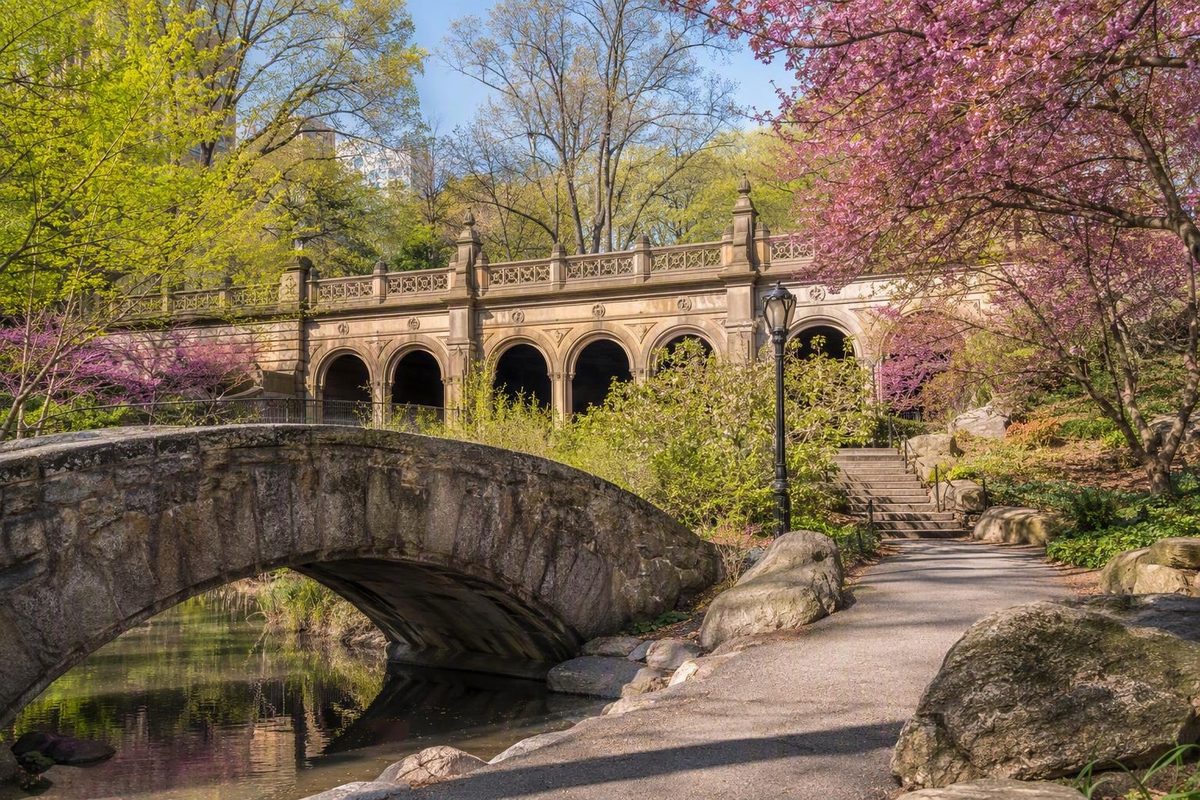
The bridges of Central Park are more than scenic objects scattered among lawns, water, and woodland. Together, they explain how the park works. They carry paths over drives, separate walkers from other routes, cross waterways, and help each landscape feel distinct from the next.
For most visitors, the useful approach is not to chase every named, unnamed, replaced, restricted, or disputed crossing. Build a coherent walk around Gapstow Bridge, the Mall, Bethesda Terrace, Bow Bridge, and the Ramble. Then add one or two lesser-known structures if their architecture or setting interests you.
This walking-first guide explains why published bridge totals differ, connects the structures to the park’s original circulation plan, and shows how stone, cast iron, wood, steel, and natural boulders were adapted to different landscapes.
How Many Bridges and Arches Are in Central Park?
The short answer is that Central Park does not have one useful bridge total unless the person counting first defines what qualifies as a bridge.
The clearest category-specific figure comes from the Central Park Conservancy, which reports 30 ornamental bridges and arches currently in the park. That figure reflects 27 structures built from 1859 through 1866, followed over time by six additions and three removals. The Conservancy discusses smaller woodland bridges separately, so its total is not intended to include every possible crossing in Central Park. The Central Park Conservancy explains the 30-structure count and its scope.
Other totals are not necessarily wrong; they may measure different categories. A Wikipedia historical overview reports 36 ornamental spans, says Central Park reached a peak of 39 bridges and arches, and distinguishes those structures from rustic crossings and bridges over the sunken transverse roads. It also identifies Marble Arch, Spur Rock Arch, and Outset Arch as structures demolished in the 1930s. The historical classification and source-specific totals are summarized in this overview.
At the broad end, an independent bridge catalog estimates that Central Park contains around 50 bridges, depending on the definition used. Its coverage includes ornamental structures, transverse-road bridges, rustic crossings, and other infrastructure, but it is not presented as a definitive current inventory. The catalog describes its roughly 50-bridge estimate as definition-dependent.
Central Park bridge-counting guide
Category How to treat it Current ornamental bridges and arches Use 30 as the clearest category-specific figure from the Central Park Conservancy. Rustic woodland crossings Count separately. These are generally smaller wood, log, stone, or naturalistic crossings over streams and paths. Transverse-road bridges Count separately. They carry the park landscape over sunken crosstown roads and are generally excluded from ornamental totals. Replacement structures Distinguish the surviving bridge from its predecessor. Gapstow Bridge is the clearest example. Demolished structures Keep them in the historical record, not on a present-day walking list. Do not add these rows together as if they formed a verified grand total. The sources use overlapping categories and different inclusion rules.
The difference between 30, 36, and roughly 50 therefore reflects method more than mystery. One source might count only surviving ornamental spans. Another might include structures from different historical periods. A broader catalog may add transverse-road infrastructure and small rustic crossings.
This guide concentrates on surviving, named ornamental bridges and arches that help explain the park’s design. Rustic and transverse-road structures are discussed as categories where they clarify the counting problem, but they are not presented as a complete visitor inventory.
Why Central Park Needed So Many Bridges
Frederick Law Olmsted and Calvert Vaux did not design Central Park as a flat open field with a few paths. Their Greensward Plan created an interwoven circulation system of pedestrian walks, bridle trails, carriage drives, and roads. Different visitors could move through the same relatively narrow park while experiencing distinct routes and landscapes.
That arrangement created an engineering problem. The routes had to intersect, but frequent crossings at the same level would interrupt movement and weaken the impression of being immersed in a landscape. Bridges and arches solved the problem by carrying one route above another.
Grade separation mattered because Central Park is only about half a mile wide. Changes in elevation, planted embankments, bridges, and arches allowed several circulation systems to occupy that confined width without appearing to merge into one large street network.
NYC Parks credits Olmsted and Vaux with the interwoven routes and identifies Calvert Vaux and Jacob Wrey Mould as the creators of 35 distinct structures. It lists brick, granite, marble, cast iron, rustic wood, and gneiss boulders among the materials employed. The bridges were therefore part of a combined landscape and transportation strategy, not monuments added independently for decoration. NYC Parks explains the original circulation system, designers, construction, and material range.
The structures fall into three practical groups:
- Ornamental bridges and arches were deliberately integrated into prominent landscapes. Their silhouettes, masonry, railings, and approaches formed part of the visual composition.
- Rustic crossings were generally smaller and more naturalistic. They often crossed streams, woodland paths, or narrow landscape features.
- Transverse-road bridges carried the park over sunken crosstown roads. They were necessary infrastructure designed to limit the presence of city traffic within the visitor’s experience.
Most of the original ornamental structures were erected between 1859 and the mid-1860s. Calvert Vaux was their principal designer, sometimes working with Jacob Wrey Mould on structures and decorative details. That concentrated building period gives the bridges a shared historical context even though their appearances differ sharply.
The variation was intentional. A formal cast-iron span could suit an open water crossing or bridle route, while rough boulders made sense in a woodland ravine. Dressed stone could frame a ceremonial approach, and rustic wood could recede into foliage. Instead of repeating one standardized bridge, the designers adapted each crossing to its immediate surroundings.
At each arch or bridge, ask two questions:
- What route passes above, and what route passes below?
- How do the material and form connect the structure to its setting?
Those questions turn a bridge walk into a readable explanation of Central Park.
Bow Bridge: The Lake Crossing at the Center of a Classic Walk
Bow Bridge stands at approximately the 74th Street level, crossing the Lake between Cherry Hill and the Ramble. It is not simply an overlook. It provides a functional connection between the open landscape around Cherry Hill and the irregular woodland paths of the Ramble.
The bridge was built between 1859 and 1862 and spans more than 60 feet across the Lake. Calvert Vaux and Jacob Wrey Mould designed it, while Janes, Kirkland, and Co. performed the ironwork. Its ornamental railing combines Gothic, Neo-Classical, and Renaissance elements. NYC Parks provides Bow Bridge’s dates, span, designers, fabricator, and decorative description.
Its name becomes clear when the bridge is seen from shore. The low, extended curve resembles an archer’s bow or the bow used to play a stringed instrument. That comparison describes its profile without requiring a claim that Bow Bridge outranks every other structure in the park.
Bow Bridge is also unusual among Central Park’s ornamental iron spans. Historical classifications identify seven ornamental iron bridges, but Bow Bridge crosses water while the others crossed bridle paths. Its position over the Lake therefore gives it a different function and visual character from structures such as Pine Bank Arch or Gothic Bridge.
What to notice on and around Bow Bridge:
- The low profile: The deck does not rise into a steep hump, so the bridge reads as a long, controlled curve over the water.
- The railing: Look beyond the overall silhouette to the mixture of decorative references in the ironwork.
- The landscape transition: The Cherry Hill side feels comparatively open and directional; the Ramble side quickly becomes enclosed and irregular.
- The shoreline views: The most revealing view may come from an approach or nearby shore rather than the middle of the bridge.
- Its role as an entrance: Crossing into the Ramble means moving from a recognizable landmark into a less linear path system.
The Central Park Conservancy describes Bow Bridge as a major entrance to the Ramble, a connection toward Bethesda Terrace, and a viewpoint over the Lake and surrounding landscape. The Conservancy explains Bow Bridge’s role in the park’s visitor circulation.
That relationship makes the bridge easy to incorporate into a central park walk. From Bethesda Terrace, continue toward Cherry Hill, cross Bow Bridge, and enter the Ramble. In the opposite direction, use the bridge as an exit from the Ramble before continuing toward Bethesda Terrace and the Mall.
Travel guides commonly suggest early morning for potentially quieter photographs, but that is not a dependable crowd forecast. Weather, season, events, tours, and ordinary day-to-day variation all affect how busy the crossing feels. If photography matters, allow time to wait or change viewpoint rather than planning around a promise of solitude.
Gapstow Bridge: The Pond and Midtown in One View
Gapstow Bridge crosses the narrow portion of the Pond near Central Park’s southeast corner. Entrances around Fifth and Sixth Avenues provide practical approaches, making it a natural first or final stop on a southern park walk.
Unlike Bow Bridge’s extended iron curve over the Lake, the present Gapstow Bridge is a stone-arch crossing. Its visual effect comes from the relationship between the bridge, the Pond, the surrounding rock and planting, and the buildings beyond the park.
The characteristic composition places water in the foreground and Midtown architecture behind it. Depending on the viewpoint, the scene can include the Plaza Hotel area and surrounding towers. A route beginning near the southeast corner can follow the Pond’s edge and encounter the bridge without requiring a separate detour. This self-guided walking account describes the Pond approaches, stone arch, skyline, and Plaza Hotel view.
The most useful comparison with Bow Bridge concerns setting rather than rank:
| Gapstow Bridge | Bow Bridge |
|---|---|
| Crosses the Pond near the southeast corner | Crosses the Lake around the 74th Street level |
| Stone-arch form | Ornamental iron span |
| Frames water against Midtown buildings | Sits within the Lake, Cherry Hill, and Ramble landscape |
| Fits naturally at the beginning or end of a southern walk | Anchors a central walk through Bethesda Terrace and the Ramble |
| Easy to combine with the Mall | Easy to combine with Cherry Hill and woodland paths |
Gapstow is where the park’s constructed landscape meets a strong city backdrop. Bow Bridge is more deeply embedded in the central water-and-woodland composition. They offer different experiences and do not need to be ranked against each other.
Gapstow’s construction history requires care. An earlier wooden bridge occupied the crossing, but it was later replaced by the present stone span, completed in 1896. Historical summaries place the original bridge in the 1870s, while some tourism pages repeat an early date without clearly distinguishing the wooden predecessor from the stone replacement. The historical overview separates the original wooden Gapstow Bridge from the 1896 stone span.
For a present-day visitor, the essential point is simple: the stone bridge now visible is not the same physical structure as the original wooden bridge. Treating both stages as one uninterrupted construction date creates the apparent contradiction.
Traveler reports consistently present Gapstow as a photography stop, but their observations about crowds vary. Some describe a busy setting; others report little waiting under different conditions. Those individual experiences illustrate why crowd reports should not be treated as dependable forecasts. Tripadvisor’s visitor reports show the variation in individual crowd observations.
A Walking-First Route from Gapstow Bridge to Bow Bridge
The simplest way to combine the two best-known crossings is to move generally north from the Pond into the park’s central landscapes. This reduces backtracking and allows the scenery to change in a logical sequence.
Recommended south-to-center order:
- The Pond and Gapstow Bridge
- The Mall
- Bethesda Terrace and Fountain
- Cherry Hill
- Bow Bridge
- The Ramble
This is a route framework, not turn-by-turn navigation. Central Park paths split, curve, pass under arches, and change elevation. A current official map is more reliable on the ground than a long series of written left and right turns.
1. Begin at the Pond and Gapstow Bridge
Approach from the southeast or southern edge and use the Pond as your first orientation point. Follow enough of the shoreline to see the bridge from more than one angle before crossing or continuing north.
Starting here introduces one of the park’s central visual themes: constructed landscape in the foreground and Manhattan beyond it. You remain close to the street grid and surrounding buildings, but the water, rock, and stone bridge begin the transition into the park.
2. Continue toward the Mall
Move north toward the Mall rather than wandering far west and later returning east. The Mall supplies a clear axis after the irregular Pond paths and creates a strong transition from the compact southern landscapes to Bethesda Terrace.
The route does not depend on seeing every nearby arch. If Pine Bank Arch or another southern structure fits naturally into your walk, treat it as an addition. Do not sacrifice the overall progression to collect crossings in no logical order.
3. Descend toward Bethesda Terrace and Fountain
Bethesda Terrace is the route’s central hinge. It provides an unmistakable landmark between the Mall and the Lake and helps restore your orientation before you continue toward Cherry Hill.
Pause instead of treating the terrace only as a corridor. The bridges make more sense when seen as elements within a larger composition of paths, drives, terraces, water, woodland, and changes in level.
4. Continue toward Cherry Hill
From the Bethesda area, make your way toward Cherry Hill and the Lake. Cherry Hill is the open-side approach to Bow Bridge and a useful orientation point before the path network becomes less predictable.
This part of the walk allows you to see Bow Bridge first as an object in the Lake landscape and then as a crossing. If photography matters, look for a shoreline view before stepping onto the bridge.
5. Cross Bow Bridge
Crossing Bow Bridge marks the transition into the Ramble. Turn around at least once to understand how the span links the open Cherry Hill side with the denser woodland ahead.
Because the bridge attracts many visitors, do not assume that its center will offer uninterrupted space for photographs. Let others pass, use the approaches, and consider wider compositions that include the bridge rather than photographing only from it.
6. Enter the Ramble
The Ramble is the least linear part of the route. Its winding paths and enclosed landscape are central to the experience, but they also make rigid written directions unreliable.
Use Bow Bridge and Bethesda Terrace as southern orientation anchors. Before entering, decide whether you want a short woodland loop followed by a return toward the Lake or intend to continue farther north toward Belvedere Castle.
A third-party first-time visitor itinerary estimates roughly two to three hours for a broader highlights walk incorporating the Ramble, Bow Bridge, Bethesda Terrace, the Mall, and Gapstow Bridge. Treat that as a planning range rather than a guaranteed duration: navigation, photography, breaks, and detours can change the total substantially. The Empty Nest Explorers provides the two-to-three-hour estimate for its broader highlights route.
Reverse route from the west side
If you begin around the West 81st Street side, reverse the sequence:
- Belvedere Castle
- The Ramble
- Bow Bridge
- Bethesda Terrace and Fountain
- The Mall
- Gapstow Bridge
- Exit near Fifth Avenue and 59th Street
This version suits a day that already places you on the Upper West Side. It moves generally south and finishes with the city-facing view at Gapstow Bridge.
Abbreviated southern option
If time or energy is limited, walk:
- Gapstow Bridge
- the Mall
- Bethesda Terrace
Leave Bow Bridge and the Ramble for another visit. This preserves a coherent southern progression instead of turning a short outing into a rushed bridge hunt.
Central-only option
For a route focused on the Lake landscape, begin with:
- Bethesda Terrace
- Cherry Hill
- Bow Bridge
- the Ramble
This is the more efficient choice when Bow Bridge matters more than the Pond-and-skyline setting at Gapstow.
Lesser-Known Bridges and Arches Worth Noticing
Central Park’s less familiar structures reveal more architectural variety than a two-bridge itinerary can show. The examples below do not form a complete inventory. They are selected because they illustrate different materials, functions, and landscape settings.
Street numbers are approximate orientation aids. Manhattan’s numbered grid does not continue through the park, so “around 77th Street” should not be treated as a precise coordinate.
| Approximate zone | Structure | What to notice |
|---|---|---|
| Southern park | Pine Bank Arch | A surviving cast-iron crossing associated with the bridle path. |
| East-central park, near the Metropolitan Museum of Art | Greywacke Arch | Ornamental masonry and a pointed-arch treatment. |
| Lake, around 77th Street | Balcony Bridge | A stone-arch vehicle bridge dating to about 1860, placed within the Lake landscape. |
| Northern edge of the Lake, around 78th Street | Oak Bridge | Also called Bank Rock Bridge or Cabinet Bridge; a wood-and-steel pedestrian crossing leading toward the Ramble. |
| Reservoir area, around 94th Street | Gothic Bridge | A surviving cast-iron bridge over the bridle path. |
| North Woods | Huddlestone Arch | Uncut boulders held by gravity and pressure rather than mortar. |
| Ravine, around 102nd Street | Glen Span | A northern crossing described by different sources as either a bridge or an arch. |
A CentralPark.com directory supplies the approximate locations and identifies Balcony Bridge as a circa-1860 stone-arch vehicle bridge, Oak Bridge as a wood-and-steel pedestrian crossing, Gothic Bridge as a bridle-path span near the Reservoir, Greywacke Arch by its pointed treatment, and Glen Span near the Ravine. The third-party bridge directory provides comparative location and construction details.
Balcony Bridge
Balcony Bridge shows how a stone vehicle bridge can become part of a water landscape. Dating to approximately 1860, it stands around the 77th Street level near the Lake. Its arch, masonry mass, and relationship to the shoreline contrast with Bow Bridge’s thinner iron profile.
Treat it as an addition to a Lake-focused walk rather than a compulsory detour from the southern route. If you are already exploring the western or northern side of the Lake, Balcony Bridge adds architectural variety without requiring a trip to another park zone.
Oak Bridge, Bank Rock Bridge, or Cabinet Bridge
These three names refer to one crossing. Oak Bridge stands near the northern edge of the Lake, around the 78th Street level, and leads toward the Ramble. Its wood-and-steel form provides a useful comparison with Balcony Bridge’s masonry and Bow Bridge’s ornamental iron.
It also offers a lesson in scale. Bow Bridge announces itself across a broad stretch of water; Oak Bridge feels more like a transition into woodland. The two structures perform related landscape work with different materials and degrees of formality.
Huddlestone Arch
Huddlestone Arch is the engineering standout among these examples. It is composed of uncut boulders held in place by gravity and pressure without mortar.
The effect is deliberately rugged. Instead of appearing as a refined object inserted into the woods, the arch seems to emerge from the surrounding geology. It demonstrates that ornamental design in Central Park does not always mean polished or delicate. A rough naturalistic structure can also be carefully engineered and visually purposeful. The visitor directory describes Huddlestone Arch’s unmortared boulder construction.
Pine Bank Arch
Pine Bank Arch is one of the park’s surviving cast-iron crossings over the bridle path. It provides a more compact iron experience than Bow Bridge and makes the circulation logic especially easy to read: one route passes over another at a separate level.
If your walk begins near the Pond, Pine Bank can serve as an early example of traffic separation before you reach the more expansive water crossings.
Gothic Bridge
Gothic Bridge stands near the Reservoir, around the 94th Street level, and crosses the bridle path. Like Pine Bank Arch, it is a surviving cast-iron structure, but its position makes it more suitable for a Reservoir or northern extension than for the compact Gapstow-to-Bow route.
Its value lies partly in comparison. Bow Bridge shows ornamental iron used over water; Gothic Bridge shows how the material was also employed to separate land routes.
Greywacke Arch
Greywacke Arch is near the Metropolitan Museum of Art. Its pointed opening and ornamental masonry give it a more overtly architectural treatment than many rustic structures. Those visible features are more useful to a walker than trying to assign an elaborate style label during a brief visit.
Glen Span
Glen Span lies near the Ravine around the 102nd Street level and can anchor a North Woods extension. Some sources call it Glen Span Bridge, while others use Glen Span Arch. The difference in terminology does not create two structures.
Together, these examples let a selective itinerary compare formal ironwork, masonry, wood and steel, and gravity-held boulders without pretending to offer a complete list.
Names, Replacements, and Structures Visitors Cannot Treat as Ordinary Stops
Conflicting bridge lists usually reflect one of four issues: alternate names, spelling differences, replacement structures, or inconsistent classification. These are not all the same kind of uncertainty.
Bridge-name and history discrepancy panel
Issue How to interpret it Oak Bridge / Bank Rock Bridge / Cabinet Bridge Three names for one structure, not three bridges. Eaglevale / Eagledale Inconsistent labels in the source record; do not count them as separate structures. Glen Span Bridge / Glen Span Arch Alternate classification terms for the same crossing. Dipway Arch at 59th or 63rd Street Conflicting approximate street references; neither should be treated as definitive without better mapping. Gapstow Bridge dates Often caused by failure to distinguish the original wooden bridge from the current stone replacement. Demolished arches Historical structures, not present-day destinations. Restricted or nonpublic structures A named structure may exist without functioning as an ordinary visitor stop.
Aliases are not additional bridges
Oak Bridge, Bank Rock Bridge, and Cabinet Bridge are alternate names for the same crossing near the northern side of the Lake. A list that treats each name as a separate structure artificially inflates the total.
The same principle applies to Glen Span. Whether a source calls it a bridge or an arch, the label refers to one crossing near the Ravine.
Some discrepancies remain unresolved
Eaglevale and Eagledale appear as inconsistent labels in the available record. Without a definitive naming resolution, the responsible approach is to flag the inconsistency rather than invent a distinction.
Dipway Arch has also been associated with conflicting approximate street labels, including 59th and 63rd Streets. Because street references are already rough orientation tools inside the park, choosing either as unquestionably correct would create false precision.
Replacement structures create conflicting dates
Gapstow Bridge demonstrates why a single name can produce several dates. The original wooden bridge and later stone bridge occupied the same general crossing but were different structures. One source may date the first bridge, another the replacement, and a third may collapse both stages into one entry.
When dates conflict, ask whether the sources are discussing:
- the first structure at the site,
- a replacement bridge,
- a reconstruction,
- or the surviving form visible today.
Not every historical structure survives
Marble Arch, Spur Rock Arch, and Outset Arch were demolished in the 1930s. They belong in a historical account of the bridge system, not on a present-day walking route.
Greengap Arch has been described by a visitor directory as closed to the public and used for storage. Because access conditions can change, treat that as a historical report rather than a permanent current-status statement. Verify its present status through an official channel before attempting to include it in a walk. The directory reports the access limitation associated with Greengap Arch.
Bridge Identification Numbers are useful but incomplete
Some Central Park structures have Bridge Identification Numbers, or BINs. These technical identifiers can distinguish structures in engineering and inspection records, especially where common names vary.
An available count of 31 Central Park bridges with BINs comes from a 2002 city condition report. It should not be presented as a current or comprehensive count of every ornamental arch, rustic crossing, short span, or replacement structure. The independent bridge catalog explains the BIN system and the date limits of its 31-structure figure.
For most visitors, a BIN is secondary information. It may help with research, but it does not replace a current official map or resolve every naming question.
How to Use This Guide on the Ground
Treat every street number in this guide as an orientation aid rather than a coordinate. Central Park interrupts Manhattan’s grid, and paths inside the park do not behave like numbered streets. A bridge described as being “around 78th Street” may still require several turns, a change in elevation, or an approach from a particular side of the landscape.
Use a current official Central Park map for navigation, especially in the Ramble, the North Woods, and around lesser-known arches. On a map, first identify the major anchors—the Pond, the Mall, Bethesda Terrace, Cherry Hill, the Lake, and the Ramble—then use nearby bridge names to refine your route.
Before visiting, verify current information through NYC Parks or the Central Park Conservancy, including:
- closures and restoration work,
- park rules,
- path conditions,
- temporary access restrictions,
- and accessibility information.
This guide does not promise that a particular approach is step-free, wheelchair accessible, stroller-friendly, or suitable for limited mobility. Historic landscapes can include slopes, stairs, uneven surfaces, and indirect approaches, while temporary work may alter routes. Current official accessibility guidance should take priority over a general walking itinerary.
For photography, choose the setting that fits the composition you want:
- Gapstow Bridge for the Pond against Midtown architecture.
- Bow Bridge for the Lake, the curved iron span, Cherry Hill, and the Ramble.
- Balcony Bridge for stone architecture within the Lake landscape.
- Oak Bridge for a smaller wood-and-steel transition toward woodland.
- Huddlestone Arch for rugged boulder construction rather than a skyline scene.
- Gothic Bridge or Pine Bank Arch for ornamental cast iron away from Bow Bridge’s water setting.
Early morning may improve the possibility of a calmer atmosphere, particularly at Bow Bridge, but no time guarantees an empty crossing. Leave flexibility in the route and be prepared to photograph from the approaches or shoreline.
Choose the route according to your priority:
- Choose Gapstow Bridge for a short southern stop with a Pond-and-Midtown composition.
- Choose Bow Bridge and Bethesda Terrace for a compact central segment combining architecture, water, and woodland.
- Add Oak Bridge or Balcony Bridge for more variety around the Lake without moving into northern Central Park.
- Add Gothic Bridge and Glen Span when architectural range matters more than keeping the walk compact.
- Add Huddlestone Arch when engineering and naturalistic construction are the main interests.
Frequently Asked Questions
How many bridges and arches are in Central Park?
The most useful category-specific figure is 30 current ornamental bridges and arches, as reported by the Central Park Conservancy. It excludes smaller woodland crossings and does not function as a total of every span over the transverse roads.
Broader sources produce higher totals because they use different inclusion rules. The numbers should not be added together or treated as direct contradictions.
Where are Bow Bridge and Gapstow Bridge?
Bow Bridge is around the 74th Street level, crossing the Lake between Cherry Hill and the Ramble. Gapstow Bridge crosses the narrow portion of the Pond near Central Park’s southeast corner. A CentralPark.com directory provides the approximate locations of both bridges.
Bow Bridge fits a central walk involving Bethesda Terrace and the Ramble. Gapstow Bridge works naturally as the beginning or end of a southern park route.
Can you visit Bow Bridge and Gapstow Bridge on the same walk?
Yes. Begin at the Pond and Gapstow Bridge, continue through the Mall to Bethesda Terrace, move toward Cherry Hill, cross Bow Bridge, and finish in the Ramble.
The route also works in reverse from the west side, beginning near Belvedere Castle and the Ramble before continuing south. Allow flexible time for navigation, photographs, breaks, and detours rather than treating any published duration as a guarantee.
Why are there so many bridges and arches in Central Park?
Olmsted and Vaux designed interwoven pedestrian paths, bridle trails, carriage drives, and roads. Bridges and arches allowed those routes to cross at separate levels, reducing conflicts while preserving distinct experiences.
Their materials and forms also supported the landscape design, ranging from formal cast iron and dressed stone to rustic wood and natural boulders.
Which Central Park bridges are most unusual architecturally?
Huddlestone Arch stands out for its unmortared construction from uncut boulders. Bow Bridge is unusual among the ornamental iron spans because it crosses water, while Pine Bank Arch and Gothic Bridge demonstrate cast iron at bridle-path crossings.
Oak Bridge adds wood-and-steel construction, Balcony Bridge provides a contrasting stone arch in the Lake landscape, and Greywacke Arch is notable for its ornamental pointed opening.
Visitors do not need to locate every disputed or unnamed crossing to understand Central Park’s bridge system. Gapstow Bridge supplies the southern Pond-and-skyline scene; Bow Bridge anchors the Lake, Cherry Hill, and the Ramble; and carefully chosen additions such as Oak Bridge, Huddlestone Arch, Gothic Bridge, or Glen Span reveal the range of materials and engineering.
Choose one compact route, use a current official map, and look at each bridge as infrastructure as well as scenery. These structures are not merely a checklist of photograph stops. They are what allow Central Park’s layered paths, drives, roads, woodlands, and waterways to operate as one landscape.