 New York Know
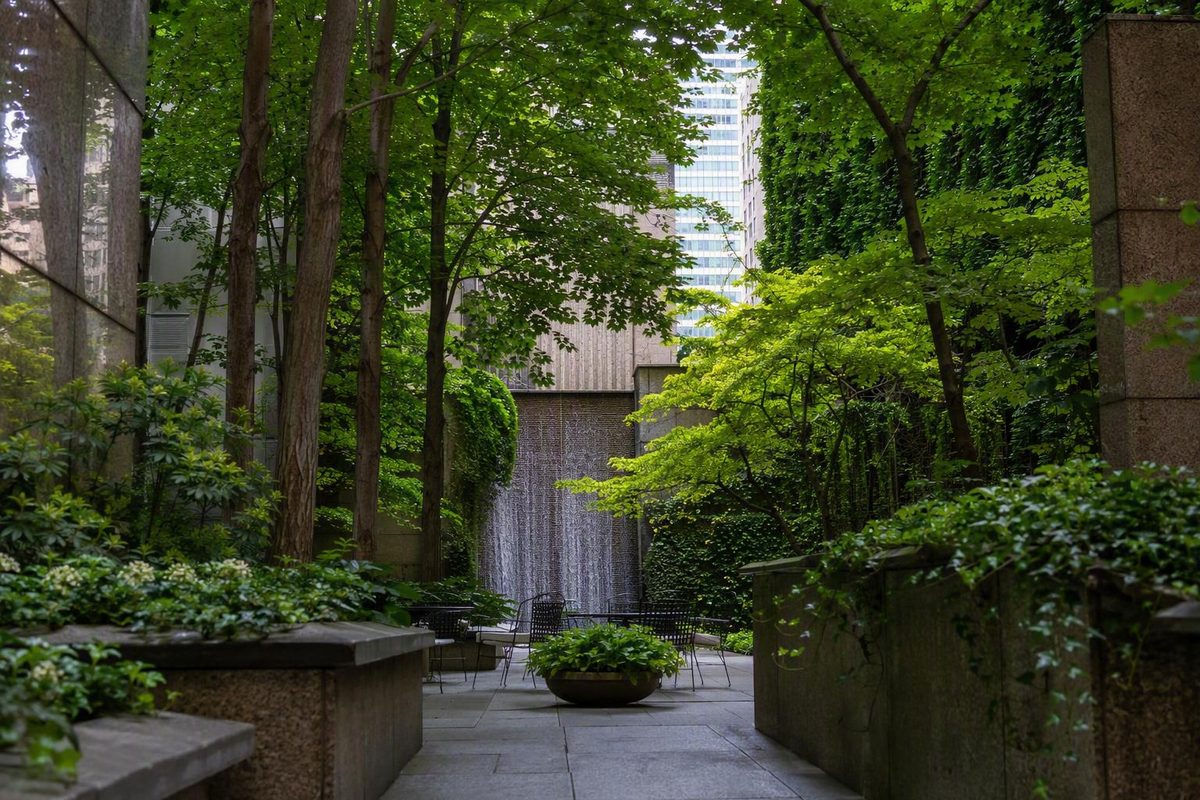
Greenacre Park at a glance
Greenacre Park is a small, publicly accessible but privately maintained vest-pocket park in Manhattan. Its street entrance is at 217 East 51st Street, between Second and Third Avenues. The area may be described as Midtown East or Turtle Bay, so the officially listed street address is the most useful guide.
The park’s defining feature is a rear cascade approximately 25 feet high, surrounded by planting and seating arranged across several levels. Greenacre Park opened in 1971 and is privately funded and maintained by the Greenacre Foundation while remaining publicly accessible, according to the Cultural Landscape Foundation’s park history.
Think of Greenacre Park as a place to sit rather than a conventional recreational park. Its documented design centers on terraces, movable furniture, planting, and water—not on an extensive walking route or active recreation. It works well for reading, talking with a companion, studying the landscape, or taking a short break between other Midtown stops.
Practical snapshot
- Address: 217 East 51st Street, between Second and Third Avenues
- Nearby subways listed by the park: 6 to 51st Street; E or M to Lexington Avenue–53rd Street
- Hours shown online: Summer hours of 8 a.m. to 8 p.m. daily
- Best role in an itinerary: A flexible seated break during a Midtown East walk
- Confirm before relying on them: Current seasonal hours, closures, admission terms, step-free access, restrooms, waterfall operation, and food service
A simple suitability test can help:
- Prioritize it if you will already be in Midtown East or Turtle Bay.
- Add it when you want a seated pause rather than another major attraction.
- Make time for it if you are interested in landscape architecture or inventive uses of constrained urban space.
- Treat it as optional if reaching it would require a substantial cross-city detour.
- Plan another setting if you need active recreation, a long walk, or facilities that must be available.
Conditions can vary with weather, season, nearby activity, and the number of visitors. The waterfall was designed to help screen traffic noise, but that does not guarantee silence. Movable seating may be occupied, and sun and shade shift across the terraces.
Greenacre Park is therefore most worthwhile when it fits the geography of your day. Its appeal is not scale or a long list of activities. It is a distinctive, low-commitment pause on East 51st Street.
Address, subway access, and hours to verify
Greenacre Park’s street-level entrance is at:
217 East 51st Street Between Second and Third Avenues New York, NY
The entrance is on East 51st Street rather than on either avenue. If you are approaching from Lexington Avenue or another Midtown stop, walk east along 51st Street and look for the park opening between the surrounding buildings.
The park lists these subway approaches:
- 6 train to 51st Street
- E or M train to Lexington Avenue–53rd Street
The official Greenacre Park visit page provides the address and subway options and displays summer hours of 8 a.m. to 8 p.m. daily.
Those are explicitly summer hours, not a documented year-round schedule. The same page contains a Labor Day closure notice without identifying the year, so it should not be treated as notice of a current or upcoming closure.
Check the official park website shortly before visiting. This is especially important if the park is central to your plans or if you need to arrive near opening or closing time. Published hours do not by themselves confirm holiday access, temporary maintenance closures, food service, or operation of the waterfall.
The most resilient approach is simple:
- Include the park in a Midtown East walking route.
- Check the official website on the day of your visit.
- Stop if it is open and conditions suit you.
- Continue to the next part of your neighborhood itinerary if access has changed.
This limits unnecessary backtracking. The listed subway stations bring you into the broader area, but the final approach still requires a walk along Midtown streets. The available park information does not establish current bus guidance, so use a live transit planner if you prefer to arrive by bus.
What the park feels like: waterfall, terraces, and seating
Greenacre Park unfolds as a sequence rather than presenting itself as one flat plaza. From East 51st Street, the entrance leads toward a central sitting area. Water appears along a relief wall, trickles into a narrow runnel, and then culminates in the rear cascade.
The main waterfall descends approximately 25 feet over a granite face and forms the park’s visual anchor. Sasaki describes the cascade as both a focal point and a sound screen against traffic, but that is a design function rather than a measured promise of noise reduction. The firm’s Greenacre Park project description also documents the water route, multilevel seating, planting, trellises, lighting, acrylic domes, and radiant heating.
The layout includes several distinct areas:
- a central sitting area near the entrance;
- broad steps and seating walls;
- a lower area close to the main water display;
- a higher terrace overlooking the garden;
- planted edges that help separate one zone from another.
Movable tables and chairs are important to the park’s operation. Instead of being limited to fixed benches, visitors can choose among available seating areas and adjust movable furniture where permitted. That flexibility accommodates different uses, from reading alone to sitting with a companion.
The built and planted details contribute to the sense of enclosure. Honey locust trees create a light canopy, while evergreen plants help give the landscape structure. Seasonal flowers introduce changing color. Trellises frame parts of the site, and the higher terrace includes acrylic domes and radiant heating as built design elements.
None of these features guarantees a particular condition during your visit. Trees do not ensure that every chair will be shaded. Covered areas do not make the park fully weatherproof, and the presence of radiant heating does not establish when it operates or how warm a terrace will feel.
The changes in elevation are central to the experience. They separate the entrance from the interior, bring some visitors closer to the water, and create an overlook from above. Planting reinforces these divisions, allowing a constrained site to feel like a short series of outdoor rooms.
On a first visit, let the design reveal itself:
- Notice the transition from sidewalk to park.
- Look at how the central seating area is organized.
- Follow the relief wall and runnel deeper into the site.
- Compare the viewpoints created by steps and terraces.
- Approach the rear cascade as the visual conclusion.
- Look back across the garden from the higher level if that route is suitable for you.
The lower area creates the closest relationship to the water, while the elevated terrace provides a broader view. Neither is automatically the best place to sit. Availability, weather, sound, and personal mobility needs should determine your choice.
Published measurements for the site conflict, so it is better not to assign one definitive square-foot total. What visitors can safely expect is a compact landscape that creates variety through water, vertical change, planting, and separate seating zones.
How to use Greenacre Park during a Midtown day
Treat Greenacre Park as a flexible break rather than an attraction with a required duration. You may be satisfied after a short look at the waterfall, or you may remain longer if a comfortable seat is available and the stop fits naturally between other plans.
Useful ways to spend the visit include:
- sitting and reading;
- talking with a companion;
- resting between Midtown destinations;
- observing the landscape design;
- eating, if current rules and arrangements allow;
- waiting briefly before a nearby appointment or reservation.
There is no need for an elaborate checklist. Enter, look for an available chair or table, choose the level that works for you, and follow the path of the water through the site. Leave when you are ready to resume your neighborhood walk.
A design-focused visitor can take a more deliberate approach. Begin with the relationship between the sidewalk and entrance. Then study the central seating area, the relief wall, and the runnel directing attention toward the rear. Compare the immediate experience near the lower waterfall area with the wider view from the elevated terrace. The sequence demonstrates how designers can divide a tight site without relying on solid interior walls.
Lunch is a natural time to stop, but it may also bring heavier use. Sasaki’s project account refers to broad steps and seating walls accommodating visitors during peak periods such as lunch hour. That describes the park’s intended use, not current crowd data or a guarantee that another time will be empty.
If sitting matters more than occupying a particular terrace, let availability guide you. A chair on another level may provide a different but equally useful perspective. If no suitable seat is open, a brief look at the water may be preferable to waiting for an ideal table.
Do not make the park’s food service essential to your meal plan without confirming that it is operating. Bringing food from elsewhere may be a practical alternative, but the supplied evidence does not establish the current policy on outside food.
Greenacre Park fits most naturally into an area-based day:
- shortly after arriving in Midtown East;
- between nearby indoor stops;
- as a pause after lunch;
- before leaving the neighborhood by subway;
- as part of a design-oriented look at small urban spaces.
This walking-first approach reflects a broader strategy of grouping sights by area rather than repeatedly crossing the city. If your route already passes near East 51st Street, the park adds texture without disrupting the day. If you are far downtown, on the West Side, or in another borough, the transit required for a short seated stop may outweigh its practical value.
That does not diminish the design. It clarifies the park’s most useful role: a close-range experience that changes the pace of a Midtown walk.
Amenities and access details that remain uncertain
The key distinction is between documented physical features and changeable operating details.
The physical landscape is well established. Greenacre Park has multiple levels, broad steps, terraces, movable tables and chairs, planting, trellises, water features, and protected seating areas. The supplied evidence is less complete about how every visitor amenity currently operates.
Here is what should be confirmed if it is essential to your visit:
| Detail | What the evidence establishes |
|---|---|
| Food service | A snack bar, café, or kiosk has been reported, but current operation, identity, hours, and menu are not established. |
| Step-free access | The park has multiple levels and broad steps, but the evidence does not document a step-free entrance or circulation among all terraces. |
| Restrooms | Availability is not established. |
| Waterfall operation | The cascade is a permanent design feature, but no authoritative year-round or daily operating schedule is supplied. |
| Visitor policies | Current rules for pets, outside food, laptops, tripods, professional photography, and groups are not established. |
| Admission | Public accessibility is documented, but the available official material does not explicitly state current admission terms. |
Food service illustrates the difficulty. Historical and visitor-oriented accounts use terms including snack bar, café, and kiosk, sometimes with different business names. A local Greenacre Park profile describes a kiosk, but it has no publication date and does not verify present operation. Do not rely on any previously reported menu.
Accessibility also requires specific rather than general questions. The park’s elevation changes are fundamental to its design, and the supplied descriptions do not establish wheelchair circulation between the central, lower, and upper areas. If step-free access is essential, ask the park whether the street entrance is step-free, which seating level can be reached without stairs, and whether the waterfall is visible from that route.
Plan as though a restroom may not be available unless the park confirms otherwise. Likewise, public accessibility does not automatically establish rules for pets, equipment, outside food, working on a laptop, commercial photography, or organized gatherings.
These unknowns need not prevent a casual look during a Midtown walk. They matter when a particular condition is necessary. In that case, consult the official site or contact the park before setting out rather than relying on an older visitor report.
The history behind the pocket park
Greenacre Park opened in 1971. It originated through philanthropist Abby Rockefeller Mauzé and the Greenacre Foundation, which privately funds and maintains the park while allowing public access.
The project belongs to a period when designers were exploring how small urban sites could provide meaningful public space. Greenacre Park is commonly described as a Modernist vest-pocket park: a compact designed landscape inserted into Manhattan’s dense built environment rather than a large park intended for conventional recreation.
Its historical interest lies in the sophistication of that response. The design does not attempt to reproduce a meadow or a miniature version of a major city park. Instead, it uses the limitations of the site. Changes in level extend the sequence of movement, water creates a destination and sensory focus, planting filters views, movable furniture supports flexible use, and terraces establish different relationships to the street and cascade.
Design credit is collaborative. The landscape is associated with Sasaki, Dawson, DeMay Associates. The Cultural Landscape Foundation identifies Masao Kinoshita as lead designer, with Hideo Sasaki and Tom Wirth involved. The evidence therefore does not support attributing the entire design to Hideo Sasaki alone.
Greenacre Park was modeled in part on nearby Paley Park, but it developed its own arrangement of terraces, water channels, planting, overlooks, and a sunken rear cascade. The entrance-to-waterfall sequence makes the park a composition to move through rather than a single open court.
In 2018, Greenacre Park was added to the National Register of Historic Places. The Cultural Landscape Foundation profile documents the opening year, collaborative design attribution, private maintenance, landscape features, and National Register listing.
That listing gives the park formal historic recognition. Without the underlying registration documentation, however, it would be inappropriate to invent a detailed account of the designation criteria. For visitors, the relevant point is that this is a recognized designed landscape rather than leftover space between buildings.
Sources also disagree about the park’s precise area. Published square-foot totals do not align neatly with commonly stated dimensions, so no single figure should be treated as definitive. Its significance rests not on acreage but on the spatial variety created within a constrained Manhattan site.
How Greenacre Park relates to Paley Park
Greenacre Park and Paley Park are frequently discussed together because Greenacre was modeled in part on the earlier park. Both are small Midtown urban spaces associated with waterfalls and movable seating.
The comparison is useful for visitors interested in landscape design, but the two parks should not be treated as interchangeable. Water appears before the main cascade, moving from a relief wall into a runnel. Seating is distributed across central, lower, and elevated areas, while a protected overlook creates another relationship to the garden.
Project for Public Spaces describes Greenacre as larger than Paley Park and as containing more varied or secluded areas. That is an organization’s comparative assessment rather than a universal visitor judgment, but it highlights the practical effect of Greenacre’s terraces. The comparison appears in its overview of Greenacre Park and other New York public spaces.
Greenacre’s distinctive sequence includes:
- the transition from East 51st Street;
- the central seating terrace;
- the relief wall and narrow runnel;
- broad steps and seating walls;
- the lower area near the water;
- evergreen and seasonal planting;
- the elevated protected overlook;
- the rear cascade.
Visiting both parks can create a compact Midtown design theme. Rather than asking which is objectively better, compare how each handles similar constraints. Consider the waterfall’s relationship to the entrance, how quickly the full site becomes visible, how movable chairs affect use, and whether the space reads as one outdoor room or several.
A paired visit is optional. It makes the most sense if you are already exploring Midtown or have a specific interest in public-space design. Verify each park’s access information independently; their hours, rules, ownership arrangements, and waterfall schedules should not be assumed to match.
Why sunlight and surrounding development matter
Sunlight is integral to the experience of a small park enclosed by taller buildings. Greenacre Park depends on relationships among filtered light, tree canopy, evergreen structure, seasonal flowers, water, and terraces at different elevations. A substantial change in surrounding shadows could affect both planting conditions and the visitor experience.
That does not mean the park is always sunny. Buildings, trees, weather, season, and time of day all influence the conditions on any particular visit. Some terraces may receive filtered light while others remain shaded, and those patterns can change during the day.
Debate over the park’s sunlight and surrounding development extends back decades. During discussion of the 2017 Greater East Midtown rezoning, competing studies reportedly reached different conclusions: a city study found no adverse effect, while a Greenacre Foundation-commissioned study projected severe shadow effects from development on several sites. This account comes from a secondary historical summary of the dispute, not from the underlying studies.
Neither conclusion should be presented as settled fact. Shadow projections depend on assumptions about building envelopes, locations, seasons, times of day, and what is ultimately constructed. A severe-impact projection does not by itself establish that the park will become completely dark.
The Cultural Landscape Foundation labels Greenacre Park “at risk,” but the supplied profile does not establish a specific current construction project threatening the park. The designation is reason to pay attention to the relationship between the landscape and its setting, not evidence of a current closure or access problem.
For visitors, the practical conclusion is limited: sunlight and shade will vary. Historical development disputes do not show that Greenacre Park is currently closed, unsafe, or inaccessible.
Greenacre Park is best approached as a focused neighborhood stop rather than a headline attraction. If your Midtown East route passes near East 51st Street, the waterfall and layered landscape offer a distinctive place to pause without breaking the flow of the day. Before relying on the stop, verify current hours and any essential needs involving access, restrooms, waterfall operation, or food service.
Is Greenacre Park free and open to the public?
Greenacre Park is publicly accessible but privately funded and maintained by the Greenacre Foundation rather than operated as a New York City municipal park. The supplied official material does not explicitly state current admission terms, so this guide cannot confirm a guaranteed free-admission policy. Check with the park if admission conditions are important to your plans.
What are Greenacre Park’s current opening hours?
The official Greenacre Park homepage displays summer hours of 8 a.m. to 8 p.m. daily. It does not provide a complete year-round schedule, and the displayed Labor Day notice does not identify a year. Verify hours and closures immediately before visiting.
Does the Greenacre Park waterfall operate year-round?
That is not confirmed. The waterfall is a permanent and central design feature, but the available sources do not provide an authoritative year-round or daily operating schedule. Weather, maintenance, seasonal practices, or mechanical conditions could affect operation. Contact the park if seeing the cascade running is essential.
Is Greenacre Park wheelchair accessible?
The available evidence does not establish full wheelchair accessibility. The park has multiple terraces, elevation changes, broad steps, and upper and lower seating areas, but the supplied descriptions do not identify a step-free entrance or document an accessible route among all levels. Ask the park about the specific entrance, terrace, and viewpoint you need.
Can I buy food or coffee inside Greenacre Park?
Food service has existed or been reported, but current operation is uncertain. Sources variously describe a snack bar, café, or kiosk and do not establish a reliable present-day schedule, identity, or menu. Confirm directly with the park before depending on food or coffee being available, and keep an alternative nearby.