 New York Know
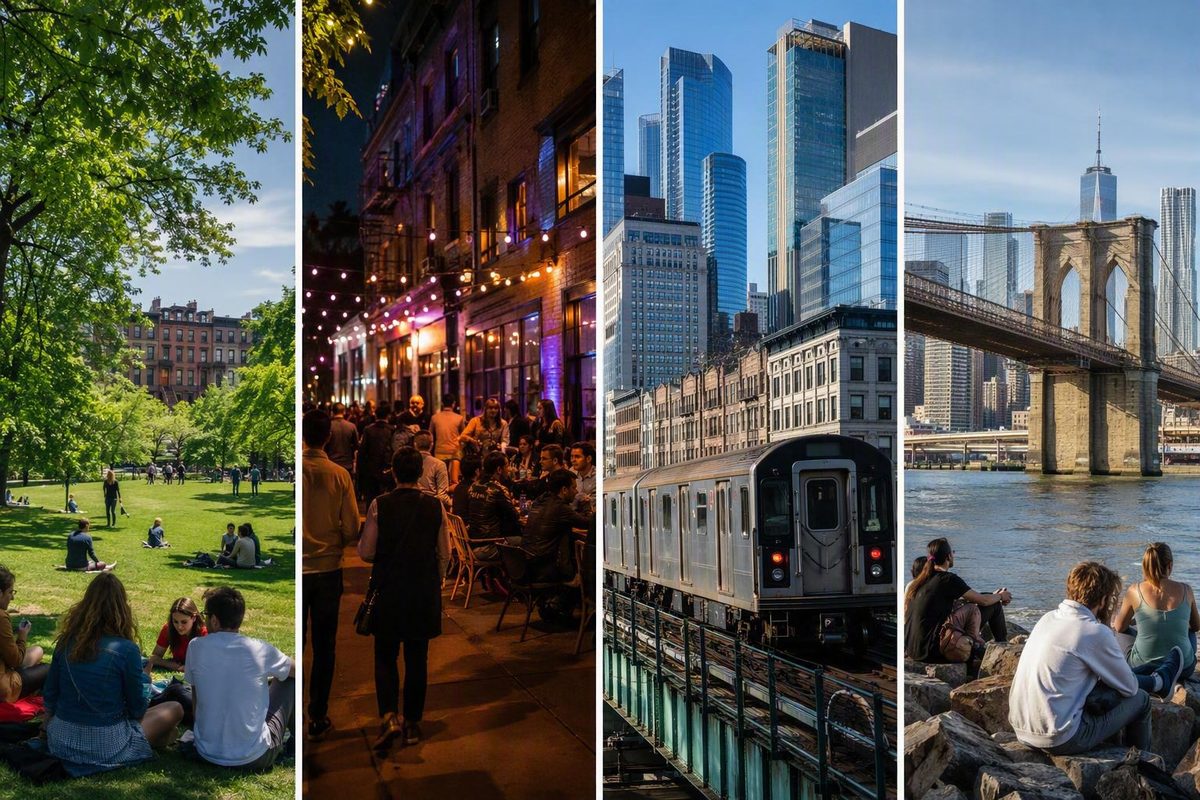
There is no single winner among the nice neighborhoods in Brooklyn. The right choice depends on the experience you want and the journeys you expect to make each day.
Park Slope works well for Prospect Park and a residential pace. Brooklyn Heights combines historic streets, waterfront walking, and convenient Manhattan connections. Williamsburg favors restaurants and nightlife. Downtown Brooklyn emphasizes transit utility. DUMBO offers waterfront scenery and converted industrial character. Fort Greene, Prospect Heights, Cobble Hill, Carroll Gardens, Greenpoint, Bedford-Stuyvesant, and Crown Heights each offer a different balance of architecture, culture, food, and location.
This guide compares those 12 well-known options primarily for visitors. It can also help prospective residents create an initial shortlist, but neighborhood descriptions cannot replace current address-level research into housing, schools, accessibility, safety, building condition, or everyday services.
Transit details here are planning cues rather than live-service information. Routes, station conditions, ferry operations, and accessibility features can change, so confirm them before booking or traveling.
What “Nice” Means in Brooklyn—and Why This Is Not a Ranking
Calling a neighborhood “nice” is useful only after defining what matters to you. One visitor may want tree-lined streets and a major park. Another may prefer restaurants, bars, and music within a short walk. A third may care less about atmosphere than reaching several parts of Brooklyn and Manhattan without complicated transfers.
Use these criteria to make the choice more concrete:
- Street character: Brownstones, row houses, converted industrial buildings, glass towers, commercial avenues, or a mixture.
- Walking experience: Whether the neighborhood itself can sustain an enjoyable walk rather than functioning mainly as a place to sleep.
- Green or waterfront space: Access to Prospect Park, Fort Greene Park, Brooklyn Bridge Park, a promenade, or the East River waterfront.
- Dining and nightlife: The amount and intensity of nearby restaurant, bar, music, and evening activity.
- Housing and architecture: Older walk-ups and townhouses versus newer high-rise buildings, particularly for a longer stay.
- Transit usefulness: Not simply the nearest station, but whether its routes support your actual destinations.
- Noise tolerance: Exposure to nightlife, major roads, bridges, highways, loading areas, mechanical equipment, and construction.
- Trip purpose: A first New York visit, a Brooklyn-focused return trip, a neighborhood walking day, or an initial residential search.
No evidence establishes one objectively nicest Brooklyn neighborhood. Even a commercial real-estate comparison covering many of these areas describes “best” as subjective and dependent on household needs and budget, while warning that neighborhood-wide figures can conceal internal variation (Prospect Places’ Brooklyn neighborhood comparison).
It also helps to separate three different decisions.
Choosing a visitor base is largely a logistics problem. You need a suitable property, a useful station, and a location that supports your itinerary. A beautiful area can still be a poor base if every day begins with a long walk and several transfers.
Choosing an area for a walking day is an experience problem. You want enough architecture, food, parks, shops, or cultural stops to fill several hours without unnecessary subway rides. The strongest walking-day destination does not have to be the strongest hotel district.
Creating a residential shortlist is a deeper housing problem. The neighborhood can narrow the search, but the building and block often determine whether a home works. Apartment condition, stairs or elevator access, groceries, commuting, school zone where relevant, and current official safety information all require separate investigation.
Visitor appeal does not establish long-term residential quality. A hotel beside nightlife may be convenient for a weekend and exhausting over a longer stay. A quiet brownstone block may be delightful on a walk but too far from the right train for a daily commute. Conversely, a transit-heavy district that feels hectic on vacation may be practical for someone who travels throughout the city.
The method in this guide is walking-first: choose a base near the places that matter, group nearby sights into compact days, and use transit for necessary transitions instead of repeatedly crossing the city. That matches New York Know’s stated approach to practical, area-based trip planning.
Finally, treat promotional language cautiously. Much of the available neighborhood writing comes from brokerages, rental companies, lodging businesses, and tourism operators. These sources can help describe physical character and commonly perceived trade-offs, but labels such as “best,” “premium,” “charming,” and “authentic” remain judgments rather than objective findings.
Quick Match: The Best-Known Options by Trip Style
This matrix is a starting point, not a safety, school, cost, or overall quality ranking. Transit usefulness varies by address and destination, and all service should be checked against current travel information. The broad neighborhood descriptions align with a commercial buyer’s guide covering the same core group, but its favorable labels should be read as real-estate marketing rather than neutral rankings (Prevu’s Brooklyn neighborhood guide).
| Neighborhood | Strongest fit | Physical character | Nearby anchors | Transit posture | Likely energy | Principal trade-off |
|---|---|---|---|---|---|---|
| Park Slope | Park access and a residential walking day | Historic brownstones, Victorian housing, tree-lined side streets, active avenues | Prospect Park, Fifth and Seventh Avenues, Grand Army Plaza nearby | Several subway corridors; usefulness varies considerably by block | Calm on many residential streets, busier on commercial avenues | Large enough that the subsection and station walk matter |
| Brooklyn Heights | Historic streets, waterfront walking, and Lower Manhattan access | Federal-style houses, brownstones, prewar buildings | Brooklyn Heights Promenade, waterfront parkland | Several services are available within or near the area | Generally more restrained than nightlife districts | Commercial guides commonly position it as expensive |
| Williamsburg | Restaurants, bars, music, and North Brooklyn atmosphere | Low-rise streets mixed with newer waterfront development | Bedford Avenue area, waterfront spaces, entertainment venues | L and G corridors; convenience is strongest near the route you need | High around major nightlife corridors | Noise, market cost, and weaker positioning for scattered Brooklyn sights |
| Downtown Brooklyn | Broad transit access and a practical base | Dense, vertical, high-rise environment | Atlantic Terminal area, cultural venues and brownstone districts nearby | One of Brooklyn’s broadest clusters of onward connections | Busy and city-center-like | Less intimate street atmosphere than adjoining brownstone areas |
| DUMBO | Waterfront views, bridges, and photography | Cobblestones, converted industrial buildings, newer luxury housing | Brooklyn Bridge Park, Jane’s Carousel, bridge and skyline views | York Street subway access plus waterfront transportation options | Busy around scenic areas, less nightlife-centered | Premium market positioning and fewer subway choices than Downtown Brooklyn |
| Fort Greene | Performing arts, restaurants, park space, and centrality | Historic architecture and brownstone streets around busier edges | Fort Greene Park, Brooklyn Academy of Music | Benefits from nearby Downtown Brooklyn and Atlantic Avenue hubs | Residential streets mixed with active cultural areas | Classic brownstone inventory may be limited |
| Prospect Heights | Museums, park access, and a compact cultural day | Townhouses, co-ops, and newer condominiums | Brooklyn Museum, Brooklyn Botanic Garden, Grand Army Plaza | Several useful services around its boundaries | Active near major avenues and attractions, quieter inside | Station convenience changes by subsection |
| Cobble Hill | Compact brownstone streets and local dining | Lower-rise row houses and commercial strips | Court Street, Smith Street, Brooklyn Heights nearby | F/G corridor at Bergen Street, with more services at the edges | Relaxed but active around dining streets | Limited housing inventory and commercially described premium positioning |
| Carroll Gardens | A deeper neighborhood walk with restaurants and older housing | Brownstones with front gardens and low-rise commercial streets | Court and Smith Streets | F/G corridor; usefulness depends on north-south position | Neighborhood-focused, with dining rather than major nightlife | Some sections are closer to the BQE |
| Greenpoint | Food, neighborhood atmosphere, and a North Brooklyn stay | Brownstones, row houses, converted spaces, waterfront development | Restaurant corridors and waterfront areas | G-train and ferry access are commonly cited; the exact walk matters | Neighborhood-oriented, with pockets of evening activity | Connections can be less convenient from some addresses |
| Bedford-Stuyvesant | Brownstone architecture and local commercial corridors | Victorian brownstones, row houses, tree-lined residential streets | Multiple shopping and dining corridors | Different lines serve different edges and subsections | Varies substantially by avenue and block | Large area with significant variation in station distance and building condition |
| Crown Heights | Historic housing, active avenues, and central Brooklyn access | Brownstone and prewar streets mixed with major commercial corridors | Prospect Park and cultural institutions accessible from some sections | Different routes serve different portions | Active and varied | Too large and internally varied to judge by name alone |
For a farther-out alternative, consider Bay Ridge when space or relative value matters more than a short trip to Midtown. A commercial rental guide presents it as its value-oriented choice, but its price categories are informal and do not establish objective affordability. The more dependable trade-off is geographic: Bay Ridge sits farther from the central sightseeing and nightlife zones considered here, so test the complete journey before deciding that a lower advertised price compensates for the distance (Edge Realty’s renter comparison).
A first-pass shortlist might therefore look like this:
- Park Slope for Prospect Park and residential character.
- Brooklyn Heights for history, waterfront access, and Manhattan convenience.
- Williamsburg for restaurants and nightlife.
- Downtown Brooklyn for the widest range of onward connections.
- DUMBO for scenery and photography.
- Fort Greene or Prospect Heights for culture, architecture, and central access.
- Cobble Hill or Carroll Gardens for lower-rise brownstone streets and dining.
- Greenpoint for a North Brooklyn neighborhood stay, provided the transit walk works.
- Bed-Stuy or Crown Heights when a specific property and block—not merely the neighborhood label—fits the trip.
Park Slope, Prospect Heights, and Fort Greene: Parks, Culture, and Brownstone Streets
These three neighborhoods are useful comparisons for visitors who want green space, architecture, cultural institutions, and a day rooted in Brooklyn rather than organized around one landmark.
Park Slope lies along the northwestern edge of Prospect Park. Its visual identity is strongly associated with 19th-century brownstones, Victorian houses, and tree-lined blocks, while Fifth and Seventh Avenues provide much of its shopping and dining activity (Craig Yoskowitz’s Brooklyn neighborhood guides).
Park Slope is a strong all-around choice when Prospect Park is the main priority. It also suits travelers who prefer a residential rhythm to an entertainment district. That does not mean every street is quiet or that the neighborhood name establishes anything about schools or safety. Commercial avenues are more active, and two Park Slope addresses can produce very different walks to the park and subway.
A practical day might begin near Grand Army Plaza, continue into Prospect Park, and return through brownstone streets toward Fifth or Seventh Avenue. A route farther south would form a separate walking cluster. Treating all of Park Slope as one compact, interchangeable area usually understates its size.
Prospect Heights places several cultural attractions within a relatively compact itinerary. It is associated with walkable access to the Brooklyn Museum and Brooklyn Botanic Garden, while Grand Army Plaza and Prospect Park sit close to its western and southern edges. Its housing includes townhouses and co-ops alongside newer condominiums.
For a park-and-museum day, Prospect Heights may be the most efficient of the three. A visitor can concentrate on the museum or garden, pass through the Grand Army Plaza area, add time in Prospect Park, and finish along a nearby restaurant corridor without crossing the borough.
Its boundaries still matter. An address near Atlantic Avenue does not create the same immediate walking experience as one closer to Eastern Parkway or Grand Army Plaza. Choose according to the anchor you expect to use most often.
Fort Greene shifts the emphasis from major museums to performing arts, restaurants, and a neighborhood park. Fort Greene Park provides a green center, while the Brooklyn Academy of Music is a defining cultural anchor. Historic architecture, dining, and proximity to Downtown Brooklyn and the Atlantic Avenue area strengthen its appeal as a central walking base.
For prospective residents, classic brownstone supply on sought-after blocks may be constrained, according to a real-estate agent’s neighborhood assessment. That is an attributed market observation rather than a guarantee about current availability (Prospect Places’ Fort Greene assessment).
The simplest comparison is:
- Choose Park Slope when Prospect Park and residential street character matter most.
- Choose Prospect Heights when you want museums, the botanic garden, Grand Army Plaza, and park access in one compact area.
- Choose Fort Greene when performing arts, restaurants, park space, and central positioning carry more weight.
Although these areas appear close on a borough map, each can support its own walking cluster. Combining all three with Williamsburg, Greenpoint, or another distant destination in one day usually sacrifices the street-level experience that makes them appealing.
Brooklyn Heights, Cobble Hill, and Carroll Gardens: Historic, Lower-Rise Brooklyn Near Manhattan
Brooklyn Heights, Cobble Hill, and Carroll Gardens create one of Brooklyn’s most coherent multi-neighborhood walks. Together they offer historic housing, lower-rise streets, restaurants, and useful access toward Lower Manhattan. They are generally a better match for architecture and local dining than for a nightlife-first trip.
Brooklyn Heights is the most waterfront-oriented and Manhattan-connected of the three. Its housing includes historic brownstones, Federal-style houses, and prewar apartment buildings. Tree-lined streets lead toward the Brooklyn Heights Promenade and the waterfront below, creating a strong contrast between residential blocks and open views.
Several subway services are available within or near the neighborhood, depending on the exact edge. Commercial guides also consistently characterize Brooklyn Heights as an expensive or premium market; that is a broad market tendency, not proof that every room or apartment costs more than every alternative (Prevu’s Brooklyn neighborhood guide).
Cobble Hill sits beside Brooklyn Heights and Downtown Brooklyn. It is compact and primarily lower-rise, with residential streets leading toward restaurants and shops. Supplied neighborhood guides identify F and G service at Bergen Street, while nearby Downtown Brooklyn broadens the range of possible connections. Confirm current service before relying on a specific route.
For visitors, Cobble Hill can provide a more residential setting without feeling detached from commercial activity. Court Street, Smith Street, Brooklyn Heights, and parts of Downtown Brooklyn can form one broad walking day.
Residential readers should expect a small market in which comparable properties may be limited. One real-estate guide specifically describes Cobble Hill inventory as constrained and places its housing in a high-cost central Brooklyn cluster (Craig Yoskowitz’s Brooklyn neighborhood guides). Older brownstone housing can also involve stairs, varied layouts, and fewer building amenities, although those features must be evaluated property by property.
Carroll Gardens extends the lower-rise character farther south. Brownstones with front gardens distinguish many residential streets, while the neighborhood’s Italian-American heritage remains visible in restaurant and bakery traditions. Court and Smith Streets form the principal commercial spine and connect naturally toward Cobble Hill.
Carroll Gardens feels more like a destination in itself than an extension of Downtown Brooklyn. That can suit visitors who want dinner near their accommodation rather than returning from Manhattan only to sleep. The trade-off is that transit convenience changes with north-south position, and a commercial neighborhood assessment notes that some sections are closer to the BQE.
A visitor-focused sequence could begin with waterfront views in Brooklyn Heights, continue south through residential streets into Cobble Hill, and finish around Court or Smith Street in Carroll Gardens. A Brooklyn hotel guide similarly groups these areas around appealing streets, shopping, and dining, while warning that a desirable location does not guarantee room quality or value (New York Like a Native’s Brooklyn hotel guidance).
The distinctions are straightforward:
- Brooklyn Heights: Waterfront walking, historic architecture, and convenient Lower Manhattan access.
- Cobble Hill: Compact residential streets close to Downtown Brooklyn and adjoining brownstone areas.
- Carroll Gardens: A deeper neighborhood atmosphere centered on Court and Smith Streets.
Choose this trio over Williamsburg when historic streets and a relaxed dinner matter more than late-night venues. Choose it over Park Slope when waterfront walking and Lower Manhattan access matter more than being beside Prospect Park.
Williamsburg and Greenpoint: Food, Nightlife, and a North Brooklyn Stay
Williamsburg and Greenpoint make the most sense when North Brooklyn is a substantial part of the trip—not merely where you sleep after sightseeing elsewhere.
Williamsburg has the stronger nightlife and entertainment profile. Restaurants, bars, breweries, shops, parks, and music venues sit among low-rise housing and newer waterfront condominiums. Commercial neighborhood guides associate it with both L and G service, with the L providing direct access to Manhattan’s 14th Street corridor.
That connection can be useful, but it should not be confused with universal Manhattan convenience. A destination far north, far south, or across town may still require transfers and additional walking. Williamsburg works best when the trip concentrates on North Brooklyn and Manhattan areas that align reasonably with the available route.
Noise-sensitive travelers should inspect the exact hotel or apartment location. A furnished-rental guide notes that the Bedford Avenue corridor can remain active late because of nearby bars and restaurants (The Best Furnished’s visitor-neighborhood comparison).
Not all of Williamsburg has the same energy. A waterfront property, a room near Bedford Avenue, and accommodation near a major road or industrial edge can produce different experiences. Recent property reviews, room orientation, and the actual station walk matter more than a general promise that a hotel is “in Williamsburg.”
Greenpoint offers a related but distinct North Brooklyn option. Brownstones and row houses remain part of its housing character, while restaurants, newer development, and converted spaces create a mixed streetscape. It also has a longstanding Polish community and is commonly associated with G-train and ferry access.
Greenpoint can suit travelers who want food and a neighborhood-focused stay without making Williamsburg’s nightlife concentration the center of the trip. The practical question is the address. Accommodation close to a useful station or ferry landing may work well; a long walk before every journey may feel inconvenient, particularly in poor weather or late at night.
A ferry can be an enjoyable part of the trip, but it should not replace checking the whole journey. The walk to the landing, service schedule, weather, and destination-side connection all matter.
The comparison comes down to priorities:
- Choose Williamsburg for stronger nightlife, a denser restaurant and entertainment scene, and direct access toward Manhattan’s 14th Street corridor.
- Choose Greenpoint for a more neighborhood-centered North Brooklyn stay, while paying close attention to the walk to transit.
- Choose Downtown Brooklyn instead when your itinerary is spread among Prospect Park, museums, brownstone neighborhoods, Lower Manhattan, and other parts of the city.
Williamsburg is often a stronger match for a returning visitor prioritizing atmosphere than for a first-time traveler attempting a Manhattan-heavy sightseeing schedule. One accommodation guide makes that distinction explicitly, recommending it mainly to returning visitors who want time to explore and linger rather than maximize access to major sights (Go Ask a Local’s NYC accommodation guide).
DUMBO and Downtown Brooklyn: Waterfront Scenery Versus Transit Utility
DUMBO and Downtown Brooklyn are adjacent but solve different visitor problems. DUMBO provides a memorable setting. Downtown Brooklyn provides a broad transportation base.
DUMBO stands for “Down Under the Manhattan Bridge Overpass.” Converted industrial buildings, cobblestone streets, luxury condominiums, and waterfront public spaces shape much of its physical character. Its best-known visitor features include Manhattan Bridge perspectives, skyline views, Brooklyn Bridge Park, and Jane’s Carousel.
That makes DUMBO an obvious candidate for photography and waterfront walking. It is also easy to combine conceptually with Brooklyn Heights: begin near the water, continue through waterfront parkland, climb toward the promenade, and finish among the residential streets above.
Commercial visitor guides identify the F at York Street as DUMBO’s principal subway connection and also note ferry access. Treat those details as starting points for route planning, not as live-service confirmation. Any quoted train time excludes at least some combination of the station walk, waiting, transfers, disruptions, and the final walk.
DUMBO is commonly presented by real-estate and furnished-rental publishers as a premium or luxury-oriented area. That framing reflects its housing and tourism profile but does not establish a universal price rank. Compare actual properties and dates rather than assuming the neighborhood name determines value.
Downtown Brooklyn is denser and more vertical. High-rise residential and commercial development, colleges and universities, heavy street activity, and numerous subway connections give it the feel of an urban center rather than a brownstone enclave. The Atlantic Terminal and Atlantic Avenue–Barclays Center area adds further transportation options.
For visitors, that network can make Downtown Brooklyn more practical than DUMBO. It can support trips toward Manhattan, Prospect Park, the Brooklyn Museum area, Fort Greene, and nearby brownstone neighborhoods. A traveler with varied daily destinations may benefit more from route choice than from staying directly beside the waterfront.
For a longer stay, Downtown Brooklyn also offers more newer high-rise housing than many nearby historic districts. The trade-off is atmosphere: large buildings, busy roads, retail corridors, and crowds create a more intense environment. Travelers picturing quiet brownstone streets may prefer Brooklyn Heights, Fort Greene, Cobble Hill, or another adjoining lower-rise area.
A useful way to frame the choice is:
- DUMBO is the experience choice: Waterfront walking, bridges, photography, views, and industrial architecture.
- Downtown Brooklyn is the utility choice: Multiple onward routes, newer high-rise lodging or housing, and access to varied destinations.
Do not expect Downtown Brooklyn to provide the same street atmosphere as DUMBO or Brooklyn Heights. It works best as a transport base or transition point. DUMBO works particularly well as part of a walking day paired with Brooklyn Heights, but its scenic position does not make every other destination effortless to reach.
Bed-Stuy and Crown Heights: Character-Rich Areas Where Micro-Location Matters
Bedford-Stuyvesant and Crown Heights often enter the conversation as alternatives to Brooklyn’s most famous visitor districts. Both contain historic housing, active commercial corridors, and access to transit, but both are too large and internally varied for a neighborhood-wide verdict.
Bedford-Stuyvesant, usually shortened to Bed-Stuy, has a historically significant African-American community and a substantial stock of Victorian brownstones. Tree-lined residential streets sit between shopping and restaurant corridors, creating meaningful changes in atmosphere from one avenue or subsection to another.
That architecture can appeal to visitors interested in brownstone Brooklyn beyond the heavily photographed western neighborhoods. It may also interest prospective residents seeking a particular housing type. Neither point means the area is uniformly inexpensive, quiet, or convenient.
Different sections relate to different subway routes, and station distance can change the usefulness of an otherwise appealing property. Accommodation on Atlantic Avenue may offer a noticeably different experience from a room on an interior residential block. Traffic, immediate street activity, building condition, and the walk home all require separate evaluation.
Crown Heights is similarly difficult to summarize. It is a large, active, varied neighborhood with historic housing and substantial commercial activity. Different subsections do not have identical relationships to subway routes, Prospect Park, or the museum and garden corridor.
An address near a useful station or major avenue may work well for a visitor. Another property under the same neighborhood label may add a long station walk or sit much farther from the planned itinerary. The name alone reveals little about the complete experience.
Commercial guides often frame Bed-Stuy and Crown Heights as combinations of neighborhood character, activity, and transit. Their price claims should not be combined into a simple affordability hierarchy because the sources use different dates, unit types, methods, and boundaries. Historic architecture and internal variation are more dependable conclusions than any universal value ranking.
For visitors:
- Evaluate the specific hotel or short-stay property, not merely the neighborhood.
- Map the walk to the station you will actually use.
- Check whether that route supports both morning and evening destinations.
- Read recent reviews for building condition and room-specific noise.
- Inspect the immediate street context on a current map and, where possible, in person.
For prospective residents, compare like with like: similar unit types, building categories, observation periods, and subsections. A renovated condominium, a brownstone rental, and an older walk-up are not interchangeable products.
Neither Bed-Stuy nor Crown Heights should receive a universal safety, affordability, or value label. The useful conclusion is narrower: either can be a strong candidate when the exact property, block, station, and daily journey work.
How to Choose the Exact Block, Hotel, or Apartment
Once you have a neighborhood shortlist, stop comparing names and start comparing addresses. The final decision should be based on where you will go, how you will get there, and what the immediate block is like when you will use it.
1. Start with the real daily destination
Write down the place you expect to reach most often:
- Lower Manhattan
- Midtown East
- Midtown West
- North Brooklyn
- Prospect Park
- A specific workplace, school, venue, or family address
“Convenient to Manhattan” is too vague. Midtown East and Midtown West can favor different subway corridors, and two addresses in the same Brooklyn neighborhood can produce materially different door-to-door journeys because of station choice, direction, and walking distance (Revived Residential’s Midtown commute guide).
Identify the relevant routes before comparing properties. Then examine the station entrances and actual walking path rather than relying only on the station name.
2. Test the complete journey
A selected train-running time is not a commute. Include:
- The walk from the building to the station
- Any stairs, elevators, or escalators you need
- Waiting time
- Transfers and in-station walking
- Weekend or late-night changes
- The final walk from the destination station
- A margin for disruption
If accessibility matters, confirm the current status of every station and transfer point you intend to use. Do not assume the closest entrance provides the features you need.
Visitors should test at least one representative trip at approximately the time they expect to make it. A route that appears simple at midday may work differently early in the morning, late at night, or on a weekend.
3. Visit three times when considering a longer stay
Inspect the block:
- In daytime
- During the expected commute period
- In the late evening
Daytime reveals the basic street environment and nearby services. Commute time shows traffic, crowding, deliveries, and the practical station walk. Evening reveals whether restaurants, bars, loading areas, traffic, or other activity fit your noise tolerance.
One open-house visit is not enough to understand a residential block. Likewise, a hotel exterior viewed on a quiet afternoon may say little about Friday-night sound.
4. Identify immediate noise sources
Look for bars, major traffic corridors, bridges, highways, loading bays, service entrances, outdoor seating, mechanical equipment, and visible construction. Ask which direction the room or apartment faces.
A rear-facing room may differ from one above a commercial avenue, but orientation alone is not a guarantee. Building construction, neighboring equipment, courtyards, and internal sound transmission can all affect the result.
5. Evaluate the property separately from the neighborhood
A good neighborhood cannot guarantee a good room, apartment, or value.
For a hotel or short stay:
- Read recent reviews instead of relying only on the overall score.
- Search for comments on noise, elevators, heating or cooling, cleanliness, and room size.
- Confirm the exact address.
- Check cancellation terms.
- Compare the room category you will actually book.
- Verify current booking and operating information directly with the property and relevant official channels.
For a residential move:
- Compare current rents or sale prices for the same unit and building type.
- Inspect the building and apartment condition.
- Confirm stairs, elevator access, doorway widths, and other accessibility needs.
- Map groceries, pharmacies, laundry, healthcare, and everyday services.
- Verify the school zone and current enrollment rules if relevant.
- Consult current official safety information for the precise area.
- Ask about construction, building work, pests, heating, cooling, sound transmission, and maintenance.
- Test the actual commute.
6. Map one realistic day from each candidate base
This is the strongest final filter. Build a day you are genuinely likely to follow.
From Park Slope, a coherent day might combine Prospect Park, Grand Army Plaza, the museum area, and dinner nearby. From Brooklyn Heights, combine the promenade, DUMBO, waterfront parkland, and Lower Manhattan. From Williamsburg, build around North Brooklyn and destinations reasonably aligned with the L rather than forcing a distant park, museum, and uptown attraction into one schedule.
New York Know’s walking-first Lower Manhattan itinerary illustrates the broader planning principle: choose a clear area, let the route progress naturally, and avoid zigzagging among unrelated stops.
Reject a candidate base if a realistic itinerary forces repeated cross-borough or cross-city trips. A less famous area near the right route may serve you better than a celebrated neighborhood positioned against your plans.
The final decision comes down to three steps:
- Choose the Brooklyn experience you want.
- Identify the transit routes and daily destinations that support it.
- Test the exact block at the times you will use it.
That produces a conditional rather than universal shortlist: Park Slope for park-centered residential character, Brooklyn Heights for history and Manhattan access, Williamsburg for dining and nightlife, Downtown Brooklyn for transit, DUMBO for waterfront scenery, and Fort Greene or Prospect Heights for culture and centrality.
Once you choose, build compact days around the base. Brooklyn rewards depth more than a schedule spent zigzagging across New York.
What is the nicest neighborhood in Brooklyn for first-time visitors?
There is no universal winner. Brooklyn Heights is a strong choice when historic streets, waterfront walking, and Lower Manhattan access matter. Downtown Brooklyn is often more practical when the itinerary includes many different Brooklyn and Manhattan destinations. DUMBO suits visitors prioritizing views and photography, although its transportation choices are narrower than Downtown Brooklyn’s.
If the trip is heavily focused on central Manhattan landmarks, test the complete journey before committing to any Brooklyn base. Williamsburg may be more satisfying for a returning visitor seeking neighborhood atmosphere than for a first-time visitor with a packed Manhattan schedule.
Which Brooklyn neighborhood is best for nightlife and restaurants?
Williamsburg is the clearest first choice among the neighborhoods covered here. It has a strong concentration of restaurants, bars, breweries, music venues, and evening activity.
Choose the exact location carefully if you are sensitive to noise. Greenpoint is an alternative for food and North Brooklyn atmosphere, although convenience depends on the station or ferry walk. Fort Greene is worth considering when you want restaurants and cultural venues without making nightlife the sole purpose of the stay.
Which Brooklyn neighborhoods are closest to Prospect Park?
Park Slope borders the park along its western side and is the strongest option for a park-centered stay. Prospect Heights provides access near Grand Army Plaza and combines the park with the Brooklyn Museum and Brooklyn Botanic Garden. Crown Heights can provide access from the east, but convenience varies substantially by subsection.
Windsor Terrace also borders Prospect Park and can be considered as an additional residential alternative, although it falls outside this guide’s main 12-neighborhood comparison.
Is Downtown Brooklyn or Williamsburg a better place to stay?
Choose Downtown Brooklyn for broad transportation access and a trip spread across Manhattan, Prospect Park, museums, and several Brooklyn neighborhoods. It is the more utilitarian base, with a dense, high-rise environment.
Choose Williamsburg when restaurants, nightlife, and North Brooklyn atmosphere are central to the trip. Its L corridor is useful for destinations along Manhattan’s 14th Street, but the neighborhood is less strategically positioned for widely dispersed Brooklyn attractions.
In short: Downtown Brooklyn generally favors network convenience; Williamsburg favors atmosphere and nightlife.
Which Brooklyn neighborhoods offer historic brownstones and quieter streets?
Start with Brooklyn Heights, Park Slope, Cobble Hill, Carroll Gardens, Fort Greene, Prospect Heights, and Bed-Stuy. Each contains historic brownstone or row-house streets, but their settings differ.
Park Slope adds Prospect Park. Cobble Hill and Carroll Gardens form a lower-rise dining and residential cluster. Fort Greene and Prospect Heights add cultural attractions and central access. Bed-Stuy offers extensive Victorian brownstone streets but requires closer attention to the block and station.
“Quieter” is always relative and address-specific. Check nearby avenues, restaurants, traffic infrastructure, loading areas, mechanical equipment, and visible construction before booking or signing.